
What if the corridors in your care facility were actively reducing resident agitation instead of contributing to it? Managing a memory care environment is a complex balance between rigorous infection control and resident well-being. You’re likely familiar with the disorientation caused by identical hallways, or the hygiene risks of traditional wallpaper peeling in clinical areas. By integrating bespoke dementia-friendly wall murals directly onto your surfaces, you can replace these legacy failures with a durable, non-reflective solution that aids wayfinding and reduces anxiety.
This guide explores how industrial UV printing technology transforms care environments into safe, navigable, and calming spaces. You’ll discover how our specialised application method eliminates the common pitfalls of vinyl and paper whilst meeting strict safety standards. We’ll examine the technical benefits of matte finishes for reducing visual confusion, the role of therapeutic art in improving CQC inspection ratings, and the practicalities of maintaining a hygienic, clinical-grade finish. This is a pragmatic look at implementing permanent, high-resolution visual cues that support both your operational efficiency and those living with dementia.
Key Takeaways
- Learn how dementia-friendly wall murals serve as functional wayfinding tools that reduce resident agitation by transforming confusing corridors into recognisable landmarks.
- Understand why high-contrast graphics and life-sized imagery are essential for supporting residents with visual impairments and age-related sight loss.
- Discover the technical benefits of direct-to-wall UV printing, which eliminates peeling edges and glare to meet the highest standards of infection control.
- Identify high-agitation zones within your facility where strategic visual interventions can turn dead-end hallways into engaging interest pathways.
- Explore the importance of professional site surveys and digital visualisations to ensure your mural project is perfectly adapted to your building’s specific substrates.
The Therapeutic Role of Dementia-Friendly Wall Murals
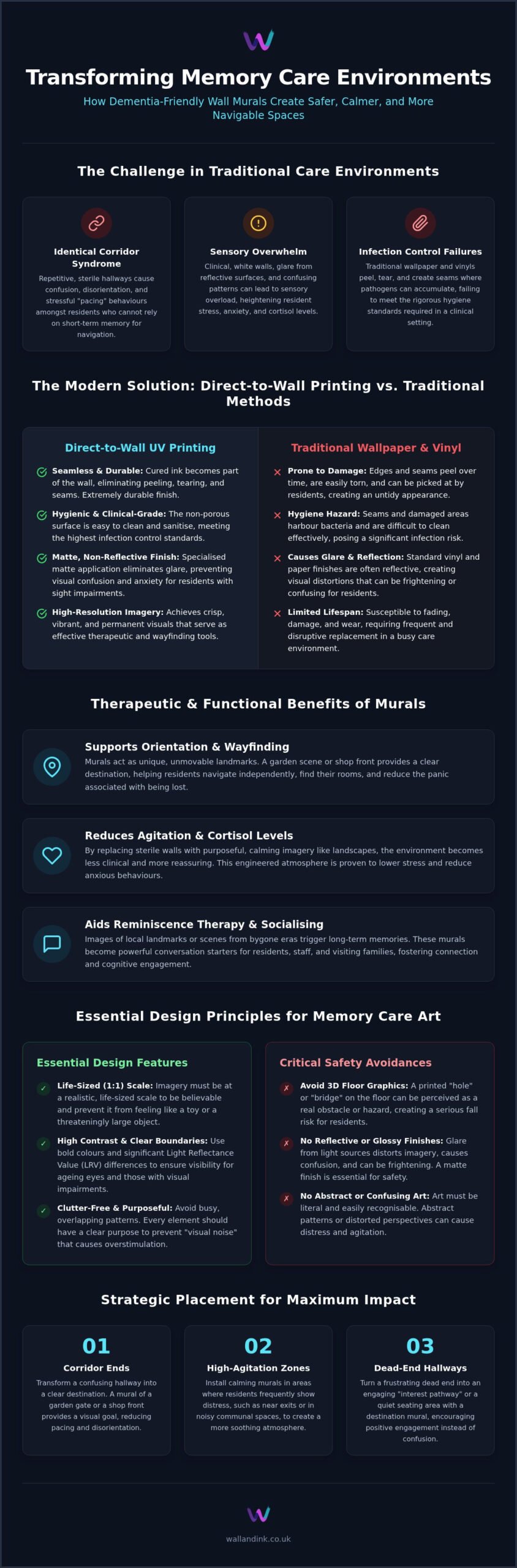
Dementia-friendly wall murals are not merely decorative additions to a care facility. They are functional, clinical tools designed to address specific cognitive challenges. In modern memory care, the shift towards creating “meaningful environments” focuses on how physical surroundings influence resident behaviour. By replacing sterile, white walls with purposeful imagery, providers can actively manage the environment to reduce cortisol levels and lower resident agitation. This approach prioritises a precise balance of visual stimulation; the objective is to modulate visual input to prevent sensory overwhelm whilst maintaining enough engagement to prevent boredom.
Effective environmental design in dementia care requires an understanding of how visual cues dictate a resident’s sense of safety. When a space feels clinical or confusing, residents often experience heightened stress. High-resolution, direct-to-wall printing allows for the integration of calming landscapes or familiar scenes that provide a sense of place. This isn’t about aesthetics. It’s about engineering a calmer atmosphere through technical precision. By utilising matte finishes that eliminate glare, we ensure that the imagery is interpreted correctly by the resident, avoiding the visual distortions that can lead to fear or anxiety.
Supporting Orientation and Wayfinding
Traditional care home layouts often suffer from “identical corridor syndrome,” where every hallway and door looks exactly the same. This leads to disorientation and “pacing” behaviours. Dementia-friendly wall murals solve this by acting as permanent, unmovable landmarks. These visual anchor points help residents identify their location without relying on short-term memory. Using specific imagery, such as a garden gate or a shop front at the end of a corridor, provides a clear destination. This reduces the panic associated with being lost and increases independence in daily navigation, allowing residents to find communal areas or their own rooms with less staff intervention.
The Psychology of Reminiscence Therapy
Reminiscence therapy uses sensory triggers to access long-term memories, which often remain intact even as short-term memory fades. By selecting imagery that resonates with the specific age demographic of your residents, such as local landmarks or bygone eras, you create powerful conversation starters. These murals aren’t just for residents; they provide staff and visiting families with tangible subjects to discuss, fostering social connection. Using direct-to-wall UV ink ensures these images remain crisp and vibrant, providing a durable backdrop for daily therapeutic engagement. It’s a pragmatic solution that turns a standard wall into a catalyst for cognitive stimulation and social wellbeing.
Design Principles for Safe and Effective Memory Care Art
Designing dementia-friendly wall murals requires a shift from purely aesthetic choices to a technical discipline rooted in environmental psychology. For art to be therapeutic, it must be legible to those with cognitive and visual impairments. This means prioritising life-sized imagery that maintains a 1:1 scale with the physical world. When a garden scene or a shopfront is printed at an accurate scale, it provides a believable landmark that residents can interact with naturally. Images that are too small feel like toys; those that are too large can feel looming and predatory.
High-contrast graphics are equally vital for ageing eyes. Conditions such as cataracts or macular degeneration reduce a resident’s ability to distinguish between subtle shades of the same colour. We utilise bold, clear boundaries and significant Light Reflectance Value (LRV) differences to ensure the art remains visible even in varied lighting conditions. Clutter is the enemy of this clarity. Busy, overlapping patterns create “visual noise” that leads to overstimulation and agitation. Every element in the design must serve a specific purpose, using accurate perspective to ensure the image doesn’t cause balance or depth perception issues for the viewer.
Avoiding False Realities and Visual Distortions
Visual perception changes significantly as dementia progresses. Whilst 3D floor graphics might be popular in retail, they are dangerous in care settings. A printed “water feature” or “bridge” on a floor can appear as a deep hole or a physical obstacle. This causes residents to stop abruptly or attempt to step over it, which leads to falls. Similarly, we avoid printing realistic doors that do not open. Discovering a “fake” door can cause intense frustration for residents attempting to navigate. We prioritise calm, recognisable scenes over abstract patterns, ensuring every visual cue is honest and easy to interpret.
Customising Imagery for Your Specific Resident Profile
Effective murals move beyond generic “old-timey” tropes. A shopfront from a town 200 miles away has little resonance for a resident with deep local roots. We focus on local landmarks, such as a specific town square or a well-known local park, to trigger genuine recognition and long-term memory. Zoning also plays a critical role. A dining area benefits from imagery associated with food and socialisation, whilst lounges require softer, more pastoral scenes. By organising a bespoke design consultation, you can ensure the imagery reflects the specific history and needs of your resident group. Collaborating with families to identify familiar nature scenes or local history ensures the environment feels like a home rather than a clinical facility.
Direct-to-Wall Printing vs. Traditional Wallpaper in Care Homes
Traditional wall coverings often fail in high-traffic care environments. Wallpaper and vinyl decals are prone to peeling at the edges, which creates both a maintenance burden and a significant hygiene risk. Direct-to-wall UV printing offers a permanent, integrated alternative by applying ink directly onto the substrate, whether it is plaster, brick, or wood. This method ensures that dementia-friendly wall murals become a physical part of the wall rather than a superficial layer. The result is a durable finish that cannot be picked at or accidentally torn, providing a much longer lifespan than legacy alternatives.
The “integrated” look of printed ink is also functionally superior for residents. A “stuck-on” mural can be visually confusing; residents may perceive the edges of a vinyl wrap as something that needs to be removed or stepped over. By eliminating adhesives and PVC, we also remove the environmental impact associated with traditional materials. There’s no off-gassing from glues and significantly less waste, as the process uses only the exact amount of ink required for the design. This technical precision ensures a high-resolution outcome that remains stable over time without the bubbling or fading common in paper-based solutions.
Eliminating Glare with Matte UV Finishes
Visual glare is a frequently overlooked trigger for agitation in memory care. Shiny vinyl surfaces or glass-framed art create harsh reflections and “hot spots” that distort the intended image. For a resident with cognitive impairment, these reflections are difficult to process and can be highly distressing. Our specialised UV ink provides a consistent matte finish that diffuses light across the surface of the mural. This ensures the image remains clear and legible from every angle, regardless of the room’s lighting configuration. Matte finishes eliminate the harsh reflections and visual “hot spots” that can trigger distressing visual hallucinations or misinterpretations in dementia patients.
Superior Hygiene and Infection Control
Infection control is a primary concern for any facility manager. Peeling wallpaper edges are notorious for trapping bacteria and moisture, making them impossible to sanitise effectively. Because direct-to-wall printing has no edges or seams, it eliminates these hidden breeding grounds for pathogens. The cured UV ink creates a robust, non-porous surface that stands up to rigorous clinical cleaning protocols. You can sanitise the walls using standard hospital-grade detergents without risking damage to the high-resolution art. This allows providers to meet strict CQC hygiene standards whilst maintaining a warm, non-institutional atmosphere that supports resident well-being.
Strategic Placement: Where to Install Dementia-Friendly Murals
Strategic placement of dementia-friendly wall murals is about identifying areas where environmental stress is highest. High-agitation zones often occur at the end of corridors or near locked doors where residents feel trapped. By installing “interest pathways,” you transform these dead ends into destinations. Instead of a blank wall that signals a stop, a landscape mural suggests a continuation of the environment. This encourages safe wandering and reduces the frustration associated with restricted movement. It’s a pragmatic way to manage resident flow without physical barriers.
You can also use murals to define the function of a room. Clinical spaces, particularly bathing rooms, are frequently associated with anxiety and resistance. Applying spa-like nature scenes or calming water vistas changes the room’s character from institutional to therapeutic. This technical shift in atmosphere can significantly reduce resident distress during personal care tasks. If you are ready to identify the optimal locations in your facility, you can book a bespoke design consultation to assess your specific layout and substrates.
Disguising Exits and Staff-Only Areas
Exit-seeking behaviour is a common challenge in secure units. Traditional doors with heavy handles and visible locks act as “magnets” for agitation. The camouflage technique involves printing a continuous mural across both the wall and the staff door. By blending these functional exits into a forest scene or a library bookshelf, you reduce the visual cue that an exit exists. This doesn’t compromise safety; staff still have access, but the resident’s focus is redirected to the calming imagery. It effectively removes the “prison-like” atmosphere of secure wards without altering the building’s security protocols.
Enhancing Dining and Social Spaces
Dining rooms benefit from specific visual triggers. Food-related imagery or scenes of social gatherings can help stimulate appetite and encourage residents to stay seated for longer periods. In windowless internal spaces, landscape murals create “garden rooms” that provide a sense of the outdoors, even in the centre of a building. Personalisation is also effective at bedroom entrances. Printing a unique, recognisable image next to a resident’s door aids individual recognition. This reduces the stress of finding one’s own room amongst identical doorways, fostering a greater sense of ownership and independence whilst reducing resident disorientation.
Organising Your Mural Project with Wall & Ink
Every successful installation of dementia-friendly wall murals begins with a comprehensive professional site survey. This is a technical necessity rather than a formality. We assess the specific substrates of your facility—whether they are plaster, brick, or concrete—and evaluate how both natural and artificial light interact with the intended space. This ensures that the final print maintains its matte, non-reflective quality and remains perfectly legible for residents from all angles. Our national UK service brings this advanced technology directly to your facility, providing a specialised approach that off-the-shelf products cannot replicate.
Care environments require minimal disruption to maintain resident safety and routine. Traditional renovation methods involving adhesives or solvent-based paints often introduce toxic fumes and long drying times, which are unsuitable for residents with respiratory sensitivities or cognitive vulnerabilities. Our UV printing process eliminates these hazards entirely. The ink cures instantly under ultraviolet light, meaning there are no fumes, no mess, and the walls are dry to the touch immediately. This industrial precision allows us to work in active wards with zero risk to resident wellbeing, ensuring that your environment is upgraded without the logistical headaches of traditional decorating.
Bespoke Design and Digital Visualisation
We follow a methodical process to translate your therapeutic goals into a wall-ready digital format. This starts with bespoke design consultations where we align imagery with your resident profile and local history. We then provide digital visualisations, allowing you to see exactly how a mural will integrate into your specific corridors or social hubs before any printing begins. Crucially, every design is vetted against established dementia-friendly principles. This ensures that contrast levels, scale, and perspective are technically optimised for cognitive support rather than just aesthetic appeal.
The Wall & Ink Professional Printing Process
Our direct-to-wall UV printers are engineered for high-resolution output on any vertical surface. The mechanical superiority of this method means we can achieve a level of detail and durability that legacy alternatives lack. Speed of execution is a core advantage; we can often transform an entire ward whilst residents are away for lunch, ensuring the daily routine remains undisturbed. Following the print, we conduct rigorous quality checks to ensure the finish meets our industrial standards for hygiene and clarity. This is the Wall & Ink promise: a technically superior, clinical-grade solution delivered with professional efficiency.
Advancing Memory Care Environments with Precision Printing
Modern memory care requires more than just aesthetic improvements. It demands functional, durable solutions that address the daily challenges of resident disorientation and agitation. By implementing dementia-friendly wall murals, you provide the essential visual landmarks and calming triggers that residents need to navigate their environment with confidence. This isn’t about temporary decoration; it’s about a permanent, technical upgrade to your facility’s therapeutic capabilities.
Wall & Ink provides a technically superior alternative to legacy wall coverings. Our direct-to-wall UV printing eliminates peeling edges and bacteria traps, ensuring your walls meet the highest clinical hygiene standards. The non-reflective matte finish ensures visual safety by removing the glare that often triggers distress in residents. With our full UK-wide professional installation, you can transform high-agitation zones into serene, navigable pathways without the disruption of traditional decorating. Take the first step toward a safer, more supportive care environment today. Request a Bespoke Visualisation for Your Care Home and see how industrial precision can enhance your resident wellbeing.
Frequently Asked Questions
What makes a wall mural “dementia-friendly” compared to standard art?
Dementia-friendly art prioritises cognitive support and visual clarity over purely aesthetic expression. These murals use high-contrast graphics, life-sized imagery, and matte finishes to reduce visual confusion for residents. They avoid abstract patterns or 3D effects that can be misinterpreted as physical obstacles. By serving as functional orientation aids, dementia-friendly wall murals help residents navigate spaces independently whilst reducing the anxiety often caused by sterile or identical environments.
Can these murals be cleaned with standard hospital-grade disinfectants?
Yes, the cured UV ink creates a non-porous, durable surface that withstands rigorous clinical cleaning protocols. Unlike traditional wallpaper or vinyl, there are no edges to peel or trap bacteria. You can use standard hospital-grade disinfectants and detergents directly on the printed wall without risking damage to the high-resolution art. This makes the technology ideal for meeting the strict infection control standards required in modern care and clinical settings.
How long does a direct-to-wall mural last in a high-traffic care home corridor?
Direct-to-wall murals are designed for industrial-grade longevity and typically outlast traditional vinyl or paper alternatives. Because the ink is integrated into the wall substrate, it cannot be scratched, peeled, or picked off by residents. In high-traffic corridors, the prints remain stable and vibrant for many years. The lack of adhesives means there is no bubbling or lifting over time, providing a permanent solution that maintains its professional finish throughout its lifespan.
Is the UV ink used in the printing process safe for indoor environments?
The UV ink used in our printing process is entirely safe for indoor care environments and clinical spaces. The ink cures instantly under ultraviolet light during the application, which means there are no harmful fumes or lingering odours. This process is solvent-free and doesn’t involve off-gassing, allowing residents and staff to remain in the vicinity during and after installation. It’s a pragmatic choice for facilities that prioritise air quality and resident safety.
How do you prevent reflections and glare on the mural surface?
We prevent visual distortions by using specialised UV inks that produce a consistent matte finish. This finish is technically engineered to diffuse both natural and artificial light across the surface of the mural. By eliminating the “hot spots” and harsh reflections found on glass-framed art or shiny vinyl, we ensure the imagery remains clear and legible. This precision reduces the risk of visual hallucinations and misinterpretations for residents with cognitive impairments.
Can you print dementia-friendly designs on textured surfaces like brick or plaster?
Our direct-to-wall printing technology is capable of applying high-resolution art to almost any vertical surface, including textured brick, plaster, wood, and concrete. The printer adjusts to the specific substrate, ensuring the ink adheres perfectly to the contours of the wall. This flexibility allows care providers to transform any existing architectural feature into a therapeutic landmark without the need for extensive replastering or the use of flat, adhesive-backed materials that eventually fail.
Do these murals help with CQC inspections regarding environment and care?
Purposeful environmental design is a key factor in achieving positive CQC inspection ratings. Using dementia-friendly wall murals demonstrates a proactive approach to resident well-being by improving wayfinding and reducing agitation. Inspectors look for evidence of “meaningful environments” that support independence and safety. By providing clear visual cues and reducing clinical sterility, these murals help facilities meet the standards for being “well-led” and “responsive” to the specific needs of those living with dementia.
How do you disguise exit doors using wall murals without creating a fire hazard?
We use a specialised “camouflage” printing technique that applies a continuous image across both the wall and the door surface. This hides the visual cue of the exit from residents without physically obstructing the door or its hardware. Because we print directly onto the existing fire-rated door rather than applying flammable vinyl wraps or thick boards, the door’s original fire safety certification and mechanical operation remain entirely unaffected and compliant with safety regulations.