
Committing to a large-scale bespoke installation shouldn’t feel like a high-stakes gamble on your interior’s future. For many project managers and homeowners, the transition from a digital file to a physical wall is often fraught with uncertainty. You might worry about how a design will interact with specific brick textures or whether the scale will overwhelm a confined corridor. These aren’t just aesthetic concerns; they’re practical risks that can lead to costly revisions. Our process for digital mural visualization addresses these pain points by providing a technically accurate preview of the final result within your specific architectural environment.
We understand that you value efficiency and precision over guesswork. This article explores how digital tools eliminate the traditional hassles of wall art by ensuring every detail aligns with your site’s unique substrates and lighting conditions. You’ll discover how we bridge the gap between concept and execution through rigorous surface mapping and colour calibration. By the end of this guide, you’ll have the technical assurance needed to proceed with a high-value direct-to-wall printing project, confident that the finished mural will match your exact specifications.
Key Takeaways
- Understand how precision site surveys and high-resolution photography ensure your mural integrates seamlessly with architectural features like windows and sockets.
- Learn how digital mural visualization eliminates uncertainty by providing a technical mock-up of your bespoke art within its specific physical environment.
- Discover the technical necessity of predicting ink absorption and colour reaction across various substrates, which is a core benefit of professional digital mural visualization.
- Explore why digital previews are critical for maintaining brand consistency in commercial settings and ensuring accurate scale in educational spaces.
- Recognise how this methodical planning phase, or digital mural visualization, serves as a modern, reliable alternative to the traditional hassles of wallpaper and vinyl.
What is Digital Mural Visualisation for Wall Printing?
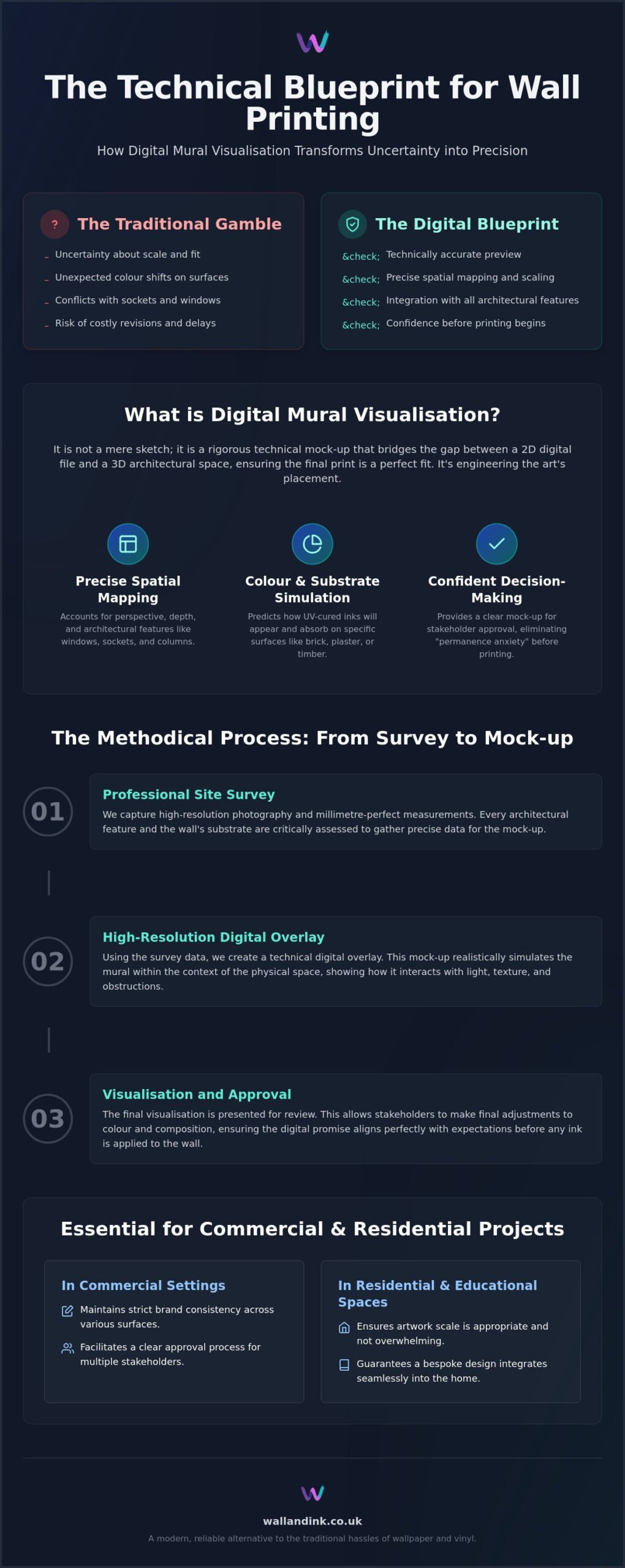
Digital mural visualization isn’t a simple creative sketch. It’s a rigorous technical mock-up that transforms a two-dimensional concept into a three-dimensional architectural reality. Whilst a traditional mood board provides a general aesthetic direction, a digital preview offers precise spatial mapping. It uses high-resolution digital files to simulate exactly how UV-cured inks will appear on your specific wall surface. This process is deeply rooted in the modern application of Frescography, where digital reproduction techniques are used to create murals that fit their environment with mathematical accuracy.
This stage is essential because direct-to-wall printing is a permanent solution. Unlike vinyl decals that might peel or wallpaper that can be stripped, our UV inks bond directly to the substrate. Because there’s no room for trial and error once the printing begins, the visualisation phase serves as the technical blueprint for the entire project. It ensures that the digital art is perfectly adapted to the physical constraints of the site, from the texture of the plaster to the ambient lighting of the room.
The Distinction Between Design and Visualisation
Creative design is about the “what,” but digital mural visualization is about the “where.” We take high-quality site photography and create realistic overlays that account for perspective and depth. This isn’t just about placing a picture on a wall; it’s about seeing how the art interacts with windows, sockets, and structural columns. Precise measurement ensures that the scale is appropriate for the room’s volume. It prevents the artwork from feeling either claustrophobic or insignificant within the space. We don’t just design art; we engineer its placement.
Visualisation as a Decision-Making Tool
Pragmatic decision-makers often face “permanence anxiety” when commissioning high-value wall art. Digital previews mitigate this risk by facilitating a clear approval process for stakeholders. In a commercial office or a school corridor, seeing the exact final result allows for final tweaks to colour and composition whilst the design is still in its virtual state. You can verify that brand colours remain consistent even when printed on textured brick or bare plaster. This transparency builds the confidence required to proceed with a large-scale installation, knowing that the physical outcome will mirror the digital promise.
The Technical Process: From Site Survey to Digital Mock-up
Moving from a digital file to a physical wall requires more than a simple upload. It demands a methodical workflow that bridges the gap between software and substrate. This process ensures that the industrial UV printer delivers a result that is both durable and visually accurate. A successful project relies on the synergy between precise site data and high-resolution design files. Without this technical foundation, the risk of misalignment or colour distortion increases significantly.
The transition from a 2D screen to a 3D architectural surface mirrors the rigour found in digital processes in façade design and construction. We treat every wall as a unique technical challenge. We don’t just look at the design; we analyse how that design will behave when applied to specific materials like brick, timber, or bare plaster. This analytical approach is what separates a professional installation from a generic decal application.
Step 1: The Professional Site Survey
Precision begins with the site survey. We don’t rely on rough estimates or low-quality smartphone snaps. Instead, we capture high-resolution photography that serves as the canvas for your digital mural visualization. Every measurement is taken to the millimetre. We identify every architectural feature that could disrupt the print, including windows, light switches, and skirting boards. Assessing the substrate is equally critical. Different surfaces absorb UV ink differently; a newly plastered wall requires a different technical approach than a textured exterior brick face. Identifying these variables early prevents delays during the printing phase.
Step 2: Creating the High-Resolution Digital Overlay
Once we have the data, we create a technical overlay. We use advanced software to wrap the design around corners and architectural recesses, ensuring the perspective remains realistic from every angle. This stage allows us to simulate different lighting environments. It helps us predict how the colours will react under harsh office LEDs versus natural sunlight in a residential setting. This iterative refinement means we can adjust the design whilst it’s still digital. If a key element of the art is obscured by a radiator or a door frame, we relocate it before the first drop of ink is deployed. This level of planning is why many clients choose our direct-to-wall printing services for high-stakes environments.
The final digital mock-up is presented for client verification. It serves as a contract of intent. It provides the technical assurance that the scale is correct and the brand colours are accurate. This transparency eliminates the guesswork and ensures that the physical execution matches the approved digital vision.
Why Visualisation is Essential for Commercial and Residential Projects
The value of a technical preview extends beyond mere aesthetics; it is a critical safeguard for project ROI. Whether you are managing a corporate headquarters or a private residence, the goal remains the same: total alignment between the digital concept and the physical space. Digital mural visualization provides this alignment by accounting for the practical realities of daily use. It ensures that a high-value investment isn’t compromised by poor placement or unforeseen architectural obstructions. By simulating the final result, we eliminate the uncertainty that often accompanies bespoke wall art.
In retail and hospitality sectors, the stakes are particularly high. A mistake in a flagship store can disrupt a brand’s launch or customer experience. We use digital mock-ups to ensure that every graphic element serves the commercial goals of the space. This methodical planning minimises waste and prevents the need for corrections after the print is complete. It’s a pragmatic approach designed for decision-makers who value efficiency and high-quality results.
Impact on Commercial Branding
In a professional environment, brand consistency is non-negotiable. Digital mural visualization allows us to test corporate colour palettes against specific wall textures before the UV printer is even deployed. We can precisely align logo placement with office furniture and natural traffic flow. This prevents critical brand elements from being obscured by desks, monitors, or shelving units. It also allows stakeholders to see how the mural will look under various lighting conditions, ensuring the corporate identity remains clear and authoritative throughout the working day.
Educational settings require a different set of technical considerations. When installing school and educational murals, scale is a primary concern. We use digital mock-ups to ensure that key illustrative elements are positioned at an age-appropriate height for students. A mural that looks perfect on a desktop screen might feel overwhelming or poorly scaled in a narrow primary school corridor. Visualisation allows us to adjust these proportions to create an immersive, functional learning environment that reflects the school’s culture.
Residential Personalisation and Aesthetic Harmony
Homeowners often struggle to imagine how a bold design will interact with their existing interior decor. A digital preview bridges this gap by showing exactly how the mural colours will match soft furnishings and flooring. It also accounts for how natural light changes throughout the day, affecting the appearance of the UV ink on the wall. By visualising the art within the room’s actual proportions, we help you choose the right focal point. This ensures the bespoke art complements the space rather than clashing with it. You gain the confidence to proceed, knowing the final result will enhance the architectural harmony of your home.
How Digital Previews Minimise Risk Across Different Wall Substrates
Printing directly onto a wall is an industrial process, not a decorative afterthought. The substrate dictates the technical success of the project. A smooth plasterboard wall behaves entirely differently to a porous brick face or a textured timber panel. Digital mural visualization allows us to account for these physical variables before the print carriage moves. By simulating the interaction between UV ink and the specific surface, we mitigate the risk of colour shifting or loss of detail on uneven textures. This isn’t about artistic impression; it’s about mechanical certainty. We analyse the surface to predict how the ink will cure and bond, ensuring the final image is as durable as it is accurate.
Every wall surface presents unique challenges that can’t be ignored. Without a technical preview, you’re guessing how a design will react to the underlying material. Our process removes that guesswork by mapping the artwork onto the physical reality of your site. This ensures that the final result isn’t just a picture on a wall, but a high-performance architectural finish.
Printing on Fresh Plaster and Bare Surfaces
New-build environments often present challenges with fresh plaster. We focus on the technical state of the wall to ensure the ink bonds permanently. Our digital mock-ups account for the specific “flatness” of the finish. Direct-to-wall printing is superior to traditional wallpaper in these settings. There’s no risk of adhesive failure, peeling, or seams opening as the building settles over time. The visualisation confirms the art will look crisp on a newly plastered surface, providing a level of durability that legacy methods can’t match. It’s a cleaner, more efficient way to treat large-scale interior surfaces without the mess of paste or the fragility of paper.
Industrial Surfaces: Brick, Concrete, and Wood
Industrial substrates like brick, concrete, and wood offer a unique aesthetic but introduce technical complexity. When printing on brick, the art must interact with deep mortar joints and surface pits. We use digital previews to ensure that fine details and text remain legible across these uneven planes. This prevents the “broken” appearance that often ruins large-scale graphics on rough walls.
- Precisely map how the design “wraps” into mortar joints to maintain perspective.
- Predict how the substrate’s base colour, such as the grey of concrete or red of brick, influences the final ink hue.
- Ensure that branding elements and fine lines aren’t lost in the natural grain of timber.
- Identify surface imperfections that might require design adjustments before printing begins.
This methodical approach results in a finish that feels integrated into the architecture. It’s a permanent, high-resolution solution that respects the material’s integrity rather than hiding it. Unlike vinyl decals that look like an “applied” sticker, our process makes the art part of the wall itself. To see how your specific surface could be transformed with industrial precision, explore our commercial wall murals for your next project.
Bespoke Design and Visualisation Services by Wall & Ink
Wall & Ink operates as a specialist partner for those who require more than just decoration. Our service is built on industrial reliability and technical clarity. We provide an end-to-end solution that starts with professional design development and ends with a durable, high-resolution print. By operating across the United Kingdom, we bring this modern application method to diverse sectors, from high-stakes corporate environments to private residences. Our commitment to radical transparency means you receive a clear, step-by-step explanation of the process. Every project includes a digital mural visualization phase to ensure the digital promise matches the physical reality.
We eliminate the traditional hassles associated with legacy alternatives. There is no peeling vinyl to manage and no messy wallpaper paste to clean. Our UV printing technology ensures a permanent bond that is both scratch-resistant and lightfast. This methodical approach ensures that every project is an investment in quality rather than a temporary fix. We position ourselves as disruptors of traditional methods, offering a clean, efficient, and technologically superior way to transform architectural surfaces across the country.
Our Integrated Approach to Wall Art
Our workflow integrates creative vision with mechanical superiority. We don’t just provide art; we provide engineered wall solutions. By using advanced digital mural visualization, we ensure that every design is technically adapted to its environment. This expertise allows us to handle complex substrates like brick and timber with the same precision as a flat office wall. We focus on high-resolution output that maintains its integrity even at a large scale. This ensures a flawless final installation that meets your specific project goals. Our technical specialists are as comfortable in high-stakes professional environments as they are in private homes, providing a consistent level of expert service regardless of the project’s scale.
Next Steps: From Visualisation to Installation
The transition from curiosity to execution is straightforward and logical. Once you decide to move away from traditional methods, the first step is a consultation to define your spatial requirements and aesthetic goals. We’ll guide you through the preparation of your wall to ensure the surface is ready for our advanced printing machinery. This preparation is essential for achieving the industrial-grade finish we promise. Our process is designed for pragmatic decision-makers who value their time and expect high-quality results without the usual industry delays. To begin the process of transforming your space with technical certainty, Contact Wall & Ink to start your digital mural visualisation today.
Secure Technical Certainty for Your Next Wall Project
Digital mural visualization is the bridge between a conceptual design and a flawless physical installation. By prioritising technical precision during the planning phase, you eliminate the risks of misalignment or colour distortion. Our process ensures that your bespoke art is perfectly adapted to the unique constraints of your site, whether you’re working with textured brick or fresh plaster. This methodical approach provides the confidence needed to transform any environment without the traditional hassles of peeling vinyl or messy adhesives.
Our expert UK-wide installation team utilises durable UV ink technology to deliver high-resolution results that are built to last. We combine industrial-grade machinery with a bespoke design service to ensure every project meets your exact specifications. This commitment to accuracy and transparency is why pragmatic decision-makers trust us for their most important architectural surfaces. It’s time to move beyond guesswork and embrace a more reliable standard for wall art.
Request your bespoke wall mural visualisation today and see how our specialised technology can redefine your space with absolute precision. We look forward to helping you achieve a result that is as durable as it is visually striking.
Frequently Asked Questions
What information do I need to provide for a digital mural visualisation?
You must provide high-resolution photography of the target wall and precise measurements of the area. We also require details regarding the substrate type, such as bare brick or plaster, and the location of architectural features like sockets, windows, and radiators. This data allows our team to create an accurate digital overlay that accounts for the physical reality of your space.
Does the digital preview accurately represent the final UV print colours?
Our digital mural visualization process uses calibrated colour profiles to ensure the preview closely matches the final UV ink output. Whilst screen settings can vary between devices, we account for the base colour of your substrate, such as the grey of concrete or the red of brick. This technical mapping ensures that brand colours remain consistent and accurate once printed directly onto the wall.
Can you visualise a mural on a wall with windows or doors?
We specialise in mapping designs around complex architectural features including windows, doors, and structural columns. The visualisation process allows us to adjust the design so that critical elements aren’t obscured by these features. By reviewing the mock-up, you can decide whether to wrap the art into window recesses or terminate the print at the frame for a cleaner finish.
Is there a separate fee for the digital visualisation service?
We position the visualisation fee as a necessary investment in project accuracy to ensure a flawless final result. This cost is typically integrated into our end-to-end service for commercial and residential projects. It covers the technical spatial mapping and design adjustments required to adapt your high-resolution art to the specific physical constraints of your wall surface.
How long does the visualisation process take from survey to mock-up?
The turnaround time for a digital mock-up depends on the complexity of the architectural space and the design requirements. Most clients receive their technical preview within a few working days following the site survey or the receipt of high-quality site data. This methodical phase ensures that every detail is refined before our industrial printing machinery arrives on-site for the final execution.
Can I request changes to the design after seeing the digital preview?
You can request adjustments to the scale, placement, and colour of the design once you’ve reviewed the digital mock-up. This is the primary purpose of the visualisation phase; it allows for iterative refinement whilst the project is still in a virtual state. Making these changes before printing begins eliminates the risk of permanent errors and ensures total stakeholder approval for high-stakes projects.
Does visualisation work for exterior wall printing projects?
Our visualisation services extend to exterior wall printing on substrates such as brick, render, and concrete. We capture site data for outdoor environments to predict how natural light and surface textures will interact with our durable UV inks. This ensures that large-scale external graphics maintain their impact and legibility even on rough, industrial surfaces before the permanent application begins.
Why is digital visualisation better than a physical sample?
Digital visualisation is superior to a small physical sample because it provides architectural context and accurate scale. A small sample can’t show how a large-scale mural interacts with the room’s volume or its structural features. Our digital mock-ups provide a holistic view of the finished installation, ensuring the artwork complements the room’s proportions rather than overwhelming the space.