
Sensory walls should be engineered directly into the architecture of a space, not applied as an afterthought sticker. For years, schools and care settings specifying sensory room wall graphics have had to settle for adhesive vinyl decals or standard wallpaper; fragile finishes that peel at the edges, harbour dirt along exposed seams, and invite picking from tactile-seeking pupils.
It’s a frustrating, familiar issue for facility managers. A newly installed feature wall quickly degrades under heavy daily use, whilst routine clinical sanitising breaks down adhesives and ruins delicate papers.
You don’t need to choose between calming visual impact and physical durability. Direct-to-wall UV printing provides a tough, wipe-clean surface by applying bespoke designs directly to the wall substrate without films or glues. In this guide, you will learn how direct vertical printing eliminates common maintenance headaches, meets rigorous hygiene and fire standards, and creates purpose-built therapeutic spaces that endure.
Key Takeaways
- Why modern SEN facilities are moving towards direct-to-wall sensory room wall graphics to eliminate the peeling edges, bacterial traps, and picking hazards of vinyl decals.
- How UV-cured inks bond directly to plaster, brick, and timber to create a wipe-clean finish that withstands clinical-grade sanitising.
- The technical advantages of printing at 1440 dpi, delivering exceptional visual clarity across uneven architectural substrates.
- Principles for selecting low-arousal colour palettes and nature-based fractal patterns to support emotional regulation and reduce cognitive overload.
- The end-to-end implementation process, from digital mock-ups to on-site printing, ensuring every mural aligns with specific therapeutic requirements.
Beyond Wallpaper: The Evolution of Sensory Room Wall Graphics
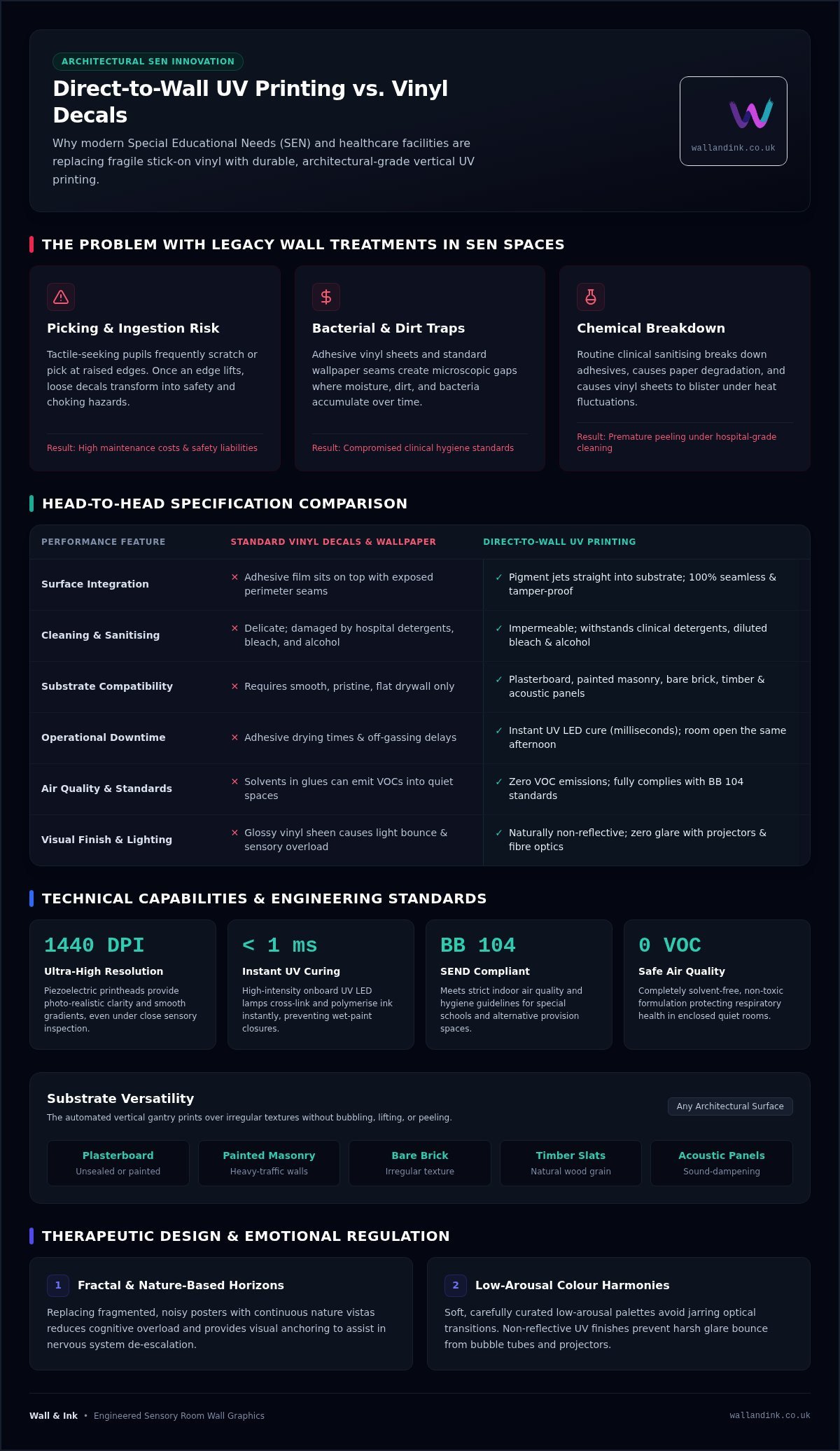
Sensory room design is shifting away from superficial interior styling toward purpose-built architectural infrastructure. Effective sensory room wall graphics serve as functional therapeutic tools, actively regulating nervous systems rather than merely filling empty wall space. Within modern therapeutic sensory room environments, visual stimuli directly influence pupil engagement, emotional de-escalation, and focus. Many legacy facilities rely purely on standalone tactile panels, neglecting the wider visual envelope that frames the room. Traditional wall treatments repeatedly fail in these high-demand spaces. Standard wallpaper paste degrades during routine washing, while adhesive vinyl sheets blister under temperature fluctuations. Direct-to-wall printing changes this dynamic by jetting UV-curable pigments straight onto the underlying substrate, creating a resilient, industrial-grade finish that integrates seamlessly with the room’s fabric.
The Problem with Peeling: Why Durability Matters
Durability in Special Educational Needs (SEN) facilities is a direct safety requirement, not an aesthetic luxury. Neurodivergent individuals frequently exhibit tactile-seeking behaviours such as scratching, rubbing, or picking at raised surface imperfections. Applied vinyl decals present exposed perimeters that invite continuous picking. Once an edge lifts, the graphic quickly transforms into a choking or ingestion hazard while making the room look neglected. Constantly replacing peeled decals or patching torn paper strains school maintenance budgets. Applying pigments straight onto the wall eliminates seams, providing a smooth finish that withstands physical tampering and protects educational investments over the long term.
Creating an Immersive Environment
Fragmented educational posters and disconnected wall boards often generate unnecessary visual noise, which can trigger anxiety in sensory-sensitive pupils. High-resolution sensory room wall graphics solve this issue by wrapping the perimeter in continuous, expansive imagery that transforms clinical rooms into calming retreats. Direct vertical printing achieves sharp clarity on large scales, grounding the space with natural vistas, fractal horizons, or soft gradients. The resulting UV-cured finish is naturally non-reflective. In rooms fitted with interactive projectors, bubble tubes, and fibre optics, glare-free walls prevent harsh light bounce, ensuring the visual atmosphere supports calming therapies rather than causing sensory overload.
The Technical Advantage of UV Printing in Therapeutic Environments
Direct vertical wall printing relies on piezoelectric printheads to deposit micro-thin layers of UV-curable ink directly onto structural substrates. High-intensity onboard UV LED lamps instantly polymerise the ink in milliseconds. Because the curing process is immediate, facilities avoid lengthy off-gassing delays or wet-paint closures; rooms can return to full operational use the same afternoon. Operating at resolutions up to 1440 dpi, this technology produces photo-realistic clarity and smooth gradients across large-scale sensory room wall graphics, ensuring visual stimuli remain crisp and immersive even under close inspection.
Hygiene and Maintenance in Clinical Settings
Infection control remains a primary blind spot for legacy wall treatments. Standard adhesive stickers create raised borders where dirt and moisture gather, whilst aggressive disinfectants dissolve sticker adhesives and cause paper to degrade. Direct-to-wall UV prints cross-link with the wall substrate to form an impermeable, scratch-resistant surface. Maintenance teams can scrub these installations using standard hospital-grade detergents, diluted bleach, or alcohol-based sanitising sprays without degrading print clarity. Crucially for neurodivergent pupils prone to sensory sensitivities, the cured inks emit virtually zero volatile organic compounds (VOCs). Designing quiet rooms that align with Building Bulletin 104 (BB 104) standards requires strict control over indoor air quality, making solvent-free, fully cured ink systems essential for respiratory health.
Adapting to Any Surface Material
Traditional wallpapers require smooth, perfectly flat drywall, yet real educational and clinical buildings often feature varied architectural surfaces. Direct vertical printing adapts seamlessly across unsealed plasterboard, painted masonry, bare brick, timber slats, and acoustic panelling. The automated vertical gantry tracks over surface irregularities without wrinkling, bubbling, or peeling. It flows effortlessly around tricky structural elements, including supporting pillars, curved bulkheads, and de-escalation alcoves. Educational teams planning comprehensive sensory renovations can use specialist direct-to-wall printing to apply uninterrupted artwork across diverse wall textures without compromising on structural adhesion.
Direct-to-Wall vs Vinyl Decals: Which is Best for SEN Spaces?
Selecting wall finishes for Special Educational Needs environments requires balancing tactile safety against long-term maintenance costs. Traditional adhesive decals provide a cheap short-term fix, but their multi-layered film sits proud of the wall. This raised perimeter creates a tactile ridge that sensory-seeking individuals quickly exploit. In contrast, direct-to-wall printing deposits pigment directly into the surface pores, leaving a completely flat, integrated finish that cannot be levered off.
The visual distinction is equally pronounced:
- Aesthetic integration: Direct printing achieves an authentic painted-on mural effect, whereas vinyl films leave an artificial sheen with noticeable perimeter borders.
- Tactile safety: A flush surface offers zero tactile purchase, preventing repetitive picking, tearing, and potential ingestion risks.
- Total cost of ownership: While self-adhesive stickers require lower initial expenditure, their vulnerability demands recurring replacements, adhesive scrubbing, and wall repainting over a five-year lifecycle. Direct vertical printing survives as a one-time capital investment that endures rigorous daily sanitising.
Resistance to Behavioural Wear and Tear
Pupils with sensory processing differences often focus intensely on small, irregular textures. A single lifted decal edge invites persistent pulling, which ruins graphics and compromises student safety. Direct-to-wall UV printing functions as the permanently bonded, pick-proof alternative to vinyl decals that completely removes surface edges. Eliminating peelable films protects both students and SEN budgets from the compounding expense of constant repairs.
Visual Consistency and Scaling
Relying on collections of small stickers creates visual clutter that distracts pupils rather than soothing them. Standard catalogue decals come in fixed dimensions, forcing staff to piece together mismatched elements across expansive walls. Direct vertical printing scales bespoke sensory room wall graphics across entire elevations without resolution drop-off. By rendering custom high-resolution illustrations across architectural features, educational spaces maintain cohesive, calming visual themes that actively support sensory de-escalation.
Strategic Design: Organising Graphics for Sensory Regulation
Generic sensory room design often defaults to saturated, high-contrast primary colours under the mistaken assumption that brighter visuals produce better engagement. In therapeutic practice, excessive visual saturation frequently triggers distress or agitation. Effective sensory room wall graphics rely instead on intentional colour theory and biophilic principles. Desaturated blues, muted sage greens, and warm earth tones help down-regulate sympathetic nervous system responses, providing a reassuring backdrop for emotional regulation.
Strategic graphic design also establishes clear visual zoning across multi-purpose spaces:
- Active movement zones: Subtle visual pathways and gradual colour shifts encourage motor planning and purposeful movement without overwhelming pupils.
- Calming de-escalation alcoves: Continuous nature-inspired landscapes and natural fractal patterns reduce stress markers and provide a restful focal point during sensory overload.
Designing for Hypersensitivity
Visual hypersensitivity makes dense illustrations, harsh outlines, and repetitive geometric grids feel intrusive or disorienting. Restraint is crucial; less detail allows pupils to process their environment calmly. The micro-thin, matte finish of direct-printed UV pigment prevents glare. When combined with sensory equipment such as bubble tubes, fibre optics, or sensory projectors, non-reflective sensory room wall graphics absorb ambient light rather than bouncing distracting reflections into sensitive eyes.
Bespoke Content: From Nature to Abstract
Off-the-shelf prints rarely support tailored therapeutic objectives. Custom murals allow schools and therapy centres to tailor visuals directly to occupational therapy (OT) targets, moving from soothing woodland vistas to abstract atmospheric textures. Generating accurate digital mock-ups before application ensures murals integrate smoothly around specialist ceiling hoists, wall pads, and lighting fixtures. To develop purposeful, low-arousal environments built around your exact facility layout, plan your direct-to-wall educational mural with specialist design input.
Bespoke Wall Murals: The Wall & Ink Professional Process
Delivering high-performance sensory room wall graphics requires a structured, methodical approach. Every installation begins with a technical consultation to assess wall substrate conditions, ambient lighting, and the specific behavioural needs of pupils. From these parameters, our studio develops detailed digital mock-ups mapped precisely to the architectural layout of the room. This planning stage accounts for existing wall fittings, padded plinths, and interactive equipment, ensuring visual balance and therapeutic intent are locked in before printing begins.
National UK Service and Professional Installation
Executing vertical prints on site demands industrial-grade precision. Mobile printing units deploy nationwide across the United Kingdom, delivering a consistent, specialist service to schools, clinics, and residential care environments. Once on site, technicians calibrate the vertical gantry to match the specific plane of the wall, whether printing on smooth drywall, exposed masonry, or acoustic timber. Because the integrated UV LED array instantly cures the ink as the printhead travels, the entire process avoids wet paint delays and lingering chemical odours. Facilities can return their sensory spaces to full use almost immediately after completion.
Transparent Pricing and Project Management
Budgeting for specialist educational infrastructure should be straightforward and predictable. We operate on a clear price-per-square-metre metric, enabling school business managers and estate directors to accurately forecast installation costs without hidden consultation fees. Our team oversees every stage of the project lifecycle:
- Initial site and design review: Evaluating wall substrates and therapeutic objectives.
- Digital mock-up sign-off: Ensuring exact alignment with architectural features and equipment.
- Direct-to-wall printing: Executing high-resolution, smudge-proof artwork with rapid turnaround.
- Handover and care: Providing facility managers with simple cleaning guidelines for long-term sanitisation.
Investing in permanent wall installations eliminates the continuous cycle of repairing ripped paper and replacing peeled vinyl stickers. To transform your space with durable, low-arousal sensory room wall graphics, enquire about our bespoke sensory room printing today and discuss your project specifications with our technical team.
Upgrading Your Sensory Facility for the Long Term
Sensory spaces demand wall finishes that endure high-traffic educational use without peeling, flaking, or trapping contaminants. Transitioning away from legacy vinyl means your sensory room wall graphics deliver lasting therapeutic value rather than ongoing maintenance headaches. By jetting UV-cured ink straight onto structural substrates, you achieve maximum durability and an impermeable, wipe-clean finish that hospital-grade detergents won’t degrade.
Every detail matters when designing for complex behavioural needs. With bespoke high-resolution digital visualisations, facility managers can review spatial harmony and low-arousal colour palettes well before on-site printing begins. Our professional national UK installation team manages the entire technical process with minimal operational downtime, letting your facility resume vital de-escalation therapies on the very same day. Ready to replace vulnerable stickers with enduring architectural art? Request a bespoke design consultation for your sensory space and take the first step toward a safer, more supportive therapeutic environment.
Frequently Asked Questions
Are sensory room wall graphics easy to clean and sanitise?
Yes, direct-to-wall printed sensory room wall graphics are exceptionally easy to sanitise. The UV ink polymerises directly into the substrate, forming an impermeable, non-porous layer. Facilities teams can wipe down and scrub the surface using standard hospital-grade detergents, diluted bleach solutions, or isopropyl alcohol without degrading visual clarity or causing colours to run. Unlike vinyl stickers, there are no raised edges where moisture or bacteria can accumulate.
Can the wall graphics be picked or peeled off by children?
No, the graphics cannot be picked or peeled off because there is no film or adhesive layer. Direct-to-wall printing applies pigment straight into the microscopic pores of the wall, sitting completely flush with the substrate. Because there are no raised borders, overlapping seams, or lifted corners, pupils displaying tactile-seeking or picking behaviours have nothing to grip. This eliminates both accidental choking hazards and costly wall damage.
Is the UV ink used in sensory rooms safe and non-toxic?
Yes, the cured UV inks are non-toxic, chemically stable, and completely safe for SEN environments. The high-intensity UV LED curing lamps trigger an instant photochemical reaction that solidifies the ink in milliseconds, leaving zero wet residue. Once cured, the inks emit virtually no volatile organic compounds (VOCs) and release no offensive chemical odours. This protects children with respiratory vulnerabilities or heightened olfactory sensitivities from airborne irritants.
How long does it take to print a full-scale sensory mural?
Most standard wall murals are completed within a single day. The automated vertical printer operates at steady commercial speeds, applying and instantly curing artwork across the wall in real time. Because the ink requires zero post-print drying or degassing time, your staff don’t have to cordon off the room for days. Spaces can return to regular therapeutic activities the very same afternoon the print finishes.
Do I need to prepare the wall surface before you arrive?
Basic surface preparation is minimal but ensures optimal adhesion. The wall should be structurally sound, dry, clean, and free of flaking paint, dust, or grease. Any structural holes or deep gouges should be filled and sanded smooth prior to installation. We review wall photos and discuss surface conditions during the initial consultation so our technical team arrives with the exact gantry calibration required for your room.
Can you print on textured walls like brick or breeze block?
Yes, vertical UV printing works effectively on uneven and textured building materials. The moving printhead maintains a calibrated offset distance from the wall face, allowing microscopic ink droplets to project cleanly across surface contours without contacting the substrate directly. Whether your sensory room features exposed brick, painted breeze block, raw concrete, or acoustic timber slats, the print adheres reliably where adhesive vinyl wraps inevitably fail.
What happens if we need to change or remove the graphic in the future?
Removing or updating direct-to-wall sensory room wall graphics is as straightforward as repainting a standard wall. Because there are no stubborn adhesives, plastic backings, or sticky residues to scrape away, you don’t risk tearing the plaster underneath. If your therapeutic requirements change or you wish to redesign the room, you simply apply a standard stain-blocking primer and paint over the graphic with your new base coat.
Do you provide the artwork or do I need to supply my own?
We offer both options to suit your facility’s requirements. Our bespoke design service can develop custom therapeutic artwork from scratch, incorporating low-arousal colour palettes, biophilic nature themes, or specific occupational therapy cues. Alternatively, if your school or trust already has approved vector artwork, logos, or digital illustrations, our design team will adapt your high-resolution files into precise digital mock-ups before printing begins.