
The most reliable way to protect your walls isn’t by sticking something onto them. Whilst traditional vinyl decals and heavy industrial panels have been the standard for years, they often fail under the pressure of daily footfall. You have likely dealt with the frustration of peeling edges in busy corridors or the clinical, uninviting look of protective plastic sheeting. If you are searching for durable wall graphics for high traffic areas, the solution lies in moving away from applied layers entirely. Direct-to-surface UV printing integrates high-resolution branding directly into the substrate, creating a finish that is as resilient as the wall itself.
We understand that maintaining a professional environment shouldn’t mean a never-ending cycle of repainting or replacing scuffed wallpaper. This guide explores why UV-cured printing is surpassing legacy alternatives to provide a permanent, scuff-resistant solution for schools, hospitals, and retail spaces. You will learn how this technology withstands damage from trolleys and bags whilst meeting strict 2026 fire safety standards. We will also break down the long-term cost benefits of choosing a method that eliminates traditional maintenance overheads once and for all.
Key Takeaways
- Understand why adhesive-based solutions fail and how direct-to-surface printing eliminates peeling edges in busy corridors and lift lobbies.
- Discover the science of UV-cured ink technology that bonds instantly to diverse substrates, including brick, wood, and glass, without requiring primers.
- Learn why direct UV printing provides the most durable wall graphics for high traffic areas by resisting heavy scrubbing and harsh industrial cleaning chemicals.
- Explore strategic design techniques that integrate wayfinding and branding into your walls whilst naturally camouflaging daily scuffs and marks.
- See how precision engineering and technical on-site execution create a permanent, maintenance-free alternative to traditional commercial wall coverings.
Why Traditional Wall Coverings Fail in High Traffic Areas
High-traffic zones are defined by constant mechanical stress. In reception centres, educational hallways, and lift lobbies, walls aren’t just seen; they are touched, bumped, and scraped. Traditional wall coverings like vinyl decals or commercial wallpaper are fundamentally ill-equipped for these environments. They rely on a secondary adhesive layer that creates a physical gap between the wall and the graphic. This gap is where failure begins. If you are responsible for maintaining public spaces, you know that even the highest-quality glue has a shelf life.
Adhesive failure is a systemic issue. Over time, the bond weakens due to fluctuations in humidity and temperature, causing edges to curl. Once a corner lifts, it becomes a snag point for bags, trolleys, and clothing. Beyond the mechanical damage, these seams become hygiene risks. In public spaces, joints in panels and wallpaper overlaps collect dust, moisture, and bacteria. This makes sanitisation difficult and eventually leads to a degraded appearance that no amount of cleaning can fix. It’s a cycle that forces facility managers into a maintenance trap, where frequent repainting and patch repairs become a permanent line item in the budget.
The Mechanical Limitations of Wallpaper and Vinyl
Standard vinyl applications are vulnerable to friction. When a heavy bag or service trolley brushes against a wall, the force is concentrated on the surface layer. If that layer is an applied decal, the friction pulls at the material. It’s a simple mechanical reality: if it can be peeled, it will be peeled. Unlike a photochemical process that bonds ink directly to a substrate, traditional graphics sit on top of the wall. Edge-lift is the primary failure point in commercial wall decor.
Aesthetics vs. Utility: The Clinical Dilemma
Historically, the only alternative to peeling vinyl was industrial protective panels. Whilst these offer impact resistance, they often create a clinical, uninviting atmosphere that feels more like a warehouse than a professional environment. This compromise between durability and design is a false choice. Worn, scuffed walls have a measurable psychological impact on brand perception and student behaviour. A space that looks neglected often invites further mistreatment.
Decision-makers need a solution for durable wall graphics for high traffic areas that combines industrial toughness with bespoke art. By moving away from applied layers and embracing direct-to-surface technology, you can achieve high-resolution branding that survives heavy use without looking like an industrial corridor. The goal is a permanent finish that requires zero maintenance whilst maintaining the aesthetic integrity of your design.
The Science of Direct-to-Wall UV Printing
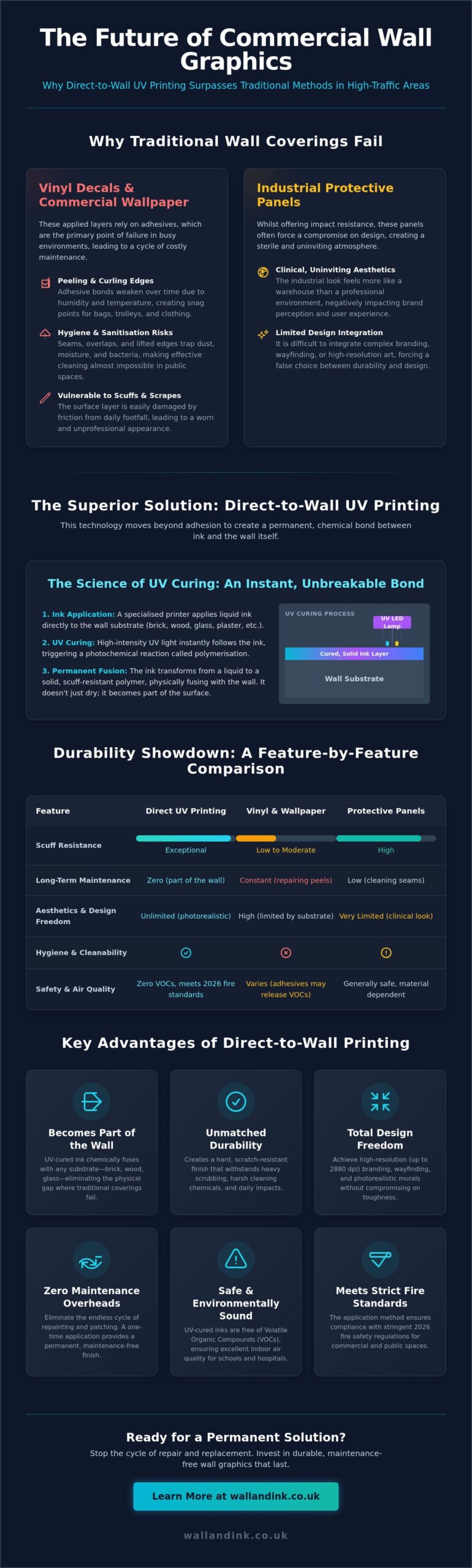
Direct-to-wall printing represents a fundamental shift from mechanical adhesion to chemical bonding. Traditional methods rely on a layer of glue to hold a material against a surface. In contrast, UV printing uses a specialised process where liquid ink is exposed to high-intensity ultraviolet light the moment it hits the wall. This light triggers a photochemical reaction known as UV polymerisation. It isn’t just drying. The ink instantly transforms into a solid, durable polymer that is physically fused with the substrate. This creates durable wall graphics for high traffic areas that don’t just sit on the surface; they become part of it.
The technical precision of this method allows for resolutions ranging from 720 to 2880 dpi. This ensures that even large-scale murals maintain photorealistic clarity. Because the ink is cured instantly, there is no bleeding or spreading, even on porous surfaces like brick or timber. You get sharp, vibrant branding that won’t fade or smudge under pressure. The result is a professional finish that meets the exacting standards of modern commercial interiors.
How UV Curing Creates a Scuff-Resistant Bond
Eliminating the Need for Traditional Substrates
One of the greatest advantages of this technology is its surface versatility. It eliminates the need for bulky MDF panels or PVC sheeting. Whether the surface is rough brick, smooth glass, or textured plaster, the printer follows the natural contour of the wall. This preserves the architectural character of the building whilst delivering high-impact visuals. It’s a cleaner, more efficient way to transform a space without the clutter of extra materials.
By removing the middleman-the substrate-you reduce material waste and installation time. There are no panels to cut, no vinyl to align, and no primers to apply. This streamlined approach is why many UK businesses are choosing Direct-to-Wall Printing as their primary decorative solution. The result is a zero-profile finish. Since there are no raised edges or seams, there is nothing for a passing bag or trolley to catch on, effectively ending the problem of mechanical damage before it starts.
Comparing Durability: Direct Printing vs. Vinyl vs. Panels
When selecting durable wall graphics for high traffic areas, the primary metric is the lifespan of the installation under mechanical stress. Traditional vinyl graphics typically offer a three to five-year functional life in busy corridors before edge-lift or surface abrasion necessitates replacement. In contrast, direct-to-surface UV printing is designed for permanent integration. By removing the vulnerable adhesive layer, the graphic remains intact for as long as the wall itself. This longevity is a result of the ink’s ability to withstand the constant friction of bags, clothing, and equipment that would otherwise tear or peel a standard decal.
The ability to withstand rigorous cleaning is another critical differentiator. Standard emulsion paints and vinyls often degrade when exposed to the harsh detergents required in public spaces. UV-cured inks are chemically resistant. They do not react to alcohol-based sanitisers or industrial-strength detergents, allowing for frequent, aggressive scrubbing without loss of colour or detail. This makes the technology a pragmatic choice for environments that demand the highest standards of cleanliness.
Maintenance and Hygiene in Public Spaces
In healthcare and food service settings, hygiene is non-negotiable. Traditional wall coverings create microscopic gaps at every seam and joint where bacteria and moisture can accumulate. Direct printing creates a completely seamless finish. There are no overlaps to trap contaminants, making the entire wall surface easy to sanitise. Additionally, the ink’s resistance to UV fading ensures that murals in sun-drenched atriums or reception areas maintain their visual impact for decades. The wipe-clean nature of the cured ink means that everyday scuffs and fingerprints are removed with a simple damp cloth, eliminating the need for a regular repainting programme.
The Failure Point Comparison
To understand the superiority of integrated graphics, one must look at the failure points of legacy systems. Vinyl fails at the edge where the adhesive gives way. Panels fail at the joint where physical impacts cause cracking or misalignment. Direct printing has neither of these vulnerabilities. Because the graphic is a zero-profile application, the impact resistance of the finish is identical to the impact resistance of the wall itself. For those seeking a long-term solution, direct to wall printing for business provides a seamless alternative that removes these traditional points of failure entirely.
Repairability also heavily favours direct printing. If a wall is physically gouged by a heavy trolley, a traditional vinyl mural often requires the entire drop to be stripped and replaced to ensure a colour match. With UV printing, a technician can re-print the specific damaged area with millimetre precision. This targeted approach saves significant material costs and reduces the disruption to your daily operations. Over a ten-year cycle, the elimination of these maintenance and replacement costs makes direct printing the most cost-effective solution for large-scale commercial branding.
Design Strategies for High-Traffic Commercial Interiors
Effective design in high-use environments is a functional requirement rather than a purely aesthetic choice. When planning durable wall graphics for high traffic areas, you must consider how visual elements interact with physical movement. A flat, monolithic colour is the most vulnerable design choice; even a minor scuff from a passing bag becomes a glaring focal point. By choosing busy patterns, intricate textures, or geometric abstractions, you create a visual field that naturally camouflages everyday wear. This strategic approach ensures the space looks pristine for longer without requiring constant intervention.
Colour selection plays a pivotal role in the perceived cleanliness of a facility. Whilst light, airy palettes are popular for creating a sense of space, they are impractical for high-impact zones. A pragmatic solution involves using darker, more resilient tones for the “kick zone”, which is the bottom metre of the wall where most contact occurs. Transitioning to lighter shades as the mural moves upward maintains the room’s brightness whilst protecting the most vulnerable areas. This methodical use of colour psychology balances the need for a welcoming atmosphere with the reality of industrial-strength use.
Camouflage and Practical Aesthetics
Abstract designs and textured pixel walls are superior for hiding mechanical damage. These styles break up the surface area, making it difficult for the eye to track small imperfections. High-contrast designs are also highly effective at directing traffic flow. By using bold lines and directional patterns, you can subconsciously guide people away from narrow bottlenecks and vulnerable corners, reducing the frequency of wall contact. It’s advisable to use darker base colours for the kick zone or bottom metre of the wall to mask the inevitable impact of shoes and equipment.
Bespoke Branding as a Durable Asset
Traditional decor often feels like an afterthought, but integrated wall art serves as a functional brand asset. By incorporating wayfinding and company values directly into the mural, you eliminate the need for secondary signage that can be easily damaged or removed. We use digital visualisations to ensure every design aligns perfectly with the architectural centre of your room. For example, a school corridor can be transformed from a drab, easily-scuffed painted surface into an interactive learning mural that encourages positive behaviour whilst resisting the rigours of student footfall.
To see how these strategies can be applied to your specific environment, explore our range of Commercial Wall Murals and discover a solution that prioritises both impact and longevity.
Wall & Ink: Precision Engineering for Your Walls
Our approach is defined by industrial precision. We’ve moved beyond the traditional design agency model to become hands-on specialists in vertical surface technology. The Wall & Ink process is a methodical progression from bespoke design consultation to technical on-site execution. We don’t just provide art; we provide an engineered surface solution that addresses the specific mechanical demands of your environment. This is the disruption the UK commercial sector requires, offering a clear alternative to the short-term fixes of the past.
Cleanliness is a core component of our service delivery. Traditional renovations often involve the dust of sanding, the mess of adhesives, or the lingering chemical smells of solvent-based paints. Our UV-cured process eliminates these hassles. Because the ink hardens instantly under ultraviolet light, there is no drying time and zero off-gassing. We organise national projects for offices, schools, and retail centres across the UK with a commitment to leaving every site as clean as we found it. This allows your facility to remain operational whilst we work.
The Technical Execution Advantage
The reliability of our service is underpinned by the precision of our wall printing machines. These systems are engineered to handle various heights and substrates with millimetre accuracy. A single machine can transform up to 20 square metres of wall space in a single day, ensuring minimal disruption to your daily operations. This speed doesn’t compromise quality. Every project begins with a rigorous digital mock-up process, providing professional reassurance that the final mural will align perfectly with your architectural features and existing wayfinding systems.
Transforming Your Space Today
It’s time to move away from the inefficient patch-and-paint cycle that drains facility budgets. By choosing durable wall graphics for high traffic areas, you are investing in a permanent asset rather than a temporary fix. Our direct-to-wall art provides the longevity and reliability that traditional vinyl simply cannot match. The zero-profile finish ensures there are no edges to catch and no seams to fail, even in the busiest corridors. If you are ready to eliminate the maintenance overheads of scuffed walls and peeling decals, Book a bespoke design consultation for your next project. We are the reliable partner you need to ensure your branding survives the rigours of heavy public use whilst maintaining a modern, professional aesthetic.
Future-Proof Your Commercial Surfaces
Maintaining the aesthetic integrity of a busy environment shouldn’t be a constant struggle against peeling vinyl or scuffed paint. By moving from applied layers to integrated, direct-to-surface art, you eliminate the primary failure points of traditional decor once and for all. Direct UV printing provides the most reliable solution for durable wall graphics for high traffic areas because it bonds chemically with the substrate. It’s a permanent, zero-profile finish that withstands the daily rigours of public use whilst meeting the strictest fire safety and hygiene standards.
Our process ensures that your branding remains a long-term asset rather than a maintenance liability. We provide full bespoke design and digital visualisations as standard, ensuring every mural fits your space with technical precision. With our no-mess, no-stress installation across the UK, your facility can be transformed in a single day without the disruption of dust or lingering chemical smells. Take the first step toward a maintenance-free interior today. Enquire about our durable commercial wall murals and discover how our UV-cured scuff-resistant technology can protect your walls for years to come. We look forward to helping you create a space that is as resilient as it is visually striking.
Frequently Asked Questions
Are direct-to-wall printed murals scuff-resistant?
Yes, direct-to-wall printed murals are highly scuff-resistant because the ink undergoes a photochemical curing process that hardens it into a durable polymer shell. Unlike vinyl, there are no raised edges to catch on bags or trolleys, making them ideal durable wall graphics for high traffic areas. This mechanical bond ensures the image remains intact even under constant friction in busy commercial environments.
How do you clean a wall that has been printed with UV ink?
You can clean printed walls using a damp cloth and mild detergents or standard industrial sanitisers. The UV-cured ink is chemically resistant and won’t smudge, fade, or react to alcohol-based cleaning agents. This allows for frequent scrubbing in healthcare or educational settings without degrading the visual quality of the mural. It is a practical solution for maintaining high hygiene standards in public spaces.
Can you print on textured surfaces like brick or breezeblock?
Yes, our technology prints directly onto diverse substrates including brick, breezeblock, timber, and textured plaster. The print head maintains a consistent distance from the surface, allowing the ink to follow the natural contours of the wall without loss of image integrity. This versatility eliminates the need for expensive and bulky MDF or PVC panelling. We can transform raw industrial surfaces into high-resolution brand assets in a single day.
How long does a direct-to-wall mural last in a busy corridor?
A direct-to-wall mural is considered a permanent installation, typically lasting over 10 years in indoor environments. Because the graphic is integrated into the wall surface, it doesn’t suffer from the peeling or adhesive failure that limits the lifespan of traditional vinyl. It remains a high-performance solution for as long as the underlying substrate is maintained. This longevity makes it a superior choice for durable wall graphics for high traffic areas.
Is the ink safe for use in schools or hospitals?
Yes, the UV-cured inks we use are safe for sensitive environments like schools and hospitals. The process is virtually free of Volatile Organic Compounds (VOCs), meaning there are no harmful fumes or lingering chemical smells during or after installation. Since the ink cures instantly under ultraviolet light, the space is ready for immediate use as soon as the printing process is complete. This ensures zero downtime for your facility.
What happens if the wall gets physically dented or damaged?
If the wall suffers physical damage, such as a deep dent from a heavy impact, we can perform a precision spot repair. We simply re-print the affected area with millimetre accuracy to match the existing design perfectly. This is far more efficient than replacing entire sections of vinyl or wallpaper, which often results in visible seams or colour mismatches. It is a targeted, cost-effective way to maintain your mural’s integrity.
Do I need to prime the wall before you arrive for printing?
In most cases, you don’t need to apply a special primer; the wall simply needs to be clean, dry, and free of loose debris. Our UV ink technology is designed to bond directly with standard commercial finishes, including emulsion paint and bare masonry. We will assess your specific surface during the initial consultation to ensure optimal adhesion. This streamlined preparation saves you significant time and material costs.
Is direct-to-wall printing more expensive than high-quality wallpaper?
Direct-to-wall printing is competitively priced against high-quality commercial wallpaper, but it offers significantly lower long-term maintenance costs. By choosing this method, you avoid the recurring expenses of repairing peeling edges or repainting scuffed surfaces. It is a pragmatic investment for anyone seeking a permanent decorative solution that eliminates the traditional maintenance cycle. The initial cost is offset by the durability and lack of replacement requirements.