
Why are you still budgeting for the inevitable failure of traditional wall coverings? In the UK’s busiest commercial environments, the standard cycle of wallpaper scuffing and vinyl peeling isn’t just an eyesore; it’s a recurring financial drain. You’ve likely seen it yourself: trolley impacts in hospital corridors or bags marking lobby walls within weeks of a fresh install. We believe there’s a more reliable way. By choosing durable wall printing for high traffic areas, you’re moving away from temporary adhesives and towards industrial-grade precision.
We understand that managing a facility requires solutions that actually last. This guide demonstrates how direct-to-wall UV printing provides a scuff-resistant, “fit and forget” mural solution that meets strict UK standards like BS 8300-2:2018 and Building Regulations Part M. You’ll learn about the mechanical superiority of UV-cured inks, the transparency of our pricing starting from £120 per square metre, and how to achieve a professional, high-resolution aesthetic that stays pristine for years.
Key Takeaways
- Learn why the instant UV curing process creates a mechanical bond with the wall, eliminating the peeling and edge-lifting common in high-traffic zones.
- Discover why durable wall printing for high traffic areas represents a structural upgrade that removes the maintenance burden of traditional decorative finishes.
- Identify the critical wall preparation steps and design strategies that ensure your mural remains pristine despite heavy impacts from bags and trolleys.
- Understand how our “No wallpaper, no mess” approach allows for high-resolution installations in active commercial spaces without the downtime of traditional methods.
The Challenge of High-Traffic Walls: Why Standard Decor Fails
High-traffic areas in commercial and educational settings, such as primary school corridors, busy lift lobbies, and hospital receptions, are relentless environments for interior finishes. These zones endure a constant barrage of physical contact. Whether it’s the impact of heavy trolleys, the friction of rucksacks, or the simple grease from hands, the wall surface is under permanent stress. Traditional decorative methods aren’t built for this. Standard wallpaper and vinyl decals are often marketed as robust, but they possess a fundamental flaw: they rely on a superficial layer of adhesive. This makes durable wall printing for high traffic areas a necessity rather than a luxury for pragmatic decision-makers.
We see three primary failure modes in standard decor. Scuffing occurs when the top layer of paper or vinyl is physically abraded. Peeling happens when the bond between the substrate and the covering fails. Fading is the result of UV exposure or aggressive cleaning chemicals. Industrial-grade wall printing addresses these issues by removing the fragile material layer entirely and applying pigment directly into the wall’s texture. By applying high-resolution graphics directly to substrates like plaster or brick, we deliver a “No wallpaper, no mess” solution that outperforms traditional alternatives.
The Problem with Peeling Edges and Adhesive Failure
Adhesives are the weakest link in any wall covering. In the UK, fluctuating humidity and temperature changes cause vinyl and wallpaper to expand and contract at different rates than the wall itself. This thermal movement eventually shears the bond, leading to lifting at the seams. In educational environments, we often encounter the “pick-factor.” Students naturally gravitate towards loose edges, pulling at them until a small scuff becomes a major repair job. Beyond the aesthetic damage, peeling edges present a genuine hygiene risk. These gaps become pockets where dust and bacteria accumulate, which is a critical concern for healthcare facilities trying to maintain sterile environments.
Maintenance Fatigue: The Cost of Constant Repainting
Many facilities managers suffer from maintenance fatigue. We define maintenance fatigue as the cycle of inevitable repair in high-traffic design. It’s the frustration of knowing that a freshly painted corridor will require touch-ups within six months. The financial drain of annual “refresh” projects is significant, especially when you factor in the labour costs and the operational downtime required for traditional decorating. Choosing durable wall printing for high traffic areas breaks this cycle. Unlike traditional methods that require the area to be cleared for days, our direct-to-wall process uses UV Printing Technology to cure ink instantly. This allows for a “fit and forget” mural that withstands years of heavy footfall without the need for a paintbrush.
The Technology of Durability: How Direct-to-Wall UV Printing Works
The secret to durable wall printing for high traffic areas lies in the chemistry of the ink itself. Unlike traditional methods that rely on air-drying or evaporation, our process utilises a high-intensity ultraviolet lamp mounted on the print head. This light triggers an immediate chemical reaction, transforming liquid ink into a hardened, scratch-resistant plastic polymer in a fraction of a second. This instant transition is known as UV curing. It ensures that the graphic doesn’t soak into the substrate or bleed, resulting in a crisp, high-resolution finish of up to 2880dpi. It’s the only way to guarantee durable wall printing for high traffic areas that looks as good in year five as it did on day one.
This process creates an incredibly resilient surface. Research into UV Curable Coating Technology confirms that these coatings offer superior mechanical properties compared to conventional air-dried finishes. For the facility manager, this means a mural that can withstand the daily friction of a busy hospital corridor or a university student union without flaking or losing its visual impact.
UV Curing vs. Solvent Inks: Why It Matters for Longevity
Standard solvent-based inks dry by releasing volatile organic compounds (VOCs) into the air, a process called outgassing. This is often unsuitable for sensitive environments like healthcare or primary schools. UV inks are VOC-free and stable. Once cured, they are “locked” into the texture of the wall. They also boast exceptional light-fastness. Even in sun-drenched lobbies or glass-fronted retail units, the colours remain vibrant and resist fading for years.
Substrate Versatility and Surface Integrity
Our technology isn’t limited to perfectly smooth plaster. Precision engineering allows our printers to map the contours of uneven surfaces like exposed brick, concrete, or textured stone. Sensors constantly adjust the print head’s distance from the wall to maintain a clean finish without distortion. By printing directly onto the bare substrate, we eliminate the risk of the graphic cracking or peeling away. It’s a structural upgrade to your space. If you’re ready to move beyond temporary stickers, you can view our commercial wall printing services to see the results for yourself.
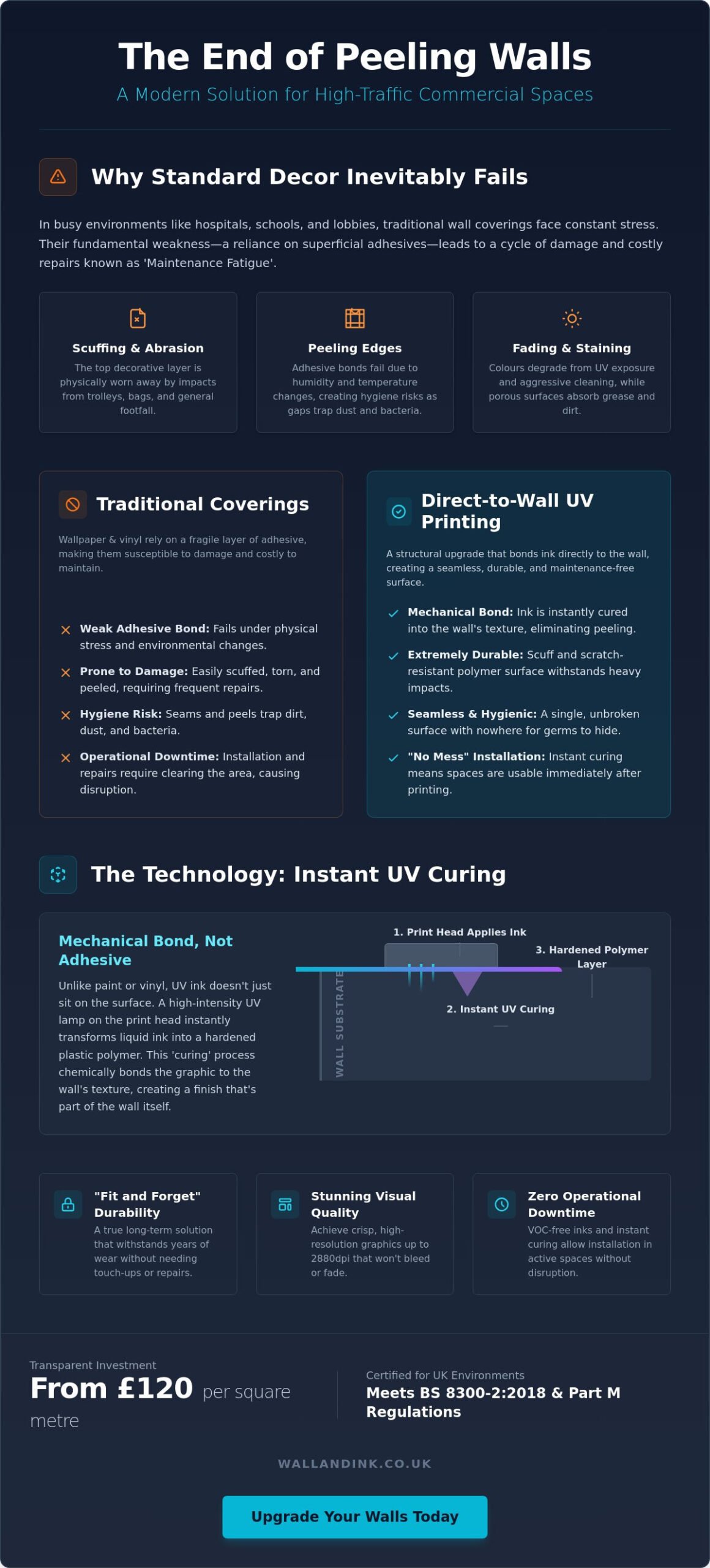
Comparing Solutions: Direct-to-Wall vs. Vinyl and Wallpaper
When evaluating finishes for busy corridors or public lobbies, decision-makers often weigh initial capital expenditure against long-term operational resilience. Traditional options like vinyl or wallpaper appear cost-effective during the procurement phase but hide significant structural failure points. In contrast, durable wall printing for high traffic areas offers a mechanical advantage by integrating the graphic into the wall surface itself. This shift from a “layered” approach to a “direct” application changes the maintenance profile of a building entirely. We focus on three core metrics: lifespan, maintenance requirements, and the total cost of ownership.
Vinyl and wallpaper are inherently modular. They rely on seams and joins that inevitably catch on trolleys or peel under the stress of high footfall. Our direct-to-wall process creates a seamless mural with no edges to lift and no overlaps to trap dirt or bacteria. While a standard 100-micron vinyl film is vulnerable to tearing and puncturing, the UV-cured ink layer used in our process is chemically bonded to the substrate. This provides a level of impact resistance that thin films simply cannot match. It’s the difference between a temporary sticker and a permanent architectural finish.
Lifespan and Total Cost of Ownership (TCO)
Lifespan is where the value proposition of direct printing becomes undeniable. A standard vinyl installation in a high-traffic zone typically has a functional life of 3 to 5 years before edge-lifting or surface scuffing necessitates replacement. Our UV prints are designed for a 10-year+ lifespan in indoor environments. Our pricing starts from £120 per square metre, which is a higher initial investment than basic £23 per square metre wallpaper. However, because you eliminate the 3-year replacement cycle, the TCO over a decade is significantly lower. You also bypass the hidden costs of removal, such as stripping old adhesive and the inevitable wall repairs required after peeling off vinyl panels.
Logistical Impact: Installation Speed and Cleanliness
Our “No wallpaper, no mess” mantra is a practical necessity for active commercial sites. Traditional decorating involves dust from sanding, strong adhesive odours, and multi-day drying times. Direct-to-wall printing is compatible with “clean room” standards. There’s no debris, no water, and no VOC outgassing. A single-day execution is standard for most commercial murals, whereas wallpapering often requires multiple site visits for preparation and hanging. Because the ink is cured instantly by ultraviolet light, the wall is touch-dry and ready for heavy traffic the moment the print head finishes its pass. This speed is vital for hospitals, schools, and retail centres where closing a thoroughfare for 48 hours isn’t an option.
Specifying for Longevity: A Buyer’s Guide to High-Footfall Graphics
Achieving a long-lasting result in a busy commercial environment requires more than just advanced hardware. It demands a strategic approach to design and surface specification. Whilst the technology itself is inherently robust, the way you specify durable wall printing for high traffic areas will determine how well the mural ages over a decade of use. For facility managers, this means considering both the visual composition of the artwork and the physical integrity of the substrate before the first drop of ink is cured.
Maintenance is straightforward once the installation is complete. Unlike traditional wallpaper that absorbs stains or vinyl that can be dissolved by certain cleaning solvents, UV-printed surfaces are chemically stable. You can clean these walls using standard, non-abrasive commercial detergents and warm water. We recommend avoiding highly abrasive scouring pads, but the hardened polymer layer is resistant to most common sanitising chemicals used in healthcare and hospitality settings. This ease of maintenance is a primary reason why direct-to-wall printing is replacing traditional decor in UK schools and hospitals.
Design Strategies for High-Traffic Environments
Visual camouflaging is a powerful tool for longevity. We advise clients to utilise “busy” patterns, textures, or intricate illustrations in areas prone to heavy impact. If a trolley or bag causes a minor surface abrasion, it’s far less visible amongst a complex pattern than on a flat, monolithic block of colour. Another effective strategy is the implementation of darker “kick-zones” at the base of the mural. By using deeper tones or textured gradients in the bottom 300mm of the design, you can effectively hide the scuffs and splashes that naturally occur at floor level from shoes and cleaning equipment.
Surface Preparation: Ensuring the Perfect Bond
The durability of the print is only as good as the surface it’s bonded to. A sound, dust-free substrate is essential for the ink to “lock” into the material properly. Before booking your installation, evaluate your space using this checklist:
- Substrate Integrity: Ensure plaster is not blown or crumbling. UV ink requires a stable foundation.
- Moisture Levels: Walls must be completely dry. A simple “foil test”—taping a piece of foil to the wall for 24 hours to check for condensation—is a reliable way to ensure no rising damp is present.
- Surface Cleanliness: Remove any loose paint, grease, or adhesive residue from previous vinyl installations.
- Obstruction Clearance: Ensure all trunking, sockets, and furniture are accounted for in the digital visualisation phase.
We provide detailed digital visualisations during the specification process to ensure the artwork aligns perfectly with your architectural features. If you are ready to upgrade your facility with a permanent solution, you can get a quote for your wall printing project today.
Wall & Ink: Delivering Industrial-Grade Murals Across the UK
Wall & Ink has established itself as the UK’s primary specialist in direct-to-wall technology, moving beyond the limitations of traditional decor. We don’t just provide art; we deliver industrial-grade installations designed for the rigours of commercial use. Our “No wallpaper, no mess” promise isn’t a marketing slogan. It’s a technical commitment to a process that eliminates the dust, adhesives, and operational downtime associated with conventional methods. For facility managers and architects, this means durable wall printing for high traffic areas is now a streamlined, predictable reality.
We provide a nationwide service capability, managing large-scale corporate rollouts from London to Edinburgh. Whether you’re overseeing a single reception area or a multi-site educational trust, our end-to-end service ensures consistency and precision. We handle everything from the initial bespoke design and file preparation to the final on-site installation. By operating as hands-on specialists rather than a general design agency, we maintain total control over the mechanical quality of every mural we print.
Radical Transparency: Pricing and Process
We believe in straightforward communication, especially regarding budgets. Our high-resolution commercial work starts from £120/m², providing a clear baseline for project planning. We operate a simple three-step process to move your project from concept to completion:
- Brief: We discuss your space, substrate, and durability requirements.
- Visualise: Our team creates digital mock-ups, allowing you to see the design in situ before printing begins.
- Print: Our technicians deploy our proprietary hardware to execute the mural with millimetre precision.
If you’re unsure how a design will translate to your specific substrate, we invite you to request a digital mock-up. This transparency ensures that the final aesthetic matches your professional expectations exactly.
Why Pragmatic Decision-Makers Choose Wall & Ink
Pragmatic decision-makers choose us because we solve the failures of the past. By replacing peeling vinyl and scuffed wallpaper with durable wall printing for high traffic areas, you’re investing in a solution that lasts for years rather than months. Every UK project is expert-led, ensuring that the technical specifications of the UV curing process are perfectly matched to your wall type, whether it’s bare brick, concrete, or plaster. We provide the reliability of an industrial partner with the visual impact of a high-end design studio.
Ready to eliminate maintenance fatigue? You can book a consultation for your high-traffic wall project and discover how our direct-to-wall technology can transform your commercial space.
Upgrade Your Commercial Environment with Industrial Precision
We’ve detailed why direct-to-wall technology represents a fundamental shift for facilities management. By choosing durable wall printing for high traffic areas, you’re opting for a structural upgrade that eliminates the chronic failure points of adhesives and seams. This isn’t just about decor; it’s about a 10-year+ resilience that withstands the daily pressure of the UK’s busiest corridors and lobbies. You’ve seen how the instant UV curing process ensures a clean, odour-free installation with zero operational downtime.
Our team provides a seamless service from bespoke digital visualisation to final execution across the UK. With transparent pricing starting from £120/m² and our “No wallpaper, no mess” guarantee, we help pragmatic decision-makers break the cycle of maintenance fatigue. You can request a bespoke quote for your high-traffic area mural to start your transformation today. It’s time to invest in a wall finish that is as hardworking as the environment it inhabits.
Frequently Asked Questions
Is direct-to-wall printing more durable than laminated vinyl?
Direct-to-wall printing is significantly more durable than laminated vinyl because it eliminates the adhesive failure points. Vinyl relies on a surface bond that eventually peels or lifts at the seams. Our UV-cured ink penetrates the wall’s texture and hardens instantly, creating a mechanical bond that cannot be picked or peeled away, even in demanding commercial corridors.
Can you clean printed walls in high-traffic areas with standard detergents?
Yes, you can clean these surfaces using standard non-abrasive commercial detergents and warm water. The hardened polymer layer created during the UV curing process is chemically resistant and stable, so it won’t smudge or bleed when wiped down. We recommend avoiding highly abrasive scouring pads to maintain the long-term integrity of the high-resolution finish.
What happens if a printed wall gets scratched or dented?
While the ink layer is exceptionally scratch-resistant, deep structural damage to the wall can be repaired. If a wall is dented by heavy equipment, the area can be filled and sanded as normal. We can then re-print that specific section to match the original design. This modular repair capability is a key advantage of durable wall printing for high traffic areas over traditional wallpaper.
How long does a UV-printed mural last in a busy school corridor?
A UV-printed mural is designed to last for over 10 years in an indoor environment such as a school corridor. The ink is highly light-fast, meaning it won’t fade even when exposed to the direct sunlight often found in modern educational buildings. It remains vibrant and clear long after traditional vinyl decals would have started to lift or discolour.
Does the wall need special preparation before the printing process begins?
The wall simply needs to be sound, dry, and free from dust or loose material. We print directly onto existing paint, plaster, or brickwork. If your wall is dark or heavily textured, we apply a white base layer of ink first. This ensures that the final colours are vibrant and the bond is secure across the entire surface.
Is the ink used in wall printing safe for hospitals and nurseries?
Yes, our UV inks are entirely safe for healthcare and childcare environments. Because the ink is cured instantly by ultraviolet light, there is no outgassing of volatile organic compounds (VOCs). This makes it a “clean room” compatible solution, ideal for hospital wards and nurseries where air quality and hygiene are paramount.
How much does durable wall printing cost per square metre in the UK?
In the UK, standard wall printing on light-coloured, smooth surfaces starts from £120 per square metre. For projects involving dark or textured substrates like brick, the price starts from £150 per square metre to include the necessary white base layer. All projects are subject to a minimum job fee of £300, ensuring a professional and precise result for every client.
Can you print on textured surfaces like brick or breeze blocks?
We can print on a wide variety of textured surfaces, including brick, breeze blocks, and concrete. Our printers use advanced sensors to map the wall’s contours in real-time, adjusting the distance of the print head to maintain precision. This allows us to create high-resolution murals on industrial substrates that would be impossible to cover with traditional wallpaper or vinyl.