
Why settle for the physical constraints of a frame when your architecture can become the canvas itself? Traditional methods of displaying art often bring more frustration than aesthetic value. You’ve likely dealt with crooked frames that won’t stay level, glass reflections that obscure the brushstrokes, or the inevitable peeling of wallpaper seams in high-traffic hallways. These legacy issues limit the impact of fine art reproduction on walls, forcing you to compromise on scale and durability.
We’ll show you how direct-to-wall UV printing is revolutionising the industry by offering a durable, frameless, and high-resolution alternative to standard prints. This technology allows for seamless, museum-grade installations that are built to withstand busy environments whilst maintaining industrial precision. You’ll learn how bespoke sizing can fit your specific architectural features, moving beyond the limits of pre-set dimensions. We’ll also cover the technical justifications for why UV ink is the modern standard for permanent, high-fidelity decor.
Key Takeaways
- Learn how direct-to-wall UV printing achieves scratch-resistant, instant-dry results that eliminate the maintenance requirements of traditional frames.
- Discover why fine art reproduction on walls provides a more durable and architecturally integrated solution than standard paper-based alternatives.
- Identify the technical file specifications, such as DPI and PPI, required to maintain high-resolution integrity at an industrial scale.
- Understand the process of utilising bespoke sizing to fit specific structural features, bypassing the physical limitations of legacy decor.
- Explore the transition from digital mock-ups to on-site execution, ensuring a clean and precise installation in any professional or private environment.
The Evolution of Fine Art Reproduction on Walls: Beyond the Frame
The concept of fine art reproduction has undergone a fundamental shift. In previous decades, a reproduction was defined by its proximity to the original’s medium, usually involving high-quality inks on paper or canvas. We have moved beyond this restrictive definition. Today, fine art reproduction on walls is about the total integration of the image into the environment’s architecture. This evolution challenges the traditional gallery model where the frame acts as a boundary between the viewer and the work.
This transition aligns with historical shifts in how we perceive the authenticity and accessibility of art. In the influential essay The Work of Art in the Age of Mechanical Reproduction, the discussion focuses on how technology changes the “aura” of an artwork. Modern UV printing technology takes this a step further. It doesn’t just reproduce the image; it transforms the wall itself into the masterpiece. By eliminating the physical barrier of the frame, the artwork gains a new level of presence that traditional prints cannot replicate.
The Limitations of Traditional Framed Prints
Traditional framing methods introduce several mechanical and aesthetic failures that detract from the impact of large-scale art. These issues are particularly prevalent in professional and residential settings where lighting and space are fixed variables.
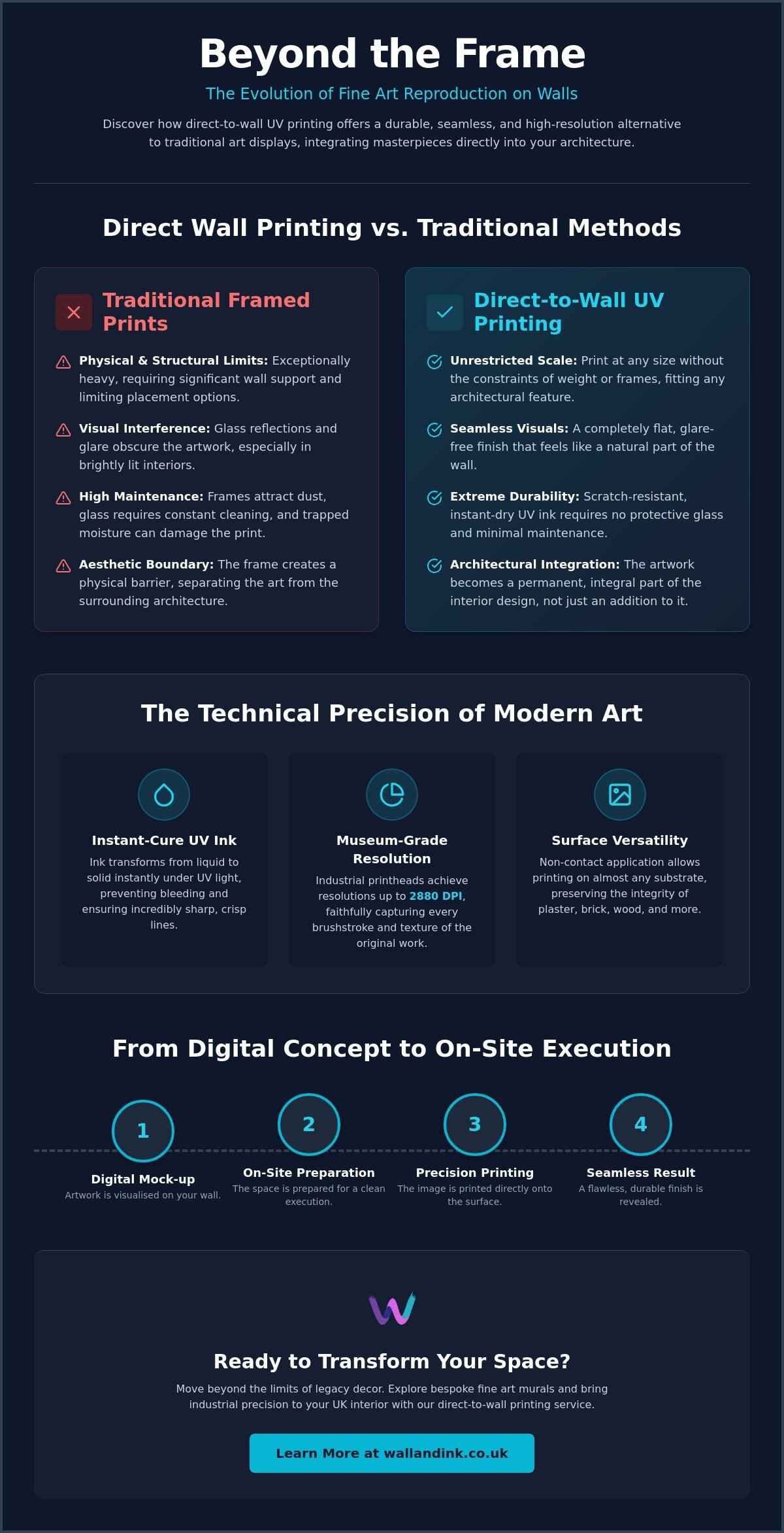
- Physical Constraints: Large-scale framed prints are exceptionally heavy. The weight of the glass and the timber frame requires significant structural support, often limiting where the art can be placed.
- Visual Interference: Glass reflections and glare are persistent problems in bright British interiors. High-traffic areas with multiple light sources often result in the artwork being obscured by distracting highlights.
- Maintenance Requirements: Frames are magnets for dust and debris. Glass requires constant cleaning to maintain clarity, and over time, moisture can become trapped behind the pane, damaging the print.
The Rise of Direct-to-Wall Technology
Direct-to-wall UV printing has disrupted the legacy decor market by moving the image directly onto the substrate. This process uses industrial-grade printheads to apply UV-cured inks that bond instantly to the wall surface. The result is a seamless, borderless finish that feels like a natural extension of the room rather than an afterthought hung upon it.
Modern interior designers are increasingly specifying these frameless reproductions for their precision and durability. Because the ink is cured instantly, the finish is scratch-resistant and requires no protective glass. This allows for a tactile, matte, or satin finish that preserves the intricate details of the original work. It’s a pragmatic solution for decision-makers who value high-quality results without the recurring hassles of traditional art maintenance.
Direct-to-Wall UV Printing: The Technical Precision of Modern Art
The mechanical superiority of modern wall printing lies in its ability to replicate fine art with industrial precision. Unlike traditional giclée methods that rely on absorbent paper, direct-to-wall systems use a non-contact application process. This ensures that the substrate’s integrity remains uncompromised whilst the ink is deposited with microscopic accuracy. The result is a high-resolution finish that achieves colour depth and clarity comparable to museum-grade standards. It eliminates the variables of paper expansion and frame mounting, providing a stable and reliable outcome.
The core of this process is the chemical reaction triggered by ultraviolet light. In this UV Printing Technology Explained overview, the focus is on how UV-cured inks transform from a liquid to a solid state instantly upon exposure to a specific light frequency. This rapid curing prevents the ink from bleeding or spreading, which is a common failure in water-based printing. It allows for a level of sharpness that supports scaling up to massive proportions without the risk of pixelation or loss of detail. Latest-generation industrial printheads can achieve resolutions up to 2880 DPI, ensuring that every brushstroke of the original masterpiece is captured faithfully during fine art reproduction on walls.
Surface Versatility and Substrate Compatibility
Durability and Longevity of Direct Prints
Direct-to-wall prints are engineered for longevity in environments where traditional framed art would fail. The UV-stable pigments are highly resistant to sunlight, preventing the fading typically seen in paper prints placed near windows. These prints don’t require protective glass because the cured ink is inherently scratch-resistant and robust. This makes the surface entirely washable, which is ideal for commercial lobbies, schools, or busy residential corridors where high traffic is a factor. Whilst the installation is permanent, the wall can be returned to its original state simply by painting over the artwork with a standard primer. For those looking to integrate professional-grade art into their environment, our Direct-to-Wall Printing service provides the technical reliability required for high-stakes projects.
Direct Wall Printing vs. Traditional Art Prints: A Comparison
Choosing between traditional framed prints and direct wall printing requires a pragmatic assessment of long-term value and structural impact. Standard art prints are often restricted by the mechanical limits of paper rolls and glass manufacturing. This usually forces a compromise on size or requires multiple panels that disrupt the visual flow. In contrast, fine art reproduction on walls allows for bespoke dimensions that match the specific architectural features of a room. There are no “A-size” constraints; the artwork scales to the physical reality of the substrate.
Installation methods also differ significantly. Traditional prints rely on invasive hardware, including drills, screws, and heavy-duty wall anchors. This creates permanent damage to the wall surface and introduces the risk of frames falling or needing constant re-levelling. Direct wall printing is a non-invasive technical process. The printer tracks the wall surface with laser precision, depositing ink without the need for structural modifications. This eliminates the visual clutter of hanging points and wires, providing a cleaner, more professional finish.
Aesthetic Impact and Spatial Integration
The absence of a frame fundamentally changes how art interacts with a space. Framed art acts as a window, whereas direct-to-wall printing makes the art part of the wall itself. This integration removes the “box” effect that can make smaller rooms feel cramped. A floor-to-ceiling masterpiece creates a sense of openness and scale that simply cannot be achieved with hanging hardware. It transforms a flat surface into a high-resolution feature that commands attention without the distraction of reflective glass or bulky timber borders.
This seamless integration is a significant asset in residential renovation projects. Specialists like Darwins of Shrewsbury often focus on creating clean, uncluttered aesthetics in their kitchen and bathroom designs, where the addition of frameless, printed art can provide a sophisticated finishing touch without compromising on space or durability.
Practicality for Commercial and Public Spaces
In high-traffic environments, the physical safety and hygiene of decor are critical considerations. Traditional frames pose significant risks in hospitals, schools, or hospitality settings due to the weight of the glass and the potential for shattering. Direct-to-wall UV printing eliminates these hazards entirely. The ink is scratch-resistant and bonds permanently to the surface, making it an anti-vandal solution that handles heavy daily use.
- Hygiene: Direct prints provide a flat, wipeable surface that doesn’t trap dust or bacteria. This is a major advantage over frame recesses and glass covers.
- Durability: UV-cured inks are robust enough to withstand industrial cleaning agents, ensuring the fine art reproduction on walls remains vibrant for years.
- Safety: No heavy frames or glass panes mean there is zero risk of injury from falling objects or sharp fragments.
Organising Your Space: Selecting Artwork for Direct Reproduction
Successful fine art reproduction on walls depends entirely on the quality of the source data. Whilst interior designers often focus on colour palettes, the technical specialist prioritises pixel density and aspect ratios. For a reproduction to maintain museum-grade integrity at a scale of three or four metres, the digital file must be of exceptional resolution. We recommend source files with high DPI (Dots Per Inch) to ensure that when the image is scaled, the industrial printheads can translate every detail without blur or digital noise. It’s the difference between a decorative mural and a professional art installation.
Selecting the right artwork also requires an understanding of how the image will interact with the wall’s physical substrate. A smooth, plastered surface is ideal for modern, sharp-edged graphics or high-contrast photography. Conversely, a slightly textured wall can enhance the reproduction of classical oil paintings, where the underlying masonry mimics the natural grain of a heavy canvas. This interaction creates a depth and tactile quality that standard paper prints cannot achieve. We help you balance the art style with the physical reality of your environment to ensure a reliable result.
From Classical Masterpieces to Contemporary Graphics
Contemporary graphics and abstract works are particularly effective when utilised as full-height murals. They transform a structural element into a bold statement piece that commands the entire room. For those preferring classical aesthetics, many international museums now provide high-resolution, legally cleared files of historical masterpieces. These files allow us to reproduce intricate Impressionist textures or Renaissance details with absolute fidelity. The choice of art should always consider the room’s primary function and the specific lighting conditions it’s exposed to throughout the day.
Digital Visualisation: Mapping the Art to the Architecture
Precision in art reproduction is not just about the print; it’s about the placement. Our process involves digital mapping to ensure the artwork accounts for architectural features such as doors, windows, and light switches. We don’t simply “crop” an image to fit a space. Instead, we organise the composition so that key visual elements are not lost to a doorway or obscured by permanent furniture. This stage also allows for the adjustment of colour saturation and brightness to compensate for the specific natural light levels of your interior, ensuring the final print looks exactly as intended.
To begin your project with a technical assessment of your space, explore our Residential Wall Art options for a bespoke design consultation.
Bespoke Fine Art Murals: The Wall & Ink Approach to UK Interiors
Wall & Ink operates as a specialist disruptor in the UK decor market. We don’t just hang pictures; we execute technical applications that integrate art into the fabric of a building. Our commitment to fine art reproduction on walls is rooted in mechanical superiority and industrial precision. We serve pragmatic decision-makers who require high-quality results without the traditional hassles of framing or wallpapering. From corporate headquarters to private residences, our approach ensures that the artistic integrity of a piece is preserved through advanced UV technology. This reliability is why we are the leading UK specialist in direct-to-surface art.
Our end-to-end service is methodical and logical. It begins with a technical consultation to assess the substrate and architectural features of your specific site. We then move to a digital mock-up phase, ensuring the artwork is mapped with absolute accuracy around doors, windows, and light switches. This logical progression guarantees that the final on-site printing meets the exact specifications of the initial design. We operate across the country, providing a reliable partnership for those looking to transform their environments with museum-grade murals that are built to last.
A Clean and Efficient Installation Process
One of the primary advantages of our UV application method is the negation of common industry pain points. Traditional wall treatments often involve messy adhesives, lingering chemical fumes, or lengthy drying times. Our process is different. Because the UV ink cures instantly, there is no drying time required and zero fumes. This allows for the immediate use of the space once the printing is complete. Our UK-wide technical team maintains professional standards of cleanliness, ensuring that the installation is as efficient as the technology itself. We handle the physical reality of the trade so you don’t have to worry about the cleanup.
Start Your Fine Art Transformation
We value transparency and efficiency above all else. Our service is designed to be straightforward, moving from initial curiosity to final execution through a well-defined journey. We lead with a clear pricing model based on square-metre metrics, ensuring you have the necessary data to make an informed decision for your project. This level of honesty distinguishes our process from competitors who often obscure costs behind lengthy consultation requirements. Whether you are looking to enhance a retail environment, a school, or a private study, our technology provides a modern, durable solution to legacy decor failures.
Contact Wall & Ink today to discuss your vision and see how our specialists can revolutionise your interior with a high-fidelity fine art reproduction on walls.
Integrating High-Resolution Art into Modern Architecture
Direct-to-wall printing represents a fundamental shift from hanging decor to architectural integration. By utilising advanced UV ink technology, you eliminate the fragility and maintenance requirements of traditional framed prints. This modern approach to fine art reproduction on walls ensures a durable, scratch-resistant finish that thrives in both high-traffic commercial zones and private residential settings. You don’t need to compromise on scale or settle for the visual clutter of frames and reflective glass. Our process treats the wall as a high-fidelity substrate, delivering results that standard prints cannot match.
We provide national UK coverage and include bespoke digital visualisation with every project to ensure your artwork maps perfectly to your building’s unique features. Our technical specialists maintain professional standards of precision from the initial consultation to the final on-site execution. It’s time to move beyond the constraints of legacy decor and embrace a seamless, museum-grade installation that is built for longevity. Request a bespoke quote for your fine art wall reproduction and start your architectural transformation today.
Frequently Asked Questions
Is direct-to-wall fine art reproduction as high-quality as a giclée print?
Direct-to-wall printing achieves a level of detail that rivals museum-grade giclée standards. Our industrial printheads deliver resolutions up to 2880 DPI, ensuring that fine art reproduction on walls captures every brushstroke with high fidelity. Unlike paper-based prints, this method eliminates the air gap between the art and the viewer. It provides a more integrated and tactile aesthetic by removing the need for reflective glass or acrylic covers.
Can you reproduce fine art on textured walls like brick or breeze block?
We can print on almost any structural surface, including brick, breeze block, wood, and glass. The printing hardware uses laser sensors to track the wall’s topography, maintaining a consistent distance from the substrate throughout the process. This allows the natural texture of the brick to add a physical dimension to the artwork. It’s an effective way to mimic the grain of a heavy canvas on a much larger scale.
What happens if I want to change the artwork in the future?
The artwork is permanent but not irreversible. If you decide to update your decor or change the image, you simply need to apply a standard primer and paint over the existing print. This is a significant advantage over traditional wallpaper or vinyl decals, which often leave adhesive residue or damage the plaster during removal. It allows you to refresh your space without structural repairs or intensive cleaning.
How do I know if my image file is high enough resolution for a full wall?
Our technical team assesses every digital file before the printing process begins to ensure a reliable result. For a full-height mural, we typically require high-resolution source files to avoid pixelation or loss of detail. If you’re unsure about your file’s suitability, we provide a digital visualisation service. This process maps the image to your specific wall dimensions and checks for technical integrity before we arrive on site.
Is the UV ink used in wall printing safe for homes and schools?
The UV-cured inks we use are entirely safe for residential and educational environments. Because the ink is cured instantly by ultraviolet light during the printing process, there are zero chemical fumes and no drying time required. This allows rooms to be occupied immediately after the installation is complete. It’s a clean, efficient solution that meets the safety and hygiene standards required for schools, hospitals, and private nurseries.
How long does a direct-to-wall art reproduction typically take to install?
Most projects are completed within a single working day. The exact duration depends on the total square-metre area and the complexity of the architectural features, such as doors or windows. Because the process involves no structural modifications or heavy hardware, we can execute the installation with minimal disruption. You won’t need to wait for adhesives to dry or for frames to be mounted and levelled.
Will sunlight fade the artwork over time?
The pigments used in our UV-cured inks are specifically engineered for high UV stability. This makes fine art reproduction on walls highly resistant to fading, even when placed in direct sunlight. Unlike traditional paper prints that require expensive UV-protective glass to maintain their integrity, our direct prints maintain their colour vibrancy for years without additional shielding. This durability is a core benefit of our industrial application method.
Do I need to prepare my wall in any special way before printing?
Walls should be clean, dry, and free from loose debris or significant structural cracks. Whilst the technology can handle various textures, a neutral or light-coloured base is usually best for ensuring absolute colour accuracy. We provide specific guidance on surface preparation during your initial consultation. This ensures the best possible ink bond and a high-resolution finish that meets our professional standards for industrial precision.