
Your brand’s physical space should be an architectural investment, not a temporary sticker. In the context of experiential retail design, first impressions are often undermined by the practical failures of legacy media. You’ve likely dealt with the frustration of vinyl graphics peeling at the edges or wallpaper bubbling under the intense lighting of a busy shop floor. These traditional methods often fail to meet the rigorous demands of high-traffic UK retail environments, resulting in escalating maintenance costs and a compromised brand aesthetic.
We recognise that modern retail decision-makers require a permanent, high-definition solution that integrates with the building’s fabric. This guide demonstrates how direct-to-wall UV printing is redefining the industry by applying graphics directly onto substrates like brick, plaster, and wood. You’ll learn how to achieve a durable, precision finish that eliminates the need for adhesive films and traditional wall coverings. We will outline the technical advantages of instant UV curing, the minimal disruption caused during installation, and why this method is the future of resilient, high-impact retail environments across the UK.
Key Takeaways
- Understand why modern experiential retail design requires a shift from temporary vinyl graphics to permanent architectural art that integrates directly with your building’s surfaces.
- Discover the technical benefits of UV-cured ink technology, providing instant curing and superior durability for high-traffic shop floors and corridors.
- Learn how to eliminate common maintenance frustrations like peeling edges and bubbling by applying high-resolution graphics to textured substrates like brick, plaster, and wood.
- Explore the importance of bespoke digital visualisation in ensuring your brand assets are perfectly scaled and positioned before on-site execution begins.
- Identify the logistical advantages of a nationwide UK service for multi-site retail rollouts, offering minimal disruption and a consistent, high-definition finish.
What is Experiential Retail Design in the Modern Architectural Era?
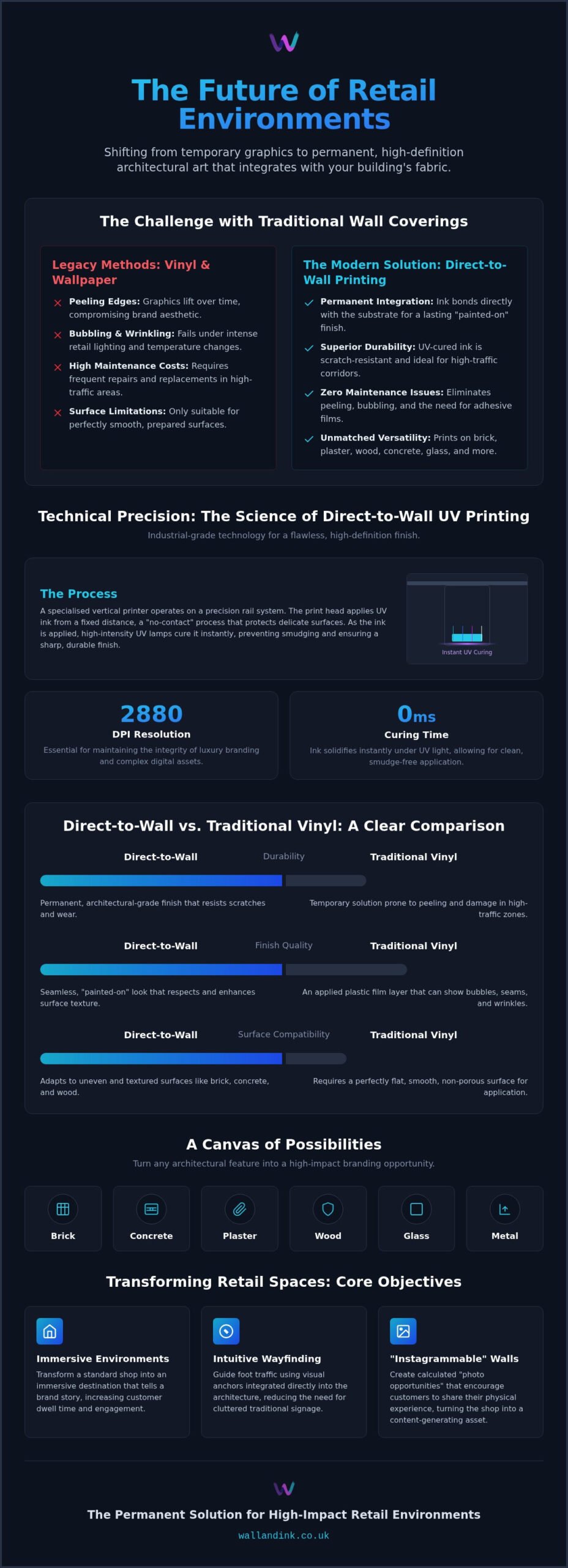
Modern retail isn’t just about the transaction; it’s about the narrative. To understand What is Experiential Retail?, you have to look beyond simple floor plans and shelving units. It’s the strategic fusion of physical space with brand storytelling. Successful experiential retail design transforms a standard shop into an immersive destination. This shift is driven by the need to offer a tangible environment that digital platforms can’t replicate.
Most retailers overlook their largest surface area. The physical wall substrate is frequently the most underutilised asset in a commercial fit-out. High-resolution imagery influences consumer behaviour and increases dwell time by creating a sense of place. A precision-printed mural isn’t just decoration; it’s a functional tool that grounds the brand in its physical location. It turns a plain corridor into a high-impact brand statement.
The Evolution from Signage to Environmental Branding
The industry is moving away from temporary pop-up aesthetics. Decision-makers now prioritise permanent architectural quality that withstands high-traffic use. Environmental graphics create a cohesive customer journey whilst shoppers browse the aisles. Rather than using disjointed posters or vinyl that peels, the entire wall becomes an integrated part of the brand experience. This approach also provides a significant boost to social media reach. “Instagrammable” walls are a calculated investment that encourages customers to share their physical experience with a global digital audience. It’s a way to turn a physical shop into a content-generating asset.
Core Objectives of High-Impact Retail Imagery
High-impact imagery achieves several functional goals beyond simple aesthetics. It improves wayfinding amongst customers by using visual anchors rather than cluttered traditional signage. When graphics are applied with colour-matched UV precision, they reinforce brand identity with industrial accuracy.
- Intuitive Wayfinding: Guiding foot traffic through visual cues integrated into the architecture.
- Brand Consistency: Using 2880dpi resolution to ensure logos and brand colours are reproduced exactly as intended.
- Tactile Engagement: Printing on textured surfaces like brick, concrete, or wood to create a physical experience that invites interaction.
By focusing on these objectives, retailers move from a transactional model to an experiential one. This ensures every square metre of the shop floor contributes to the brand’s long-term value.
Technical Precision: The Science of Direct-to-Wall UV Printing
Executing experiential retail design at a professional level requires more than just a creative eye; it demands industrial-grade technology. Direct-to-wall printing uses a specialised vertical printer that operates on a precision rail system. Unlike traditional methods, this is a “no-contact” process. The print head remains at a fixed distance from the wall, allowing us to apply high-definition graphics to delicate or uneven surfaces without any physical pressure. This eliminates the risk of substrate damage during installation.
The technical core of this process is the UV-cured ink. As the printer moves, high-intensity UV lamps cure the ink instantly. This immediate solidification allows for a 2880dpi resolution, which is essential for maintaining the integrity of luxury branding and complex digital assets. Because the curing happens in milliseconds, there’s no bleeding or smudging, even on non-porous surfaces. It’s a clean, efficient method designed for professional environments where time and precision are paramount.
Substrate Versatility: Printing on Any Surface
In modern retail, architectural features like exposed brick, concrete, and timber are often central to the aesthetic. These materials were once considered obstacles for branding, but our technology turns them into canvases. The printer adapts to the texture of the masonry, delivering a “painted-on” look that preserves the natural character of the wall. This versatility extends to glass partitions and metal cladding, providing a seamless finish that standard adhesive films cannot replicate. For projects requiring specific technical advice on unique substrates, you can explore our full range of retail graphics.
Durability in High-Traffic Retail Zones
Retail corridors and shop floors are high-impact environments where durability is a functional requirement. UV-printed murals are engineered for longevity, with an interior lifespan rated for over 10 years. The cured ink is highly resistant to scratches and the various cleaning chemicals used amongst maintenance staff. Because the ink bonds directly to the wall’s pores, there are no edges to lift or peel. This is a significant advantage over legacy media, which often fails at the corners in busy areas. The result is a permanent architectural feature that remains fade-resistant and moisture-proof for a decade or more.
Direct-to-Wall vs. Traditional Vinyl: Why Durability Matters
Legacy media like vinyl wraps and adhesive-backed graphics have long been the default for shop fit-outs. However, these materials often undermine the long-term goals of experiential retail design by introducing visible failures. Vinyl graphics rely on adhesive films that eventually degrade under the stress of a commercial environment. In contrast, direct-to-wall UV printing creates a seamless finish with zero joins. There are no overlapping seams to catch the light or collect dust, ensuring the architectural integrity of the design remains intact from every viewing angle.
The total cost of ownership is a critical factor for pragmatic decision-makers. Whilst a vinyl application might seem cost-effective initially, its susceptibility to damage often leads to frequent, expensive replacements. UV-printed murals offer a superior lifecycle, maintaining their high-definition finish for over a decade in interior settings. Maintenance is equally straightforward. The “wipe-clean” surface resists moisture and can be sanitised without the risk of the graphics delaminating or losing colour density. This durability is matched by a better environmental profile, as the process eliminates the need for plastic carriers and PVC waste.
Eliminating Common Retail Branding Failures
High-street corridors and narrow retail units present unique challenges for environmental graphics. Vinyl is prone to peeling at the edges when brushed by customers or cleaning equipment. It also reacts to temperature fluctuations, which can cause unsightly bubbling or shrinking. Direct-to-wall printing solves these issues by bonding the ink into the pores of the substrate. There is no adhesive layer to fail. When the time comes for a rebrand, there’s no sticky residue to remove; the surface is simply painted over, providing a clean slate for the next installation.
Installation Efficiency for Commercial Spaces
Time is a primary constraint in any commercial renovation. Our vertical printing process is significantly faster than hanging heavy-duty wallpaper or applying complex vinyl wraps. It’s a clean operation that produces no fumes, no paste mess, and no intrusive smells. This allows for flexible scheduling, including overnight installations that ensure the shop is ready for trading the next morning. For national retailers, this means a consistent rollout across multiple sites with minimal disruption to daily operations. The elimination of traditional installation hassles makes it the logical choice for high-stakes professional environments.
Strategic Visualisation: Organising Your Retail Space for Impact
Successful experiential retail design is built on the bridge between digital assets and physical architecture. Moving a brand logo from a screen to a ten-metre retail wall isn’t a matter of simple enlargement; it’s a strategic translation. We focus on the “visual weight” of the space, identifying prime focal points that naturally draw the customer’s eye as they enter the shop. This methodical approach ensures that your most expensive square footage works as hard as possible to reinforce your brand narrative. You aren’t just decorating a wall; you’re organising a customer journey.
Colour management requires industrial precision when dealing with porous or dark substrates. A brand’s signature colour must look identical whether it’s applied to smooth plaster or textured masonry. We utilise advanced colour-matching technology to compensate for the base material’s natural hue, ensuring total brand consistency across all surfaces. This eliminates the “hit or miss” nature of traditional wall applications, providing a reliable outcome for pragmatic project managers.
The Role of Digital Mock-ups in Decision Making
We avoid abstract sketches and guesswork. Instead, we use digital visualisation to overlay designs onto high-resolution photographs of your actual premises. This allows decision-makers to see exactly how a mural interacts with existing shop fittings, lighting, and shelving. It’s a functional method to adjust positioning before the first drop of ink touches the surface. If a shelf obstructs a key part of the brand logo, we identify it in the mock-up phase, not on installation day. This level of transparency is essential for securing stakeholder approval. To start your process, you can request a bespoke digital visualisation for your retail space.
Creative Trends in Retail Wall Art for 2026
Looking ahead to 2026, the trend in luxury boutiques is shifting towards minimalist line art and geometric branding. These designs use the raw texture of the wall as a background, creating a sophisticated, integrated look that feels like part of the building. Oversized typography is also becoming a standard for making bold statements in high-traffic areas. Additionally, we’re utilising the technical capability of UV layering to create subtle 3D effects and depth. By layering ink, we can add a tactile dimension to the graphics that encourages physical engagement and reinforces the “destination” feel of the space. It’s an innovative way to differentiate a physical shop from its digital counterparts.
Implementing Your Vision: Wall & Ink’s National UK Service
Bringing a complex experiential retail design to life requires a partner who understands the logistical challenges of the UK high street. Our end-to-end service manages every technical detail, from the initial digital visualisation to the final on-site execution. We don’t just provide the technology; we provide the expertise to ensure your brand narrative is applied with industrial precision across any vertical surface. This methodical approach eliminates the common errors associated with third-party contractors and ensures that the final mural matches the approved digital mock-up exactly.
For retailers with a national footprint, consistency is vital. We offer full UK coverage, allowing for synchronised rebrands and multi-site rollouts. Whether you’re updating a single flagship store or coordinating a refresh across twenty regional shopping centres, our team ensures a uniform finish. Our pricing models are transparent and based on project complexity and square footage. This allows for accurate budgeting without the hidden costs often found in the traditional design industry. It’s a pragmatic solution for decision-makers who value efficiency and high-quality results.
Bespoke Solutions for Every Retail Sector
We tailor our direct-to-wall printing to meet the specific requirements of different retail environments. In luxury boutiques and showrooms, we focus on the 2880dpi precision required for high-end branding and intricate line art. For the hospitality sector, including cafes and restaurants, we provide durable graphics that withstand the heat and moisture of a busy service environment. Large-scale retail parks and shopping centres benefit from our ability to scale graphics across vast architectural surfaces, turning functional walls into high-impact brand destinations.
Starting Your Retail Transformation
The journey begins with a professional consultation to establish your project’s scope. Once we receive your initial enquiry, we conduct a technical site survey to assess the wall substrate and environmental conditions. You can provide your own artwork for a technical feasibility check, where our specialists ensure the resolution and scale are optimised for the vertical printer. We handle the technical preparation, so your team doesn’t have to worry about surface priming or complex setups. To take the first step in upgrading your physical space, you can enquire about our retail graphics services today.
Investing in Permanent Architectural Branding
The shift towards more immersive, high-traffic environments requires a transition from temporary stickers to permanent architectural features. By utilising direct-to-wall UV printing, you eliminate the common failures of legacy media like peeling edges and adhesive breakdown. This technology ensures that your brand narrative is integrated directly into the substrate, whether you’re working with exposed brick, concrete, or smooth plaster. Our use of UV ink technology provides superior durability for interior settings, ensuring your investment remains high-definition for over a decade.
Achieving a professional experiential retail design demands a methodical approach, from initial digital visualisations to nationwide on-site execution. As specialists in direct-to-wall architectural branding, we provide the technical reliability needed for high-stakes commercial rollouts. We help you move beyond the limitations of traditional wall coverings to create a seamless, high-impact finish that defines your physical space. You can transform your retail space with bespoke wall printing and secure a future-proof solution for your brand. We look forward to helping you redefine your customer journey with precision and expertise.
Frequently Asked Questions
How long do direct-to-wall retail graphics last in high-traffic areas?
Direct-to-wall graphics are rated for over 10 years of interior use. The UV-cured ink technology ensures the imagery remains fade-resistant and moisture-proof, even in high-traffic corridors. Because the ink bonds directly into the wall’s pores, there are no adhesive layers to fail or edges to peel. This makes it a superior choice for experiential retail design compared to legacy vinyl alternatives which often require replacement after a few years of wear.
Can you print on textured retail walls like brick or concrete?
Our vertical printing technology is designed to handle a wide variety of vertical surfaces including brick, concrete, timber, and plaster. The print head maintains a consistent distance from the substrate, allowing for a “painted-on” aesthetic that follows the natural texture of the masonry. This versatility allows retailers to utilise raw architectural features as canvases for branding without the need for smoothing or covering the original material first.
Is the UV printing process safe for food-service retail environments?
The UV printing process is entirely suitable for food-service and hospitality environments. We use zero VOC UV-cured inks that are cured instantly by high-intensity lamps during the application process. This results in a finished surface that is odourless, non-toxic, and easy to maintain. The prints are moisture-resistant and can be wiped clean with standard sanitisers, ensuring they meet the hygiene requirements of busy cafes and restaurant settings.
How much do bespoke retail graphics cost per square metre?
Project costs are calculated based on the total square footage of the print area and the specific complexity of the wall substrate. Factors such as the wall’s condition, the height of the installation, and the intricacy of the digital assets will influence the final fee. We operate with a transparent pricing structure that includes the technical execution and digital visualisation. For a precise quote tailored to your retail unit, we recommend a direct consultation.
Can the wall graphics be removed or painted over if we rebrand?
Wall graphics can be updated easily by simply painting over the existing print. Because the ink bonds into the surface rather than sitting on a film, there is no adhesive residue to scrape away or heat guns required for removal. This provides a clean slate for future rebrands without damaging the underlying plaster or masonry. It’s a permanent solution that remains flexible enough to accommodate the evolving needs of modern retail spaces.
How long does a typical retail wall printing project take to install?
Most retail wall printing projects are completed in a single session, often in under five hours for standard installations. The vertical printer operates at speeds of up to 3 square metres per hour, depending on the required resolution and surface type. Because the ink cures instantly, there is no drying time required. This efficiency allows us to schedule work during closing hours to ensure zero disruption to your daily trading operations.
Do I need to prepare my walls in a special way before printing?
Walls should be clean, dry, and relatively flat for the best results, but no specialised priming is typically required. We can print directly onto existing paint, raw brick, or concrete. If the surface has significant cracks or holes, these should be repaired beforehand to ensure the resolution remains consistent across the entire mural. Our technical team conducts a site survey or feasibility check to verify that the substrate is ready for the printing process.
Can you print high-resolution photographs directly onto the wall?
We can print high-resolution photographs and complex digital assets with exceptional clarity. The technology supports a resolution of up to 2880dpi, ensuring that fine details and subtle colour gradients are reproduced with professional precision. This capability is essential for creating immersive experiential retail design that features realistic textures or large-scale photography. The process maintains the integrity of your original artwork, translating digital files into architectural-scale art without loss of quality.