
Most people assume that a brick wall or a rough plaster surface is a “no-go” zone for high-definition graphics. You’ve likely experienced the frustration of watching expensive vinyl decals peel away from masonry or seeing traditional wallpaper fail to grip onto uneven concrete. It’s a common struggle for those trying to transform industrial or rustic spaces without the mess and expense of a hand-painted mural. If you’re looking for a reliable way of printing on textured walls, the solution lies in industrial-grade UV technology.
This guide reveals how direct-to-wall printing masters these challenging substrates, providing a permanent, high-resolution finish that follows the natural contours of your wall. We’ll explore the technical precision of UV-cured inks, the durability of the application across various materials, and why this mess-free process is the superior choice for both interior and exterior surfaces. You’ll discover how to achieve long-lasting colour that won’t fade or lift, even on the most difficult architectural substrates. By the end, you’ll understand why this modern method is disrupting traditional decor standards for pragmatic decision-makers.
Key Takeaways
- Understand the mechanics of UV-cured ink and how instant curing ensures high-resolution results on substrates that typically reject traditional adhesives.
- Learn why direct application outperforms vinyl and wallpaper by eliminating peeling, bubbling, and adhesive failure on uneven surfaces.
- Discover the specific benefits of printing on textured walls made of exposed brick or concrete to enhance industrial and commercial aesthetics.
- Explore how digital visualisation during the design phase ensures your graphic perfectly aligns with the wall’s unique architectural character.
- Identify the durability advantages of UV ink for high-traffic UK commercial environments where resistance to fading and physical wear is a priority.
Printing on Textured Walls: The Challenges and Opportunities
Textured walls are a standard feature in UK architecture, from the exposed brickwork of converted London warehouses to the plasterboard and breeze blocks of modern commercial units. For years, these surfaces were considered a liability for interior designers. Traditional decorative methods rely on perfectly flat substrates. When you attempt printing on textured walls using standard graphics, the material struggles to conform to the topography. This creates a barrier between the design and the wall, leading to immediate visual flaws and long-term durability issues. Whether it’s rough Artex in a residential setting or industrial concrete in an office, the uneven surface has historically limited decor choices to paint or nothing at all.
Why Traditional Methods Fail on Bumpy Surfaces
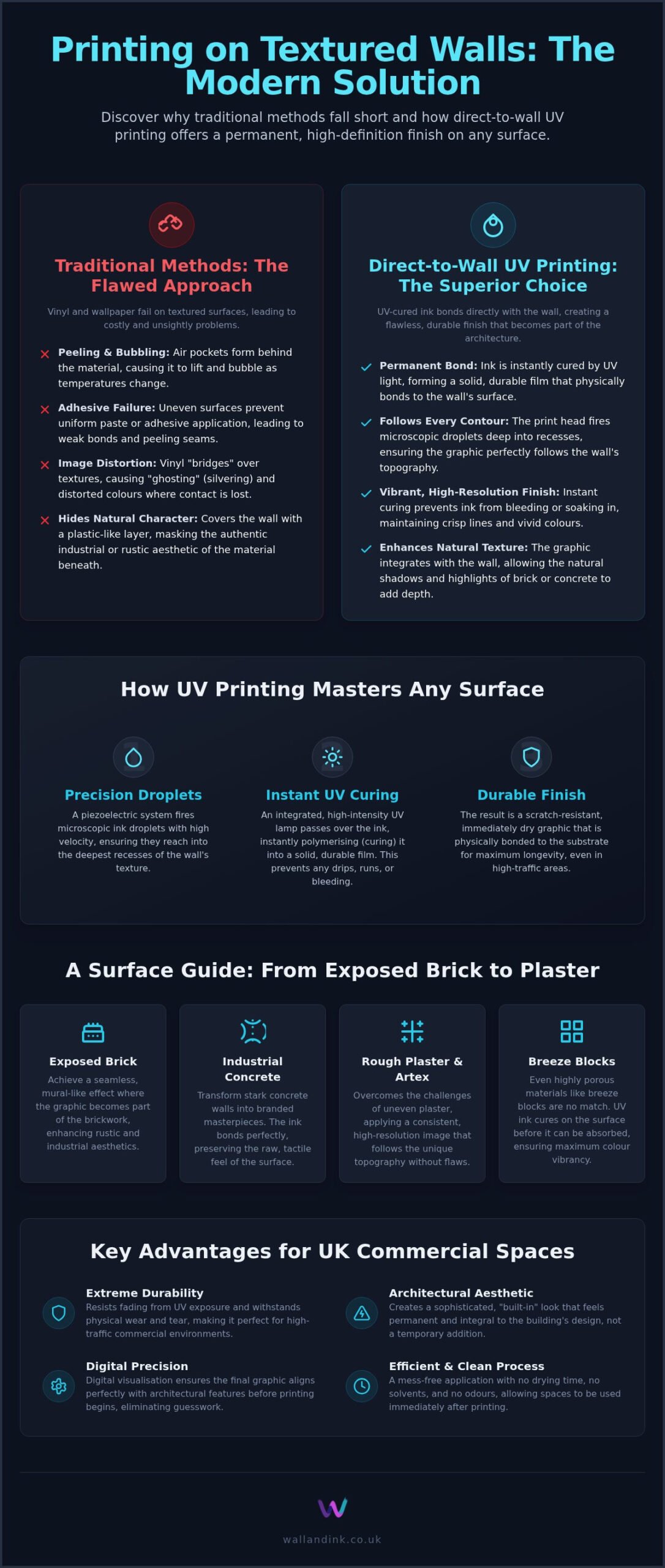
Traditional vinyl decals and wallpapers are designed for two-dimensional planes. On a textured surface, vinyl often “bridges” the gaps in the masonry or plaster. This creates microscopic air pockets behind the material. Over time, temperature fluctuations cause these pockets to expand and contract, which eventually forces the adhesive to fail and the graphic to peel away. You’re left with a bubbled, untidy finish that requires constant maintenance or replacement.
There is also the problem of “ghosting”. This occurs when vinyl fails to settle into deep textures, leaving unsightly silvering or distorted colours where the material isn’t in full contact with the wall. Wallpaper paste faces similar challenges. On uneven surfaces, the paste cannot distribute evenly, leading to bubbles and peeling seams. Unlike Flatbed digital printers that use UV-curable inks to bond directly with a variety of substrates, these legacy methods fight against the wall’s natural shape rather than working with it.
The Aesthetic Appeal of Industrial and Natural Textures
The shift towards printing on textured walls isn’t just about solving a problem; it’s about embracing a unique aesthetic opportunity. Texture adds a tactile dimension that a flat, vinyl-wrapped wall simply cannot replicate. When ink is applied directly to a substrate like brick or stone, the natural shadows and highlights of the material interact with the digital artwork. This creates a sophisticated, “built-in” look that feels like part of the architecture.
Instead of a plastic-looking sticker sitting on top of the surface, the mural becomes part of the wall’s DNA. It allows for a more authentic industrial feel, where the grit of the concrete or the grain of the wood enhances the image rather than detracting from it. For UK businesses, this means office graphics can feel permanent and architectural rather than temporary and corporate. Direct-to-wall printing ensures that the character of your building remains visible, adding depth and credibility to your branding without the mess of traditional hand-painted murals.
The Science of Direct-to-Wall UV Printing on Substrates
Direct-to-wall UV printing represents a fundamental shift away from standard desktop or wide-format inkjet methods. While traditional printers require a flat, absorbent medium like paper or canvas, UV technology uses a high-intensity ultraviolet lamp to polymerise the ink instantly. This chemical reaction turns liquid ink into a durable solid film the moment it makes contact with the substrate. It eliminates the requirement for the surface to “soak up” the pigment, which is why it is the only viable method for printing on textured walls that are non-porous or highly irregular. The result is a finish that is both scratch-resistant and immediately dry to the touch.
How UV Ink Adapts to Uneven Topography
Modern wall printers utilise a “drop-on-demand” piezoelectric system. This mechanism fires microscopic droplets with extreme velocity, ensuring the ink reaches into the deep recesses of textures such as brick mortar or rough-cast plaster. Because the ink cures instantly under the integrated UV lamp, it cannot run, drip, or bleed into the valleys of the wall. This is a significant advancement over standard UV-curable inkjet printing technology used in factory settings, as it maintains incredible colour vibrancy even on high-absorption materials like breeze blocks. Modern UV inks are also entirely solvent-free and odourless. This makes them ideal for indoor environments like schools and hospitals where air quality and safety are paramount.
Precision Engineering: The Role of the Wall Printer
The hardware is as critical as the ink chemistry. Advanced sensors, typically ultrasonic or laser-based, constantly monitor the distance between the print head and the substrate. As the machine tracks across the wall, these sensors adjust the head position in real-time to navigate bumps and dips. This maintains a consistent focal point for the ink spray, which prevents the blurring that usually occurs when printing on uneven topography. UV wall printing is a contactless architectural application. The machine manages complex vertical and horizontal alignments with industrial precision, ensuring that large-scale murals remain perfectly straight even on non-standard surfaces. For those looking to transform a specific space, choosing direct-to-wall printing ensures a level of detail that traditional hand-painting or vinyl simply cannot match. This technical reliability allows for high-resolution graphics to be applied to almost any vertical surface with zero mess and total accuracy.
UV Printing vs Vinyl and Wallpaper: Which Wins on Texture?
Direct-to-wall printing is a permanent architectural upgrade, whereas vinyl and wallpaper are temporary surface coverings. When printing on textured walls, the primary differentiator is how the medium interacts with the substrate. Vinyl relies on a pressure-sensitive adhesive that must maintain contact with a flat surface to remain secure. On a textured wall, this bond is compromised from day one. UV printing bypasses the need for adhesives entirely by bonding the pigment directly to the material. This ensures that the graphic remains stable regardless of the wall’s underlying topography.
Durability and Adhesion Across Different Materials
In commercial environments, vinyl is highly susceptible to “peel-back”. This occurs when the edges of a decal are caught by passing foot traffic or cleaning equipment, leading to rapid degradation. Because direct-to-wall ink becomes part of the substrate itself, there are no edges to catch or lift. Understanding the science of UV-curable ink reveals why this method is superior; the photoinitiators in the ink react to UV light to create a cross-linked polymer chain that is incredibly scratch-resistant. This makes it the ideal solution for high-traffic corridors where traditional wallpaper would scuff or tear. Direct prints are also UV-stable, ensuring that murals in sunlit atriums don’t fade over time.
Visual Fidelity: Maintaining Image Integrity
Traditional vinyl graphics often carry a “plastic sheen” that looks out of place on premium architectural materials like brick or stone. Direct-to-wall printing maintains a matte, integrated finish that mimics the look of a bespoke hand-painted mural but with the precision of digital resolution. This is vital for maintaining brand integrity. Logos and fine text remain perfectly legible across heavy textures because the print head adjusts to the wall’s topography, preventing the distortion common with stretched vinyl. The result is a high-fidelity image that feels like a natural extension of the building rather than a temporary sticker.
The No-Mess and Environmental Advantage
The installation of traditional wallpaper involves sticky pastes, large cutting tables, and significant downtime. In contrast, direct wall printing is a clean, mess-free process that requires minimal floor space and zero chemical adhesives. This approach also significantly reduces environmental impact. By eliminating the plastic backings and PVC waste associated with vinyl decals, businesses can meet sustainability targets whilst achieving a more durable result. It’s a pragmatic choice for UK project managers who value both efficiency and long-term performance. Eliminating the need for traditional wallpaper also removes the risk of mould growth behind the paper, which is a common issue in damp or poorly ventilated spaces.
Surface Guide: From Exposed Brick to Artex and Plaster
Success in printing on textured walls depends on understanding how different materials interact with UV-cured ink. While many providers insist on perfectly flat surfaces, our technical process is specifically engineered to handle the architectural irregularities found in UK properties. Whether you are dealing with the porous nature of industrial concrete or the decorative peaks of Artex, each substrate offers a unique opportunity to enhance a digital mural with tactile depth. We don’t view texture as a hurdle; we view it as a substrate that adds character to the final result.
Printing on Exposed Brick and Concrete Facades
Exposed brick is the hallmark of the industrial chic aesthetic, yet it is notoriously difficult to decorate with traditional media. Mortar lines create deep recesses that cause vinyl to bridge and fail almost immediately. Our wall printing technology uses ultrasonic sensors to maintain a precise distance from the brick face, ensuring the ink reaches into the grout lines without any loss of resolution. This creates a finish that looks like a hand-painted mural, but with the crispness of a high-resolution digital file. Concrete and breeze blocks, often found in retail units and warehouses, are also ideal substrates for this method. UV ink bonds to mineral-based surfaces by polymerising into a durable, integrated layer that resists moisture and physical impact. This makes it a permanent solution for commercial environments where durability is just as important as visual impact.
Navigating Interior Textures: Wood, Plaster, and Artex
Interior surfaces often present more delicate challenges for property managers and designers. Wood panelling can be transformed by printing directly onto the grain, which allows the natural texture to show through the artwork for a sophisticated, stained effect. Artex and rough-cast plaster, often seen as outdated liabilities, can be modernised without the need for expensive skimming or removal. The print head’s ability to navigate sharp peaks and troughs means that even the most aggressive textures can host high-resolution graphics. This eliminates the dust and disruption of traditional renovation. For exterior projects, the same precision applies to render and stone facades, providing a weatherproof alternative to signage that won’t peel in the British rain.
If you are ready to transform a challenging architectural surface, contact us to discuss our Direct-to-Wall Printing solutions for your next project. We specialise in turning difficult substrates into high-impact design features across the UK with industrial precision and zero mess.
Bespoke Wall Printing Solutions for UK Commercial Spaces
Successfully executing printing on textured walls at a commercial scale requires a methodical approach that prioritises technical assessment over guesswork. Unlike standardised online services that treat every surface as a flat canvas, we recognise that architectural substrates in the UK vary significantly in absorption and topography. Our service is designed for project managers and facility directors who require a reliable, professional partner capable of delivering high-resolution graphics without the logistical headaches of traditional renovation. We provide a comprehensive service journey that moves from initial design visualisation through to national on-site installation across the United Kingdom.
The Wall & Ink Process: From Visualisation to Installation
The journey begins with a detailed surface assessment. We analyse the material, whether it’s rough-cast render or aged brick, to determine the optimal ink density and print head height. This technical precision ensures that the final image remains sharp despite the peaks and troughs of the wall. To eliminate uncertainty, we provide digital mock-ups that allow you to see your mural on your specific wall texture before a single drop of ink is applied. On the day of installation, our specialists arrive with the wall printing hardware; this equipment requires minimal floor space and produces zero dust or chemical fumes. The process is efficient. Most commercial murals are completed in a single session, so you don’t have to worry about extended downtime whilst the transformation occurs.
National Reach: Professional Printing Across the United Kingdom
We support multi-site corporate rebrands by providing consistent quality from London to Edinburgh. Our logistics team organises national coverage to ensure that retail chains, hospitality groups, and educational institutions receive the same high standard of architectural graphics across their entire estate. Our expertise in printing on textured walls ensures that even the most challenging surfaces become high-impact design features. This speed of installation is a major advantage for high-traffic environments like schools and hospitals, where downtime must be kept to an absolute minimum. Whether you’re looking to enhance a student common room or a corporate lobby, our bespoke solutions adapt to the unique character of your building. You can Check our Commercial Wall Murals for office inspiration to see how we’ve transformed varied UK workspaces. By choosing a specialist in direct-to-wall application, you ensure a durable, professional finish that reflects the quality of your brand.
Transform Your Architectural Assets with Precision Printing
Textured surfaces are no longer a limitation for high-impact design; they are an opportunity to create depth and character that flat walls cannot match. By moving away from the inevitable failure of vinyl and wallpaper, you can ensure your space benefits from a permanent, architectural-grade finish. The technical reliability of UV-cured ink ensures that printing on textured walls provides a scratch-resistant, vibrant result that integrates perfectly with the substrate. Whether you’re managing an industrial warehouse conversion or a modern office suite, this contactless method delivers industrial precision without the mess of traditional renovation.
Our national UK installation team is ready to help you navigate the complexities of your specific building materials. We provide a bespoke design visualisation service as standard, allowing you to see the final result before the first drop of ink is applied. This methodical approach guarantees a result that meets the highest professional standards whilst respecting your project timelines. It’s time to replace temporary, peeling coverings with durable, high-resolution technology that lasts. Book your bespoke wall printing consultation with Wall & Ink today and start your transformation.
Frequently Asked Questions
Can you print on brick walls without the ink running?
Yes, the ink will not run or bleed on brick surfaces. Our technology uses advanced UV lamps to cure the ink instantly upon contact with the substrate. This rapid polymerisation process ensures that the pigment stays exactly where it is placed, even when navigating the deep mortar lines and irregular faces of traditional UK brickwork. It produces a crisp, high-definition finish that is immediately dry to the touch.
Is direct-to-wall printing more expensive than traditional wallpaper?
Direct printing provides a cost-efficient alternative when you consider the total project lifecycle. Traditional wallpaper often requires expensive wall skimming or priming to achieve a flat surface, whereas printing on textured walls works with the existing substrate. By eliminating the labour costs of surface preparation and the future expense of repairing peeling edges, direct-to-wall application offers superior long-term value for pragmatic commercial decision-makers.
How long does a UV wall print last on a textured surface?
Interior UV prints are designed to last for over a decade without significant fading or degradation. The ink creates a permanent bond with the material, making it highly resistant to scratches and scuffs in high-traffic corridors. For exterior applications, the durability typically ranges between three and five years. This lifespan depends on the specific exposure to UK weather conditions and the underlying stability of the render or stone.
Do I need to prepare my textured wall before you arrive to print?
Preparation is minimal compared to legacy decor methods. Your wall simply needs to be clean, dry, and free from loose debris or flaking paint. You don’t need to sand down peaks or fill in troughs, as our sensors manage these irregularities automatically. A basic wipe-down to remove dust ensures the best possible adhesion when printing on textured walls, allowing for a seamless and mess-free installation day.
Can you print high-resolution photos on rough concrete?
High-resolution photography is entirely achievable on industrial concrete. The print head maintains a consistent focal distance by tracking the wall’s topography in real-time, which prevents the blurring usually associated with uneven surfaces. The resulting image remains sharp and detailed, whilst the underlying concrete texture adds a sophisticated, tactile dimension to the artwork. This creates an integrated architectural feature rather than a simple surface graphic.
Is the ink used in wall printing safe for schools and hospitals?
The UV-curable inks we utilise are solvent-free and completely odourless once the curing process is complete. This makes the technology ideal for sensitive environments such as primary schools, hospital wards, and care homes. There are no harmful VOC emissions to worry about, meaning rooms can be occupied immediately after the machine has finished. It is a clean, non-toxic solution that meets strict health and safety requirements.
What happens if I want to remove the print in the future?
Removing the mural is a straightforward process that involves painting over the graphic. Because the ink film is incredibly thin, it does not leave a raised profile or a textured residue on the wall. You simply apply a high-quality primer followed by your chosen emulsion. This is a significant advantage over vinyl or wallpaper, which often leave adhesive remnants or damage the plaster during the removal process.
Can you print on exterior textured walls in the UK climate?
Our exterior printing service is specifically engineered to withstand the British climate. The UV-cured ink is resistant to moisture, frost, and UV radiation, ensuring the graphic remains stable on render, stone, or brick facades. This provides a durable, professional alternative to traditional signage or hand-painted murals, which often crack or peel when exposed to fluctuating temperatures and heavy rain. It is a reliable solution for outdoor branding.