
A mural should be a permanent architectural integration, not a temporary decorative sticker that looks cheap or peels within months. You likely recognise that a feature wall can redefine a workspace or home, yet the technical hurdles of how to choose a mural design that accounts for scale, substrate compatibility, and long-term durability often lead to decision paralysis. It is frustrating to invest in a vision only to worry about fading colours or a design that clashes with the existing geometry of the room.
This professional guide promises to help you master the technical and aesthetic criteria required to select artwork that scales perfectly to your space. We will explore how to achieve a high-impact finish on challenging surfaces like bare plaster or brick using precision direct-to-wall printing. By the end of this article, you will have a clear framework for selecting a durable, professional feature wall that integrates seamlessly with your environment through a clean and efficient process.
Key Takeaways
- Define the mural’s functional purpose and calculate viewing distances to ensure the artwork remains effective within its specific architectural context.
- Learn how to choose a mural design that integrates with diverse substrates, including brick, wood, and glass, using specialised UV printing methods.
- Utilise digital mock-ups and high-resolution file verification to de-risk your project; it’s the most reliable way to ensure the final output matches your vision.
- Account for the impact of cool British natural light on colour profiles and select UV-resistant inks for permanent, fade-free results.
- Recognise the efficiency of direct-to-wall printing; it’s a seamless solution that eliminates the traditional risks of peeling, bubbling, or edge lifting.
Defining the Purpose and Spatial Context of Your Mural
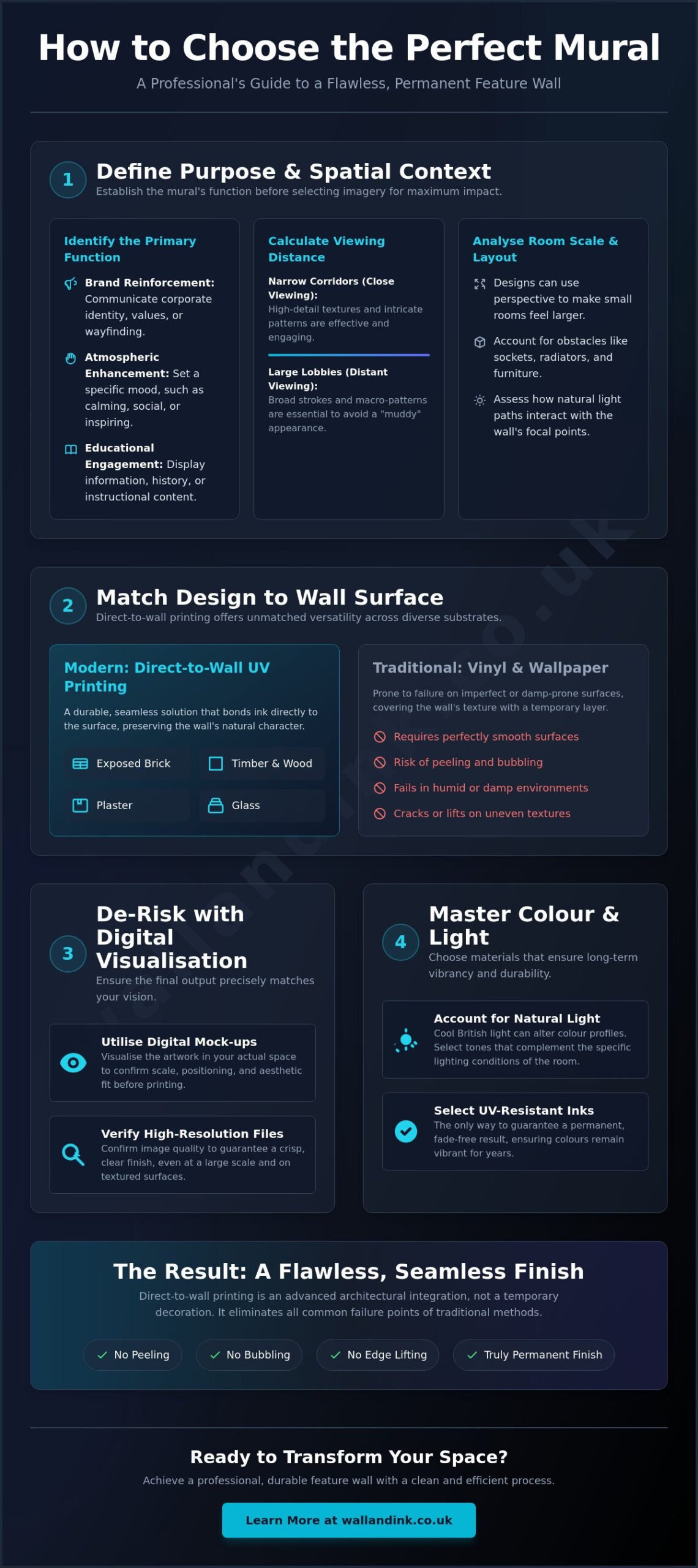
Successful spatial transformation begins with intent. Before selecting any imagery, you must define the primary function of the wall. Is it intended for brand reinforcement, atmospheric enhancement, or educational engagement? Understanding how to choose a mural design requires a deep analysis of the room’s utility. Looking back at the history of murals, these works have always served as functional narratives within architecture rather than mere surface treatments. Today, we apply that same principle through advanced technical processes that treat the wall as an integrated component of the building’s identity.
Viewing distance is a critical technical factor often overlooked by traditional decorators. In a narrow corridor, the eye is forced close to the surface, making high-detail textures and intricate patterns appropriate. Conversely, in a large lobby or open-plan office, broad strokes and macro-patterns are essential. If the design is too detailed for a large viewing distance, it risks appearing as a muddy, indistinct wash of colour. You must also analyse the architectural flow of the space. A professional installation considers how a design might wrap around corners or traverse different substrates whilst maintaining visual logic.
Commercial vs Residential Objectives
Commercial murals often focus on the visitor journey or brand values. This might involve wayfinding graphics in a hospital or corporate storytelling in a reception area. The design must direct behaviour and communicate reliability. In contrast, residential projects typically prioritise mood-setting. A bedroom mural should create a calming, restorative environment whilst a lounge might require a more social, grounding aesthetic. The complexity of the design should always follow the intended behaviour of the space, ensuring the outcome is both functional and durable.
The Impact of Room Scale and Layout
Scale dictates the success of the installation. In small offices, designs that utilise perspective can “open up” the room, making it feel less restrictive. Larger halls require designs that “ground” the architecture, preventing the space from feeling cold or cavernous. You must also account for permanent obstacles. Radiators, sockets, and door frames are fixed elements that the design must accommodate precisely. A professional approach ensures the focal point aligns with the natural eye level, preventing the artwork from looking disconnected. Knowing how to choose a mural design means viewing the wall as a three-dimensional environment rather than a flat canvas.
- Identify if the design needs to wrap around external corners to maintain visual continuity.
- Assess how natural light paths interact with the wall’s primary focal points.
- Determine if furniture placement will obscure critical elements of the artwork over time.
Selecting Designs Based on Wall Substrates and Surfaces
The technical success of a mural depends entirely on the substrate. Whilst traditional methods like vinyl decals or wallpaper rolls demand a perfectly smooth surface, direct-to-wall UV printing is engineered for mechanical versatility. You can apply complex designs to plaster, brick, wood, and even glass without sacrificing clarity. When considering how to choose a mural design, you must evaluate the underlying material first. For example, an industrial-style graphic featuring sharp lines and architectural elements often complements the raw, tactile texture of exposed brickwork better than a delicate, painterly landscape.
A significant advantage of direct-to-wall printing is its performance on damp-prone surfaces. Traditional adhesives in wallpaper often fail in environments with fluctuating humidity; this leads to peeling and bubbling at the edges. UV-cured ink bonds directly to the substrate, eliminating these common failure points. For newly plastered walls, patience is essential. The plaster must be fully cured and dry before application to ensure the ink adheres correctly. This typically requires a minimum of four weeks, though specific environmental conditions may extend this timeframe.
Printing on Textured Surfaces
One of the most impressive features of UV printing is how the ink follows the specific contour of the wall. This creates a “painted-on” look that preserves the character of the building. If you’re working with timber, you can choose artwork that allows the natural grain to remain visible, adding organic depth to the design. This method is far superior to vinyl decals, which often bridge gaps on uneven substrates and eventually crack or lift. High-resolution digital art ensures that even on rough mortar lines, the image remains sharp and professional.
Durability and Maintenance Requirements
In high-traffic environments like school corridors or busy retail centres, durability is non-negotiable. You need a design that can withstand physical contact and frequent cleaning without degrading. Our commercial wall murals utilise scratch-resistant finishes that maintain their integrity under pressure. For exterior facades, the choice of UV-cured ink is critical. It provides superior resistance to fading and weather damage, ensuring the mural remains vibrant for years. Understanding how to choose a mural design involves balancing these technical requirements with your aesthetic goals to ensure a result that stands the test of time.
Using Digital Visualisation to De-Risk Your Design Choice
Precision is the hallmark of a professional installation. Eliminating ambiguity before the printing process begins is the most effective way to ensure a high-quality result. When you are learning how to choose a mural design, you must move beyond hand-drawn sketches or small-scale paper samples. Digital visualisation allows you to see the artwork in situ, providing a technically accurate preview of how the design interacts with your specific architecture. By requesting a digital mock-up, you can verify how the imagery sits behind furniture or wraps around structural features before any ink touches the wall surface.
Resolution is a critical technical metric. You must ensure the digital file size supports the physical dimensions of your wall. A design that looks sharp on a tablet screen can easily become pixelated when scaled to a five-metre span if the source file lacks the necessary pixel density. Professional direct-to-wall printing requires high-resolution assets to maintain industrial-grade clarity. Testing different colourways digitally also allows you to match existing interior palettes with precision, accounting for the specific lighting conditions of your room.
The 1:1 Scale Reality Check
A digital overlay on a high-resolution photograph of your actual room provides a 1:1 scale reality check. This process identifies potential design clashes with light switches, radiators, or permanent fixtures that a generic catalogue image would miss. It allows for the adjustment of individual elements within the design to suit your furniture layout perfectly. If a central figure in the artwork is obscured by a boardroom table, digital tools allow us to reposition that element whilst maintaining the integrity of the composition. This eliminates the guesswork associated with traditional installation methods.
Customising Bespoke Artwork
Adapting corporate logos or personal photography into mural-ready formats requires technical expertise. Professional design consultations refine the final composition, ensuring that branding elements are positioned for maximum impact and visibility. This methodical approach saves time and eliminates the risk of buyer’s remorse. By using industry-standard software like Adobe Photoshop (version 27.7) or Procreate (version 5.4.11), specialists can manipulate layers to create a bespoke feature that feels integrated into the building rather than an afterthought. This level of customisation ensures that your how to choose a mural design process results in a unique, high-impact feature.
- Request a digital proof to confirm colour accuracy under your specific room lighting.
- Verify that the image resolution meets a minimum of 300 DPI at the final printed size.
- Ensure the focal point of the design is not bisected by doorways or structural pillars.
Balancing Aesthetics with Technical Colour Behaviour
Colour choice is often treated as a subjective preference, yet in professional spatial transformation, it is a technical variable. British natural light is frequently cool and grey; this specific luminosity can make warm terracotta tones appear muddy or cause vibrant blues to feel overly clinical. When you are determining how to choose a mural design, you must account for these environmental factors. A design that looks balanced in a Mediterranean studio will behave differently in a London office. Selecting a palette that anchors to your existing floor finishes ensures the mural feels like a permanent architectural feature rather than a disjointed addition.
Durability is inextricably linked to colour integrity. Standard inks often fade when exposed to direct sunlight, leading to a “washed-out” appearance within months. We utilise UV-resistant inks that undergo a specific curing process, ensuring that vibrant pigments remain stable even in high-exposure areas. This technical superiority is essential for maintaining the professional standards of your space over the long term. Understanding how to choose a mural design means prioritising materials that can withstand the physical reality of your building’s orientation and light levels.
Lighting and Colour Perception
The type of artificial lighting in your room will fundamentally alter the mural’s appearance. LED lighting tends to be cooler and sharper, whilst older halogen bulbs provide a warmer, yellow-toned wash. Managing glare is equally critical. In spaces with large windows or heavy overhead lighting, a matte finish is the superior choice to prevent distracting reflections. UV-cured ink provides a robust, non-reflective surface that maintains its visual impact from every angle. This reliability is why modern specialists prefer direct-to-wall application over traditional glossy vinyl.
Psychology of Colour in Specific Sectors
Strategic colour selection influences human behaviour within a space. In healthcare and educational environments, calming blues and greens are utilised to reduce stress and promote concentration. Conversely, retail and hospitality branding often requires high-energy reds or yellows to stimulate engagement. Modern office spaces benefit from neutral palettes with focused accent colours to encourage productivity without causing visual fatigue. To ensure your project achieves these outcomes, explore our professional wall printing services for a technically precise finish.
- Test colour swatches under both natural daylight and your specific artificial lighting.
- Select matte finishes for walls opposite large windows to eliminate surface glare.
- Coordinate the primary mural tones with the undertones of your carpet or hard flooring.
Executing the Vision: From Digital Design to Wall Printing
The final phase of how to choose a mural design is the transition from a digital asset to a physical architectural feature. Traditional methods like wallpaper installation or vinyl application often carry inherent risks, such as visible seams, trapped air bubbles, and edge lifting. Direct-to-wall printing eliminates these variables through mechanical precision. By printing directly onto the substrate, the artwork becomes a permanent part of the wall surface, ensuring a high-impact finish that outlasts legacy alternatives. There are no seams to align, no bubbles to smooth, and no edges that will eventually peel.
Speed of execution is a significant benefit for pragmatic decision-makers. Whilst traditional mural painting or wallpapering can take several days to cure and settle, most direct-to-wall projects are completed within a single day. The UV printing process is also remarkably clean. It is a low-odour, dust-free method that does not require the messy adhesives or trimmings associated with wallpaper paste. This makes it a suitable solution for occupied environments where minimising disruption is essential.
The Wall & Ink Professional Process
Our end-to-end service manages every technical detail from bespoke design refinement to final execution. We utilise specialised UV printers that are engineered to handle complex surfaces, including those with significant texture like brick or wood. This modern approach removes the traditional inconveniences of wall art. You don’t have to worry about peeling edges or the degradation of the image over time. The result is a durable, professional feature wall that maintains its integrity in both high-traffic commercial sectors and private residential settings.
Final Steps and Contact
Mastering how to choose a mural design requires a partner who values transparency and technical reliability. We offer a straightforward process for national UK projects, moving logically from an initial consultation to a precisely executed installation. Our pricing structure is transparent, based on square footage and design complexity, ensuring you can plan your budget with confidence. To see the quality of our recent work across various sectors, View our gallery and start your design journey with Wall & Ink today. Our team is ready to help you transform your space with industrial precision and expert care.
- Confirm your wall dimensions and substrate type for a technical assessment.
- Review your digital mock-up to ensure the design integrates with your furniture layout.
- Schedule your installation for a single-day completion with no mess or odour.
Transforming Your Space with Technical Precision
Selecting a feature wall is a strategic architectural decision that requires balancing aesthetic vision with technical reality. You now understand that how to choose a mural design involves more than just picking a favourite image. It requires a thorough evaluation of viewing distances, substrate compatibility, and the specific lighting conditions of your environment. By utilising digital visualisation and high-resolution file verification, you can eliminate the traditional risks of misalignment or pixelation before the installation begins.
Our process is designed for those who value efficiency and industrial-grade durability. We use advanced UV ink technology for zero-fade durability and ensure a seamless application on any surface, whether it’s plaster, brick, or wood. This method removes the hassles of peeling edges or bubbling associated with legacy alternatives. To take the next step in your spatial transformation, enquire about our professional wall printing services. We include bespoke digital visualisation in our design process to ensure your final result is both precise and permanent. We look forward to helping you execute a high-impact vision that stands the test of time.
Frequently Asked Questions
Can you print a mural on a wall that has already been painted?
Yes, we can print directly over existing paint provided the surface is stable and free from flaking or significant debris. The UV ink bonds effectively to most standard emulsions, creating a permanent architectural feature. This capability is a significant advantage for those determining how to choose a mural design for occupied offices or homes, as it eliminates the need for stripping or priming the substrate.
How long does a direct-to-wall printed mural typically last?
Indoors, a mural printed with our UV-cured ink technology is designed to maintain its colour integrity for over 10 years. The process provides industrial-grade durability and high resistance to fading from natural light exposure. For exterior applications, the weather-resistant properties of the ink ensure a long-lasting finish that survives the environmental demands of the British climate without peeling or cracking.
Is it possible to remove or change the mural design later?
You can update your space by simply painting over the mural with a standard emulsion. Because the ink is applied flush to the wall, there are no seams, edges, or adhesive residues to remove. Unlike traditional wallpaper or vinyl decals that require scraping and can damage the underlying plaster, our printing process allows for a clean and efficient transition to a new design or colour scheme.
What is the difference between a wall mural and traditional wallpaper?
Direct-to-wall murals are a seamless, digital application that integrates with the wall’s texture, whereas wallpaper relies on paper rolls and adhesives. Our printing method eliminates the risk of bubbling, peeling, or visible seams. When considering how to choose a mural design, it’s important to recognise that our process offers superior mechanical precision and durability, making it better suited for high-traffic environments like schools and retail centres.
Do I need to prepare my wall before the printing process begins?
The wall surface must be clean, dry, and structurally sound to ensure optimal ink adhesion. If you’re working with newly plastered walls, they must be fully cured for at least four weeks before printing begins. Any significant cracks or structural imperfections should be filled and sanded to a smooth finish to ensure the high-resolution output remains sharp and professional across the entire span.
Can you print custom designs, such as company logos or personal photos?
We specialise in the high-resolution execution of bespoke assets, including corporate branding, intricate logos, and high-quality photography. Our technical team will verify your digital files to ensure the resolution supports the physical scale of your wall without pixelation. This end-to-end service ensures that your custom vision is translated into a precise, high-impact architectural feature that matches your brand identity.
Is the UV ink used in wall printing safe for schools and hospitals?
The UV inks we utilise are low-odour and environmentally stable, making them perfectly safe for sensitive environments like healthcare facilities and educational institutions. The printing process is entirely dust-free and does not involve the harsh solvents or toxic glues found in traditional wall coverings. You don’t have to worry about air quality, as the space remains safe for occupancy immediately after the installation is complete.
How much does a custom wall mural cost per square metre?
Our pricing is structured transparently based on the total square footage of the project and the complexity of the design requirements. Factors such as the substrate type, the height of the wall, and the specific geographic location of the site also influence the final technical assessment. We recommend booking a professional consultation to receive a precise quote that accounts for the unique architectural demands of your project.