
Traditional vinyl wall graphics often become a liability in high-traffic corridors long before they’ve paid for themselves. You’ve likely dealt with the frustration of peeling edges, bubbling surfaces, or the significant office downtime required for a standard installation. These common failures aren’t just an eyesore; they’re a reminder that legacy methods struggle to meet the demands of a modern workspace. By reviewing these office wall mural case studies from across the UK, you’ll see why pragmatic facility managers are moving away from temporary stickers in favour of industrial-grade UV printing.
We understand that your priority is a result that’s both visually striking and technically sound. This article promises to show you how direct-to-wall technology provides bespoke design precision and a level of durability that traditional media can’t match. We’ll walk through the design-to-wall workflow, demonstrate how UV inks cure instantly on various substrates, and provide proof of the technical precision our printers achieve. You’ll gain a clear understanding of how this process eliminates mess whilst ensuring compliance with UK fire safety standards such as BS EN 13501-1. From initial consultation to the final cured finish, we’re detailing the specialist approach that’s redefining commercial interiors.
Key Takeaways
- Understand why industrial-grade UV printing outperforms traditional media by reviewing technical performance data and visual evidence of durability.
- Examine office wall mural case studies from across the UK to see how direct-to-substrate application withstands the rigours of high-traffic commercial environments.
- Learn the step-by-step workflow from digital visualisation to instant UV curing, ensuring a precision finish with zero installation mess or office downtime.
- Use our professional checklist to assess your wall’s substrate stability and design resolution requirements before commissioning a large-scale project.
- Discover how tailored wall art serves specific sectoral needs, from brand storytelling in corporate hubs to calming visual therapy in healthcare settings.
Why Case Studies are Essential for Wall Printing Projects
A case study serves as a technical benchmark for industrial-grade wall printing. Whilst a gallery shows aesthetic appeal, office wall mural case studies provide the empirical evidence required to justify a transition from legacy media to modern UV printing. For a decision-maker, visual proof is the only way to distinguish the permanent, integrated finish of a direct-to-substrate application from the temporary nature of a vinyl decal. It’s about moving from decoration to infrastructure. Real-world examples allow stakeholders to see how bespoke designs adapt to specific architectural features, ensuring the final result isn’t just art, but a functional part of the building.
Moving Beyond Traditional Wall Decor
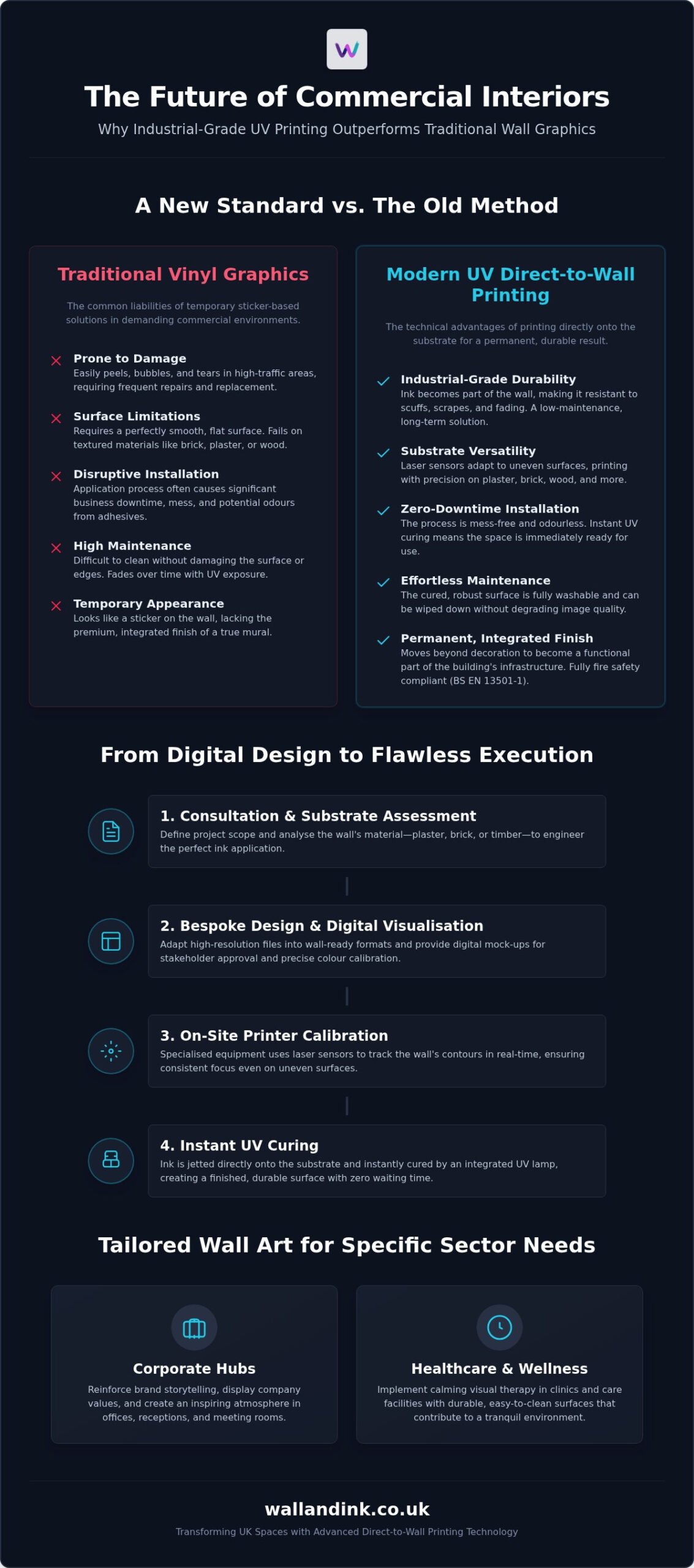
Traditional wallpaper and vinyl decals often fail in busy commercial environments. They peel at the corners, bubble in humid conditions, and suffer from UV fading. Direct-to-wall printing solves these issues by bonding ink directly to the plaster, brick, or wood. This shift from generic, repeating patterns to bespoke, high-resolution art allows for a level of brand integration that was previously impossible without lengthy office downtime. While the history and techniques of mural painting traditionally involve manual labour and slow-drying pigments, modern UV printing uses mechanical precision to achieve instant results. This industrial accuracy ensures that every pixel of a digital design is translated onto the wall with mathematical precision.
The Evidence of Durability in High-Traffic Areas
Durability isn’t a vague promise; it’s a measurable result. Case studies track how UV ink behaves over years of exposure in corridors and reception areas. UK businesses prioritise low-maintenance surface solutions that don’t require constant repair or replacement. The cured ink becomes a part of the wall surface, making it resistant to the scuffs and scrapes common in office walkways. Unlike traditional paper, these surfaces are washable and can be wiped down without degrading the image quality. This technical reliability means the aesthetic integrity of the workspace remains intact without the recurring costs of redecoration.
The Technical Journey: From Digital Design to UV Execution
The journey from a blank wall to a completed installation is a methodical technical workflow. It starts with a comprehensive consultation to define the project scope and identify the specific surface material. Our office wall mural case studies show that every substrate, from bare plaster and painted drywall to textured brick and timber, requires a unique approach. We don’t just print; we engineer the application to suit the environment. This technical assessment ensures the ink bonds perfectly, providing the industrial-grade durability that modern UK offices demand. We evaluate the ambient lighting and room usage to recommend the best finish, ensuring the mural serves its purpose for years.
Bespoke Design and Digital Visualisation
High-resolution file preparation is where the aesthetic vision meets technical reality. We take client logos or complex photography and adapt them into wall-ready digital formats, ensuring no loss of detail at scale. Digital mock-ups are an essential part of this phase. By showing the mural within the actual architectural space, we give stakeholders the confidence to approve the design before any physical work starts. As seen in various office wall mural case studies, this process allows us to manage colour accuracy with surgical precision. We calibrate the digital files to account for the base colour and texture of the wall, ensuring the final output matches your corporate branding exactly across every square metre.
The Precision of UV Ink Technology
Once the design is finalised, the on-site execution begins with the arrival of our specialised equipment. The UV printer is calibrated to the specific substrate, using laser sensors to track the wall’s contours in real-time. This allows the machine to maintain a consistent distance from the surface, even on uneven walls that would be impossible for vinyl to cover. The ink is jetted directly onto the substrate and cured instantly by an integrated UV lamp. This mechanism is entirely odourless and mess-free, contrasting sharply with the fumes and disruption of traditional painting. Because the curing is instantaneous, there’s zero office downtime. Employees can return to the area immediately after the printer finishes its pass, with no risk of smudging or chemical smells. You can explore our direct-to-wall printing services to see how this technology handles complex surfaces across various UK sectors.
Commercial vs. Residential: Diverse Sector Applications
Direct-to-wall UV printing serves distinct purposes across the commercial and residential sectors. Whilst the underlying technology remains the same, the technical requirements and design objectives vary significantly. Office wall mural case studies frequently highlight the need for brand consistency and wayfinding, whereas residential projects often focus on creating a singular, non-repeating aesthetic that traditional wallpaper cannot achieve. Both sectors benefit from the same industrial precision, but the scale and substrate preparation often dictate the project’s complexity. It’s a matter of matching the application method to the specific demands of the environment.
Commercial Murals and Brand Identity
In corporate environments, wall art is a strategic tool for rebranding. We’ve seen how high-resolution graphics transform sterile corridors into immersive brand experiences. These projects often involve complex wayfinding elements or mission statements printed directly onto plaster or glass partitions. Retail and hospitality sectors use this technology to create photo-worthy feature walls that drive social engagement and improve the guest experience. Technical precision is non-negotiable here; colour matching to strict corporate guidelines is essential. Our office wall mural case studies demonstrate that these installations contribute to employee productivity by creating a more stimulating and organised workspace. We don’t just print; we integrate the brand into the building’s fabric.
The application extends beyond interior surfaces. Exterior wall printing on brick or render requires a specific understanding of substrate porosity and weather resistance. Unlike vinyl, which struggles with the thermal expansion of exterior walls, UV-cured ink bonds into the texture of the masonry. This provides a durable finish that withstands the UK’s variable climate without peeling or cracking. It’s an industrial solution for building exteriors that traditional media simply can’t match.
Residential Feature Walls and Personalised Art
Homeowners are increasingly moving away from mass-produced wall coverings. In modern UK homes, printing directly onto fresh plaster in kitchens or lounges offers a seamless finish that’s far more durable than traditional paper. Residential clients typically seek bespoke art that reflects personal taste, ranging from family photography to unique abstract designs. Because the ink is scrubbable and scratch-resistant, it’s an ideal solution for high-traffic family areas. The elimination of adhesives and the zero-odour curing process make it a safer, cleaner alternative for private living spaces. It ensures the art remains a permanent feature without the risk of edges lifting or colours fading over time.
Evaluating a Wall Printing Project: A UK Decision-Maker Checklist
Successful installations are the result of technical planning rather than aesthetic guesswork. When reviewing our office wall mural case studies, it’s clear that the most effective results come from projects where the substrate and environment were properly assessed before the printer arrived on site. Pragmatic facility managers use a technical framework to ensure the project meets both durability and safety standards. This checklist provides the necessary benchmarks for a reliable, high-quality outcome.
- Substrate Stability: The wall must be structurally sound, dry, and free from loose debris or peeling legacy coatings.
- Moisture Levels: For UV ink to bond correctly, the surface moisture content should be low. This is particularly critical for fresh plaster in new UK builds which must be fully cured.
- Spatial Clearance: The printing unit requires a minimum of 1 metre of clear floor space in front of the wall to operate its vertical and horizontal axes safely.
- Resolution Standards: Source files should be provided at a minimum of 300 DPI at 1:10 scale or as vector files to prevent pixelation on large-scale surfaces.
Surface Preparation and Substrate Compatibility
The technical requirements for printing on bare plaster differ significantly from those for painted surfaces. Whilst bare plaster provides an excellent bond, it must be fully cured to prevent the ink from sinking too deeply into the porous material. On painted walls, the existing coating must be stable; UV ink will not fix a wall where the underlying paint is already failing. Handling textured surfaces like brick or timber requires the printer’s laser sensors to adjust the print head’s focus in real-time. This ensures that the image remains sharp despite the physical depth of the substrate. For glass or metal, a specific primer is often applied to guarantee adhesion, a detail frequently documented in technical office wall mural case studies across the commercial sector.
Long-Term Maintenance and ROI
Calculating the return on investment for a mural involves looking past the initial cost-per-square-metre. Traditional vinyl often requires replacement every 24 to 36 months due to edge lifting or surface damage in busy corridors. In contrast, UV-printed murals are industrial-grade solutions with a significantly longer lifecycle. Maintenance is straightforward; the cured ink is scrub-resistant and can be cleaned with standard non-abrasive detergents. This is vital for maintaining hygiene in healthcare or educational environments without degrading the art. If branding requirements change, the surface can be lightly sanded and over-painted, or even printed over directly, providing a level of flexibility that traditional media lacks. This adaptability ensures your investment remains relevant as your business evolves. You can book a technical site survey to determine if your workspace is ready for a direct-to-wall installation.
Wall & Ink Success Stories: Transforming UK Spaces
The real-world application of UV printing technology is best understood through its impact on professional environments. Reviewing office wall mural case studies shows how corporate headquarters integrate their brand values directly into the physical workspace, moving away from generic office decor. In healthcare settings, including NHS facilities, the focus shifts to patient well-being. We use calming, biophilic designs to reduce anxiety in waiting rooms, providing a surface that’s both visually therapeutic and clinically compliant. These installations are scrub-resistant and withstand hospital-grade cleaning protocols, ensuring a long-term ROI that traditional wallpaper can’t match. Every project is a testament to the industrial precision required for modern UK interiors.
Inspiring Art for Schools and Education
British primary schools and secondary colleges require wall coverings that withstand the rigours of high-traffic corridors. Our educational murals are engineered for this purpose. Unlike vinyl decals that peel or bubble, our ink bonds to the substrate, creating a permanent learning aid. These projects often support curriculum goals, such as immersive historical timelines or geography walls. A primary benefit for educational settings is the safety profile of our process. We use odourless, non-toxic UV inks that cure instantly. This means no VOCs and no downtime, allowing us to complete projects during term breaks without any lingering chemical smells when students return. It’s a clean, efficient way to transform a school’s identity.
Exterior Branding and Large-Scale Facades
Applying weather-resistant art to industrial units and shop fronts involves navigating complex substrates like uneven render or brick. Our office wall mural case studies highlight how UK businesses use exterior printing for permanent, high-impact branding. UV-stable pigments ensure that large-scale facades remain vibrant despite the British weather, avoiding the sun-bleaching and wind-damage issues associated with banners. This method allows retail and hospitality brands to drive footfall through bespoke, photo-worthy exteriors that are integrated into the building’s fabric. It’s a specialised solution for those who prioritise industrial precision and long-term durability over temporary fixes. By printing directly onto the masonry, we ensure the brand remains a permanent part of the local landscape.
Elevating Commercial Interiors with Industrial Precision
The evidence presented in these office wall mural case studies confirms that direct-to-wall UV printing is a superior technical solution for modern UK workplaces. By moving away from the limitations of legacy media, businesses can achieve a level of industrial precision that was previously impossible. We’ve explored how the design-to-wall workflow ensures bespoke accuracy whilst the instant curing process eliminates the mess and downtime associated with traditional redecoration. Whether you’re managing a high-traffic school corridor or a corporate reception, the choice of substrate no longer dictates the quality of the finish.
Our direct-to-wall technology works on almost any substrate, providing a result that’s UV-cured for instant durability. This process is entirely zero-mess, ensuring your environment remains operational throughout the installation. If you’re ready to transform your space with a result that balances aesthetic impact with mechanical reliability, we’re here to assist. You can Request a Bespoke Quote for Your Wall Printing Project to begin your technical consultation. We look forward to helping you create a workspace that reflects your professional standards.
Frequently Asked Questions
How long does a wall printing project typically take to complete?
Most standard office murals are completed within a single working day. The printer operates at a consistent mechanical speed, and because the UV ink cures instantly under the integrated lamp, there’s no waiting for paint to dry. Larger or more complex projects involving multiple walls or intricate substrates may require additional time, but we prioritise minimal disruption to your daily operations. This efficiency is a core advantage for busy UK workspaces.
Can you print on any surface, such as brick or bare plaster?
Yes, our direct-to-wall technology is engineered to bond with almost any substrate including brick, bare plaster, wood, and glass. The printer uses laser sensors to track the wall’s contours, ensuring the print head maintains a precise distance even on textured surfaces. This versatility is a recurring theme in our office wall mural case studies, where we’ve successfully transformed diverse industrial and heritage environments across the United Kingdom.
Is direct-to-wall printing more expensive than traditional wallpaper?
Whilst the initial project-based fees for UV printing may be higher than off-the-shelf wallpaper, the long-term value is significantly greater. You’re investing in a bespoke, industrial-grade finish that doesn’t peel, bubble, or require adhesive. When you factor in the elimination of traditional installation mess and the extended lifecycle of the cured ink, direct-to-wall printing often proves to be the more cost-effective solution for permanent commercial infrastructure.
How durable is the UV ink in high-traffic commercial environments?
UV-cured ink is exceptionally durable and resistant to scratches, scuffs, and fading. Once the ink is jetted onto the substrate, it’s instantly hardened by UV light, creating a robust bond that withstands the rigours of busy corridors and reception areas. The finished surface is scrub-resistant and can be cleaned with standard non-abrasive detergents, making it ideal for maintaining hygiene standards in schools and healthcare settings without degrading the image.
What is the process for creating a bespoke design for my wall?
The process begins with a bespoke design consultation where we define your project scope and aesthetic goals. We adapt your existing logos, photography, or brand assets into high-resolution, wall-ready digital formats. Our team ensures colour accuracy and composition are optimised for the specific dimensions of your space. This methodical approach ensures that the final output aligns perfectly with your corporate identity or interior design scheme before any printing commences.
Can a wall print be removed or painted over if I change my mind?
Yes, the mural can be easily updated or removed by painting over the surface with a standard emulsion. Because the ink is applied directly to the substrate without thick layers or adhesives, there’s no need to strip paper or scrape away vinyl residue. This flexibility allows businesses to refresh their branding or repurpose spaces without the structural damage or lengthy cleanup associated with legacy wall coverings, ensuring your walls remain stable.
Do you provide digital visualisations before the printing starts?
We provide digital visualisations for every project as a standard part of our service. These mock-ups show exactly how your bespoke design will appear within your actual architectural space, accounting for features like doors, windows, and light switches. This step is crucial for gaining stakeholder approval and ensuring that the scale and placement of the art are technically perfect. It’s a key reason why office wall mural case studies show such high satisfaction rates.
Is the wall printing process messy or does it have a strong odour?
The process is entirely mess-free and virtually odourless. Unlike traditional painting or wallpapering, there are no fumes, no dust, and no chemical adhesives involved. The UV inks are non-toxic and cure instantly, meaning employees can continue working in the same room whilst the printer is in operation. This lack of environmental impact is vital for sensitive settings like hospitals and primary schools where air quality and cleanliness are non-negotiable technical requirements.