
Traditional pediatric clinic wall art isn’t just a design choice; it’s often a hidden hygiene liability that complicates your infection control protocols. You understand that a calming environment is vital for reducing patient anxiety, yet you’re likely tired of vinyl stickers peeling into choking hazards or heavy frames acting as dust traps for bacteria. These surface-mounted solutions frequently feel like afterthoughts that fail to meet the rigorous standards of a modern clinical setting.
In this guide, you’ll discover how direct-to-wall UV printing surpasses these limitations by creating durable, non-toxic, and entirely seamless murals. We’ll explain how this technology adheres to the latest UK fire safety standards, such as European Class B-s3, d2, whilst providing a wipe-clean surface that integrates with your medical equipment. From the benefits of GREENGUARD Gold certified inks to the psychological impact of biophilic design, we provide the technical roadmap for transforming your clinic into a professional, healing space.
Key Takeaways
- UV-curable inks eliminate the risks of peeling edges and bacterial growth associated with traditional surface-mounted art. Learn why instant curing creates a hospital-grade finish that is both odourless and non-toxic.
- Discover how to implement pediatric clinic wall art that serves as a functional “positive distraction” for young patients. This approach integrates imagery directly into the environment without compromising access to medical equipment.
- Compare the technical failures of wallpaper and vinyl decals, such as bubbling and seam separation, against direct-to-wall durability. Direct printing offers a superior, long-term solution that withstands rigorous clinical cleaning regimes.
- Master the logistical workflow of a clinical installation, from digital visualisation and mock-ups to the final print session. Proper preparation ensures that the design aligns perfectly with your facility’s specific layout and lighting.
- Explore the industrial precision of UV printing systems that deliver unmatched colour accuracy for clinic branding. This method provides a professional, high-quality result that hand-painted or surface-mounted alternatives cannot match.
Redefining the Healing Environment: Pediatric Clinic Wall Art in 2026
Direct-to-wall printing is the precise application of digital imagery directly onto clinical substrates using specialised UV-curable inks. This is not a sticker or a hanging frame; it’s an architectural integration of art into the building’s fabric. By eliminating the physical barrier between the wall and the artwork, clinics can transform sterile corridors into immersive environments that actively support patient well-being. This technology represents a significant shift from surface-mounted decorations to permanent, integrated design solutions.
In healthcare design, the shift toward “Positive Distraction” has become a technical priority. This concept focuses on using visual stimuli to redirect a child’s attention away from clinical procedures and anxiety. Unlike fragmented posters that create visual noise, an immersive mural provides a cohesive narrative. It allows a child to lose themselves in a scene, which is a core tenet of Evidence-based design principles. When the environment feels intentional rather than cluttered, the perceived quality of care increases. Modern clinics now move away from generic characters toward bespoke designs that reflect their specific brand identity and local community.
The Limitations of Traditional Clinical Decor
Traditional methods of decorating a clinic often introduce unnecessary risks. Heavy frames in high-traffic waiting rooms present a physical safety hazard if knocked or improperly secured. Beyond safety, these frames are notorious dust traps. The ledges and gaps between the glass and the wall provide perfect environments for pathogens to accumulate, which contradicts modern infection control standards. Even vinyl decals, often seen as a quick fix, fail in medical settings. The constant temperature fluctuations in controlled environments cause adhesive failure, leading to peeling edges that become a choking hazard for curious toddlers. These failures make traditional options unsuitable for modern healthcare standards.
The Direct-to-Wall Advantage for Healthcare
Direct printing provides a seamless finish that integrates with any surface, including plaster, brick, or glass. Because the ink is cured instantly, there are no raised edges or physical layers to pick at. This durability is essential in treatment rooms where equipment is frequently moved and surfaces are regularly scrubbed with harsh disinfectants. Pediatric clinic wall art applied this way is as permanent as the wall itself, yet it can be scaled with mathematical precision to fit around medical gas points or monitoring screens. This level of technical customisation ensures the art supports the clinical workflow rather than obstructing it. It is a robust, industrial-grade solution for sensitive environments.
Hygiene and Safety: Why UV Ink Technology is the Clinical Gold Standard
The UV curing process is a photochemical reaction that occurs the moment the ink meets the wall substrate. Unlike solvent-based inks that rely on evaporation, UV-curable inks harden instantly under high-intensity ultraviolet light. This transition from liquid to solid happens in milliseconds. There’s no drying time. There’s no off-gassing. This technical precision ensures that the pediatric clinic wall art is physically stable before the printer even leaves the room.
Effective healing environments in pediatric design require materials that withstand rigorous sanitisation whilst remaining safe for young patients. UV printing technology meets this demand by adhering to the strictest UK safety standards. In England and Wales, interior wall finishes must now meet the European Class B-s3, d2 classification for fire safety under EN 13501-1. Because UV ink bonds directly to the substrate, it doesn’t add a flammable layer or a fuel source in the way that traditional vinyl or wallpaper might. It’s a pragmatic choice for any facility manager prioritising compliance.
Non-Toxic and Odourless Application
The absence of Volatile Organic Compounds (VOCs) is the most critical factor for maintaining indoor air quality in a clinic. Traditional printing methods release harmful chemicals into the air as they dry, which can trigger respiratory issues in sensitive patients or staff. UV printing eliminates this risk entirely. Because the ink is cured instantly, rooms can be occupied immediately after the session. There are no lingering chemical smells or “new paint” odours to contend with. VOC-free UV ink provides a chemically stable finish that is entirely safe for high-sensitivity medical environments.
Mechanical Superiority and Durability
Direct-to-wall ink creates a “zero-profile” finish. This means there are no raised edges, seams, or textures where bacteria or pathogens can hide. The ink bonds at a molecular level with the wall surface, making it exceptionally resistant to scratching or impact from trolleys and wheelchairs. This durability is vital in busy pediatric centres where walls are subjected to constant high-traffic wear and tear.
You don’t need to worry about fading or degradation from hospital-grade cleaning agents. The cured ink is resistant to harsh chemicals, including those used in deep-cleaning protocols. This allows clinical staff to maintain a sterile environment without damaging the artwork. For facilities prioritising both long-term aesthetics and infection control, professional direct-to-wall printing offers a level of performance that surface-mounted alternatives simply cannot match.
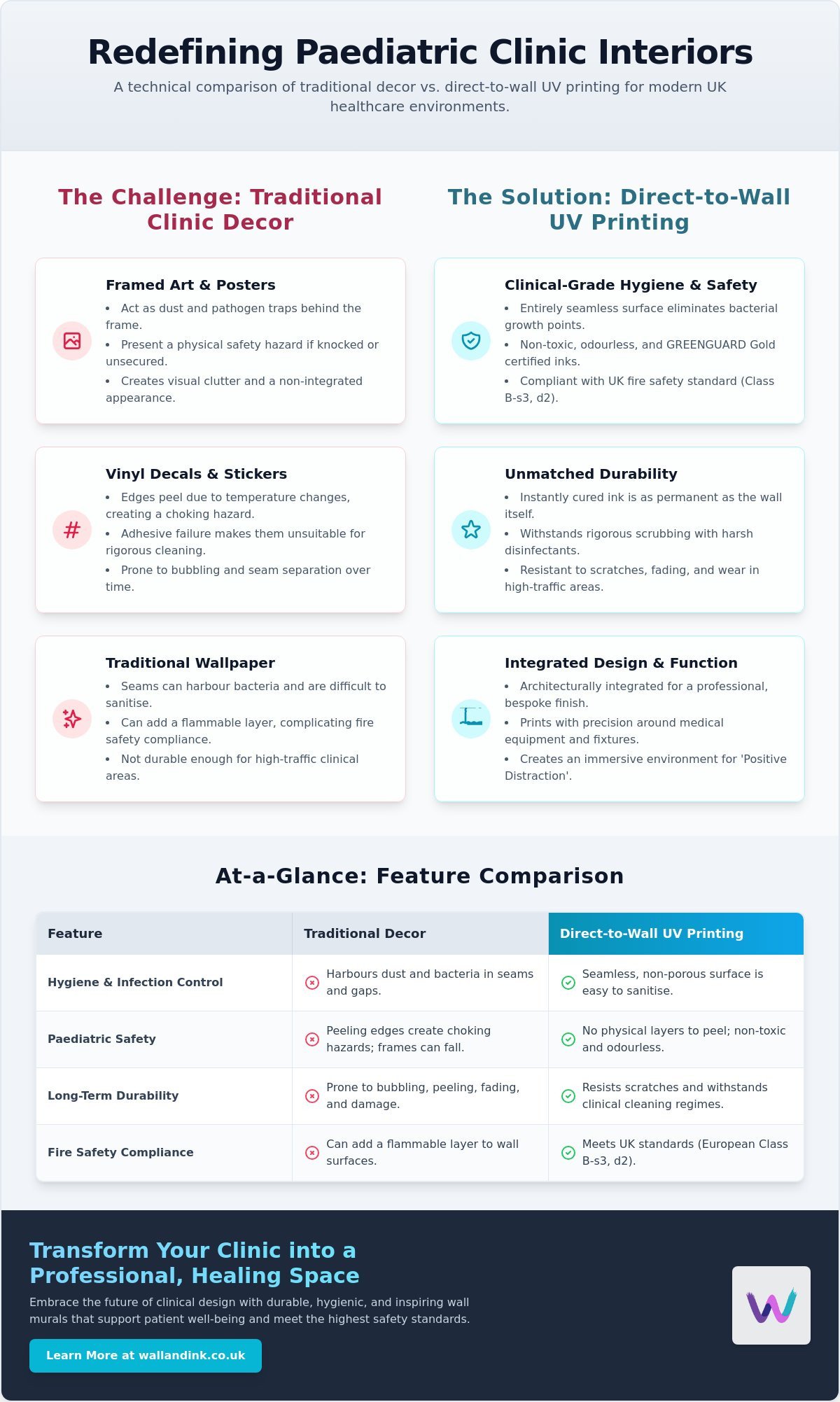
Direct-to-Wall Murals vs. Traditional Wallpaper and Vinyl
Traditional wallpaper and vinyl decals are surface-mounted products that rely on chemical adhesives to remain in place. In a clinical environment, these adhesives represent a significant point of failure. Over time, humidity and temperature fluctuations cause wallpaper to bubble or peel at the seams. This isn’t just an aesthetic issue; it’s a structural one that compromises the integrity of your pediatric clinic wall art. Direct-to-wall printing eliminates these vulnerabilities by removing the medium itself and applying the design directly to the substrate.
The installation process is engineered for efficiency and minimal disruption. Traditional decorating involves stripping old paper, applying primers, and waiting for adhesives to cure. Our system prints at a rate that allows for a complete room transformation in a single session. Because there is no “mess” involved-no buckets of paste or scraps of vinyl-your clinical staff can return to the space almost immediately. This speed of execution is a critical advantage for busy UK pediatric centres that cannot afford lengthy closures for refurbishment. You get a professional, permanent result without the traditional hassles of a construction site.
The Problem with Seams and Adhesives
Wallpaper seams are inherent hygiene risks in medical facilities. These joins create microscopic gaps where moisture and pathogens can accumulate, making them impossible to sanitise fully. Curious children often pick at these edges, leading to tearing and potential choking hazards. By opting for a direct-to-wall mural, you achieve a continuous, join-free finish across the entire surface. There is no messy paste, no water required for application, and no drying time. This dry process ensures your facility remains operational without the risk of mould growth behind the paper or adhesive failure in high-traffic corridors.
Precision and Customisation
Direct-to-wall technology offers a level of industrial precision that traditional methods cannot match. We can print around medical monitors, oxygen points, and electrical sockets with millimetre accuracy. This ensures the artwork feels like an integrated part of the room’s architecture rather than a sticker placed on top of it. Colour matching is equally precise. We can replicate your specific healthcare brand palettes with absolute fidelity, ensuring consistency across multiple clinic sites. Whether the substrate is smooth plaster, textured brick, or industrial wood panelling, the ink bonds perfectly to provide a vibrant, high-definition result.
Organising Your Clinic Transformation: From Visualisation to Print
The transformation of a medical space requires a systematic approach that balances aesthetic impact with clinical utility. Designing pediatric clinic wall art is a collaborative process that begins with a detailed spatial analysis. Our design consultants evaluate the room’s layout to ensure that key visual elements aren’t obscured by examination tables or diagnostic monitors. Imagery selection is grounded in biophilic design principles; nature-based themes are proven to lower heart rates and reduce cortisol levels in young patients. This intentional planning ensures the art serves as a functional tool for anxiety reduction rather than just a decorative addition.
Whilst traditional decorating relies on estimation, our process uses digital overlays to ensure architectural precision. Choosing the right pediatric clinic wall art involves more than just selecting a theme; it requires an understanding of how children interact with their surroundings at different heights and angles. We work to ensure that the design enhances the patient journey from the moment they enter the waiting area until they leave the treatment room.
Digital Visualisation: Ensuring the Perfect Fit
We use high-resolution photography of your actual treatment rooms to create digital mock-ups. This allows you to see exactly how a mural interacts with your existing infrastructure before a single drop of ink is applied. We adjust the composition to ensure that the most engaging parts of the illustration sit at a child’s eye level, whilst keeping the upper sections clear for medical signage or equipment mounts. Scaling is handled with mathematical accuracy to ensure a design that works in a small consultation room is just as effective in a large open-plan waiting area.
Practical Preparation for Printing
Technical success depends on the condition of the substrate. Walls should be finished to a high standard, being both flat and dry before the printing technician arrives. We typically recommend a neutral, light-coloured base coat; this ensures the UV-curable inks achieve maximum vibrancy and colour depth. Unlike traditional decorating, there’s no need to clear the entire room or shut down the clinic for days. We simply require a clear path to the wall surface, allowing your facility to remain partially operational during the session.
Our methodical process ensures that your project moves from concept to completion with industrial efficiency. If you’re ready to plan your facility’s upgrade, you can enquire about our direct-to-wall printing services to receive a bespoke technical consultation.
Why Wall & Ink is the Trusted Choice for UK Pediatric Clinics
Wall & Ink positions itself as a specialist partner for healthcare providers across the United Kingdom. We replace the fragility of traditional decor with industrial-grade pediatric clinic wall art that is engineered to last. Our approach is defined by technical reliability and a commitment to clinical standards that generic retailers cannot meet. By focusing on direct-to-wall application, we eliminate the secondary layers that typically fail in high-traffic medical environments. This results in a permanent asset that is as robust as the building’s own infrastructure.
The Wall & Ink UV printing system is a disruptor in the interior design market. We use mechanical precision to ensure that every micron of ink is cured instantly, creating a bond that resists both physical impact and chemical cleaning. This level of durability is essential for meeting the fire safety standards required in UK healthcare premises, such as the European Class B-s3, d2 classification. We don’t just provide art; we provide a technically compliant finish that supports your facility’s safety protocols.
Investing in direct-to-wall printing is a pragmatic financial decision. Whilst the initial technical application involves specialised equipment, the total cost of ownership is lower than traditional alternatives. You avoid the recurring expenses of replacing torn wallpaper or re-applying peeling vinyl stickers. There is no maintenance cost beyond your standard cleaning regime. This long-term durability makes it the most cost-effective method for maintaining a professional, child-friendly atmosphere over the clinic’s lifespan.
Expert National UK Service
Our reach extends across the UK, allowing us to manage large-scale commercial projects with methodical precision. We understand the logistical complexities of working within active healthcare facilities. Our technicians work to a strict schedule to ensure minimal disruption to patient care. We provide a single point of professional accountability, ensuring that the final print matches the approved digital mock-up with absolute fidelity. Our advanced UV printing hardware is capable of rendering high-resolution, photorealistic art on any clinical substrate, including smooth plasterboard and textured partitions.
The Future of Pediatric Interior Design
The shift toward integrated architectural art marks the end of the fragmented clinic era. Modern pediatric clinic wall art is no longer a surface-mounted afterthought; it is a fundamental component of the healing space. As your clinic evolves, our murals provide a stable foundation. If you decide to rebrand or repurpose a room, the wall can be prepared and reprinted without the mess of stripping old materials. This is the future of sustainable, high-performance healthcare design.
Contact Wall & Ink to discuss your pediatric clinic project today to secure an expert consultation and receive a technical assessment for your facility.
Future-proofing Your Clinical Environment
Transitioning from temporary, surface-mounted decor to integrated architectural solutions is a technical necessity for modern healthcare facilities. By utilising UV ink technology with zero VOCs, you ensure a chemically stable environment that’s safe for sensitive patients whilst meeting rigorous UK fire safety standards. The move away from dust-trap frames and peeling vinyl is a pragmatic step toward superior infection control and long-term durability. Every project begins with bespoke digital visualisation, ensuring the design integrates seamlessly with your medical equipment and floor plan.
A professional, wipe-clean finish ensures your pediatric clinic wall art remains a permanent asset that withstands industrial cleaning protocols. This methodical approach to design eliminates traditional maintenance hassles and provides a functional, positive distraction for young patients. You can achieve a durable, high-resolution transformation that reflects the precision and care of your clinical operations. We look forward to helping you create a more efficient and reassuring space for your patients.
Transform your clinic with a bespoke wall mural – Contact Wall & Ink today
Frequently Asked Questions
Is direct-to-wall printing safe for a pediatric clinic environment?
Direct-to-wall printing is entirely safe for pediatric environments because it eliminates the physical risks associated with traditional frames. There are no heavy glass panels to break or sharp corners to navigate in high-traffic corridors. Because the ink is non-toxic and VOC-free, it doesn’t compromise the indoor air quality for patients with respiratory sensitivities. It’s a stable, integrated solution that meets the highest safety standards for pediatric clinic wall art.
How long does it take to print a full-scale mural in a waiting room?
Most full-scale murals are completed within a single working day. The exact duration depends on the complexity of the design and the dimensions of the wall, but our industrial printers operate at a speed that traditional hand-painting cannot match. Because the ink cures instantly under UV light, there’s no additional time required for drying. You can return the waiting room to full use immediately after the technician finishes their session.
Can the UV ink be cleaned with hospital-grade disinfectants?
UV ink is highly resistant to hospital-grade disinfectants and harsh cleaning agents. The cured ink bonds at a molecular level with the substrate, creating a durable surface that won’t fade or smudge when scrubbed. This allows your clinical staff to maintain strict infection control protocols without damaging the artwork. Unlike wallpaper, there are no seams where moisture or bacteria can penetrate during the cleaning process.
Can you print on textured walls or glass partitions in a clinic?
Our printing technology is compatible with a wide range of surfaces, including textured plaster, bare brick, and glass partitions. The printer’s sensors automatically adjust to the contours of the wall to ensure a consistent finish even on uneven substrates. This versatility allows you to integrate pediatric clinic wall art across various architectural features, from consultation room walls to glass privacy screens in reception areas.
Do we need to close the clinic whilst the printing takes place?
You don’t need to close your clinic during the installation process. The printing process is exceptionally quiet, odourless, and creates zero dust or liquid waste. Whilst we require a clear path to the wall, your staff can continue their duties in adjacent areas without disruption. This lack of mess makes it a preferred choice for facilities that must maintain operational continuity whilst upgrading their interior design.
Can I use my own clinic branding and logos in the design?
Bespoke branding and logos can be integrated directly into any mural design. We use a high-precision colour-matching system to ensure your specific corporate palette is replicated with absolute accuracy. This allows you to maintain brand consistency across multiple sites. Our design consultants work with your existing assets to scale logos appropriately, ensuring they complement the clinical environment whilst reinforcing your professional identity.
What happens if we need to remove the mural in the future?
If you need to update your space, the mural can be simply painted over with a standard high-quality emulsion. There’s no need for the laborious stripping, scraping, or sanding associated with traditional wallpaper or vinyl decals. Because the ink has a “zero-profile” finish, it doesn’t leave a raised texture on the wall. This makes it incredibly easy to refresh your clinic’s appearance as your design requirements evolve.
Is the print quality high enough for detailed educational illustrations?
The print quality is of a photorealistic standard, making it ideal for intricate educational illustrations or detailed anatomical diagrams. Our systems deliver high-resolution imagery with sharp lines and vibrant colours that remain crisp even at a large scale. This level of detail is perfect for creating engaging, informative spaces that can help explain medical concepts to children in a non-threatening and visually clear manner.