
The era of treating photo wall murals as oversized stickers is officially over. You’ve likely experienced the frustration of a traditional installation where, despite meticulous alignment, a visible seam or a stubborn air bubble compromises the entire aesthetic. It’s a persistent challenge for decision-makers who require the visual impact of high-resolution imagery but find themselves battling peeling corners and the inevitable degradation of paper or vinyl substrates. Whilst these legacy methods were once the standard, they often fail to meet the rigorous demands of modern commercial and residential environments.
This article demonstrates how direct-to-wall UV printing provides a permanent, industrial-grade alternative that eliminates these common failures entirely. You’ll discover how this specialised process delivers a perfectly flat, seamless finish with mechanical precision. We’ll explore the technical advantages of direct-ink application, its superior durability in high-traffic zones, and how this innovative method transforms any architectural surface into a bespoke feature that won’t peel or fade. By moving away from temporary adhesives, we ensure your design integrates perfectly with the building’s structure for a result that’s as durable as it is striking.
Key Takeaways
- Understand how direct-to-wall UV printing eliminates common installation failures such as peeling corners, air bubbles, and visible seams.
- Discover how bespoke photo wall murals are applied directly to diverse substrates, including brick and wood, for a seamless architectural finish.
- Learn about the industrial-grade durability of UV-cured ink, providing a wipeable and scratch-resistant surface for high-traffic environments.
- Identify the essential resolution requirements and the role of digital visualisation in ensuring a perfect fit for your specific architectural space.
- Explore the advantages of a professional, mess-free installation process that avoids the use of traditional adhesives and allows for immediate room occupancy.
Beyond Wallpaper: The Evolution of Photo Wall Murals
Modern interior design in the UK has moved past the concept of surface-level decoration. Today, photo wall murals are viewed as integral architectural components rather than temporary additions. This change reflects a broader trend in The Evolution of Photo Wall Murals, moving from manual artistry to high-fidelity digital precision. Pragmatic decision-makers now prioritise permanent solutions that harmonise with a building’s structure. This shift is driven by a demand for bespoke imagery that reflects brand identity or personal style without the aesthetic compromises of legacy products. By treating the wall as a direct canvas, we move away from the “stuck-on” look of the past and towards a fully integrated visual experience.
Traditional methods like wallpaper and vinyl decals often struggle to maintain this architectural integrity. They rely on adhesives that are susceptible to environmental changes, leading to common failures that compromise the professional finish. In high-stakes commercial environments or refined residential spaces, these failures aren’t just inconvenient; they’re a distraction from the intended design.
The Limitations of Traditional Photo Wallpaper
Visible seams are the primary failure point of traditional paper-based murals. Because these designs are installed in panels, the visual continuity is broken by vertical lines that disrupt the illusion of a single, expansive image. Over time, these seams often widen as the paper reacts to humidity or temperature fluctuations. Adhesive issues also plague these installations, leading to peeling corners and stubborn air bubbles that are nearly impossible to rectify once the paste has set. In high-traffic corridors, paper substrates lack the necessary resilience. They are easily scuffed, torn, or stained, making them a poor choice for schools, hospitals, or busy retail centres where durability is a non-negotiable requirement.
Why Direct-to-Wall Printing is a Design Disruptor
Direct-to-wall printing represents a fundamental shift in how we apply photo wall murals to physical spaces. By using industrial-grade UV ink, the artwork is cured instantly and bonded directly to the substrate. This eliminates the need for paper or vinyl entirely. The result is a scratch-resistant, wipeable finish that survives the rigours of busy environments. This method offers total seamlessness; whether the wall is three metres or thirty metres long, the image is printed as one continuous piece. This precision isn’t limited to smooth plaster. The technology adapts to textured surfaces like brick, concrete, and wood, turning challenging architectural features into design opportunities without the mess and hassle of traditional decorating.
The Technology Behind High-Resolution Wall Printing
The transition from a digital file to a large-scale physical installation requires more than just scaling an image. It demands high-precision hardware that translates millions of pixels into precise ink droplets. For photo wall murals to achieve the clarity expected in 2026, the source file must be of exceptional resolution. Our UV wall printers use advanced print heads that move vertically and horizontally with mechanical exactness, ensuring every detail of the original photograph is preserved. This isn’t just a projection; it’s a direct application of pigment that respects the colour depth and tonal range of the digital asset. Because the printer operates with such granular control, the final output mirrors the sharpness of the original file without the blurriness often seen in expanded vinyl prints.
The technical core of this process is the UV curing system. As the printer applies the ink, a high-intensity ultraviolet light follows immediately behind the print head. This light triggers a chemical reaction that solidifies the ink instantly. There’s no drying time required, which means the space can be used immediately after the printer finishes its pass. This instant curing also prevents the ink from spreading or soaking into the substrate, maintaining sharp edges and vibrant colours that don’t bleed. It’s a clean, efficient method that prioritises both speed and visual fidelity.
UV Ink: Durability and Environmental Benefits
Industrial UV ink offers mechanical superiority over traditional dyes. Once cured, the surface is scratch-resistant and entirely wipeable, making it suitable for both commercial lobbies and private residences. Unlike paper-based murals that can yellow or fade when exposed to sunlight, UV-cured pigments are inherently resistant to UV degradation. This ensures the artwork maintains its original saturation even in bright, south-facing rooms. From an environmental perspective, this method is significantly cleaner. We print only the ink required for the design, eliminating the waste associated with wallpaper offcuts and adhesive runoff. Planning Your Bespoke Photo Wall Mural often involves considering these long-term sustainability and performance factors alongside the initial design.
Precision Engineering for Complex Surfaces
The reliability of our service stems from the printer’s ability to navigate physical irregularities. Built-in sensors constantly monitor the distance between the print head and the wall, adjusting for slight curves or textures in real-time. This allows us to apply photo wall murals to diverse substrates, including bare brick, wood panelling, and glass, without losing image quality. Laser-guided alignment ensures perfect verticality, removing the risk of human error that often leads to crooked wallpaper panels. If you’re looking for a technical solution that bypasses the limitations of traditional media, our direct-to-wall printing service delivers a result that is physically bonded to your architectural space.
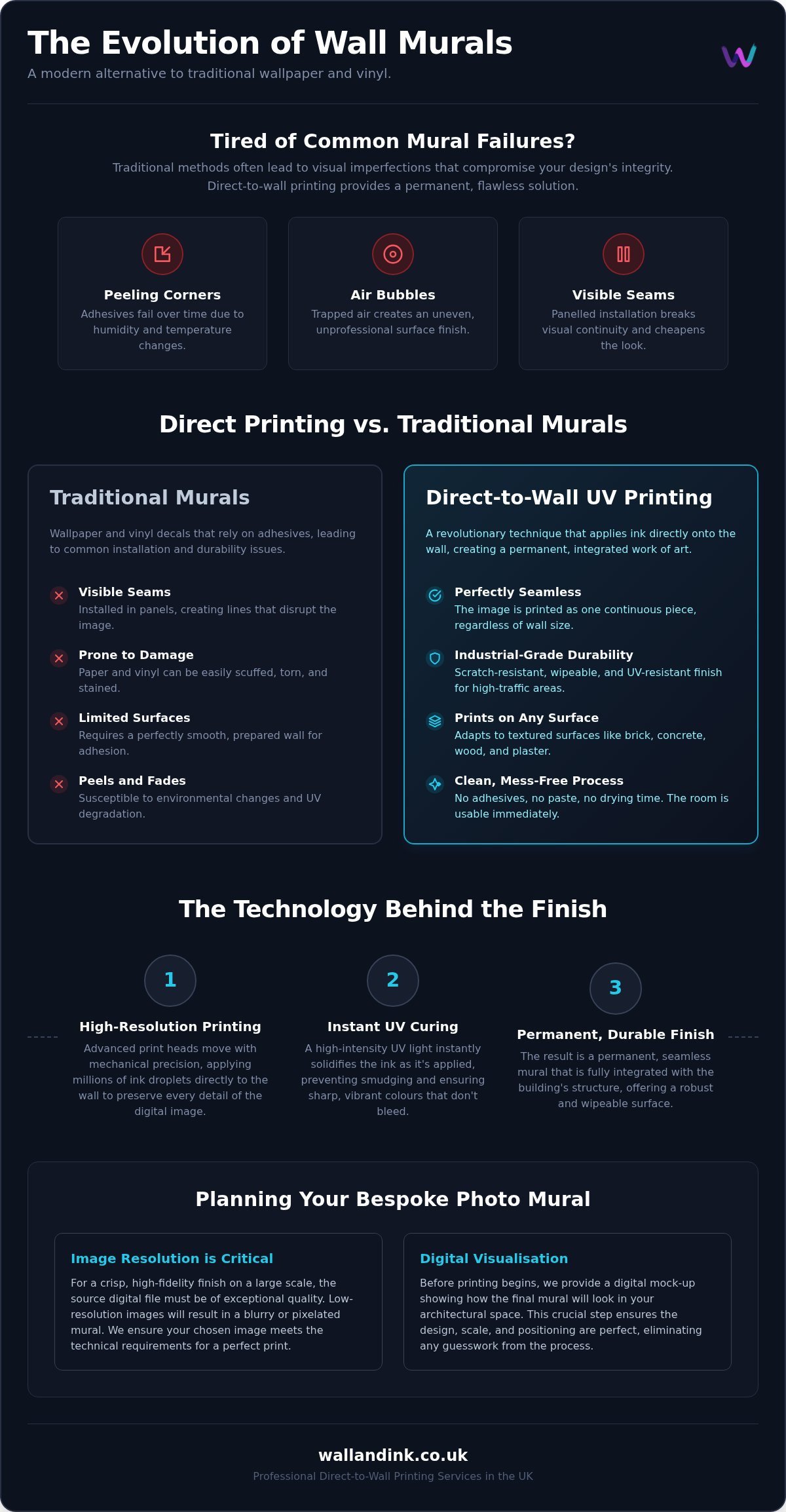
Direct Printing vs. Traditional Murals: A Comparison
The choice between traditional media and direct-to-wall printing often comes down to the desired permanence and visual integration. Traditional photo wall murals made of vinyl or paper function as a superficial layer. They rely on chemical adhesives to grip the surface, which inevitably creates a “stuck-on” appearance. In contrast, direct-to-wall UV printing creates an architectural bond. The ink becomes part of the substrate’s texture, providing a “painted-on” finish that feels like a natural extension of the room’s design. This aesthetic difference is particularly noticeable under professional lighting, where the glare and edges of vinyl panels often betray their temporary nature.
Longevity is a critical factor for pragmatic decision-makers. Whilst a paper mural might look acceptable upon initial installation, its decline is often rapid. Environmental factors like humidity cause edges to curl, whilst physical contact in high-traffic zones leads to tears. Direct printing bypasses these failures by removing the vulnerable substrate entirely. The result is a feature that maintains its integrity for years, standing up to the rigours of commercial use without the need for constant maintenance or repair.
Installation Comparison: Mess-Free vs. Adhesive-Heavy
The installation of traditional murals is a labour-intensive, adhesive-heavy process. It involves water, paste, and chemical solvents that can leave residues and lingering odours. Alignment is a manual task, prone to human error and environmental shifts. Our direct-to-wall process eliminates these inconveniences entirely. We don’t use paste or water, so the environment remains clean and dry throughout the print. Because the ink cures instantly via UV light, there’s no “drying out” period. This efficiency is vital for commercial sectors where downtime equals lost revenue. A retail space or office can be transformed overnight and be fully operational by morning, avoiding the disruption of a multi-day wallpapering project.
Maintenance and Removal
Direct-to-wall UV prints are industrial-grade and wipeable. This makes them a superior choice for environments requiring high hygiene standards, such as hospitals or school dining halls. You can clean the surface without risking damage to the print or the underlying wall. When it’s time to update the space, the difference in removal is stark. Stripping traditional wallpaper is a destructive process that often damages the underlying plaster, requiring costly repairs. With direct-to-wall printing, you simply paint over the existing art. The surface remains intact, and the substrate is protected. This provides better long-term value, as the initial outlay covers both a more durable product and a significantly easier transition when the design eventually needs to change.
Planning Your Bespoke Photo Wall Mural
Successful photo wall murals begin with rigorous technical planning. Unlike basic consumer tools that offer a simple “upload and print” function, a professional installation requires a comprehensive assessment of the architectural space. Digital visualisation plays a critical role in this phase. It allows you to see how a design interacts with physical features like radiators, door frames, and light switches before a single drop of ink is applied. This foresight ensures that the most important elements of your chosen image aren’t obscured by a window or cut off by a corner. By mapping the design to the wall’s specific dimensions, we ensure the final result looks like an intentional architectural feature rather than an after-thought.
Image Selection and Resolution Guidelines
Resolution is the most vital technical specification for any large-scale project. For photo wall murals to remain sharp at close range, the source file must have a high pixel count. We evaluate every image based on its DPI (dots per inch) relative to the final print size. A standard smartphone photo rarely suffices for a full-height wall without professional intervention. Our bespoke design service includes advanced image upscaling and editing to maintain clarity and colour accuracy. We also provide guidance on how specific compositions will behave under your room’s existing lighting, preventing glare from dulling the visual impact of the artwork.
Site Preparation and Surface Assessment
The quality of the underlying substrate directly affects the final print’s precision. The wall must be structurally sound, dry, and free from loose debris or flaking paint. Whilst our UV technology excels on diverse materials, including bare brick, wood, and concrete, the preparation requirements vary for each. For a perfectly smooth finish on plaster, light sanding or a specific primer might be necessary. Conversely, if you’re printing on a textured surface, we calibrate the printer to embrace those contours, creating a unique tactile effect that adds depth to the image.
A professional site survey is a standard part of our national UK service. This ensures every variable, from surface moisture to structural alignment, is accounted for before the printing process begins. This methodical approach eliminates the guesswork and technical failures associated with DIY applications. If you’re ready to transform your space with industrial precision, contact our design team to discuss your project specifications and arrange a site assessment.
The Wall & Ink Advantage: Professional UK Installation
Wall & Ink operates as a specialised partner for decision-makers who value high-quality results over the convenience of a “self-install” kit. Whilst many competitors simply ship rolls of paper and leave the complex task of execution to the customer, our model is entirely service-driven. We provide a national UK service that manages the entire lifecycle of photo wall murals, from the initial digital consultation to the final UV-cured print. This end-to-end approach ensures that the technical capabilities of our hardware and the architectural nuances of your space are perfectly aligned. By choosing a professional installation, you bypass the risks of misalignment and material failure that often plague traditional decorating projects.
Bespoke Design and Digital Mock-ups
A critical stage of our process is the digital visualisation phase, a step often ignored by standard mural suppliers. We don’t just apply an image; we integrate it into your specific environment. Our design team creates high-fidelity mock-ups that demonstrate exactly how your chosen photograph interacts with the room’s permanent features. This allows for precise adjustments to the composition, ensuring that key visual elements aren’t lost to doorways, radiators, or light switches. This collaborative step removes the uncertainty of traditional decorating. It provides a clear, technical preview of the final industrial-grade finish before any ink is applied to the wall, ensuring the design fits the architectural space perfectly.
A Professional, Hassle-Free Experience
On the day of installation, our process is defined by industrial precision and cleanliness. Traditional decorators often require water, paste, and extensive floor protection, creating a messy environment that can disrupt your home or office for days. Our UV printing setup is self-contained and entirely dry. The printer moves with mechanical exactness, applying ink that cures instantly under high-intensity light. There is no lingering chemical odour and no drying time, meaning your space is ready for immediate use. We eliminate the “wallpaper headache” of peeling seams and air bubbles by removing the paper substrate entirely. The result is a durable, scratch-resistant feature that meets the highest professional standards for commercial and residential durability. Contact us today to start your bespoke mural project and experience the precision of direct-to-wall technology.
Future-Proof Your Space with Precision Wall Art
Direct-to-wall UV printing represents a fundamental shift in interior design, moving away from temporary adhesives towards permanent, architectural integration. This technology ensures that photo wall murals remain flawless by eliminating the physical vulnerabilities of paper and vinyl. You’ve seen how industrial-grade pigments provide a wipeable, scratch-resistant finish that stands up to the rigours of any environment, from busy commercial corridors to refined private residences.
By choosing a professional, mess-free installation, you invest in a solution that’s as durable as it is visually striking. Our national UK coverage and end-to-end service, including digital visualisation, guarantee a result that fits your space perfectly. Book your bespoke design consultation with Wall & Ink to begin your transition from traditional wall coverings to high-fidelity direct printing. We look forward to helping you transform your architectural surfaces into permanent works of art.
Frequently Asked Questions
Can any photograph be turned into a wall mural?
Most high-resolution digital photographs are suitable for conversion into photo wall murals. Our design team evaluates every file to ensure it meets the necessary DPI for large-scale application. If a photo lacks the required pixel count, we use advanced digital upscaling techniques to enhance clarity. We also provide bespoke design services to adjust colours or remove unwanted elements, ensuring the final print maintains professional fidelity across the entire architectural surface.
How long does a direct-to-wall photo mural last?
Indoors, these murals typically maintain their integrity for five to ten years depending on environmental conditions. The UV-cured ink is bonded directly to the substrate, preventing the peeling and bubbling common with traditional paper. This industrial-grade durability ensures the artwork remains vibrant and scratch-resistant even in high-traffic commercial zones. Because the pigment is resistant to UV degradation, it won’t yellow or fade significantly when exposed to natural sunlight through windows.
Is the printing process messy or smelly?
The direct-to-wall printing process is entirely dry and mess-free. Unlike traditional decorating, we don’t use water, paste, or chemical adhesives that leave residues or lingering odours. The UV ink is cured instantly by a high-intensity light following the print head, which means there’s no drying time required. This allows for immediate use of the space after installation, making it an ideal solution for operational offices, hospitals, and residential living areas.
Can I print a photo mural on a textured wall like brick?
Our technology is designed to print on diverse substrates beyond flat plaster, including bare brick, concrete, and wood panelling. The printer features built-in sensors that monitor the distance between the print head and the wall, adjusting for surface irregularities in real-time. This allows the ink to follow the natural contours of the material, creating a unique tactile finish. This versatility turns challenging architectural features into integrated design opportunities without requiring extensive sanding or smoothing.
What happens if I want to remove or change the mural later?
Direct-to-wall prints are permanent but can be easily updated by painting over them. Because there is no paper or vinyl substrate to strip away, you avoid the risk of damaging the underlying plaster. This makes the removal process much cleaner and more cost-effective than traditional methods. When you’re ready for a change, simply apply a standard primer and topcoat to return the wall to a blank canvas, ready for a new design.
How do I clean my photo wall mural without damaging it?
Cleaning photo wall murals is straightforward due to the scratch-resistant and waterproof nature of UV-cured ink. You can simply wipe the surface with a soft, damp cloth and a mild detergent to remove dust or fingerprints. This industrial durability makes the mural suitable for environments with high hygiene requirements, such as school dining halls or healthcare facilities. Unlike paper murals, the ink won’t smudge or run when exposed to moisture during routine maintenance.
Is UV printing safe for use in hospitals or schools?
UV printing is a highly safe and sustainable choice for sensitive environments like hospitals and schools. The process uses low-VOC inks and eliminates the need for chemical-heavy adhesives or solvents used in wallpaper installation. Because the ink is cured instantly, there are no off-gassing periods or harmful fumes released into the atmosphere. The resulting wipeable surface also supports infection control protocols, providing a professional aesthetic that doesn’t compromise air quality or safety standards.
Do I need to prepare my wall in a special way before you arrive?
The wall should be clean, dry, and structurally sound before the printing process begins. Any loose paint or debris must be removed, and significant holes should be filled and sanded to ensure a level surface. Whilst our technology handles minor textures, a well-prepared substrate ensures the highest level of image precision. As part of our professional service, we conduct a site survey to assess the wall condition and provide specific preparation guidance for your substrate.