
Traditional vinyl graphics and hand-painted murals are no longer the gold standard for masonry; they are the compromise. For years, the architectural character of a building was often sacrificed under layers of peeling adhesive or obscured by weeks of costly manual labour. You likely recognise the frustration of watching a premium graphic bubble and lift away from porous brickwork, or perhaps you’ve felt forced to choose between a flat, plastic-looking finish and no branding at all.
Direct-to-wall UV technology has changed this dynamic by making professional printing on brick a precise, industrial reality. This method treats the wall as a textured canvas rather than an obstacle, allowing for high-resolution imagery that integrates perfectly with the substrate’s natural aesthetic. In this guide, we’ll detail how this fume-free process works, why it offers superior durability for both interior and exterior environments, and how it eliminates the traditional hassles of wall decoration whilst maintaining the tactile beauty of the original surface.
Key Takeaways
- Understand how UV-curable inks achieve instant bonding and industrial-grade durability on non-absorbent masonry.
- Learn why direct-to-wall printing on brick eliminates the risk of peeling or bubbling often associated with vinyl graphics on textured surfaces.
- Evaluate the significant time and cost advantages of high-resolution digital murals compared to traditional hand-painted methods.
- Discover how digital visualisation ensures your bespoke design complements the natural texture and colour of the brickwork.
- Identify the technical benefits of a clean, fume-free installation process for both interior and exterior commercial environments.
What is Direct-to-Wall Printing on Brick?
Direct-to-wall printing is a specialised technical process that uses vertical UV machinery to apply pigment directly onto masonry surfaces. It’s important to distinguish this from small-scale customisation, such as printing on individual toy bricks or decorative tiles. This is an architectural-scale service designed for large murals and commercial branding. By applying ink directly to the substrate, we bypass the need for intermediary materials like vinyl or wallpaper, which often struggle to adhere to the rugged profile of a brick wall.
In the UK, the “exposed brick” aesthetic has become a staple of modern commercial and residential design. From converted industrial warehouses in Manchester to contemporary retail centres in London, the raw texture of masonry is highly valued for its character and durability. Professional printing on brick allows decision-makers to add high-resolution graphics and branding to these spaces without masking the architectural features that make them unique. It’s a solution that balances digital precision with industrial authenticity.
The Evolution of Masonry Graphics
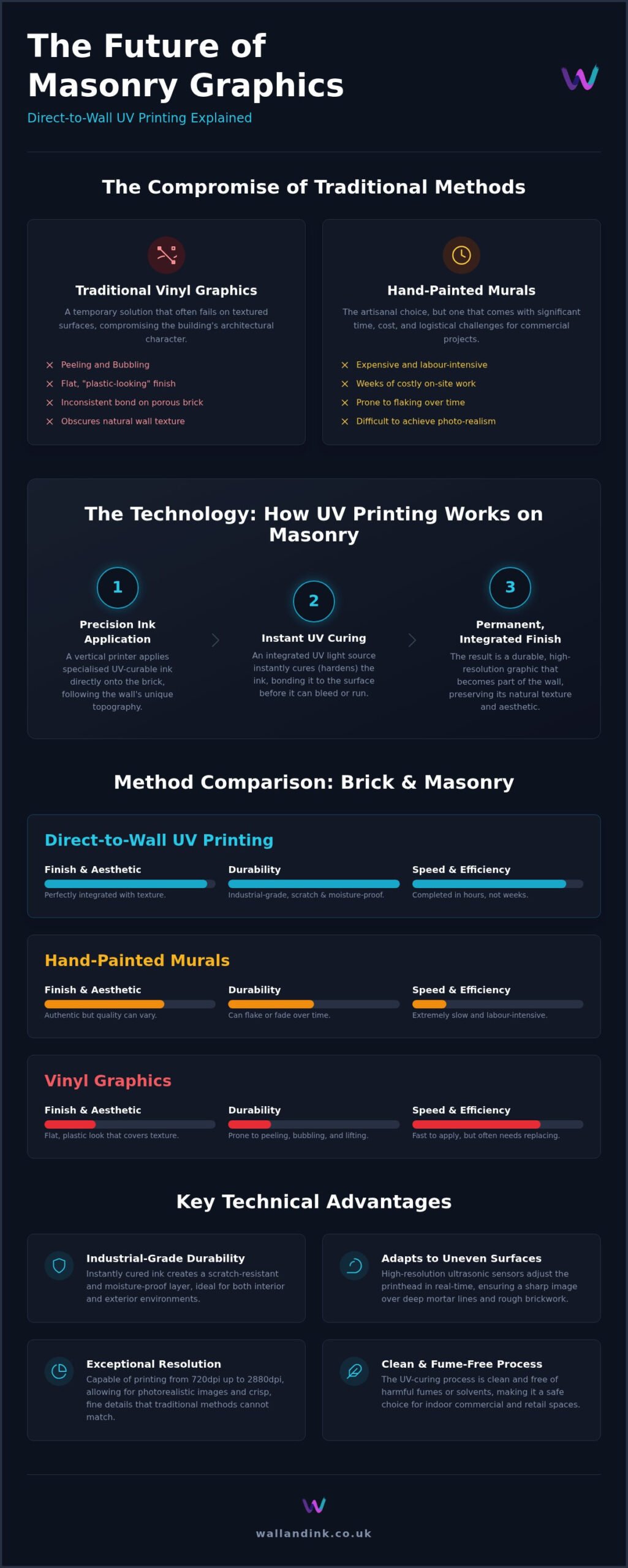
Signage on brickwork used to be limited to two options: expensive, time-consuming hand-painting or temporary vinyl wraps. Hand-painted murals require significant labour and often result in long lead times. Conversely, vinyl wraps frequently fail on porous surfaces. Because brick is uneven, adhesive cannot form a consistent bond, leading to the inevitable bubbling and peeling seen in many retail environments. Modern UV technology has made digital execution commercially viable. By adapting the mechanical principles of Flatbed UV printers to a vertical rail system, we can now achieve permanent, high-resolution results in a fraction of the time required for traditional methods.
Why Brick Texture Matters for Design
Brick isn’t a flat surface; it’s a landscape of pits, ridges, and mortar joints. Traditional signage attempts to hide these “imperfections,” but direct printing integrates them into the final design. The UV-curable ink settles into the natural recesses of the masonry. This creates an “integrated” look that feels like a part of the building’s history rather than a plastic afterthought. You maintain the industrial feel of the space whilst delivering branding that’s both sharp and durable. The result is a mural that won’t flake like paint or lift like vinyl, ensuring the graphic remains as permanent as the wall itself.
The Technology: How UV Printing Works on Masonry
Successful printing on brick requires more than just high-quality pigment; it demands a fundamental shift in how ink interacts with a surface. Standard water-based inks often fail on masonry because they either soak too deeply into porous brick or bead on the surface of non-absorbent mortar. UV-curable inks solve this by remaining liquid until they are exposed to a specific wavelength of ultraviolet light. This triggers an instantaneous chemical reaction that bonds the ink to the substrate before it has a chance to bleed or run. This precision ensures that even the finest details of a digital design remain sharp against the rugged backdrop of a wall.
The technical application of UV 3D printing on architectural materials has revolutionised how we approach textured surfaces like cement and stone. Unlike traditional flatbed machines, our wall printers utilise a sophisticated vertical rail system. This machinery doesn’t just move; it thinks. High-resolution ultrasonic sensors constantly monitor the distance between the printhead and the brickwork, adjusting the focus in real-time to account for the natural variance in the masonry’s topography. This prevents the distortion that typically occurs when graphics are applied over deep mortar lines or uneven headers.
Precision Engineering for Rough Surfaces
The printer operates on a dual-axis rail system that provides mechanical stability across both horizontal and vertical planes. As the printhead traverses the wall, it “reads” the surface depth hundreds of times per second. This allows the machine to maintain a consistent gap, ensuring that the 720dpi to 2880dpi resolution remains uniform across the entire mural. Whether the surface is a smooth modern brick or a heavily weathered Victorian facade, the technology compensates for the substrate’s character without losing digital clarity. If you’re planning a project, you can explore our commercial wall mural services to see how this precision translates to professional environments.
Durability and UV Resistance
Durability is built into the chemistry of the process. Because the ink is cured instantly, it forms a scratch-resistant and moisture-proof layer that is far superior to water-based alternatives. This makes the technology ideal for high-traffic interior feature walls and exposed exterior facades alike. Under 2026 industry standards, UV curing is defined as the instantaneous polymerisation of inks via high-intensity ultraviolet light, a process now strictly governed by updated COSHH regulations to ensure both environmental safety and maximum substrate adhesion. The result is a graphic that resists fading and environmental wear, maintaining its vibrancy for up to ten years in interior settings.
Printing vs. Painting vs. Vinyl: Which is Best for Brick?
Choosing the correct medium for masonry is a decision that impacts both the immediate aesthetic and the long-term structural integrity of the wall. Whilst vinyl and hand-painting have historically been the primary options, they each carry significant technical compromises. Traditional vinyl application relies on a smooth surface for a consistent bond, which brick simply cannot provide. Hand-painting, though aesthetically pleasing, is often prohibited by the sheer volume of labour and the inconsistency of manual execution. Professional printing on brick offers a middle ground of industrial precision and architectural respect.
The “breathability” of a wall is a critical factor often overlooked by design agencies. Unlike vinyl, which creates a non-breathable plastic seal over the masonry, direct-to-wall printing allows the brick to remain porous. Sealing a wall with vinyl can trap moisture behind the film, leading to spalling and structural decay over a five-year period. Technical studies regarding UV printing on concrete blocks demonstrate that this technology successfully manages porous, uneven surfaces without compromising the substrate’s integrity. This principle applies directly to brickwork, ensuring the graphic doesn’t interfere with the building’s natural moisture regulation.
Maintenance requirements vary wildly between these methods over a five-year cycle. Vinyl often requires total replacement within 24 months as the edges inevitably lift from the mortar joints. Hand-painted murals may fade or chip, requiring specialised touch-ups every three years to maintain their impact. In contrast, UV-printed murals are designed for a decade of interior use with zero maintenance, or up to five years in exterior conditions before any noticeable degradation occurs. This makes the digital approach the most cost-effective long-term investment for commercial property managers.
The Failure of Traditional Vinyl on Brick
Vinyl graphics are fundamentally incompatible with textured masonry. To force a bond, installers often use high-temperature heat guns to stretch the film into the mortar lines. This process can cause permanent surface damage to the brick or leave a stubborn adhesive residue that is almost impossible to remove, a major concern for historic or listed buildings. Direct printing eliminates this risk entirely. It removes the “plastic” sheen associated with wraps, replacing it with a flat, integrated finish that respects the original material.
Speed and Efficiency in Commercial Spaces
For commercial projects, time is a primary metric of success. A hand-painted mural can take a week to complete, involving scaffolding, paint fumes, and significant onsite disruption. We can deliver a full-scale mural in a matter of hours. The process is completely fume-free, meaning schools, hospitals, and offices don’t need to close during installation. Decision-makers prefer this predictable, high-resolution outcome because it removes the creative guesswork of manual painting, ensuring the final result matches the digital proof exactly.
Designing for Brick: Preparation and Visualisation
Designing for masonry is a technical exercise in integration. Unlike a standard white canvas, the substrate acts as a secondary colour layer that influences the final output. Professional printing on brick requires a meticulous visualisation phase to ensure the digital artwork translates accurately to the physical wall. This process allows you to evaluate the design in situ, ensuring that the scale and positioning are optimised for the specific architecture of your space. We use digital visualisations to map your imagery directly onto the wall, accounting for every mortar line and surface variation before any ink is applied.
Ink density and transparency are critical design variables. You can opt for a semi-transparent finish that allows the natural character of the masonry to show through, which is ideal for achieving a weathered, historic aesthetic. Conversely, a high-density white underprint can be applied to create a neutral base. This ensures that brand colours remain vibrant and colour-accurate, even on dark or irregular engineering bricks. By managing these layers, we can control exactly how much of the wall’s industrial character remains visible in the final mural.
Colour Theory for Red and Buff Brickwork
Red brickwork carries significant warm undertones that can shift the appearance of blues and greens. Buff bricks are more neutral but still influence the saturation of lighter tints. We adjust digital files to compensate for these environmental variables before the printer ever touches the wall. Digital mock-ups ensure that graphic elements are positioned to avoid awkward intersections with deep mortar joints or irregular headers. This level of foresight prevents costly design errors and ensures the final result matches your brand guidelines with precision.
Preparation Checklist for a Flawless Finish
Surface integrity is non-negotiable for a professional result. The wall must be clean, dry, and free from loose debris or failing mortar. If you’re ready to see how your branding could look on a textured surface, you can book a bespoke design consultation to begin the visualisation process. Proper preparation includes the following steps:
- Remove dust and loose mortar using a stiff brush or industrial vacuum.
- Identify and treat efflorescence; salt deposits can prevent the UV ink from bonding correctly.
- Ensure the wall is structurally sound to support the vertical rail system.
- Maintain a dry environment to avoid moisture interference during the UV curing stage.
The ideal temperature for UV application is generally between 10°C and 30°C. If the bricks are too cold or damp, the chemical bond may be compromised, which could lead to a reduction in the long-term durability of your printing on brick project. Identifying these problem areas early ensures a permanent, high-resolution finish that lasts for years.
Wall & Ink: Specialist Wall Printing Across the UK
Wall & Ink operates as a dedicated specialist in direct-to-wall application, providing end-to-end management from the initial bespoke design consultation to the final technical execution. Whilst some providers focus on small-scale shipping of printed materials, we bring advanced UV machinery directly to your site. This national service ensures that professional printing on brick is accessible across the United Kingdom, regardless of project scale or location. Our approach is defined by industrial precision and a commitment to radical transparency; we believe in providing decision-makers with a clear, step-by-step understanding of the process and costs involved before the machinery arrives on site.
The bespoke design service includes detailed digital visualisations that allow you to see the mural in situ. This eliminates the uncertainty often associated with traditional mural painting, where the final outcome depends on the individual artist’s interpretation. Instead, we provide a predictable, high-resolution result that matches your digital proof with absolute accuracy. This level of technical reliability is why we are trusted by commercial partners who value efficiency and high-quality results.
Commercial Branding and Office Murals
High-impact architectural graphics can transform standard boardrooms into professional brand environments. In educational settings, school and educational murals are utilised to turn brick corridors into durable, high-resolution learning tools. Unlike traditional paint or vinyl, these murals withstand the rigours of high foot traffic and regular cleaning without degradation. Retail and hospitality graphics benefit from the same mechanical superiority, allowing for branding that integrates with the building’s facade whilst maintaining the architectural character of the masonry. Because the UV printing process is fume-free and fast, commercial spaces can be updated without the need for extended closures or health and safety concerns regarding VOCs.
Residential Feature Walls
The “exposed brick” aesthetic is a hallmark of modern UK loft conversions and residential renovations. Wall & Ink allows homeowners to create unique “pixel walls” through specialised printing on brick that adds a personalised layer to their space without hiding the natural texture of the substrate. This residential wall art is permanent and fume-free, making it a practical choice for private living environments where air quality is a priority. You get a bespoke finish that respects the home’s character whilst introducing modern digital art. This method ensures that the tactile beauty of the original brickwork is preserved, providing a permanent solution that is far superior to traditional wallpaper or vinyl.
Request your bespoke design consultation with Wall & Ink
Precision Graphics for Architectural Masonry
Traditional methods like vinyl application often fail because they fight against the natural texture of the wall. Direct-to-wall UV technology succeeds by integrating with the substrate. This process ensures your graphics remain permanent and vibrant whilst allowing the brickwork to breathe, preventing the moisture traps that lead to structural decay. You no longer have to choose between high-resolution branding and the architectural character of your building.
Wall & Ink provides a streamlined, industrial solution for both commercial and residential environments across the UK. By utilising advanced UV ink technology and bespoke digital visualisations, we ensure every project meets the highest standards of durability and precision. Professional printing on brick is the most efficient way to transform a workspace or home without the fumes, mess, or extended lead times associated with manual painting. Our national coverage ensures that this innovative technology is available wherever your project is located.
Transform your brick walls with a custom mural from Wall & Ink
We look forward to helping you modernise your space with technical excellence and industrial-grade reliability.
Frequently Asked Questions
Can you print on any type of brick surface?
We can print on almost any type of masonry, including engineering bricks, buff bricks, and weathered Victorian facades. The primary requirement is that the substrate is clean, dry, and structurally sound. Our vertical rail system utilises ultrasonic sensors to compensate for the natural variance in these surfaces, ensuring consistent ink application across both modern smooth finishes and heavily textured historic walls.
How long does a printed brick mural last outdoors?
Exterior murals typically maintain their vibrancy for up to five years, depending on the wall’s orientation and exposure to environmental elements. The UV-cured ink is highly resistant to fading and moisture, making it far more durable than traditional paint or vinyl wraps. For interior projects, the lifespan increases significantly; many prints remain in excellent condition for up to ten years without any maintenance required.
Is the ink used in wall printing eco-friendly and safe for schools?
The UV-curable inks used in our process are completely fume-free and safe for use in sensitive environments such as schools and hospitals. Because the ink cures instantly under ultraviolet light, there are no volatile organic compounds (VOCs) released during or after the installation. This allows us to complete school and educational murals during standard hours without the need for ventilation or room closures.
Does the printer work on uneven or “wonky” old brick walls?
Our machinery is specifically engineered to handle uneven or aged masonry through the use of high-resolution ultrasonic sensors. These sensors read the wall’s topography hundreds of times per second, adjusting the printhead’s distance in real-time to account for deep mortar joints or irregular headers. This prevents distortion and ensures that printing on brick remains sharp and professional, even when the substrate is architecturally imperfect.
What happens if I want to remove the mural in the future?
Printed murals are permanent but can be removed or covered if your branding requirements change. Because the ink bonds directly to the surface rather than sitting on a plastic film, you can simply paint over the mural using standard masonry paint once the surface is cleaned. For historic or listed buildings, specialised chemical cleaning or low-pressure steam removal can often strip the ink without damaging the underlying brickwork.
How much does it cost to print a mural on a brick wall?
Project costs are calculated based on the total square meterage and the complexity of the surface texture. We operate with a policy of radical transparency, providing clear pricing structures that account for setup, travel, and the specific ink density required for your design. Whilst textured surfaces like brick require more precise mechanical calibration than flat plaster, the process remains a cost-effective alternative to the high labour costs of manual painting.
Can you print white ink onto dark or red bricks?
We utilise a high-opacity white ink layer to ensure colour accuracy when printing on brick that is dark, red, or heavily toned. This base layer prevents the natural colour of the masonry from bleeding through the graphic, allowing for vibrant, high-resolution results. By managing the white underprint, we can achieve everything from a fully opaque commercial logo to a semi-transparent finish that allows the brick’s character to remain visible.
Do I need to prime the brick wall before you arrive to print?
You do not need to apply a primer or base coat before we arrive; the UV ink is designed to bond directly to raw masonry. The only preparation required is ensuring the wall is clean, dry, and free from dust, grease, or efflorescence. If the brickwork is particularly old or flaky, we recommend a light wire-brushing to remove loose debris, ensuring the highest possible level of adhesion for the UV-cured ink.