
Traditional signage methods are fundamentally ill-equipped for the realities of raw masonry. Whether it’s vinyl decals peeling away from porous surfaces or hand-painted murals that take weeks to complete and lack fine detail, the industrial nature of concrete has long been a barrier to high-quality branding. You’ve likely experienced the frustration of “dusty” substrates that refuse to bond with standard adhesives. However, modern printing on concrete walls using direct UV technology has transformed this difficult material into a high-performance, industrial-grade canvas. It’s no longer about fighting the texture; it’s about employing a mechanical process designed specifically to integrate with it.
This professional guide explores how advanced UV-curable inks provide a permanent, high-definition solution for both commercial and residential environments. You’ll discover how this technology handles the natural pits and textures of the substrate whilst ensuring a mess-free installation that eliminates the need for traditional wallpaper. We will outline the technical justifications for UV curing, the durability of the finish, and the practical steps to achieving a reliable, high-resolution result on even the most challenging surfaces.
Key Takeaways
- Understand how UV-curing technology ensures instant adhesion to porous concrete without the ink bleeding or losing fine detail.
- Learn why printing on concrete walls offers a more durable and efficient alternative to traditional vinyl decals or time-consuming hand-painted murals.
- Discover the essential site preparation steps, such as removing loose aggregate, to ensure a high-definition finish on textured substrates.
- Contrast the industrial precision of direct-to-wall printing with legacy methods to achieve significant reductions in material waste and long-term maintenance.
- Explore the logistical advantages of a mess-free, high-speed installation process that provides national UK coverage for commercial and residential sectors.
What is Direct Printing on Concrete Walls?
Direct-to-wall printing is the precise mechanical application of UV-curable ink onto an existing vertical surface. Unlike traditional methods that rely on an adhesive carrier, this process applies the pigment directly to the substrate, where it is cured instantly by high-intensity LED lights. This creates a permanent bond that integrates with the wall rather than sitting as a fragile layer on top of it. For industrial and commercial spaces, printing on concrete walls has evolved from a difficult technical challenge into a streamlined branding solution.
Concrete is a unique substrate amongst common building materials. It is porous, often uneven, and prone to releasing microscopic dust particles that compromise standard adhesives. Historically, these characteristics made it a hostile environment for high-definition graphics. However, the industry is witnessing a significant shift from simply building with concrete to actively branding on concrete. Pragmatic decision-makers now view raw masonry as a high-performance canvas rather than just a structural necessity.
The Distinction Between 3D Printing and Direct Wall Murals
It is essential to distinguish this decorative method from 3D construction printing. Whilst 3D construction printing is a structural process used to build walls layer-by-layer from a concrete mix, direct-to-wall printing is an aesthetic and functional finish applied to a wall that is already standing. This process utilises advanced Inkjet printing technology engineered for vertical stability and precision.
The role of UV-LED technology is critical here. It allows for instant adhesion on various concrete types, including:
- Raw Poured Concrete: Smooth but often prone to outgassing.
- Breeze Blocks: Highly porous surfaces that traditionally “soak up” paint.
- Pre-cast Panels: Dense surfaces that can be difficult for standard inks to grip.
Why Traditional Methods Fail on Concrete
Traditional decorative methods are rarely designed for the physical reality of masonry. Vinyl decals frequently fail because of concrete’s natural outgassing; as the material “breathes,” air becomes trapped behind the plastic, causing unsightly bubbles and peeling. The rough texture also prevents a 100% contact bond, making edge-lift inevitable in high-traffic areas.
Hand-painted murals present a different set of problems. They are slow, expensive, and often lack the crisp detail required for modern corporate branding. Furthermore, the porous nature of the material means it can take multiple coats of expensive primer and paint just to achieve basic opacity. Direct printing on concrete walls eliminates these hassles. It provides a mess-free, high-speed alternative that handles the natural pits and textures of the substrate without the risk of peeling, bleeding, or fading.
The Science of UV Ink Adhesion on Concrete Substrates
The mechanical superiority of printing on concrete walls lies in the rapid polymerisation of the ink. Standard solvent-based inks rely on evaporation, which often leads to “bleeding” as the liquid is drawn into the capillary network of the concrete. In contrast, UV-curable inks remain on the surface in a liquid state until they are exposed to a specific wavelength of LED light. This trigger causes a near-instantaneous transition from liquid to a solid, cross-linked polymer. This process ensures that the pigment stays exactly where it is placed, regardless of the substrate’s thirst.
Recent research on UV-curable materials highlights how these photopolymers interact with porous structures to provide a stable, mechanical bond without deep penetration. This is vital for concrete because it preserves the clarity of the image. The ink forms a durable lattice that is hard-wearing yet remains sufficiently breathable to allow for the natural outgassing of the masonry. This prevents the blistering and delamination common with non-porous alternatives like vinyl. It’s a technical solution that respects the physical behaviour of the building material.
Handling Surface Texture and Pits
Maintaining high-definition results on shuttered or rough-cast concrete requires active mechanical compensation. Unlike a traditional flatbed printer, the equipment used for printing on concrete walls employs high-resolution ultrasonic sensors to map the “hills and valleys” of the wall in real-time. These sensors adjust the distance of the print head hundreds of times per second. This precision ensures that the ink droplets land with absolute accuracy, even when navigating the natural aggregate and deep pits of the masonry. It allows for crisp lines and complex gradients that would be impossible to achieve through manual application.
Longevity and Environmental Resistance
UV-stabilised pigments are engineered to resist fading even when exposed to direct sunlight for extended periods. This makes the process ideal for exterior facades where traditional paint would quickly degrade. Beyond solar resistance, the cured ink is remarkably resilient against mechanical wear and common industrial cleaning chemicals. This durability is why direct printing is becoming the standard for high-traffic corridors and busy retail environments. If you’re looking to implement these high-performance graphics in your own facility, exploring Direct-to-Wall Printing solutions can provide the industrial-grade finish your space requires. The resulting murals are scratch-resistant and waterproof, ensuring the branding remains as sharp as the day it was installed.
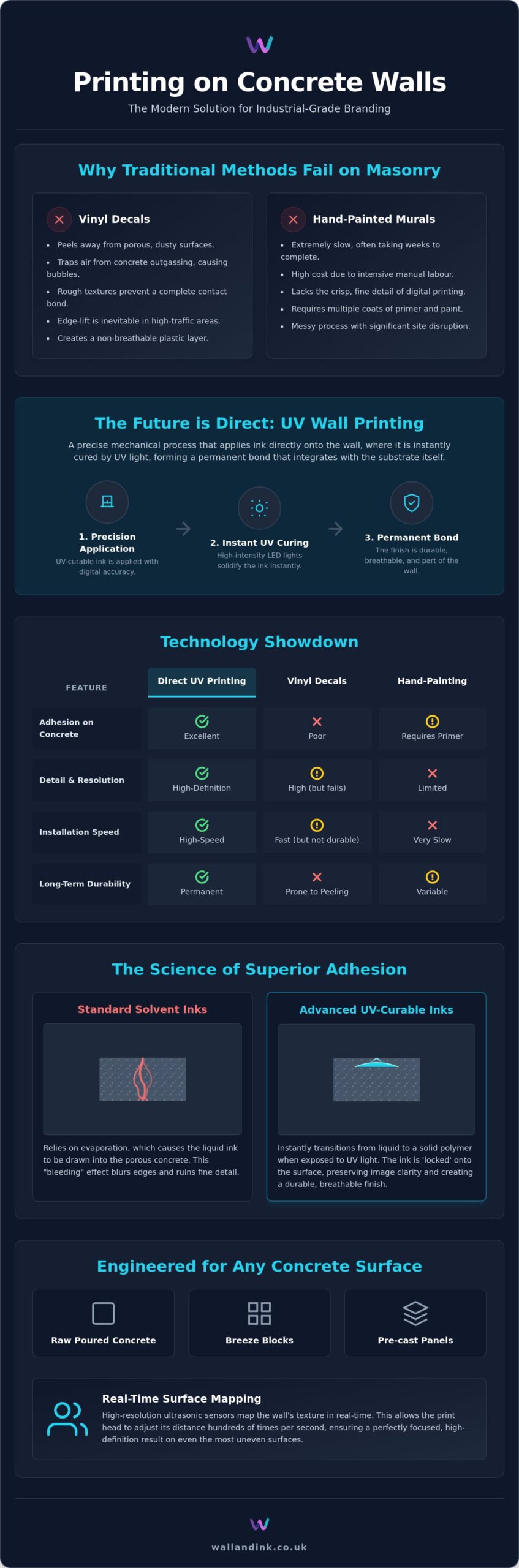
Direct Printing vs Vinyl and Hand-Painting on Concrete
Choosing a decorative method for masonry requires a balance of speed, durability, and visual fidelity. Legacy options like vinyl application or hand-painting often present logistical hurdles that modern printing on concrete walls simply bypasses. Where a manual muralist might require several days or even weeks to complete a complex piece, a digital wall printer achieves the same result in a fraction of the time. This speed is not just a matter of convenience; it represents a significant reduction in site disruption and labour costs for pragmatic facility managers.
The Vinyl Problem: Why Adhesion is a Gamble
Applying vinyl to concrete is a high-risk strategy. The material’s natural texture prevents a uniform bond, whilst temperature fluctuations in unheated industrial spaces lead to “bubbling” as air expands and contracts behind the film. Edge-peeling is almost inevitable in high-traffic or humid environments, leading to a degraded aesthetic within months. Technical standards, such as the Ohio Department of Transportation material specifications, highlight the rigorous requirements for materials applied to concrete to ensure long-term adhesion. UV-cured ink meets these challenges by becoming a physical part of the wall surface, eliminating the risk of delamination entirely.
Precision and Detail: The Digital Advantage
The quality of the finish is where the technical gap becomes most apparent. Hand-painting often results in a stencil-like appearance with visible brush strokes and inconsistent colour saturation. Digital printing on concrete walls, however, offers photographic realism and perfect replication of complex corporate logos. This level of precision is vital for national branding projects where consistency across multiple sites is mandatory.
Digital workflows also provide the benefit of visualisation before the first drop of ink is applied. Clients can see a precise digital overlay of the artwork on their specific wall, ensuring the scale and placement are correct. When the time comes to update the space, the process remains straightforward. Unlike vinyl, which leaves a sticky residue and can damage the substrate during removal, a UV-printed mural can simply be painted over with standard emulsion. This allows for a clean slate without the mess or expense of chemical stripping or intensive surface repairs. The result is a reliable, high-detail finish that outperforms traditional alternatives in every measurable metric.
Planning Your Concrete Wall Printing Project
Successful execution starts with a rigorous technical assessment. When printing on concrete walls, the physical state of the surface dictates the design strategy. You must ensure the wall is structurally sound and free from loose aggregate, oils, or heavy dust. This isn’t just about cleanliness; it’s about providing a stable foundation for the UV ink lattice to bond with the substrate. Measuring the square footage accurately is the next essential step. We operate with radical transparency, utilising a square-footage-based pricing model that allows you to calculate costs upfront without the need for complex consultation cycles.
Choosing Art for Different Concrete Finishes
Designers must adapt their vision to the specific substrate to achieve the best results. For shuttered concrete, the vertical or horizontal seams shouldn’t be ignored. Incorporating these architectural lines into the graphic creates a more integrated, bespoke appearance. Polished concrete offers a sleek, gallery-like surface that is ideal for high-resolution photography and fine line work. Conversely, breeze blocks have a deep, irregular texture. Designs for these surfaces should focus on bold shapes and high contrast to manage the natural shadows cast by the porous blocks.
Lighting plays a functional role in the final visual outcome. Because the UV-cured ink sits on the surface of the masonry, directional lighting can be used to enhance the 3D effect of the print. This highlights the interplay between the digital pigment and the physical texture of the wall. It creates a sense of depth and permanence that traditional wallpaper or vinyl simply cannot replicate in industrial environments.
The Design Visualisation Process
Digital mock-ups are a mandatory part of our workflow. They allow you to visualise how corporate branding scales against the industrial backdrop before any ink is applied. It’s about ensuring the industrial precision of printing on concrete walls aligns with the architectural intent of the space. We adapt existing assets to work with the natural grey tones of the concrete, ensuring colours remain vibrant whilst respecting the raw aesthetic of the building. To ensure your design is perfectly scaled for your specific environment, you can book a consultation for Commercial Wall Murals to begin the visualisation phase.
Wall & Ink: Specialist Direct-to-Wall Printing Across the UK
Wall & Ink provides a specialised solution for decision-makers who require high-speed branding without the traditional disruption of site closures or messy installations. Our commitment to industrial precision ensures that printing on concrete walls is executed with mechanical reliability across the United Kingdom. We eliminate common industry pain points, such as peeling vinyl and slow hand-painting, by using advanced UV technology that cures pigment instantly. This approach allows us to deliver high-resolution murals that are durable, scratch-resistant, and chemically stable.
Our operational model is built on radical transparency. We provide clear pricing structures based on square-footage metrics, allowing for accurate budgeting from the outset of any project. This straightforward approach distinguishes our service from agencies that hide costs behind lengthy consultation requirements. Every project includes bespoke design and digital visualisation fees as part of the process. This ensures that the final execution matches your architectural intent with total accuracy.
From Commercial Offices to Industrial Facades
We specialise in transforming difficult substrates across diverse sectors. In commercial environments, we turn raw breeze blocks and poured concrete into high-definition branding assets that enhance the professional atmosphere. For industrial facades, our exterior wall printing solutions are engineered to withstand the British weather without fading or delamination. When upgrading your building’s exterior, it is also wise to consider the condition of the roof; specialists like I R. Wilson Roofing can provide the necessary structural support to ensure your property remains fully protected. The ink lattice remains breathable, respecting the physical nature of the masonry whilst providing a permanent finish.
Educational and healthcare facilities choose our process because of our use of VOC-compliant, odourless UV inks. These pigments are non-toxic and hygienic. They are perfectly suited for sensitive environments where traditional solvent-based paints or adhesives would cause significant disruption. Whether it is for school and educational murals or retail and hospitality graphics, the result is a hard-wearing finish that is easy to clean and maintain in high-traffic zones.
Start Your Transformation Today
Our process is methodical and logical. It is designed to guide you from initial curiosity to final execution in three defined steps:
- Consultation: We assess your specific wall type, surface texture, and project requirements.
- Visualisation: Our team provides a digital overlay of the artwork on your concrete surface to confirm scale and colour.
- Execution: Our specialists arrive on-site for a mess-free, high-speed installation with no drying time required.
To begin your project or to gain a clear understanding of the costs involved, you can view our commercial wall mural gallery and pricing. We provide the expertise and national reach required to handle high-stakes professional environments with total reliability and industrial precision.
Secure Your Branding with Industrial Precision
Selecting the right method for printing on concrete walls is a strategic decision that directly impacts long-term maintenance and brand perception. Advanced UV technology has replaced the unpredictable nature of vinyl and the inefficiencies of hand-painting. Our mechanical process ensures total adhesion. By integrating pigment into the substrate rather than applying a fragile layer on top, you achieve a finish that is as durable as the masonry itself.
We prioritise clarity and reliability through transparent square-footage based pricing and full digital visualisation before any work begins. This ensures that every mural is scaled perfectly to its environment without hidden costs or logistical delays. The result is a streamlined, mess-free installation that respects your time and the architectural integrity of your space. It’s a modern solution designed for those who value efficiency and high-quality results.
If you’re ready to transform raw concrete into a high-performance branding asset, get a bespoke quote for your concrete wall project today. We look forward to delivering a permanent, high-definition solution for your facility.
Frequently Asked Questions
Can you print on rough or textured concrete walls?
Yes, you can achieve high-definition results on rough or textured surfaces. Our equipment utilises high-resolution ultrasonic sensors to map the physical profile of the substrate in real-time. This mechanical precision ensures the print head maintains an optimal distance from the wall, allowing for crisp lines and accurate colour even on shuttered concrete or breeze blocks.
How long does a direct-to-wall print last on an exterior concrete surface?
Exterior prints on concrete typically have a lifespan of up to 5 years, depending on environmental exposure and sunlight intensity. The UV-cured ink is engineered for maximum adhesion and resistance to mechanical wear. This makes it a far more durable solution than traditional exterior paint or vinyl, which often succumb to peeling and fading in harsh weather.
Is the ink used for concrete printing safe for indoor environments like schools?
The inks we use are entirely safe for sensitive indoor environments. Once the UV-curing process is complete, the pigment is odourless and VOC-compliant. This makes it an ideal choice for school and educational murals or healthcare settings where air quality is a critical consideration. There is no lingering chemical scent or off-gassing after the installation.
Do I need to prime or paint the concrete wall before printing?
Most raw concrete surfaces do not require priming or painting before the process begins. The UV ink technology is designed to bond directly with the porous nature of the masonry. If the wall is exceptionally dark or has a high aggregate content, we may suggest a white base layer during the digital visualisation phase to ensure maximum colour vibrancy.
How much does printing on concrete walls cost per square metre?
We operate with radical transparency by using a square-footage based pricing model for printing on concrete walls. This allows pragmatic decision-makers to calculate accurate budgets without the need for complex consultation cycles. Final costs depend on the total surface area and the specific requirements of the substrate, ensuring you only pay for the exact dimensions of your project.
Can the print be removed if we decide to change the branding later?
The print is a permanent branding solution that cannot be peeled away like a vinyl decal. However, it is designed for long-term flexibility. If your branding requirements change, you can simply paint over the mural using standard emulsion. This allows for a clean slate without the mess or expense associated with chemical stripping or intensive surface repairs.
What is the maximum size for a concrete wall mural?
There is virtually no limit to the width of a mural, as the machine can track along a horizontal rail indefinitely. The height is generally limited by the vertical rail system, which typically accommodates walls up to 4 metres in height. For larger industrial facades, we can organise the execution in sections to ensure the entire surface is covered with total precision.
How long does the on-site printing process take for a standard wall?
The on-site process is significantly more efficient than traditional manual methods. A standard commercial mural can often be completed within a few hours or a single working day, depending on the complexity of the artwork. Because the UV ink cures instantly under LED light, the space is ready for immediate use as soon as the equipment is removed.