
The traditional “waiting game” of decorating fresh walls is officially obsolete. For years, the industry standard has dictated a lengthy curing period to avoid the nightmare of peeling paint or bubbling wallpaper. However, printing on new plaster with modern UV technology bypasses these legacy frustrations by bonding directly with the substrate. You no longer need to choose between a fast project turnaround and a high-quality finish. This method offers a level of industrial precision that traditional decorating simply cannot match.
We understand the anxiety that comes with fresh gypsum; the conflicting advice on drying times and the fear that trapped moisture will ruin a bespoke design are common hurdles for any pragmatic decision-maker. This guide provides the technical clarity you require. You’ll discover the exact moisture percentages needed for perfect adhesion, the specific advantages of UV-cured inks over vinyl, and a logical timeline for your next project. We’re moving away from the guesswork of “mist coats” toward a future of mechanical superiority and flawless, durable wall art that stands the test of time.
Key Takeaways
- Understand the unique properties of gypsum as a substrate and why printing on new plaster requires specific moisture management to prevent efflorescence.
- Learn how UV-LED curing technology enables instant ink polymerisation; this allows for immediate results without the typical “waiting game” of traditional decorating.
- Compare the efficiency of a one-day mural installation against the multi-day timelines of painting and the durability issues associated with vinyl decals.
- Master the surface preparation requirements, including the necessity of a professional skim finish to ensure a flawless, high-resolution output.
- Discover the streamlined journey from bespoke digital visualisation to a durable, physical mural that integrates perfectly with your interior architecture.
The Science of Printing on New Plaster: Moisture and Suction
New plaster is a living, breathing substrate. It’s not merely a flat canvas; it’s a highly porous, alkaline environment that continues to change long after the plasterer has left the site. For professionals, successful printing on new plaster requires an understanding of the chemical transition from a wet slurry to a stable surface. Unlike cured masonry, fresh gypsum is aggressively absorbent. This high suction is a double-edged sword; it allows for deep ink penetration but can also pull the moisture out of traditional paints too quickly, leading to cracking and poor adhesion.
A primary concern during the curing phase is efflorescence. As water evaporates from deep within the wall, it carries natural salts to the surface. These salts crystallise into a white, powdery residue that can lift traditional paint films. UV-LED technology manages this differently. Because the ink is cured instantly by high-intensity light, it doesn’t rely on the same slow-drying mechanics as emulsion. However, the surface must still be managed to ensure these crystals don’t form a barrier between the ink and the substrate. Understanding the evolution of mural techniques helps us appreciate how modern digital applications have solved these age-old chemical conflicts.
Why Fresh Plaster is a Challenging Substrate
The high alkalinity of fresh plaster, often reaching a pH level of 12 or higher, can be destructive to traditional organic pigments. Many standard paints will “burn” or discolour when applied too early. UV inks are engineered for industrial stability, making them far more resistant to this chemical aggression. We must also consider the risk of moisture entrapment. If a non-breathable layer is applied too soon, moisture stays trapped, potentially leading to mould growth or “blown” plaster where the finish separates from the brickwork. Hygroscopic behaviour in new plaster refers to the material’s inherent ability to absorb and retain moisture from the atmosphere until it reaches a state of equilibrium with its surroundings.
The Critical Drying Timeline for 2026
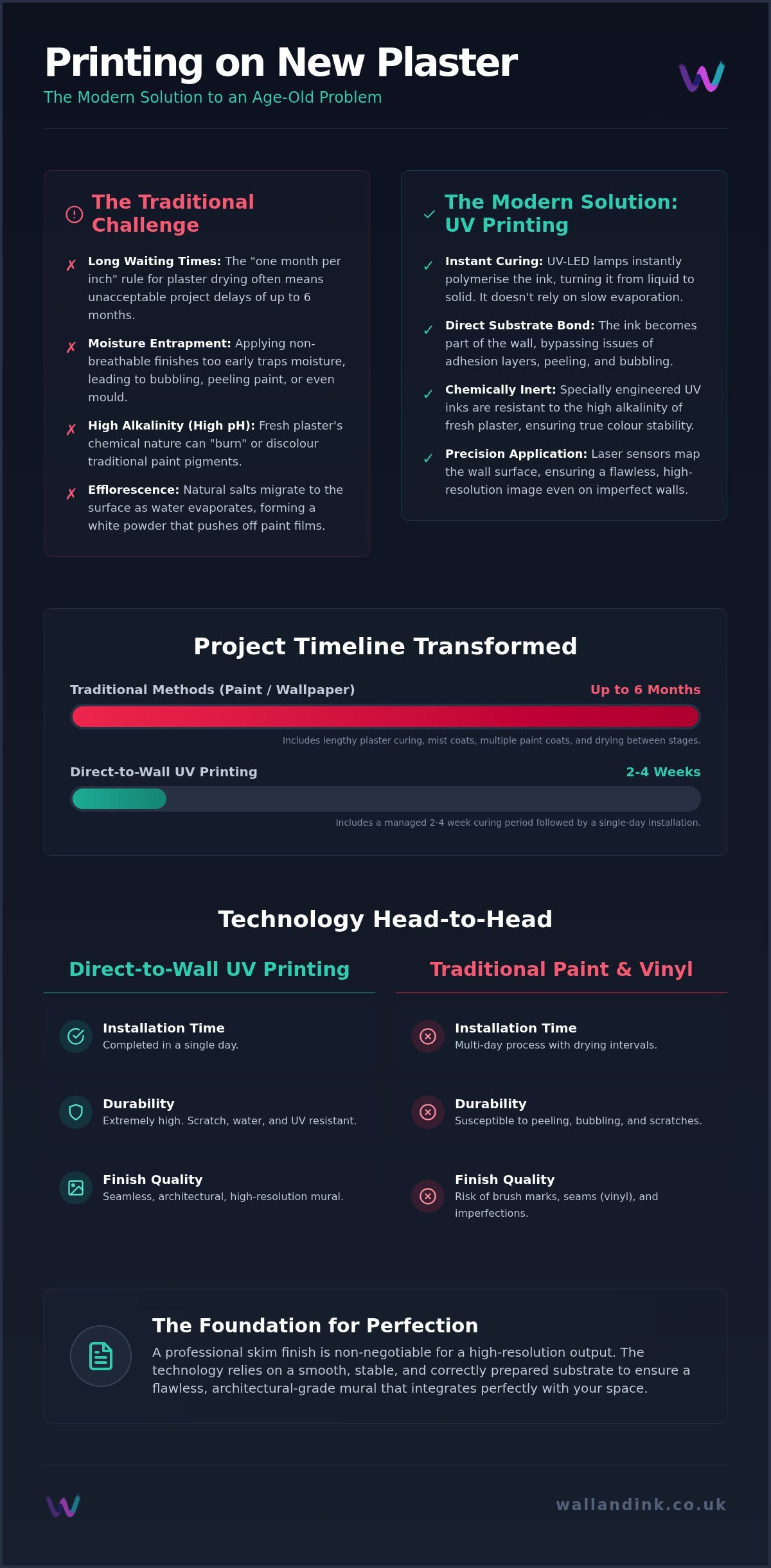
Many decorators still cling to outdated advice, suggesting a six-month wait before applying any permanent finish. In a modern commercial environment, this delay is unacceptable. We differentiate between “pink” plaster, which is still shedding bulk moisture, and “white” dry plaster. Whilst the surface may look ready within days, deep structural curing takes longer. The industrial sweet spot for printing on new plaster is typically between two and four weeks.
Readiness is determined by environmental variables rather than just the calendar. Humidity, airflow, and the thickness of the plaster coat all dictate the timeline. In a well-ventilated space with controlled heating, the curing process accelerates. We don’t guess; we look for the uniform white finish that signals the substrate is stable enough for a high-resolution, durable mural that won’t peel or degrade.
How UV Wall Printing Technology Interacts with Fresh Surfaces
The transition from a raw plaster finish to a high-resolution mural is a feat of mechanical precision. Traditional methods fail on fresh surfaces because they rely on evaporation. In contrast, printing on new plaster using UV-LED technology utilises a process called polymerisation. As the print head traverses the substrate, high-intensity ultraviolet light strikes the ink, triggering an immediate chemical reaction that transforms the liquid into a durable solid. This isn’t a “drying” phase in the traditional sense; it’s an instantaneous structural change that locks the pigment in place before it has the opportunity to wick too deep into the porous gypsum.
Modern wall printers are designed to handle the inherent irregularities of architectural plaster. Even a professional skim finish will have subtle depressions or ridges. To manage this, the equipment uses advanced laser sensors to maintain a constant distance between the nozzles and the wall. This ensures that the focal point of the ink droplets remains consistent, preventing the blurring or “overspray” often associated with manual applications. Before the first drop of ink is even fired, high-resolution digital visualisation allows us to map the artwork to the specific geometry of the space, ensuring that every architectural feature is accounted for with millimetre accuracy.
The Immediate Curing Process
The speed of UV-LED curing is the primary disruptor of the traditional decorating timeline. Because the UV lamps follow the print head in a single pass, the mural is fully cured the moment the technician moves to the next section. There’s no waiting period for the surface to become “touch dry,” which eliminates the risk of dust contamination or accidental smudging. This instant solidification is particularly beneficial for printing on new plaster; it prevents the ink from bleeding into the high-suction surface, maintaining the crispness of fine details and the vibrancy of the colour profile.
Ink Penetration vs Surface Bonding
Durability in wall art depends on how the medium interacts with the substrate’s pores. UV ink technology creates a hybrid bond that combines physical anchoring with surface adhesion. UV ink sits on the surface whilst anchoring in pores, creating a resilient finish that is far superior to the superficial adhesive used in vinyl decals. Unlike wallpaper, which can peel at the seams or bubble due to moisture fluctuations, a printed mural becomes an integral part of the wall. This mechanical superiority ensures that the artwork remains stable even as the building settles. If you are looking to integrate high-resolution art into a new build, exploring bespoke wall printing solutions provides a pathway to a permanent, industrial-grade finish that traditional materials cannot replicate.
Direct-to-Wall Printing vs Traditional Paint and Wallpaper
Traditional decorating forces a compromise between speed and quality. When you choose painting or wallpapering, you’re committing to a multi-day, multi-stage schedule that disrupts site operations. Printing on new plaster eliminates these logistical bottlenecks entirely. Whilst a painter must wait for each coat to dry, a wall printer completes a high-resolution mural in a single session. This efficiency doesn’t just save time; it reduces the environmental footprint by removing the need for plastic-heavy vinyl decals or the excessive water consumption associated with traditional paint preparation.
Eliminating the Mist Coat Requirement
A mist coat is a diluted layer of emulsion used to prime the high-suction surface of fresh gypsum. It’s a messy, labour-intensive necessity for paint adhesion that often leads to overspray and site cleanup issues. UV printing technology completely bypasses this requirement, making printing on new plaster a far cleaner alternative. By firing ink directly onto the bare substrate, we eliminate the need for sacrificial primer layers. This direct application ensures that the pigment bonds with the physical structure of the wall, rather than sitting on a potentially unstable layer of watered-down paint. This saves both material costs and the labour hours typically spent on prep.
Breathability and Moisture Management
Wallpaper is a significant risk for new builds and renovations. It acts as a non-permeable barrier that can trap residual moisture, leading to structural damp, mould, or the eventual failure of the plaster. UV inks are micro-porous by design. This technical characteristic allows the wall to continue its structural curing whilst the mural is in place. You get the aesthetic impact of a bespoke design without the risk of “blown” plaster or peeling seams. Maintaining these surfaces is straightforward; the industrial-grade finish is far more resilient to cleaning than standard emulsion, providing a durable solution for high-traffic environments like schools or retail centres.
Pragmatic decision-makers often compare the cost of bespoke murals against mass-produced wallpaper. Whilst the initial investment in high-resolution printing reflects its mechanical superiority, the long-term value is undeniable. You’re not just buying art; you’re investing in a durable, breathable, and seamless finish that requires no future “re-pasting” or seam repairs. It’s a modern solution for those who value efficiency, transparency, and the elimination of traditional decorating hassles.
Preparing Your Walls for a Professional High-Resolution Finish
Mechanical precision requires a stable foundation. Whilst our UV technology is designed to adapt to various substrates, the final clarity of the mural is directly influenced by the quality of the surface preparation. A professional “skim finish” is essential for high-resolution digital art. This ensures the plaster is flat, uniform, and free from the structural undulations that can occur with heavier rendering. Achieving a gallery-standard result starts with the physical integrity of the wall itself.
Before the technician arrives, the wall must be inspected for “snots,” ridges, and plaster splashes. These minor imperfections are more than just aesthetic flaws; they are physical hazards that can catch the print head as it traverses the vertical track. Our equipment uses laser sensors to maintain a precise distance from the substrate, but extreme irregularities can disrupt the focal point of the ink droplets. Ensuring the wall is flat and true allows the machine to operate at peak efficiency, resulting in the sharpest possible image reproduction.
Surface Perfection and Sanding
Preparation involves a methodical approach to sanding. We recommend a grit sequence that starts with 120-grit sandpaper to level any prominent ridges, followed by a 180-grit finish to achieve the necessary smoothness for printing on new plaster. This process also helps to identify “hot spots” where the suction might be uneven due to different plaster thicknesses. Once sanding is complete, the removal of all residual dust is critical. Dust is the primary enemy of UV ink adhesion; it must be vacuumed from the surface and the surrounding floor area to prevent airborne particles from settling on the wet ink during the application process.
Environmental Conditions for Optimal Results
The environment of the room plays a decisive role in the final output. Consistent temperature is necessary to prevent “ghosting,” a phenomenon where temperature fluctuations affect the viscosity of the ink as it leaves the nozzles. We require a stable room temperature, ideally between 18°C and 22°C, to ensure the mechanical components and the ink remain within their optimal operating parameters. Airflow must also be managed; whilst ventilation is good for the curing plaster, excessive draughts can cause the vertical print track to vibrate, compromising the precision of the high-resolution pass. The ideal humidity range for wall printing typically falls between 40% and 60% to ensure the ink cures consistently without environmental interference.
To ensure your substrate meets these technical requirements, book a technical site survey with our specialist team to evaluate your space before installation begins. Proper preparation eliminates the traditional hassles of decorating and guarantees a durable, industrial-grade finish for your printing on new plaster project.
Transforming Your Space with Wall & Ink’s Specialist Service
Wall & Ink bridges the gap between architectural raw materials and high-resolution aesthetics. Our service is engineered for pragmatic decision-makers who require a definitive, high-quality result without the logistical failures of traditional decorating. By specialising in printing on new plaster, we provide a solution that is as much about mechanical reliability as it is about visual impact. We move your project from a construction site to a finished professional environment with industrial speed and precision.
Bespoke Design and Digital Visualisation
We don’t just print; we integrate. Our process begins with comprehensive digital mock-ups that account for every socket, light switch, and architectural corner. We adapt corporate logos, high-resolution photography, and complex illustrations to fit the specific scale and geometry of your environment. This collaborative phase ensures the colour palette aligns perfectly with your interior architecture before the first pass of the print head. It’s a transparent process that eliminates the guesswork often associated with manual painting or wallpaper alignment.
Our design team works to ensure that your vision is translated into a physical mural with millimetre accuracy. Whether we’re working with a specific brand colour or a complex geometric pattern, the digital-to-physical journey is managed through rigorous technical oversight. This ensures that the final output on the wall is a faithful reproduction of the approved digital visualisation, maintaining the integrity of your brand or design concept across the entire surface area.
Efficiency Without the Traditional Hassle
Traditional decorating is intrusive. It typically involves dust, lingering chemical fumes, and a physical footprint that can shut down commercial spaces for days. Our wall printing technology operates with a minimal footprint. There are no paint spills, no volatile organic compounds (VOCs), and no messy adhesive pastes. A single technician and a precision machine can achieve in hours what a team of decorators would take a week to complete. This “clean site” promise makes printing on new plaster the ideal choice for live environments such as schools, hospitals, and retail centres where downtime must be kept to an absolute minimum.
A printed mural isn’t a temporary decoration; it’s a durable, long-term asset for the property. Because the UV ink bonds with the physical structure of the substrate, the finish is resilient and incredibly easy to maintain. It won’t peel at the seams, bubble due to moisture, or fade like legacy alternatives. You’re investing in a permanent architectural feature that remains as vibrant and stable as the day it was installed. For those ready to bypass the inconveniences of traditional methods and embrace a modern, high-resolution solution, the next step is straightforward.
Contact Wall & Ink for a bespoke mural consultation to discuss your project requirements and discover how our specialist technology can transform your newly plastered surfaces into a durable work of art.
Elevate Your Interior Architecture with Industrial Precision
Modern construction demands efficiency that legacy decorating methods cannot provide. By understanding the chemical transition of fresh gypsum, you can bypass the traditional “waiting game” without compromising on quality. Our innovative UV ink technology ensures that printing on new plaster results in a durable, high-resolution finish that remains breathable and stable. This specialist national service provides a seamless journey from digital visualisation to a permanent architectural feature.
You don’t need to settle for the peeling seams of wallpaper or the multi-day disruption of traditional painting. We provide a cleaner, faster, and more precise decorating solution that respects both your timeline and your property’s structural integrity. Take the first step toward a flawless finish that eliminates traditional hassles and delivers mechanical superiority.
Book your bespoke wall printing consultation today and transform your space with confidence.
Frequently Asked Questions
How long must I wait for new plaster to dry before printing?
You should typically wait between two and four weeks for the substrate to cure properly. While the surface may appear dry within days, deep structural moisture must evaporate to ensure a stable bond for the ink. We look for a uniform white appearance rather than the pink hue of fresh gypsum. This timeline allows for successful printing on new plaster without the risk of moisture entrapment.
Do I need to apply a mist coat or primer before you print on my wall?
You don’t need to apply a mist coat or any primer before our installation. Our UV-LED technology is designed to bond directly with the raw substrate, bypassing the messy and time-consuming preparation required for traditional paint. This direct application ensures the ink penetrates the pores of the plaster, creating a mechanical bond. We simply require the wall to be clean, flat, and free from dust.
Can you print on plaster that has already been painted?
Yes, we can print on previously painted plaster surfaces with excellent results. The UV ink technology is versatile and adheres to most standard emulsions, provided the paint is stable and not peeling. If the wall has been recently painted, we recommend waiting at least 24 hours for the paint to fully de-gas. This ensures the ink creates a durable, high-resolution finish without reacting to underlying chemicals.
Is the ink used in wall printing safe for schools and hospitals?
Our UV-curable inks are perfectly safe for sensitive environments like schools and hospitals. Because the ink polymerises instantly under ultraviolet light, there are no lingering chemical fumes or volatile organic compounds (VOCs) released into the air. This “clean site” process allows us to work in live environments without the need for evacuation. The finished mural is odourless, non-toxic, and ready for immediate use.
How durable is a mural printed directly onto plaster?
A mural printed directly onto plaster is exceptionally durable and designed for long-term use. The UV-cured ink is scratch-resistant and doesn’t suffer from the peeling, bubbling, or seam failure associated with vinyl or wallpaper. It becomes a permanent part of the wall’s surface. In high-traffic commercial areas, the print maintains its high-resolution clarity and colour vibrancy for many years, offering a significant advantage over traditional decorative finishes.
What happens if the plaster cracks after the mural is printed?
If the building settles and the plaster develops minor hairline cracks, the ink will typically crack along with the substrate. Unlike wallpaper, which might tear or peel away from the wall when movement occurs, the printed image remains anchored to the surface. For larger structural cracks, the area can be repaired with filler and then spot-printed to restore the design’s integrity. The mural’s overall bond remains unaffected.
Can the mural be removed or painted over in the future?
You can easily paint over the mural if your design requirements change in the future. Because the ink sits as a thin, durable layer, a light sanding followed by a standard coat of primer or emulsion will cover the artwork completely. There is no need for the laborious stripping process required for wallpaper. This flexibility makes it a practical choice for evolving commercial spaces or residential properties where aesthetics need updating.
Does the wall printing machine work on curved or uneven plaster walls?
Our equipment utilises advanced laser sensors to manage subtle surface irregularities and maintain a precise distance from the wall. This ensures consistent resolution even on walls that aren’t perfectly true. While the machine requires a vertical track, it can accommodate gentle curves depending on the radius. For significantly uneven surfaces, we recommend a professional skim finish beforehand to ensure the print head can traverse the area without interference.