
What if the most effective way to deliver sustainable wall murals UK wide was to remove the physical substrate entirely? For years, interior designers and facility managers have battled with the hidden environmental costs of traditional decor. You’ve likely experienced the frustration of seeing expensive wallpaper offcuts filling skips or felt the lingering scent of VOC emissions from chemical adhesives. It’s a common dilemma; the desire for a bespoke aesthetic often clashes with the reality of generating unnecessary waste and the inevitable peeling of traditional eco papers.
This guide explains how direct-to-wall printing technology is revolutionising the industry by printing high-definition, UV-stable designs directly onto any wall surface. This method eliminates the need for paper, vinyl, and toxic glues, offering a durable solution that aligns with the UK’s tightening environmental mandates. We’ll explore how this precise, industrial process ensures compliance with the October 2026 Digital Waste Tracking requirements whilst providing a permanent finish that won’t require replacement. You’ll discover a pragmatic path to high-impact design that prioritises both mechanical superiority and environmental responsibility.
Key Takeaways
- Understand the transition from simple recycled materials to process-led sustainability standards like BREEAM in modern UK interior design.
- Discover how substrate-free direct-to-wall printing provides a low-waste alternative for sustainable wall murals UK by removing paper and vinyl from the equation.
- Analyse the lifecycle benefits of eliminating toxic adhesives and offcuts, resulting in a cleaner installation and reduced carbon footprint.
- Learn how to select appropriate wall surfaces and timeless designs to ensure your mural remains a permanent, durable fixture.
- Explore the advantages of using advanced UV ink technology and bespoke digital visualisation to achieve precise, high-impact results in any professional environment.
What Defines Sustainable Wall Murals in the UK?
Sustainability in the UK commercial sector is no longer a vague marketing term; it’s a measurable metric governed by standards like BREEAM and the UK Sustainability Reporting Standards (UK SRS). While a traditional Mural is defined as artwork applied directly to a wall, the modern industry has spent decades relying on ‘eco-friendly’ wallpapers that still require heavy processing. In 2026, we’ve seen a definitive shift from simply using recycled materials to ‘process-led sustainability’. This means looking at the entire lifecycle of the installation, from the energy used in the print room to the waste generated on-site.
For those sourcing sustainable wall murals UK wide, the criteria have evolved. It’s not enough to use FSC-certified paper if that paper is then coated in plastic and fixed with chemical adhesives. True sustainability now demands the elimination of unnecessary layers. This approach aligns with the Digital Waste Tracking (DWT) mandate effective from October 2026, which forces businesses to be transparent about every kilogram of waste their fit-outs produce. To meet these standards, designers are moving away from multi-layered products toward high-precision, direct-application methods.
The Hidden Impact of Traditional Wallcoverings
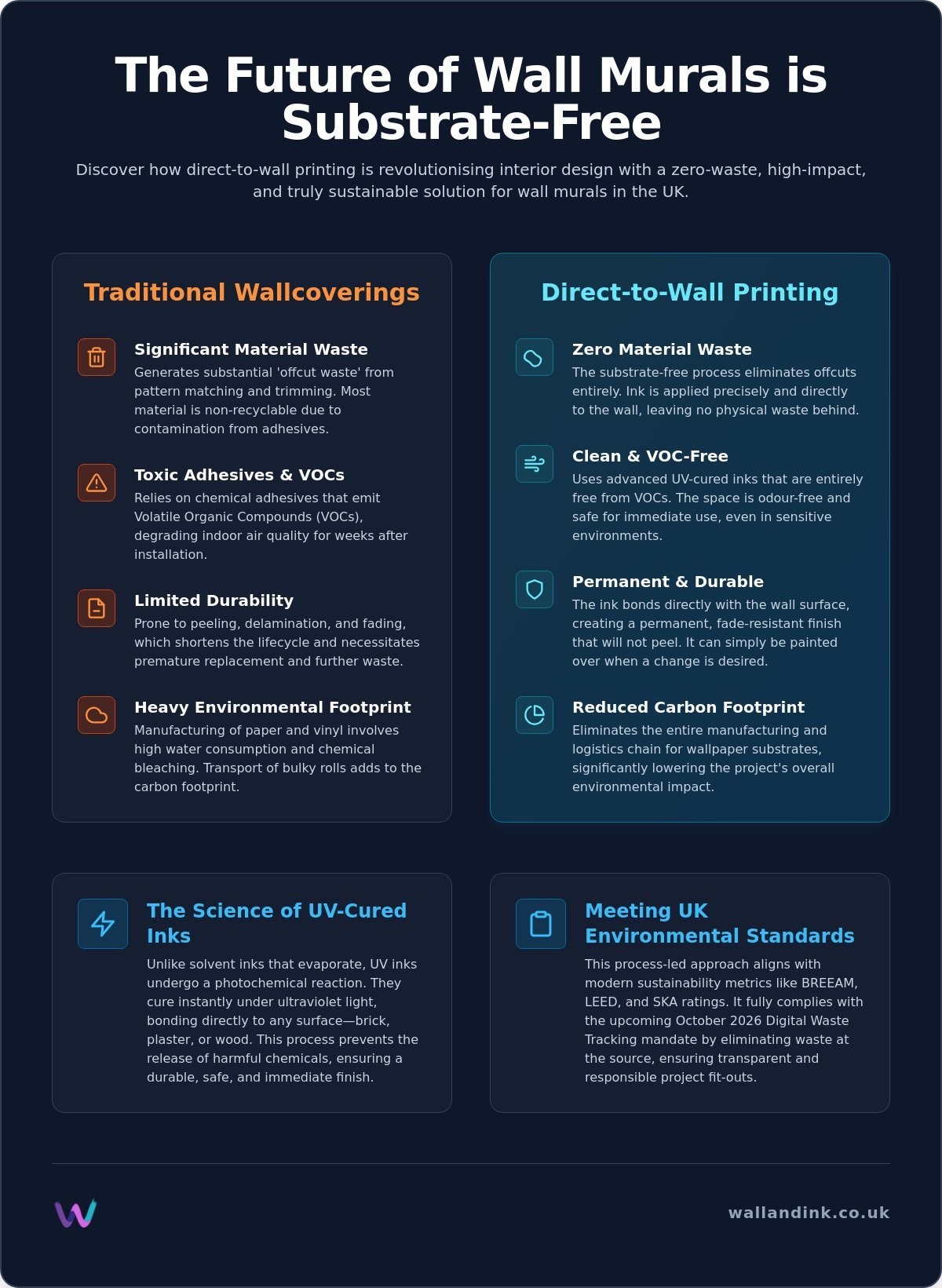
Traditional wallcoverings carry a heavy environmental tax. The manufacturing of vinyl and heavy-duty papers involves high water consumption and chemical bleaching. Once these materials arrive on-site, the problem intensifies. Standard wallpaper installation generates significant ‘offcut waste’ as patterns are matched and edges trimmed. Most of this material is non-recyclable due to adhesive contamination. These pastes don’t just create physical waste; they often emit Volatile Organic Compounds (VOCs) that degrade indoor air quality for weeks after the project finishes. It’s a cycle of manufacturing, transport, and disposal that modern projects can no longer justify.
UK Environmental Standards for Interior Graphics
UK environmental standards for interior graphics are increasingly stringent. Commercial spaces targeting LEED or SKA ratings must prove that their decor doesn’t compromise air quality or contribute to landfill. VOC limits in British offices and schools are now a primary concern for facility managers. By choosing a substrate-free method, you bypass the issues of peeling and delamination that plague traditional ‘eco’ papers. End-of-life considerations are also simpler. Instead of stripping and disposing of contaminated vinyl, a direct-to-wall print can simply be painted over when a design refresh is required. This leaves zero material waste behind and ensures your project remains compliant with the latest UK SRS S1 and S2 reporting frameworks.
Direct-to-Wall Printing: The Future of Eco-Friendly Murals
Direct-to-wall printing represents a fundamental shift in how we approach large-scale decor. Most “eco-friendly” solutions still rely on physical substrates, but this technology removes the middleman entirely. By printing directly onto the wall, you eliminate the need for PVC-based vinyls and heavy paper stocks. This immediately reduces the carbon footprint of your project by cutting out the manufacturing and heavy-duty logistics required for bulky rolls of wallpaper. Direct-to-wall printing provides a superior framework for sustainable wall murals UK based projects by removing the physical waste associated with traditional paper stocks. It’s a precision-led alternative that only uses the exact amount of ink required for the design.
The Science of UV-Cured Inks
Unlike solvent-based inks that rely on evaporation, UV-cured inks undergo a photochemical reaction. They cure instantly under ultraviolet light, which prevents the release of harmful chemicals into the air. This is crucial for compliance with UK regulations on VOCs, ensuring that indoor environments remain safe and odour-free immediately after application. This instant curing is a primary reason why direct-to-wall printing is preferred in high-stakes environments like hospitals and schools. Because the ink bonds directly with the substrate, whether it’s brick, plaster, or wood, the result is incredibly durable. You won’t face the common problem of edges peeling or colours fading, which extends the lifecycle of the art and prevents premature replacement.
Zero-Waste Installation Processes
The installation phase is where traditional murals often fail their sustainability tests. Traditional wallpaper requires plastic packaging, transport-heavy rolls, and significant water use for mixing pastes. Direct-to-wall printing bypasses these hassles. There are no offcuts to dispose of and no chemical strippers required for future removal. The process is remarkably clean; it generates no dust and leaves no scraps behind. This efficiency makes it an ideal choice for operational commercial spaces where downtime must be minimised. For those looking to implement sustainable wall murals UK wide, exploring Direct-to-Wall Printing with a specialist team ensures your project meets modern environmental standards without compromising on visual quality.
Comparing Traditional Murals vs. Direct-to-Wall Methods
Choosing sustainable wall murals UK wide requires a technical understanding of how different application methods interact with the building’s structure. Traditional murals are typically multi-layered systems consisting of a paper or vinyl substrate, a chemical adhesive, and a surface ink. This layered approach creates a non-permeable barrier that can trap moisture behind the material, leading to delamination or mould growth in older British masonry. Direct-to-wall printing replaces this complex assembly with a single, high-precision layer of UV-cured ink. Because the ink bonds directly to the substrate without an intermediate film, the wall maintains its natural vapour permeability, protecting the long-term integrity of the surface.
The lifecycle of a mural also dictates its true environmental cost. Traditional wallpaper murals often face a ‘failure point’ at the seams, where heat and humidity cause peeling. Once a section begins to lift, the entire installation usually requires replacement. Direct-to-wall printing eliminates these failure points entirely. There are no edges to catch and no adhesives to dry out. This mechanical superiority ensures that the ‘cheapest’ initial option—often budget peel-and-stick vinyl—becomes the most wasteful over a five-year period due to the frequency of re-installation and landfill contributions.
Waste Generation and Carbon Footprint
A standard 20sqm wallpaper installation typically generates between 10% and 15% physical waste through offcuts and pattern matching. For a single project, this results in several kilograms of non-recyclable material destined for a skip. Direct-to-wall technology operates on a zero-waste principle; the machine prints only the pixels required for the design. The logistics advantage is equally significant. Shipping a digital file consumes negligible energy compared to the manufacturing, packaging, and heavy-goods transport required for physical rolls of wallpaper. This digital-first workflow aligns with the principles of sustainable interior design by reducing the total resource extraction required for every square metre of art.
Maintenance and Longevity in Commercial Spaces
In high-traffic UK environments, such as school corridors or retail centres, durability is a primary sustainability factor. Traditional paper murals are easily scuffed and difficult to clean without damaging the fibres. Direct-to-wall UV prints are scratch-resistant and can be wiped down with standard cleaning agents without loss of detail. When the design eventually needs to be updated, the process is straightforward. Instead of stripping layers of vinyl and scraping off toxic glue residues, you simply paint over the existing print. This clean re-decoration cycle eliminates the need for chemical strippers and ensures that no physical material enters the waste stream during a room refresh.
Planning Your Sustainable Mural Project in the UK
Successful implementation of sustainable wall murals UK wide requires a shift from purely decorative thinking to technical foresight. Longevity is the ultimate metric of sustainability. If a design remains relevant and intact for a decade rather than two years, the total environmental footprint is dramatically reduced. This planning phase involves selecting timeless aesthetics that resist fleeting trends, ensuring the installation doesn’t become obsolete. Coordinating with UK architects and interior designers early in the process ensures that the chosen method aligns with specific eco-compliance frameworks, such as BREEAM or SKA ratings, which are increasingly mandatory for commercial fit-outs.
Digital visualisation plays a critical role in waste reduction. By using high-resolution digital mockups, stakeholders can see exactly how a design interacts with the architectural features of a room before a single drop of ink is deployed. This precision eliminates creative errors and the need for costly, wasteful re-prints. It’s a methodical approach that prioritises accuracy over trial and error, reflecting the industrial reliability required in professional environments. When every detail is verified digitally, the physical execution becomes a seamless, zero-waste process.
Surface Preparation for Eco-Printing
One of the primary advantages of direct-to-wall technology is its ability to bond with raw substrates. Unlike traditional wallpaper, which requires smooth, primed surfaces and chemical sealants, UV-cured inks can be applied directly to bare plaster, brick, or wood. This preserves the natural texture of the building material whilst adding high-definition art. The key requirement is ensuring the wall is sufficiently dry; moisture levels must be monitored to ensure optimal ink adhesion without the use of toxic primers. This approach maintains the wall’s breathability and reduces the chemical load within the interior space.
Designing for Impact and Longevity
High-resolution digital art is essential for a professional finish that stands the test of time. Low-quality files lead to pixelation and dissatisfaction, which often results in premature re-decoration. Bespoke design consultations prevent this by tailoring the artwork to the specific dimensions and lighting conditions of the site. Bespoke design serves as the cornerstone of sustainable interior planning in 2026 by ensuring every installation is perfectly calibrated to the specific environment. To begin your project with technical precision, you can book a consultation for Direct-to-Wall Printing to discuss your specific surface and design requirements.
Wall & Ink: Leading the UK in Sustainable Wall Printing
Wall & Ink represents the modern standard for sustainable wall murals UK wide. We’ve replaced the traditional, waste-heavy wallpaper model with advanced UV printing technology that applies designs directly to your vertical surfaces. This industrial process ensures every project is executed with mechanical superiority, providing a permanent aesthetic solution that doesn’t rely on the temporary adhesives or plastics used by legacy providers. By removing the substrate, we remove the environmental burden, delivering results that are as durable as they are environmentally responsible.
Our commitment to industrial precision is reflected in our bespoke design and digital visualisation service. We don’t guess; we calculate. By creating accurate digital mockups before the printing process begins, we eliminate the creative errors that lead to wasted materials and project delays. This methodical approach ensures the final result meets the high standards required in professional environments, from corporate headquarters to high-traffic retail spaces. Our on-site philosophy is built on the total elimination of waste, ensuring no scraps, packaging, or offcuts enter the skip.
The Wall & Ink Process: From Concept to Clean Finish
Our process is designed for pragmatic decision-makers who value efficiency and high-quality results. It begins with a comprehensive consultation where we assess the substrate, whether it’s brick, wood, or bare plaster. We then move to the digital visualisation stage, ensuring the design fits the architectural context perfectly. Once approved, our specialists deploy our UV wall printing technology on-site. This method is preferred by UK schools and hospitals because it’s odour-free and provides an instant cure, meaning spaces can return to operational use immediately. We operate with radical transparency, providing clear pricing structures that reflect the long-term value of a durable, low-maintenance installation.
Why Choose Us for Your Next Green Project?
Choosing Wall & Ink means eliminating the traditional hassles associated with wallpaper. You won’t deal with peeling edges, unsightly bubbles, or the guilt of discarded offcuts. Our substrate-free method ensures the only thing we leave behind is the art itself. From our central hub in Derby, we provide expert wall printing services across the entire United Kingdom, bringing industrial reliability to every sector. Whether you’re refreshing a private residence or managing a large-scale commercial fit-out, we provide the technical expertise to ensure your project complies with the highest environmental standards. Contact Wall & Ink today for a sustainable mural consultation to discuss how we can transform your space with precision and care.
Future-Proof Your Interior with Precision Wall Printing
Transitioning to a substrate-free model is the most effective way to meet the UK’s evolving environmental mandates. By bypassing the manufacturing and disposal cycles of traditional wallpaper, you secure a durable, high-impact aesthetic that remains compliant with BREEAM and UK SRS standards. This shift toward industrial precision ensures that your project generates zero physical waste whilst maintaining superior indoor air quality through the use of UV-cured inks. You don’t have to choose between aesthetic excellence and environmental responsibility when the technology exists to deliver both simultaneously.
Implementing sustainable wall murals UK wide is a strategic choice for long-term efficiency and durability. Our team provides the technical expertise and national reach required to deliver high-stakes professional environments with zero on-site disruption. Book your sustainable wall mural consultation with Wall & Ink to leverage our specialist UV ink technology and zero-waste on-site installation. Our national UK service coverage ensures that your next project is handled with the reliability and expertise your space deserves. It’s time to replace the persistent failures of traditional decor with a modern solution that respects your environment.
Frequently Asked Questions
Are your wall murals really more sustainable than recycled wallpaper?
Yes, our method is fundamentally more sustainable because it eliminates the physical substrate entirely. Recycled wallpaper still requires significant energy for manufacturing, transport weight, and the use of chemical adhesives for installation. By printing directly onto the wall, we use only the necessary ink and generate zero material waste. This approach provides a superior lifecycle for sustainable wall murals UK wide by removing the need for future stripping and landfill disposal.
What kind of inks do you use for your sustainable wall murals?
We utilise specialist UV-cured inks that are designed for industrial precision and environmental safety. These inks don’t rely on solvent evaporation to dry; instead, they undergo a photochemical reaction that cures them instantly under ultraviolet light. This process ensures a durable, scratch-resistant finish that bonds permanently with the wall surface without releasing harmful toxins into your indoor environment.
How long does a direct-to-wall printed mural last compared to traditional wallpaper?
Direct-to-wall prints typically outlast traditional wallpaper because they lack the structural failure points of paper or vinyl. Wallpaper often suffers from peeling at the seams or delamination due to adhesive failure over time. Our UV-stable inks are resistant to fading and mechanical wear, ensuring the artwork remains intact for as long as the wall surface itself. You won’t need to worry about the edges lifting or the colours dulling in high-traffic areas.
Can you print on eco-friendly substrates like bare plaster or reclaimed wood?
Our technology is highly versatile and bonds effectively with almost any vertical substrate. We frequently print directly onto bare plaster, brick, stone, and reclaimed wood without the need for traditional chemical primers. This capability allows you to maintain the natural texture and aesthetic of your building materials whilst adding high-definition graphics. It’s a clean process that respects the integrity of the original surface.
Is there any smell or off-gassing with your UV printing process?
There is no lingering smell or off-gassing period because the inks are cured instantly during the application. Traditional paints and wallpaper pastes often release Volatile Organic Compounds (VOCs) for days or weeks after installation. Our process is completely odour-free once the print head has passed, making it the safest choice for sensitive UK environments like hospitals, nurseries, and modern office centres.
How do I remove a direct-to-wall mural if I want to re-decorate sustainably?
Removal is achieved simply by painting over the mural with a standard emulsion. This is the ultimate sustainable re-decoration cycle; you don’t have to scrape off old paper, deal with glue residue, or dispose of large amounts of waste. Because the ink layer is incredibly thin, it doesn’t create a build-up of texture. You can refresh your space as often as needed without contributing to the millions of tonnes of wallpaper waste sent to UK landfills annually.
Do your sustainable murals meet UK building and fire safety regulations?
Yes, our direct-to-wall printing method fully complies with UK building and fire safety standards. Unlike traditional wallpaper or vinyl decals, which add a combustible layer to the wall, our thin ink layer doesn’t alter the fire rating of the underlying substrate. This makes it a technically superior choice for commercial corridors and public spaces where strict safety compliance is a non-negotiable requirement.
Can I use my own eco-themed designs for a custom wall print?
We encourage the use of bespoke designs to ensure your project meets your specific aesthetic goals. You can provide your own high-resolution files, and our digital visualisation service will ensure the design is perfectly scaled for your wall dimensions. This bespoke approach is a core part of delivering high-quality sustainable wall murals UK wide, ensuring the final result is exactly what you require without the waste of trial and error.