
Traditional wallpaper and vinyl wraps are no longer the gold standard for high-traffic commercial or residential interiors. These wall printing case studies across the UK prove that direct-to-wall UV technology is the superior technical solution for decision-makers who prioritise industrial precision over temporary fixes. We recognise the common anxieties surrounding interior transformations, particularly the fear of poor-quality finishes, the inconvenience of lengthy installation downtime, and uncertainty about how ink behaves on challenging surfaces like brick or plaster.
By examining these successful applications, you’ll see exactly how direct-to-wall UV printing solves complex design challenges whilst delivering high-impact results. We’ll provide the visual inspiration you need for your own space alongside the technical reassurance that our cured-ink process is built for durability. This preview of our end-to-end service journey shows how we eliminate traditional decorating hassles. We move from a digital concept to a permanent, wipeable finish with total transparency and expert reliability, ensuring every project meets the rigorous standards of a modern professional environment.
Key Takeaways
- Learn how direct-to-wall printing eliminates the common failure points of traditional wallpaper by using UV ink technology for instant curing and a clean installation.
- Discover how bespoke commercial murals enhance brand identity and employee wellbeing whilst providing a durable, high-impact alternative to vinyl wraps.
- Review our wall printing case studies to understand how wipeable, precision designs solve the unique maintenance challenges of high-traffic educational and healthcare zones.
- Understand the technical process of printing on complex substrates, including brick and fresh plaster, to achieve high-quality results in residential spaces.
- Identify the essential steps for planning your project, from substrate assessment to defining clear functional objectives for your environment.
The Value of Direct-to-Wall Printing Case Studies in 2026
Direct-to-wall printing is a technical solution to legacy design problems. It’s a fundamental shift in how we treat interior surfaces. Decision-makers need more than just aesthetic promises; they require industrial-grade proof. Reviewing recent wall printing case studies provides the data necessary to move beyond traditional decorating methods that often fail under pressure. We don’t just offer art; we provide a precision-engineered application that eliminates the common failure points of wallpaper and vinyl.
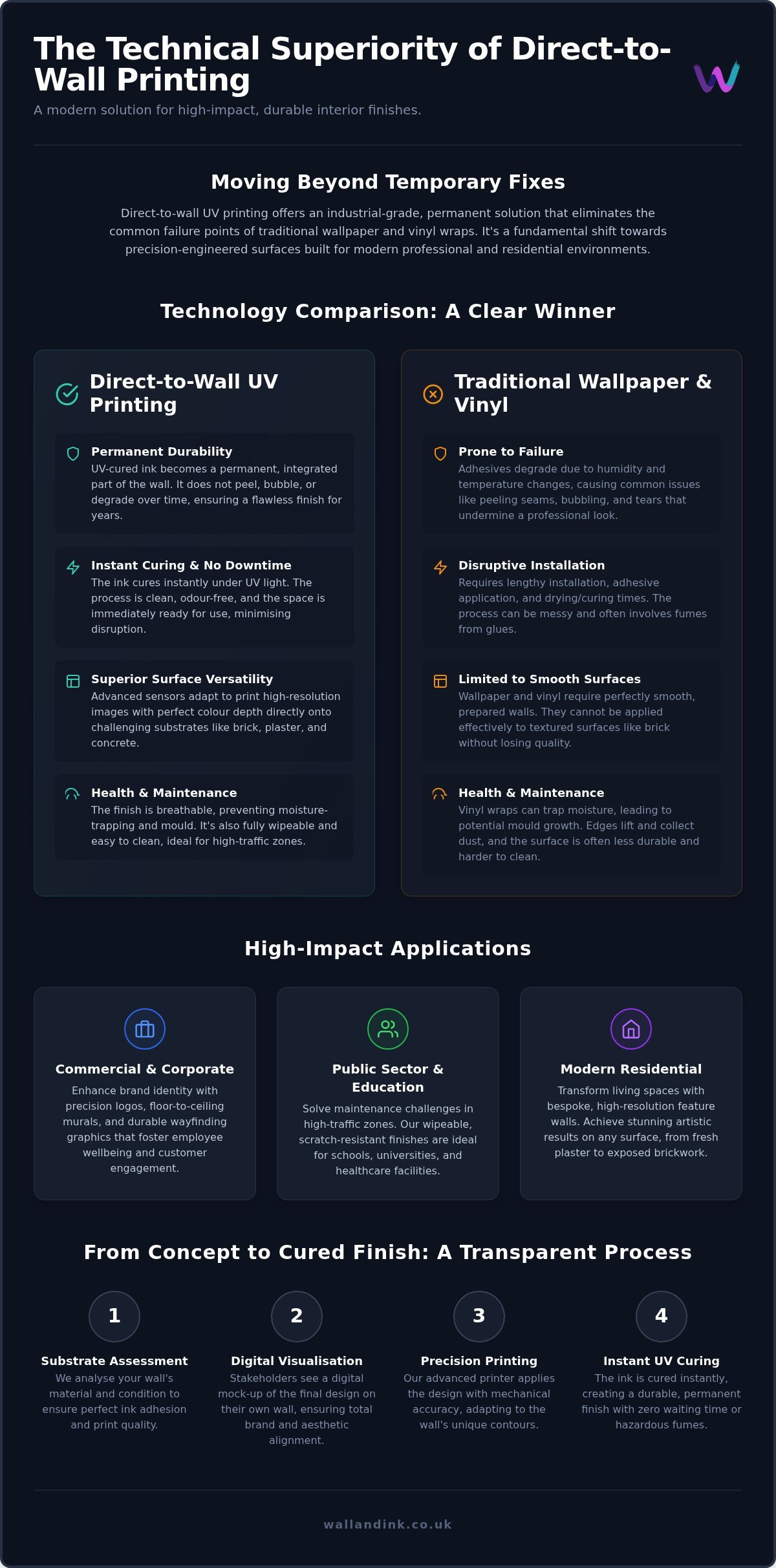
Wallpaper relies on organic adhesives that degrade over time. These bonds are susceptible to temperature fluctuations and humidity, leading to unsightly peeling or bubbling. Direct-to-wall printing bypasses these issues entirely. By applying UV-cured ink directly onto the substrate, the image becomes a permanent part of the surface. This process utilises advanced digital printing technology to ensure that every pixel is placed with mechanical accuracy. The result is a finish that doesn’t just look better; it performs better in high-traffic UK environments.
Why Visual Evidence Matters for UV Printing
Static descriptions can’t capture the way UV ink interacts with textured surfaces. Our wall printing case studies demonstrate how the printer’s sensors adapt to the contours of bare plaster or uneven brickwork. Seeing a high-resolution mural maintain its colour depth across a massive architectural feature provides the confidence that digital visualisation alone cannot. It proves that the scale and proportion of the design will remain consistent, whether the project is a small residential feature or a sprawling commercial installation.
The Shift from Vinyl to Direct-to-Wall Solutions
Vinyl wraps and decals have long been the default for commercial branding, yet they carry significant drawbacks. They trap moisture behind the plastic layer, which can lead to mould growth in older UK properties. Our direct-to-wall method is breathable and far more durable. Real-world examples frequently highlight the removal of damaged vinyl in favour of our wipeable, UV-stable prints. Whilst vinyl edges eventually lift and collect dust, a direct print remains flush and pristine. This shift reflects a move towards permanent, high-quality assets that offer a better return on investment over the building’s lifecycle.
Commercial Case Studies: Enhancing Brand Identity and ROI
Commercial interiors are high-stakes environments where every square metre must justify its presence. Traditional methods like vinyl decals or hand-painted murals often involve disruptive timelines, toxic fumes, or peeling edges that undermine a professional image. These wall printing case studies highlight a cleaner, more efficient alternative for UK businesses. We apply UV-cured ink directly to the surface, ensuring millimetre-perfect precision for corporate logos and brand colours whilst maintaining a clean, odour-free site.
The return on investment for direct-to-wall printing is found in both durability and speed. Since the ink cures instantly under UV light, there is no waiting period for drying. This allows for immediate use of the space. Pragmatic decision-makers value this industrial reliability, as it eliminates the recurring costs associated with repairing torn wallpaper or bubbling vinyl. Our process turns static walls into functional assets that reinforce corporate culture and drive customer engagement.
Office Rebranding and Corporate Murals
Decision-makers prioritise certainty over guesswork. Our process includes digital visualisation, allowing stakeholders to see the final result overlaid on their own walls before the project begins. This ensures total brand alignment. In one boardroom project, we converted a sterile, white space into a creative hub using a floor-to-ceiling high-resolution mural. The impact on employee wellbeing is often immediate; vibrant, purposeful environments foster better focus and collaboration. For larger complexes, we integrate wayfinding graphics that are as durable as they are clear, ensuring a seamless journey for visitors and staff alike.
Retail and Hospitality: Driving Footfall
Retailers and restaurateurs use wall printing to drive footfall through “Instagrammable” features that encourage social sharing. These spaces require frequent updates to remain relevant to shifting trends. Unlike wallpaper, which involves a messy removal process, our UV prints can be overprinted or updated with minimal fuss. One high-end boutique case study demonstrated how we enhanced the customer experience by printing bespoke digital art directly onto a textured masonry feature wall. The result was a premium finish that traditional stickers simply cannot replicate. If you are looking to modernise your premises without the typical construction mess, you can explore our commercial wall murals to see how we streamline the installation process.
A critical advantage for any active business is the lack of operational downtime. Our machines operate quietly and produce no VOCs or unpleasant odours. This means we can work in active offices or retail centres without closing the doors to the public or relocating staff. This level of efficiency is a recurring theme in our wall printing case studies, proving that high-impact design doesn’t have to come at the cost of productivity.
Public Sector and Education: Durability in High-Traffic Zones
Public sector environments demand materials that withstand constant physical contact and rigorous cleaning schedules. Paper-based posters and vinyl stickers frequently fail in school corridors and hospital wards because they are easily torn, scratched, or defaced. These wall printing case studies demonstrate how direct-to-wall UV printing provides a resilient solution for these high-stakes settings. The UV-cured ink bonds to the substrate, creating a scratch-resistant surface that handles the daily wear and tear of thousands of passers-by without degrading.
The technical “why” behind choosing this method in the public sector centres on long-term asset protection. Whilst traditional displays require constant replacement, a direct-to-wall print is a permanent architectural feature. It remains flush with the wall, removing the edges that children might pick at or that trolleys might snag. This industrial reliability is why facility managers are shifting away from legacy alternatives in favour of a solution that requires zero maintenance beyond a standard wipe-down.
Educational Murals and Interactive Spaces
Schools prioritising corridor learning often struggle with the lifespan of traditional paper displays. By printing maps, timelines, and complex scientific diagrams directly onto plaster, we eliminate the need for glass frames or plastic lamination. This significantly reduces maintenance costs over the school year. One case study in a primary education setting showed that interactive learning walls remain pristine even when students frequently touch the diagrams. The vibrant, high-resolution art transforms sterile corridors into inspiring zones, which has a documented positive impact on student engagement and behaviour.
Healthcare and Wellbeing Environments
In healthcare, hygiene is non-negotiable. Our UV inks are non-toxic and odourless, which is essential for installation in active hospital wards or clinics. Unlike wallpaper, which has seams where bacteria can gather, direct-to-wall printing is seamless and entirely wipeable. Wall printing case studies within clinical environments highlight the use of biophilic design to reduce patient anxiety. The cured ink is durable enough to withstand industrial cleaning agents and frequent contact, ensuring that the environment remains both sterile and visually comforting for years. This precision-engineered approach ensures that aesthetics never compromise the strict safety and hygiene standards required in UK medical facilities.
Every project in these sectors is backed by the same commitment to precision and safety. We ensure all installations comply with relevant UKCA markings and safety standards, providing peace of mind for public sector decision-makers. By choosing a technical application over a decorative one, schools and hospitals can invest in their infrastructure with confidence, knowing the results are built to last in the most demanding environments.
Residential Case Studies: Bespoke Art for Modern Homes
Homeowners are increasingly moving away from mass-produced decor. They want something bespoke. Direct-to-wall printing allows for one-off digital art on surfaces that would reject traditional wallpaper. These wall printing case studies show how we handle brick, wood, and fresh plaster with the same industrial precision used in our commercial projects. We don’t just decorate; we apply a technical finish that respects the architectural integrity of your home. It’s a modern solution for those who value unique aesthetics without the fragility of legacy materials.
Unlike wallpaper, which requires extensive surface preparation and sanding, our technology adapts to the substrate’s texture. We can print directly onto exposed brickwork in a modern loft or onto a wooden feature wall in a traditional setting. The UV ink cures instantly. This means you don’t have the lingering smell of glue or the mess of paste. It’s a pragmatic choice for residents who value high-quality results without the typical disruption of a home renovation. Every project begins with a digital visualization to ensure the scale and colour are perfect before the first drop of ink touches the wall.
Feature Walls and Personalised Decor
In a recent project for a modern open-plan living area, we transformed a large partition wall into a high-definition gallery of personal travel photography. The client avoided the clutter of multiple frames whilst achieving a seamless, integrated look. Another case study involved a bespoke home cinema. We printed a dark, matte-finish cinematic mural that absorbed light correctly for the screen. The “clean room” advantage is vital here; we work without dust or liquids, protecting your expensive electronics and furniture. Our machines are compact enough to operate in domestic rooms, delivering millimetre-perfect detail that captures every nuance of the original digital file.
Kitchens and Bathrooms: Moisture Resistance
Humidity is the primary enemy of traditional wall coverings. Wallpaper peels in steam; vinyl can trap moisture against the plaster, leading to mould. Our UV ink is inherently moisture-resistant and durable. It doesn’t bubble or degrade in humid environments. We’ve successfully printed directly onto kitchen splashbacks, providing a wipeable surface that resists grease and heat. These wall printing case studies prove that even in the most demanding domestic zones, the print remains stable and vibrant. The result is a surface that’s easy to clean with standard household products, maintaining its precision-engineered finish for years.
If you want to upgrade your home with a permanent, precision-engineered design, you can view our residential wall art options to start your transformation. We provide the same expert reliability for private homes as we do for high-stakes professional environments, ensuring your living space reflects your personal standards.
Planning Your Project: Lessons from Our Case Studies
Reviewing wall printing case studies provides more than just visual inspiration; it offers a blueprint for technical success. You should begin by identifying your core objective. Commercial projects typically focus on branding and measurable ROI, whilst public sector installations prioritise durability in high-traffic zones. Residential projects usually centre on bespoke aesthetics. Defining this objective early ensures the technical execution matches the functional needs of the environment. We lead with this pragmatic approach to ensure every project delivers a high-impact result without the traditional hassles of decorating.
Substrate assessment is a fundamental stage of our process. We treat every surface, from bare plaster to painted masonry, as a unique substrate requiring specific calibration. Our specialists evaluate the wall’s texture and absorption to ensure the UV ink cures with mechanical accuracy. This focus on the physical reality of the trade ensures a permanent bond that traditional adhesives cannot replicate. Every successful project in our portfolio started with this level of technical scrutiny, ensuring the finish is as durable as it is precise.
Step-by-Step: From Brief to Print
A methodical approach ensures a clean installation with zero operational downtime. Our workflow moves through three distinct phases to guarantee the outcome. The initial consultation defines the scope and creative direction, aligning the digital art with your brand or personal goals. We then conduct a site assessment to verify the wall surface is ready for the UV application. Finally, we provide a digital mock-up. This allows you to see the exact scale and colour of the mural in your space before the printing begins, providing the certainty that modern decision-makers require.
Measuring Success and ROI
The value of direct-to-wall printing is found in its industrial reliability. When evaluating your project, consider the long-term cost savings over legacy alternatives like wallpaper or vinyl. Our prints don’t peel, bubble, or fade, which eliminates the recurring maintenance costs associated with traditional decorating. Beyond the hardware, the impact on employee productivity or customer retention in commercial spaces is a key metric for success. You can view our full gallery of national projects to see the diverse range of high-impact results we’ve delivered across the UK.
Future-Proof Your Interior with Technical Precision
These wall printing case studies confirm that direct-to-wall UV printing is the superior technical choice for modern UK interiors. We’ve demonstrated how our specialised method replaces the failures of legacy wallpaper and vinyl with a permanent, precision-engineered finish. By utilising UV ink technology for instant durability, we ensure that your murals are wipeable and scratch-resistant from the moment of installation. This process eliminates the traditional inconveniences of seams, peeling edges, and messy adhesives.
Our professional national installation service provides the expert reliability needed for high-stakes commercial environments and bespoke residential projects alike. We focus on delivering a clean, odour-free experience that respects your timeline and your space. You can now move beyond the limitations of traditional decorating with a solution built for longevity and high-impact results. Start your project with a bespoke design consultation today. We are ready to help you transform your walls into durable, high-resolution assets that reflect your professional standards.
Frequently Asked Questions
How long does a typical wall printing project take to complete?
Most standard projects are completed within a single working day. The exact duration depends on the complexity and resolution of your chosen design. Because our UV ink technology ensures instant curing, there is no drying time required. Your space is ready for immediate use as soon as the machine finishes the application.
Can you print over existing wallpaper or do I need to strip the wall?
We do not recommend printing over existing wallpaper. For a technically sound result and maximum durability, the wall should be stripped to a solid substrate like plaster or masonry. Printing on wallpaper risks the final image failing if the paper’s original adhesive begins to bubble or peel away from the wall over time.
Is the ink used in direct-to-wall printing safe for schools and hospitals?
Yes, the UV-cured inks we utilise are non-toxic and entirely odourless. They are perfectly suited for sensitive environments such as classrooms and clinical wards. As evidenced in our wall printing case studies, this technology is preferred in the public sector because it produces no VOCs and requires no messy liquids during the installation process.
What happens if I want to change the design in a few years?
You can simply paint over the existing design when you are ready for a change. Unlike vinyl decals or traditional wallpaper, there is no adhesive residue to scrape away or heat guns required for removal. Once you apply a standard primer and topcoat, the wall is returned to a blank state, ready for a new design or a different finish.
Does the wall need any special preparation before you arrive?
The wall surface must be clean, dry, and relatively flat before we begin. Any significant cracks or holes should be filled and sanded to ensure a smooth finish. Whilst we can print on various textures like brick or wood, a neutral-coloured and smooth substrate provides the highest level of colour precision and mechanical detail for the final print.
How durable is the print against scratches and cleaning products?
The cured ink is highly durable and resistant to both physical scratches and standard household cleaning agents. The UV-curing process creates a permanent bond with the substrate, resulting in a wipeable surface that excels in high-traffic zones. This industrial-grade reliability is a primary focus in our wall printing case studies, particularly for projects in corridors and retail spaces.
What is the maximum size you can print on a single wall?
We can print murals of almost any length, whilst the vertical height is typically limited by the machine’s rail system. Most standard installations can reach heights of up to 4 metres in a single pass. For larger architectural features, our specialists use a modular approach to ensure the design remains seamless and perfectly aligned across the entire surface area.
Do you provide the artwork or do I need to supply my own?
We offer a flexible service where you can either supply your own high-resolution digital files or utilise our bespoke design services. Our process includes digital visualisation to ensure the artwork is perfectly scaled for your specific wall dimensions. We work with you to verify the image quality and colour accuracy before any ink is applied to the substrate.