
Wallpaper was never really built to last. The seams appear within months, the edges begin to lift, and a bespoke design that once felt considered quickly starts to look compromised. If you’ve spent time and money transforming a space only to watch it slowly peel away from the wall, you already know the frustration that’s driving a quiet revolution in UK interiors.
Traditional methods have always asked you to accept a trade-off: tolerate visible joins, work around fixed dimensions, or manage a messy, disruptive installation. That trade-off is no longer necessary. Wall printing services UK businesses and homeowners are now turning to use advanced UV ink technology to print directly onto the wall itself, with no vinyl, no wallpaper, and no compromise on resolution or durability.
This guide covers everything you need to know about direct-to-wall UV printing: how the technology works, why it outperforms legacy alternatives, and what to expect from the process. Whether you’re specifying a commercial mural or transforming a residential space, the information ahead will help you make a confident, well-informed decision.
Key Takeaways
- Direct-to-wall UV printing applies high-resolution artwork directly onto the surface itself, eliminating the seams, peeling edges, and compromised finishes associated with traditional wallpaper.
- The technology works across a wide range of substrates — from bare plaster to brick and beyond — making wall printing services UK homeowners and businesses rely on genuinely versatile for almost any interior or exterior project.
- Commercial sectors including retail, hospitality, and education are seeing measurable benefits from bespoke murals, with research suggesting that considered environments directly influence behaviour and wellbeing.
- When assessed across durability, installation disruption, and long-term cost, direct-to-wall printing consistently outperforms both wallpaper and vinyl — particularly for larger or high-traffic spaces.
- Every Wall & Ink project follows a structured process from initial enquiry through to digital visualisation and final print, with nationwide coverage across the United Kingdom.
Understanding Wall Printing Services in the UK: A Modern Decor Revolution
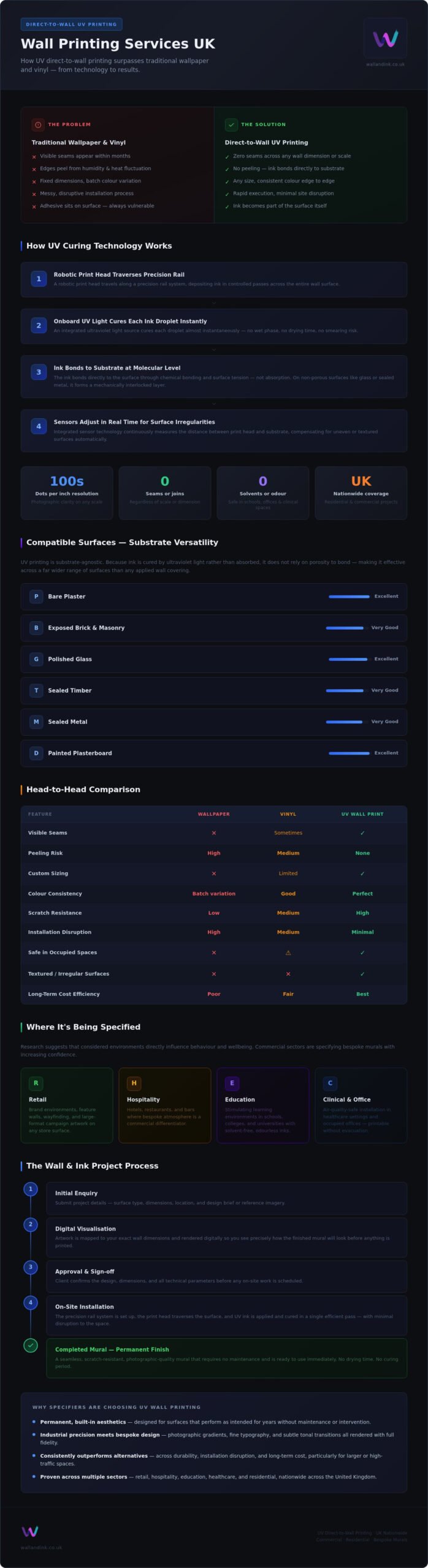
Direct-to-wall printing is a high-resolution inkjet process that applies artwork directly onto a vertical surface using UV-cured inks. No vinyl. No wallpaper. No intermediary material between the design and the substrate. A robotic print head travels along a precision rail system, depositing ink in controlled passes across the wall to build up a finished image with photographic clarity. The result is a permanent, seamless mural that becomes part of the surface itself.
That distinction matters. The technology doesn’t approximate what a traditional wall covering might achieve; it surpasses it at every measurable point, from resolution to longevity to installation speed.
The Technology Behind UV Direct-to-Wall Printing
The UV curing mechanism is what separates this process from conventional inkjet printing. As the print head deposits ink, an integrated ultraviolet light source cures each droplet almost instantaneously. There’s no wet phase, no drying time, and no risk of smearing. The ink bonds directly to the substrate at a molecular level, producing a scratch-resistant finish that doesn’t degrade with cleaning or heavy use.
Resolution capabilities typically reach into the hundreds of dots per inch, which means complex photographic gradients, fine typographic detail, and subtle tonal transitions are all rendered with precision. Colours remain consistent from edge to edge across even the largest surfaces, with none of the batch variation that affects printed wallpaper panels. The inks themselves are solvent-free and odourless, making installation practical in occupied spaces including schools, offices, and clinical environments where air quality and minimal disruption are non-negotiable.
Why the UK is Embracing Wall Printing Over Traditional Methods
The shift is being driven by a broader architectural preference for permanent, built-in aesthetics. Specifiers and interior designers across the UK are moving away from applied finishes that require ongoing maintenance, and towards surfaces that perform as designed for years without intervention. Wall printing services UK providers are responding to a market that’s grown impatient with the compromises wallpaper demands.
The practical advantages are straightforward:
- No seams or joins across any wall dimension, regardless of scale
- No peeling edges caused by humidity, heat fluctuation, or adhesive failure
- Rapid execution on large-scale commercial projects, with minimal site disruption
- Compatibility with almost any vertical surface, from smooth plaster to exposed brick
Industrial precision and bespoke design are no longer in tension. The process delivers both simultaneously, which is exactly why commercial clients across retail, hospitality, and education are specifying it with increasing confidence.
Versatility Across Substrates: Printing on Any Vertical Surface
One of the most persistent misconceptions about direct-to-wall printing is that it works best on smooth, freshly plastered surfaces. The reality is considerably more capable. UV printing technology is substrate-agnostic in a way that no applied wall covering can match, operating effectively across porous masonry, sealed timber, polished glass, and painted plasterboard alike.
The mechanism behind this versatility is the UV curing process itself. Because the ink is cured instantaneously by ultraviolet light rather than absorbed into the surface, it doesn’t rely on porosity to bond. On a non-porous material like glass or sealed metal, the cured ink forms a mechanically interlocked layer at a microscopic level, adhering through surface tension and chemical bonding rather than absorption. This is fundamentally different from how a vinyl decal or wallpaper adhesive behaves; those methods sit on top of the surface and are always vulnerable to the interface between material and adhesive. UV ink becomes part of the surface.
Surface irregularities are handled through integrated sensor technology within the print head assembly. As the machine traverses the wall, onboard sensors continuously measure the distance between the print head and the substrate, adjusting in real time to maintain a consistent output regardless of texture or undulation. Rough brickwork, textured render, and uneven plaster are all manageable. The print head compensates rather than struggles.
Preparation requirements vary by material, but the principle is consistent: the surface must be clean, structurally sound, and free of loose material. Porous substrates like bare brick or untreated plaster typically require a primer coat to stabilise the surface and prevent excessive ink absorption. Smooth substrates may need degreasing. Neither process is disruptive or time-consuming, and both are standard practice for wall printing services UK providers working across the full range of building types found in British commercial and residential stock.
Industrial Surfaces: Concrete, Brick, and Steel
Raw industrial materials present an aesthetic challenge that UV printing resolves without compromise. Exposed concrete, engineering brick, and powder-coated steel cladding all accept UV inks with strong adhesion, producing finished murals that sit within the texture of the material rather than masking it. The result is a design that feels considered rather than applied. For warehouses converted to retail use, urban hospitality venues, and industrial office spaces, this capability transforms surfaces that would otherwise remain visually inert. Exterior brickwork is equally viable, where UV-cured inks resist UV degradation, moisture, and temperature cycling far more reliably than any painted finish.
Domestic and Commercial Surfaces: Plaster, Wood, and Glass
Smooth plasterboard, whether bare or previously painted, is among the most straightforward substrates for direct-to-wall printing. The surface accepts ink evenly, and photographic-quality resolution is achievable without additional preparation beyond standard priming. Timber and wood panelling introduce natural grain variation that UV printing can work with rather than against, producing artwork that integrates with the material’s character. Glass partitions demand the greatest precision; the print head must maintain an exceptionally consistent distance from the surface to preserve edge definition and tonal accuracy. When executed correctly, the outcome on glass is visually striking and practically durable, with the cured ink resisting the cleaning regimes typical in commercial environments.
If you’re assessing a specific substrate and want to confirm suitability before committing to a project, speak to the Wall & Ink team for straightforward, technically grounded advice.
Commercial and Residential Applications: Transforming UK Spaces
Direct-to-wall printing isn’t a niche solution for a single type of space. It scales from a single feature wall in a family home to an entire corridor system in a national retail chain, with the same precision and the same seamless finish at every scale. The sectors benefiting most are those where environment directly influences behaviour: workplaces, homes, schools, and healthcare settings.
Elevating Business Environments with Commercial Wall Murals
First impressions are made before a word is spoken. A lobby printed with a high-resolution brand identity communicates confidence and permanence in a way that a framed poster or vinyl decal simply cannot. Boardrooms, reception areas, and open-plan offices all respond well to bespoke murals that reinforce brand values without requiring ongoing maintenance. Beyond branding, wall printing services UK businesses commission increasingly for wayfinding: large-format directional graphics printed directly onto corridor walls and stairwells are durable, impossible to peel, and far more visually coherent than signage systems mounted on brackets.
The productivity case is equally well-grounded. Research published by organisations including the World Green Building Council has linked considered workplace environments to measurable improvements in employee wellbeing and focus. A visually stimulating, deliberately designed workspace isn’t a luxury; it’s an operational decision.
Bespoke Residential Wall Art for Modern Homes
Residential applications are where design freedom is at its most personal. A high-resolution landscape printed across a lounge wall, a family photograph scaled to fill an entire bedroom, a geometric pattern that wraps a kitchen alcove: none of these require compromise on quality or scale. The scratch-resistant finish that UV curing produces is particularly valuable in family homes, where walls take punishment from children, pets, and daily life. Unlike wallpaper, there’s nothing to scuff, lift, or mark permanently. Cleaning is straightforward.
The bespoke nature of every project means the artwork is entirely original. No catalogues, no pre-set dimensions, no design that appears in someone else’s home.
Educational and Healthcare Settings
Schools and nurseries present a specific challenge: surfaces must be visually engaging, robust enough to survive heavy daily use, and safe for young children. UV-cured inks are solvent-free and odourless once cured, making them appropriate for occupied educational environments. Murals printed directly onto classroom and corridor walls withstand the kind of contact that would destroy applied finishes within months.
In healthcare settings, the hygienic properties are equally relevant. Direct-to-wall prints have no joins, no raised edges, and no surfaces where bacteria can accumulate behind a material layer. Clinical cleaning regimes, including the use of standard hospital-grade disinfectants, don’t compromise the finish. Waiting rooms and treatment corridors benefit from calming, considered imagery that reduces patient anxiety without introducing any infection control risk.
Wall Printing vs Wallpaper and Vinyl: A Comparative Analysis
The comparison deserves more than a bullet list. Most assessments of wall printing against traditional methods stop at “no seams, no peeling” and leave the reader to fill in the gaps. That’s not enough information to make a confident decision, particularly when the upfront cost of direct-to-wall printing prompts the obvious question: is it actually worth it?
The answer requires a framework. Durability, aesthetics, installation disruption, and long-term cost efficiency are the four dimensions that matter. Assessed across all four, direct-to-wall UV printing doesn’t just compete with wallpaper and vinyl; it makes both look like poor investments.
The most common objection is price. Direct-to-wall printing carries a higher upfront cost than standard wallpaper. That’s accurate. What the comparison routinely omits are the invisible costs that accumulate on the other side of the ledger: adhesive failure repairs, panel replacements after moisture damage, professional re-hanging fees, and the operational disruption of redecoration every few years. Wallpaper in a high-traffic commercial corridor may need replacing within two to three years. A UV-cured print on the same wall doesn’t.
Durability and Longevity in High-Traffic Areas
Vinyl decals, even premium-grade products, typically perform reliably for three to five years before edges begin to lift and colours start to shift. UV-cured prints bonded directly to the substrate are widely cited within the industry as lasting twelve years or more under normal interior conditions. The mechanism behind that longevity is lightfastness: the UV curing process that bonds the ink also stabilises it against ultraviolet degradation. Colours don’t bleach out in sunlit rooms. In public corridors, where abrasion from bags, trolleys, and general contact is constant, the scratch-resistant surface that UV curing produces outperforms any applied finish. There’s no laminate layer to scratch through, no vinyl surface to scuff permanently.
Maintenance, Cleanliness, and Environmental Impact
Cleaning a UV-printed wall is straightforward: wipe it down with a damp cloth or standard cleaning solution and the print is unaffected. There are no raised edges, no material joins, and no gaps where moisture or bacteria can accumulate behind a surface layer. For the wall printing services UK commercial clients rely on in food service, healthcare, and education, this isn’t a minor convenience; it’s a hygiene requirement that applied finishes structurally cannot meet.
The environmental case is equally clear. Traditional wallpaper installation generates significant chemical waste through adhesives, stripping agents, and disposal of failed panels. Direct-to-wall UV printing uses solvent-free inks, produces no off-cuts from pre-printed panels, and eliminates the adhesive chemistry entirely. Less waste. Fewer site consumables. A smaller material footprint per square metre.
When the full cost picture is drawn honestly, direct-to-wall printing isn’t the expensive option. It’s the one that stops costing money after installation. Talk to Wall & Ink about the long-term value of a UV-printed mural for your space.
The Wall & Ink Process: Delivering Precision Murals Nationwide
Most wall printing services UK clients encounter follow a frustratingly opaque process: submit a brief, receive a quote, hope the result matches expectations. Wall & Ink operates differently. The journey from initial enquiry to finished print is structured, transparent, and built around a single principle: no surprises on installation day.
National coverage is central to how the service is delivered. Wall & Ink works across the United Kingdom, from commercial projects in London and Manchester to residential commissions in rural Scotland. Geography doesn’t limit what’s possible, and the same technical standards apply regardless of location.
Bespoke Design Consultations and Digital Visualisation
The design phase is where Wall & Ink separates itself most clearly from competitors who treat the creative process as an afterthought. Every project begins with a structured consultation to understand the space, the brief, and the intended effect. From there, the team works your ideas into a print-ready digital format, resolving scale, colour calibration, and compositional balance before a single drop of ink is committed to the wall.
The digital mock-up is the most undervalued step in the entire process, and it’s one that most providers skip entirely. Wall & Ink produces a scaled visualisation that places the artwork within your actual space, so you can assess proportion, tonal weight, and detail at true scale before approving the final file. This matters particularly when adapting source material that wasn’t originally designed for large vertical surfaces: a brand logo built for a business card behaves differently at three metres wide, and bespoke photography requires careful resolution assessment and compositional cropping to perform at wall scale. These adjustments happen during visualisation, not after installation.
Professional On-Site Installation and Technical Standards
On installation day, the process is methodical and contained. The print system is set up, calibrated to the specific substrate, and printing begins. There’s no dust, no chemical odour, and no off-cuts left on the floor. UV-cured inks don’t require drying time, so the wall is effectively finished the moment the print head completes its final pass.
What clients consistently note is how unremarkable the installation is in the best possible sense. Occupied offices, open retail floors, and active school corridors have all been printed without requiring the space to close. The technicians are trained to work within live environments, and the equipment footprint is compact enough to operate without disrupting surrounding areas.
Before leaving site, the team conducts a thorough quality check across the full printed surface, verifying colour consistency, edge definition, and adhesion. Any technical questions are addressed directly with the client at handover, so you leave the process with complete confidence in what’s on your wall.
If you’re ready to move from concept to print, contact Wall & Ink to begin your project consultation.
Ready to Print Something Permanent?
Direct-to-wall UV printing resolves the three problems that applied finishes have never managed to solve: seams that compromise large-scale designs, edges that lift under real-world conditions, and finishes that require repeated replacement. The technology bonds directly to the substrate, works across almost any vertical surface, and produces results that genuinely last.
Wall printing services UK clients rely on from Wall & Ink combine that technical capability with a structured design process and nationwide coverage. Whether you’re specifying a commercial mural or transforming a single room, the outcome is a seamless, scratch-resistant finish with no mess during installation and no maintenance headaches afterwards.
The next step is straightforward. Request a bespoke quote for your UK wall printing project and the Wall & Ink team will guide you from initial brief through to digital visualisation, with complete transparency at every stage. Your walls are a permanent feature; they deserve a finish that performs accordingly.
Frequently Asked Questions About Wall Printing Services in the UK
How long does a wall print actually last?
A direct-to-wall UV print is widely cited within the industry as lasting twelve years or more under normal interior conditions. The UV curing process that bonds the ink to the substrate also stabilises it against colour degradation, so you won’t see bleaching in sunlit rooms or fading in high-traffic corridors. That lifespan significantly exceeds what wallpaper or vinyl decals deliver in comparable environments.
Exterior prints face harsher conditions, including moisture cycling and direct sunlight, but UV-cured inks are formulated to resist exactly these stresses. For exterior applications, longevity depends on substrate preparation and local climate, so it’s worth discussing your specific site conditions before committing to a project.
Can you print on uneven or textured walls like brick or breeze block?
Yes. The print head assembly uses integrated sensors to continuously measure its distance from the substrate and adjust in real time, which means surface irregularities don’t compromise the output. Exposed brick, rough render, and breeze block are all manageable. The finished result sits within the texture of the material rather than masking it, which often produces a more considered aesthetic than a smooth surface would.
Heavily friable or structurally compromised surfaces do require stabilisation before printing begins, but that’s a standard preparation step rather than a barrier to the project. Most textured substrates that are structurally sound are printable.
Is the ink used in wall printing safe for nurseries and hospitals?
UV-cured inks are solvent-free and odourless once cured, making them appropriate for occupied environments where air quality is a priority. Schools, nurseries, and clinical settings have all been printed without requiring the space to close or ventilate. There’s no wet phase, no off-gassing, and no chemical residue left on the surface after the print head completes its pass.
In healthcare settings specifically, the hygienic properties are practically relevant. A direct-to-wall print has no joins, no raised edges, and no gaps behind which bacteria can accumulate. Standard hospital-grade disinfectants don’t compromise the finish, which means the surface meets clinical cleaning requirements without any special treatment.
How much do wall printing services cost in the UK?
Pricing for wall printing services UK projects varies based on surface area, substrate type, design complexity, and location. Because every project is bespoke, there’s no fixed rate that applies universally. What’s consistent is that the upfront cost should be assessed against the full picture: no adhesive failure repairs, no panel replacements, no redecoration cycle every few years. Over time, a UV-printed wall typically costs less than the alternatives it replaces.
Wall & Ink provides transparent, project-specific quotes rather than hiding costs behind vague consultation requirements. The most straightforward way to get an accurate figure is to submit your brief directly, including the wall dimensions and substrate type, and receive a clear breakdown in return.
Can a wall print be removed or painted over if I change my mind?
A UV-cured print bonds directly to the substrate at a molecular level, so it can’t be peeled away like wallpaper or vinyl. It can, however, be painted over with standard wall paint, which effectively covers the design without requiring any specialist removal process. The surface preparation for repainting is no different from painting over any previously decorated wall.
For clients who want the option of future changes, it’s worth factoring this into the design brief from the outset. A primer coat or specific substrate preparation can influence how easily the surface accepts paint later, and the Wall & Ink team can advise on this during the consultation phase.
Does the wall need special preparation before the printing starts?
Preparation requirements depend on the substrate. Porous materials like bare plaster or untreated brick typically need a primer coat to stabilise the surface and prevent excessive ink absorption. Smooth, non-porous surfaces may simply need degreasing. Neither process is disruptive or time-consuming, and both are standard practice on every project.
The consistent requirement across all substrates is that the surface must be structurally sound, clean, and free of loose material. Flaking paint, damp patches, or crumbling render need addressing before printing begins, not because the technology can’t handle texture, but because no finish, applied or printed, performs reliably on a compromised substrate.
What is the maximum size of a direct-to-wall mural?
There’s no fixed upper limit on width. The print system traverses the wall on a precision rail, so the print area can extend across an entire wall face regardless of how wide it runs. Height is the more practical consideration; the equipment operates within a specific vertical range, and very tall walls may require the system to be repositioned to cover the full surface. This is a standard operational step rather than a technical limitation.
Large-scale commercial projects, including full corridor systems and multi-wall installations across an entire floor, are well within the scope of what direct-to-wall printing delivers. The seamless finish that makes the technology valuable at small scale becomes even more significant at large scale, where wallpaper joins would be immediately visible.
How long does the installation process take for a standard wall?
A single standard-sized feature wall, roughly three to four metres wide, typically takes a few hours to print from setup to completion. Larger surfaces take longer, but the process scales efficiently because the print head works methodically across the surface without requiring manual intervention between passes. There’s no drying time; UV inks cure instantaneously, so the wall is effectively finished the moment printing completes.
The practical implication is that installation is far less disruptive than traditional decorating. Occupied offices, active retail floors, and live school corridors have all been printed without closing the space. The equipment footprint is compact, the process is clean, and there are no consumables left on site afterwards.