
Traditional wallpaper and vinyl decals are no longer the gold standard for professional interiors; they’re a compromise. You’ve likely experienced the frustration of peeling edges, messy paste, or the significant downtime required for a standard office rebrand. It’s a common pain point for decision-makers who need high-impact visuals without the typical disruption. This is where wall printing uk technology shifts the narrative. By using direct-to-wall UV printers, we eliminate the need for adhesives and physical media entirely, providing a clean alternative to dated decorating methods.
You’ll discover how this advanced process delivers high-resolution murals that are scratch-resistant and instantly dry. We’ll explain why this method works on challenging substrates like brick, concrete, and plaster, providing a seamless finish that outlasts traditional alternatives. This guide covers everything from the technical precision of our proprietary equipment to the practicalities of a “no mess” installation. By the end, you’ll understand why modern UK businesses are moving away from vinyl in 2024 to ensure a durable, professional result with zero lingering odours.
Key Takeaways
- Understand how direct-to-wall technology eliminates the need for wallpaper, delivering high-resolution murals with no mess and absolute precision.
- Discover why UV-curable inks are the superior choice for durability, offering odourless and fade-resistant finishes safe for hospitals and schools.
- Compare the performance of wall printing uk against traditional vinyl and wallpaper to see why ink-to-substrate bonding prevents peeling.
- Learn which surfaces—including brick, glass, and plaster—are suitable for printing and how to ensure your wall is technically ready for application.
- Explore how bespoke murals can revolutionise commercial branding and educational environments through modern, industrial-grade visual storytelling.
What is Direct-to-Wall Printing? A Modern Solution for UK Interiors
Direct-to-wall printing is a high-resolution UV inkjet process that applies digital graphics directly onto vertical surfaces. It’s a precise, industrial-grade alternative to traditional decorative methods. Our “no wallpaper, no mess” mantra represents the core benefit for property owners who want high-impact visuals without the typical drawbacks of physical media. This technology facilitates a shift from repetitive wallpaper patterns to bespoke digital murals that fit the exact dimensions of a space. Whilst traditional wall coverings often suffer from visible joins, wall printing uk allows for a seamless, floor-to-ceiling finish that’s integrated into the room’s architecture.
The versatility of this method extends beyond simple painted plaster. The printer successfully handles various substrates, including brick, concrete, timber, and glass. By eliminating the need for adhesive backings, the finish is more durable and avoids the peeling or bubbling associated with vinyl. It’s a modern solution designed for those who value efficiency and long-term quality over temporary fixes.
The Technology Behind the Machine
The system relies on a combination of vertical rails and advanced laser sensors to maintain precision alignment during the printing process. These sensors detect surface irregularities 500 times per second, allowing the print head to adjust its depth with millimetre accuracy. This ensures that the image remains sharp even on textured or slightly curved walls. Much like the mechanisms found in Flatbed digital printers, our equipment uses specialised inks designed for immediate stability. UV wall printing uses ultraviolet light to instantly dry ink as it is applied, ensuring a smudge-proof finish. This means the printed surface is touch-dry and durable the moment the machine completes its pass.
Why the UK is Embracing Wall Printing in 2026
The demand for wall printing uk has surged as commercial sectors refine their “return to office” strategies. Research indicates that 82% of UK facility managers now prioritise bespoke branding to create more engaging, collaborative environments. Digital murals provide a professional, high-tech aesthetic that aligns with modern corporate identities. These installations serve as a permanent branding solution that doesn’t require the maintenance of traditional paint or wallpaper.
Residential trends have also shifted toward hyper-personalised feature walls. Homeowners are moving away from mass-produced designs in favour of unique, high-resolution imagery that reflects their personal style. Speed of execution is a major factor in this adoption. A detailed mural that requires five days of manual labour from a traditional artist is finished by our machine in under six hours. This efficiency makes it a pragmatic choice for busy UK households and commercial spaces that cannot afford lengthy downtime or the disruption of a messy installation site.
The Science of UV Ink: Durability, Colour, and Precision
The core of wall printing uk lies in UV-curable ink technology. Unlike traditional inkjet processes that rely on solvent evaporation, these inks undergo a rapid photochemical reaction. High-intensity ultraviolet lamps follow the print head, instantly polymerising the liquid into a durable solid. This curing process prevents the ink from spreading or soaking into porous substrates like plaster or brick. The result is a pin-sharp image with a resolution of up to 2880 dpi, delivering photographic quality that rivals high-end gallery prints.
Safety is a non-negotiable factor in commercial and public environments. These inks are entirely solvent-free and odourless. Because they don’t release volatile organic compounds (VOCs), they meet the stringent air quality requirements for NHS hospitals and UK primary schools. Once cured, the finish is exceptionally hard-wearing. It resists scratches and scuffs without the need for additional lamination or protective films. This durability ensures the mural remains intact in high-traffic corridors for over 12 years indoors.
- Lightfastness: UV inks are engineered to resist fading from sunlight, maintaining their integrity for up to 5 years in outdoor settings.
- Substrate Versatility: The technology bonds to glass, metal, wood, and concrete with equal precision.
- Instant Drying: Surfaces are touch-dry and ready for use the moment the machine finishes its pass.
Vibrant Colours and Lifelike Depth
Standard wall printing uses a CMYK+W system. The inclusion of white ink is vital; it acts as a primer on dark or textured surfaces, ensuring colours remain true and vibrant regardless of the base material. The printer’s precision allows for micro-layering, which can create subtle 3D-like textures and smooth gradients. This direct-to-wall approach eliminates the visible seams and peeling edges associated with vinyl, providing a seamless finish that integrates perfectly with the architecture.
Environmental Impact and Sustainability
Modern UK wall printing machines are designed for efficiency. A typical project consumes less energy than a standard household appliance, and because the ink is applied directly to the surface, there’s zero waste from wallpaper offcuts or backing paper. This “buy once” decor solution offers a lifespan of 10 plus years indoors, significantly reducing the carbon footprint compared to redecorating with traditional materials every few seasons. If you’re looking to upgrade your space responsibly, wall printing uk offers a cleaner, more sustainable alternative to traditional renovation.
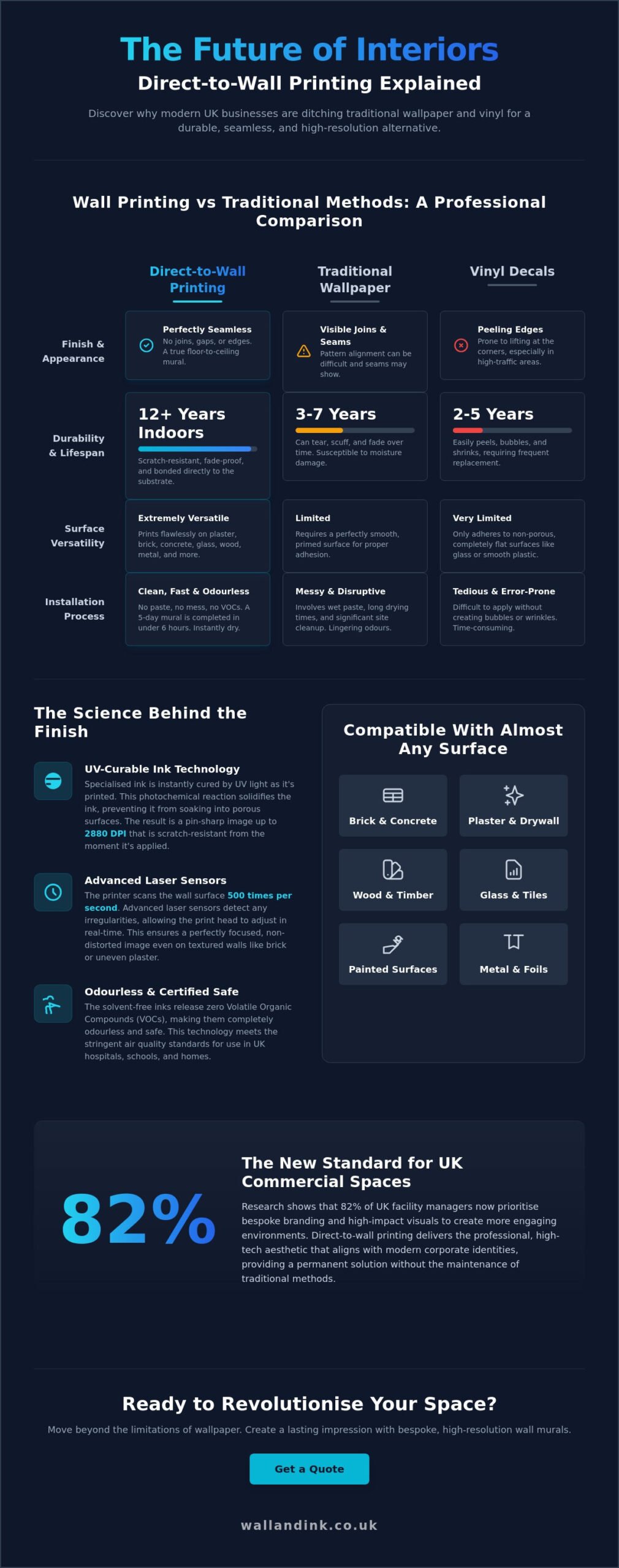
Wall Printing vs Wallpaper and Vinyl: The Professional Comparison
Choosing between traditional media and modern technology requires a look at long-term durability and installation logistics. While wallpaper and vinyl rely on adhesives, wall printing uk utilises a direct-to-wall process where UV-cured ink becomes part of the substrate itself. This mechanical bond eliminates the risk of peeling or edge-curling. It’s a permanent solution that remains breathable, which is vital for the integrity of the building’s surfaces. Because the ink is applied directly, there are no layers to delaminate or trap moisture.
When a design needs updating, the difference in maintenance becomes clear. Wallpaper requires hours of scraping and chemical steamers to remove stubborn glue. Vinyl often strips away layers of paint or plasterboard. With wall printing, you simply paint over the image as you would any other wall. It’s a clean, efficient transition that fits the needs of busy commercial environments. For large-scale murals exceeding 10 square metres, the transparency of the £120/m² pricing model often proves more cost-effective than high-end bespoke wallpaper, especially when factoring in the cost of professional decorators and specialist adhesives.
The aesthetic result is fundamentally different. Wall printing uk provides a seamless finish that physical rolls of paper simply cannot achieve. There are no vertical lines breaking up the image and no risk of the pattern shifting during the drying process. It is industrial precision applied to interior design.
The Problem with Traditional Wallpaper
Wallpaper introduces several points of failure in a professional setting. Seam visibility is inevitable, especially in large-scale murals where pattern matching errors of even 1mm can ruin the visual impact. In the UK, fluctuating humidity levels often cause adhesive to dry out or crystallise; this leads to unsightly bubbling and lifting at the corners. The “wet” installation process also creates significant disruption. Busy offices or retail spaces can’t easily accommodate the mess of paste and the long drying times required for a high-quality finish. No wallpaper, no mess.
Why Vinyl Decals Fall Short
Vinyl wraps frequently suffer from a “plastic look” that reflects harsh overhead lighting, creating glare that obscures the artwork. Because vinyl is a non-porous film, it masks the natural character of the wall. If you have a feature brick, concrete, or timber surface, vinyl hides that texture under a flat sheet of plastic. Removing these decals is equally problematic. The high-tack adhesives often pull away the underlying paint, necessitating a full skim and repaint. Our printing process maintains the tactile feel of the substrate whilst delivering high-resolution detail without the synthetic sheen.
Surface Preparation: Printing on Plaster, Brick, and Glass
Precision in wall printing uk starts long before the machine arrives on site. To achieve the industrial grade finish Wall & Ink is known for, the substrate must meet specific technical standards. Our technology is compatible with a wide range of surfaces including:
- Painted plaster and drywall
- Exposed brickwork and breeze blocks
- Polished or raw concrete
- Timber, plywood, and MDF
- Ceramic tiles and glass
- Metallic and magnetic surfaces
A wall ready surface requires two primary conditions: flatness and cleanliness. The wall shouldn’t deviate by more than 3mm over the print area to ensure the print head maintains a consistent distance. Every surface must be free from loose debris, dust, or oils. Before the physical work begins, we conduct a digital visualisation phase. We overlay your chosen design onto a high resolution photograph of your specific wall. This process eliminates guesswork and ensures the scale and positioning are perfect.
Expert Guide: Printing on New Plaster
Fresh plaster acts as a sponge. Printing directly onto it results in dull colours and poor durability. A mist coat, which is a mixture of 70% emulsion and 30% water, is mandatory to seal the surface. You must allow at least 28 days for new plaster to cure fully before we begin the wall printing uk process. If the wall feels cold or shows dark patches, it’s still holding moisture. “For optimal ink adhesion, new plaster must be fully cured and sealed with a high-quality breathable emulsion.”
Handling Challenging Textures
Textured surfaces like brick or industrial concrete don’t require sanding or smoothing. Our printers utilise dual ultrasonic sensors to map the wall’s topography in real time. As the machine moves, the print head automatically adjusts its depth to account for mortar lines or uneven concrete peaks. This maintains a sharp focus even on rugged textures. On industrial concrete, the ink settles into the natural pits of the material, creating a high impact aesthetic that looks like it was painted by hand. For metallic or magnetic surfaces, we use specific ink settings to manage the different surface tensions, ensuring the final image is crisp and durable.
Ensure your surface is ready for a high impact mural by consulting our technical preparation guide.
Transforming Spaces: Commercial and Residential Applications
Wall printing uk technology offers a level of precision that traditional hand-painting or wallpaper cannot match. The process uses UV-cured inks that bond instantly to the substrate. This ensures a durable, high-resolution finish on plaster, brick, or concrete. It’s a modern solution for those who require professional results without the logistical delays or the mess of conventional decorating.
Office and Retail Branding
Corporate environments rely on brand consistency. Our technology integrates company logos and specific brand colours with exact precision. Beyond simple logos, businesses use wall art to define specific “zones” within open-plan offices. A vibrant mural in a breakout area distinguishes it from the focused, neutral tones of a workstation zone. This visual cues help employees transition between different types of work throughout the day. You can find more details on direct to wall printing for business to see how these installations improve workplace culture.
In the education sector, schools are replacing sterile corridors with immersive learning murals. These graphics turn passive spaces into active educational tools. A 20-metre timeline in a history corridor or a floor-to-ceiling periodic table in a science lab creates an environment where students engage with information naturally. These installations are scratch-resistant and easy to clean, making them ideal for high-traffic school environments where durability is a priority.
Hospitality venues, including independent cafes and bars, use the technology to create unique backdrops. Because the printer handles uneven surfaces like exposed brick or timber, it creates an “Instagrammable” aesthetic that attracts footfall. It’s a practical way to enhance the customer experience without the long-term maintenance issues of peeling vinyl or fading paint.
Bespoke Art for the Modern Home
Residential projects often focus on the feature wall as a premium alternative to generic art prints. Unlike a framed picture, a direct-to-wall mural is scaled to the room’s exact dimensions. This is particularly effective for custom nurseries, bedroom murals, and even kitchen splashbacks on non-porous surfaces. The printer applies the ink directly, ensuring that the texture of the wall remains visible if desired, which adds a sophisticated, integrated look to the room.
The primary benefit for homeowners is the “no wallpaper, no mess” installation. There is no adhesive to dry and no off-gassing from traditional solvent-based paints. Most domestic projects are completed in a single day. The printer moves quietly and efficiently, leaving the room ready for immediate use. You can enquire about your custom wall mural project today to start the design process and receive a quote based on our transparent pricing model.
Future-Proof Your Space with Direct-to-Wall Technology
Traditional wallpaper and vinyl applications are being replaced by the precision of wall printing uk specialists. Choosing a direct-to-wall approach eliminates the risks of peeling edges and air bubbles common with manual adhesives. Our advanced UV ink technology ensures a high-resolution finish on challenging surfaces like brick, glass, and plaster, backed by a 10-year indoor guarantee for lasting durability.
Wall & Ink provides a modern solution that prioritises efficiency. We operate with a clear pricing structure starting from £120/m², ensuring you understand the investment from the outset. Because our process involves no wallpaper, no mess, and no disruption, your space remains functional throughout the installation. Whether you’re upgrading a commercial lobby or a residential feature wall, our hardware delivers a seamless result that hand-painted murals can’t match.
Ready to transform your environment with professional precision? Get a bespoke quote for your wall printing project today. We’re here to help you bring your vision to life with technical excellence.
Frequently Asked Questions
How much does wall printing cost in the UK?
Direct-to-wall printing costs start from £120 per square metre across the UK. This flat rate includes the full technical setup and the high-resolution application of your chosen design. Unlike traditional muralists who often charge variable daily rates or hidden fees, our transparent pricing model ensures you only pay for the exact dimensions of your wall. It’s a pragmatic, honest solution for commercial and residential project managers alike.
Can you print on any wall surface?
Our technology prints on almost any substrate, including brick, plaster, wood, glass, and concrete. The printer uses advanced sensors to maintain a consistent distance from the surface, even on uneven or textured materials. This allows for high-resolution results on substrates where wallpaper would typically fail to adhere or peel. Whether it’s a smooth office partition or a rough exterior brick wall, the finish remains sharp and professional.
How long does a wall-printed mural last?
A wall-printed mural lasts up to 15 years in indoor settings and approximately 5 years in outdoor environments. We utilise specialised UV-cured inks that are both scratch-resistant and fade-proof under direct sunlight. This level of durability makes our process a superior choice for high-traffic zones such as school corridors or retail centres. You get a long-term visual impact without the maintenance issues or the frequent repairs required by traditional paint.
Is wall printing better than wallpaper?
Wall printing is a superior alternative to wallpaper because it eliminates common failures like peeling seams, bubbling, and adhesive stains. Our “no wallpaper, no mess” mantra reflects the efficiency of a process that bonds ink directly to the wall. This creates a seamless, durable finish that withstands the daily wear of high-traffic British environments better than paper or vinyl. It’s also much faster to install and requires zero surface stripping.
Can I provide my own design for the wall printer?
You can provide any high-resolution digital file for your wall printing UK project, including JPEGs, PNGs, or vector files. We recommend a minimum resolution of 300 DPI to maintain industrial-grade precision when the image is scaled up. Our technicians review every design to ensure it meets the technical requirements for a sharp finish. If your file isn’t quite ready, we can help you adjust the specifications to guarantee the best result.
What happens if I want to remove the printed mural?
You can remove the mural by simply painting over it with two coats of standard emulsion. Because the ink is applied directly to the surface without messy adhesives, there’s no need for scraping, steaming, or chemical stripping. This makes it a practical solution for rented commercial units or residential spaces where decor needs to change every 2 or 3 years. It’s the cleanest way to update a space without damaging the underlying wall.
Is the ink used in wall printing safe and odourless?
We use eco-friendly, UV-cured inks that are 100% odourless and safe for all sensitive environments. These inks are dry the instant they’re printed, meaning a room can be occupied by staff or residents immediately after we finish the job. This is why our process is frequently chosen for hospitals, nurseries, and kitchens where air quality standards are strictly monitored. There’s no off-gassing and no lingering chemical smells to worry about.
How long does the actual printing process take?
The printing hardware typically covers between 2 and 4 square metres per hour depending on the complexity of the artwork. A standard residential feature wall is usually completed in less than 5 hours. This rapid execution significantly reduces the multi-day disruptions and site closures associated with traditional hand-painted murals or complex wallpapering. It’s a fast, efficient way to transform any professional space with minimal downtime for your business operations.