
Is the lowest quote for your feature wall actually the most expensive mistake you’ll make this year? When comparing wall printing vs wallpaper cost UK homeowners and facility managers often focus solely on the initial invoice. It’s frustrating to invest in designer wallpaper only to see edges peel in high-traffic corridors or bubbles appear after a few months. You likely want a bespoke finish that fits your exact wall dimensions without the recurring headache of maintenance or the hidden fees of professional decorators.
We understand that pragmatic decision-makers value industrial precision and long-term reliability over temporary fixes. This 2026 guide provides a comprehensive breakdown of the financial variables and technical factors that define the true cost of custom wall murals. You’ll gain a clear understanding of the total project expenditure by looking at the price-per-year-of-life rather than just the square-metre rate. We’ll compare the labour costs of traditional papering against the mechanical efficiency of direct-to-wall printing to help you find the best value for your space.
Key Takeaways
- Learn why direct-to-wall UV printing is replacing traditional wallpaper for high-traffic environments due to its superior mechanical durability and zero-maintenance finish.
- Discover how to calculate your project baseline by evaluating total square footage and design complexity, from simple corporate branding to high-resolution photographic murals.
- Analyse the long-term financial benefits of wall printing vs wallpaper cost UK by contrasting “all-in” technical fees against the hidden labour and repair costs of traditional alternatives.
- Use our professional checklist to accurately measure your space and categorise your project, ensuring a reliable and transparent quote for any bespoke mural.
- Understand the Wall & Ink approach to pricing, where design, technical application, and professional installation are integrated into a single, straightforward fee.
Understanding the True Cost of a Custom Wall Mural in the UK (2026)
Traditional interior design often relies on physical layers. Rolls of paper or sheets of vinyl are applied with adhesives that inevitably fail over time. Direct-to-wall UV printing represents a fundamental shift in how we approach large-scale graphics. By applying pigment directly to the substrate, the graphic becomes part of the wall itself rather than a temporary addition to it. This evolution is driven by a need for durability. UK property owners are increasingly moving away from “temporary” vinyl solutions that bubble and tear, opting instead for integrated technology that stands up to the rigours of high-traffic environments.
Evaluating wall printing vs wallpaper cost UK requires looking past the price of a single roll. Traditional wallpaper costs are often fragmented between material purchases, adhesive supplies, and the skilled labour required for professional hanging. Direct-to-wall printing simplifies this into project-based fees. You pay for a completed result rather than just the raw components. Modern UV ink technology ensures that these results remain vibrant for years without the need for touch-ups or edge-gluing, which significantly reduces your long-term maintenance spend. If you are exploring ways to fund these types of property improvements, I Need Cash can help by matching you with suitable personal or homeowner loan options.
The Evolution of Wall Art: Why Technology Dictates Price
Historically, creating a bespoke environment required hand-painting, a process that is both labour-intensive and prone to human error. When considering What is a mural? in a contemporary context, we must include digital precision. High-resolution digital visualisation allows you to see the final product before a single drop of ink hits the wall, eliminating the risk of costly design mistakes. The premium associated with a technical process comes from the use of UV-cured inks. These pigments dry instantly under ultraviolet light, creating a hardened, durable surface that traditional liquid paints or printed papers cannot match. Consistency is guaranteed. Every line is sharp. Every colour is exact.
Initial Investment vs Long-Term Asset Value
For UK businesses, a custom mural is a capital improvement rather than a decorative whim. It’s an investment in branding and environment that adds measurable value to a property. Choosing a seam-free finish is a pragmatic financial decision. Wallpaper often fails at the joins, especially in humid or poorly ventilated spaces. Because direct printing eliminates these seams entirely, it cannot peel or lift. This mechanical superiority ensures that your investment retains its aesthetic integrity for years, whilst traditional paper often requires replacement every few years in professional settings. This longevity shifts the wall printing vs wallpaper cost UK calculation in favour of the modern specialist who values efficiency and high-quality results.
Core Pricing Factors: What Influences the Final Quote?
Calculating the total project cost requires a move away from the “price per roll” mentality of traditional decorating. The primary baseline for any quote is the total square footage of the print area. Unlike wallpaper, where you often pay for offcuts and waste material to match patterns, direct-to-wall printing is precise. You only pay for the ink and machine time applied to the wall. The nature of the image itself plays a significant role. A simple corporate logo requires less technical processing than a high-resolution, full-bleed photographic mural that covers an entire atrium.
Architectural access is another critical variable. Standard vertical walls are straightforward, but high ceilings, stairwells, or awkward alcoves require specialised equipment or extended setup times. These technical factors influence the final fee. This is why a professional site survey is essential. We assess the physical environment to identify potential obstacles before they become costly delays. A thorough survey ensures that the final quote is accurate and transparent, reflecting the actual work required rather than a vague estimate. For a detailed breakdown of how these factors apply to your specific project, you can request a technical consultation to discuss your requirements.
Surface Material and Substrate Complexity
The substrate significantly impacts the preparation and application process. Smooth, skimmed plaster is the ideal canvas, but our technology allows for direct application on challenging surfaces where wallpaper would fail. Printing on textured brick or industrial concrete requires a different technical approach. These porous materials often necessitate specific technical primers to ensure perfect ink adhesion and colour vibrancy. When considering wall printing vs wallpaper cost UK, property owners must account for these substrate-specific requirements. Exterior wall printing also carries a unique price profile. These projects require weather-proof ink configurations and additional surface treatments to withstand the UK climate, ensuring the mural remains a long-term asset rather than a fading liability.
Design Development and Digital Visualisation Fees
Bespoke murals aren’t just about the print; they’re about the design’s integration with the space. Professional designers must adapt artwork to accommodate architectural features such as windows, doors, or light switches. A bespoke design consultation includes precise colour matching to existing branding and environment-specific scaling. This stage is vital for pragmatic decision-makers who value high-quality results. Digital mock-ups allow you to visualise the final result on your specific wall before the process begins. This “try before you buy” approach eliminates the risk of aesthetic dissatisfaction and ensures the final wall printing vs wallpaper cost UK reflects a project executed with total precision.
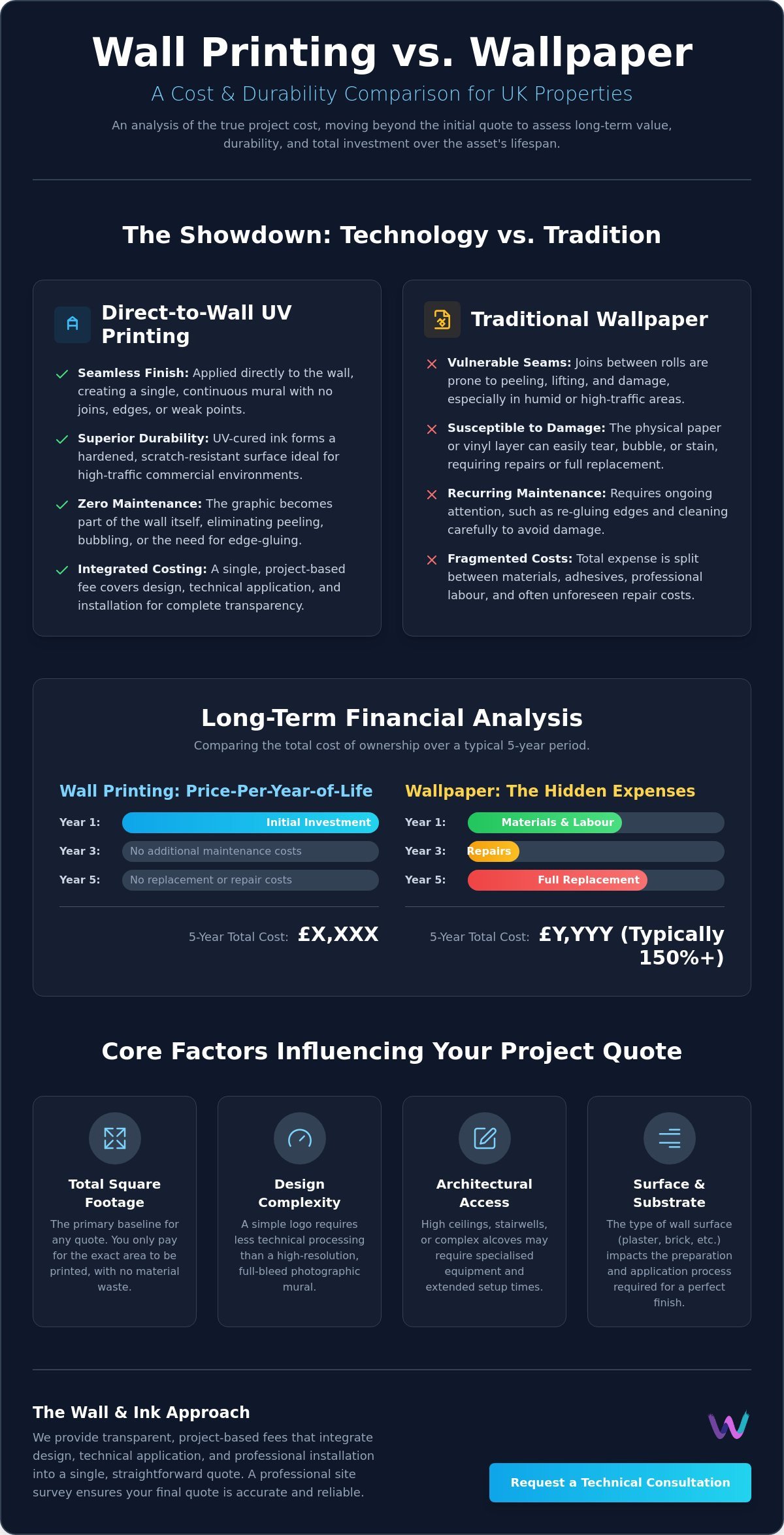
Comparative Analysis: Direct-to-Wall UV Printing vs Traditional Alternatives
A pragmatic assessment of wall printing vs wallpaper cost UK must look beyond the purchase price of the materials. Traditional wallpaper installation is notorious for hidden expenses that don’t appear on the initial roll price. You must account for specialist adhesives, professional hanging fees, and the standard 10% to 15% material waste required for pattern matching. Decorators in the UK typically charge day rates between £100 and £150, which can quickly inflate the final invoice for complex rooms. Direct-to-wall UV printing replaces these fragmented variables with a single, all-in project fee. This transparency allows for accurate budgeting and eliminates the risk of escalating labour costs.
Commercial facility managers prioritise UV printing for its zero-drying-time capability. Because the ink is cured instantly by ultraviolet lamps during the application process, rooms can be returned to service immediately. There’s no lingering chemical smell or wet adhesive to manage, which is vital for hospitality and healthcare sectors. When calculating the durability factor, the financial argument becomes even clearer. Indoor UV prints typically maintain their integrity for 5 to 10 years, whilst wallpaper in similar high-traffic environments often fades or peels within 2 to 4 years. This longevity ensures you receive significantly more years of life for every pound spent on the initial installation.
Why UV Printing Beats Wallpaper on Maintenance Costs
In high-traffic corridors or commercial kitchens, wallpaper is often a liability. It peels at the edges and absorbs moisture, leading to unsightly damage and hygiene concerns. UV-cured ink is a hardened, mechanical solution that bonds directly to the substrate. It eliminates the need for expensive protective varnishes or glass shields that are often required to protect traditional art from physical wear. The result is a durable, wipe-clean surface that withstands rigorous cleaning protocols. This reduces long-term commercial cleaning overheads and removes the recurring cost of patch-up repairs that plague paper-based alternatives.
Digital Precision vs Hand-Painted Variability
Hand-painted murals are subject to human error and significant time delays. An artist may spend several days or even weeks onsite, which increases the disruption costs for your business. Replicating brand-accurate colours is technically difficult with manual mixing, often leading to inconsistencies that require costly corrections. Digital UV technology ensures total colour accuracy and consistency across any number of walls. The speed advantage is undeniable; most projects are completed in a fraction of the time required for manual painting. By reducing onsite time, you lower your overall disruption costs, making it the more efficient choice for high-stakes professional environments.
Budgeting and Planning Your Mural Project
Accurate planning is the only way to ensure the wall printing vs wallpaper cost UK remains within your initial projections. Precision starts with measurement. You should record the height and width of your wall at the top, middle, and bottom. UK buildings, especially older properties, are rarely perfectly square. Identifying obstructions like light switches, radiators, or alarm sensors early prevents technical delays during the printing phase. A comprehensive checklist for your space should include:
- Triple-point measurements for width and height.
- Mapping of all fixed architectural elements.
- Assessment of the surface substrate and current finish.
- Verification of power outlet proximity for the printing equipment.
Categorising your project defines its technical scope and helps manage your budget. A Feature Wall acts as a high-impact focal point. Branding projects require strict adherence to corporate colour palettes and precise logo placement. Full-Room Immersive projects involve complex spatial mapping to ensure graphics wrap seamlessly around corners. A clear design brief is your primary tool for avoiding “scope creep.” Defining your resolution requirements and layout before the technical setup begins prevents the extra fees associated with late-stage revisions. To start your planning with professional guidance, you can book a site survey to assess your wall’s technical readiness.
Scheduling depends on seasonal demand. UK mural projects often peak during school holidays for educational settings or the lead-up to the April financial year-end for commercial clients. Planning four to six weeks in advance is recommended to ensure your project aligns with your internal deadlines. This proactive approach eliminates the stress of last-minute decorating and ensures a professional, hassle-free execution.
Preparing Your Wall for Professional Printing
The condition of your substrate directly impacts the final result. Starting with a clean, dry, and flat plaster surface is the most cost-effective approach. Whilst our technology can print on various materials, investing in professional skimming before the team arrives ensures a gallery-grade finish. It’s also vital to identify and rectify any damp issues during the planning phase. In the UK climate, moisture trapped behind wallpaper causes mould and peeling. Direct printing avoids these issues, but the wall must be structurally sound and dry to ensure the UV-cured ink bonds correctly to the surface.
Residential vs Commercial Budgeting
Budgeting requirements differ significantly between sectors. Schools and offices require higher mechanical resistance due to constant foot traffic and cleaning. Residential projects often focus on bespoke aesthetics for private homes. For those seeking a truly luxury finish, firms like Pianta Design often look for innovative solutions like wall printing to enhance high-end residential and yacht interiors. VAT is another critical consideration; UK business projects can often recover the 20% VAT, whilst residential art installations are usually a standard-rated cost for the homeowner. You can scale your project to fit a specific budget by adjusting the print density or selecting specific high-impact areas rather than a full-room wrap, ensuring you maintain visual impact without exceeding your financial limits.
The Wall & Ink Approach: Transparent Project-Based Fees
Wall & Ink operates with a policy of radical transparency. We reject the fragmented pricing models that define the traditional UK decorating industry. When property managers evaluate wall printing vs wallpaper cost UK, the most significant “hidden” expense is often the requirement to source and manage a separate specialist installer. Our approach eliminates this friction. We provide a single, project-based fee that integrates every stage of the process. This includes the initial technical assessment, design development, and the final mechanical application of UV-cured ink to your wall.
Our focus is on industrial precision. We don’t just sell a product; we provide a technical service designed to remove the hassles of peeling edges and adhesive failure. By treating each commission as a bespoke engineering project rather than a simple decorating task, we ensure that the final result is a permanent asset. This methodology is particularly valuable for those managing high-stakes professional environments where downtime must be minimised. You receive a professional finish with no visible seams, bubbles, or drying requirements. We invite you to request a bespoke quote tailored to your specific architectural substrate, whether you’re working with industrial concrete or high-spec plaster.
Our End-to-End Service Model
We manage the entire lifecycle of your mural. Our service begins with a digital consultation to evaluate your space and ends with on-site UV print execution. This end-to-end model ensures that our technical expertise is applied at every touchpoint, guaranteeing a right-first-time result even on complex or non-standard surfaces. Working with a UK-based specialist provides the benefit of national reach. We bring our specialised equipment directly to your location, maintaining consistent quality standards across multiple sites if required. This reliability is why we’re the preferred partner for organisations that value efficiency and high-quality results over legacy decorating methods.
Booking Your National Consultation
Starting your project is a straightforward process. To receive a rapid and accurate estimate, you simply need to provide clear photos of the intended wall and precise dimensions. During the digital visualisation phase, our designers will show you exactly how your artwork will interact with your space’s specific features. This transparency allows you to make informed decisions before any physical work begins. It’s a pragmatic, step-by-step journey from initial curiosity to final execution. Request your bespoke wall mural quote from Wall & Ink today.
Secure a Permanent Visual Asset for Your Environment
Pragmatic decision-makers understand that the real wall printing vs wallpaper cost UK is measured in years of service rather than the initial square-metre rate. We’ve analysed how traditional methods often lead to recurring repair costs and hidden labour fees. By choosing a technical solution that integrates design, print, and professional installation, you eliminate the typical hassles of peeling edges and moisture damage. This shift from temporary decoration to permanent capital improvement ensures your investment remains vibrant and intact for the long term.
Our process guarantees a right-first-time result through bespoke design visualisations and the use of UV-cured ink for maximum durability and scratch resistance. We provide a national UK service with professional on-site installation to ensure every project meets our standards of industrial precision. This end-to-end model provides the transparency and reliability required for high-stakes professional and private spaces alike.
Take the first step toward a maintenance-free mural by engaging with our technical specialists. Get a Professional Quote for Your Custom Wall Mural and discover the value of a transparent, expert-led approach to interior branding. We look forward to helping you transform your walls into durable, high-impact assets.
Frequently Asked Questions
How much does a custom wall mural cost per square metre in the UK?
Standard wall printing on smooth, light-coloured surfaces typically starts from £120 per square metre in the UK market. For darker or textured substrates that require an integrated white base layer, prices generally begin at £150 per square metre. Most professional providers apply a minimum job fee, often around £300, to cover the technical setup and transport of specialised equipment to your location.
Is direct-to-wall UV printing more expensive than traditional wallpaper?
Direct-to-wall printing often has a higher initial square-metre rate than budget wallpaper, but it eliminates fragmented costs like specialist adhesives and professional hanging fees. When evaluating the total wall printing vs wallpaper cost UK, printing is frequently more cost-effective for high-end bespoke murals. You pay a single integrated fee rather than managing separate material and labour invoices for a decorator.
Are there extra costs for printing on textured surfaces like brick or wood?
Printing on textured or porous surfaces like brick, wood, or concrete usually incurs a higher technical fee due to the requirement for a white base layer. This additional ink pass ensures colour vibrancy and proper adhesion on non-standard substrates. These surfaces also require specific technical primers to create a stable canvas for the UV-curable inks, ensuring the final image remains durable and sharp.
What is included in a professional wall mural quote?
A comprehensive quote includes the initial digital consultation, bespoke design visualisation, and the professional on-site execution of the print. Unlike traditional decorating quotes that often exclude materials or surface preparation advice, our project-based fees cover the specialised UV-curable inks and the mechanical application process. This “no hidden surprises” policy ensures you understand the total expenditure before the technical setup begins.
How long does a UV-printed wall mural last compared to wallpaper?
Indoor UV-printed murals are designed to maintain their integrity for 5 to 10 years without peeling or fading. In contrast, traditional wallpaper in high-traffic environments often shows signs of wear, such as lifting edges or scuffs, within 2 to 4 years. This superior durability significantly reduces the “price-per-year” cost, making direct printing a more sustainable financial asset for commercial and residential properties.
Can I provide my own artwork to reduce the design cost?
You can provide your own high-resolution files to streamline the design development phase of your project. Our technical team will assess the artwork to ensure it meets the necessary resolution and scaling requirements for your specific wall dimensions. Whilst this can reduce the design hours required, a small technical setup fee still applies to calibrate the image for the specific substrate and architectural features of your space.
Do you charge extra for travel to different parts of the UK?
Travel costs are typically integrated into your bespoke project quote based on your location within the UK. As a national service provider, we organise our schedule to minimise transport overheads for our clients wherever possible. The final quote clearly outlines all logistics fees, ensuring that whether your project is in a major city or a more remote area, the pricing remains transparent and predictable.
What happens if the wall needs preparation before the mural is printed?
The wall must be clean, dry, and structurally sound before the printing team arrives onsite to ensure perfect ink adhesion. If our initial technical survey identifies issues like damp or significant surface irregularities, we recommend rectifying these through professional skimming or moisture treatment first. Whilst we don’t provide general decorating services, we offer specific technical guidance on how to prepare your substrate to ensure a gallery-grade finish.