
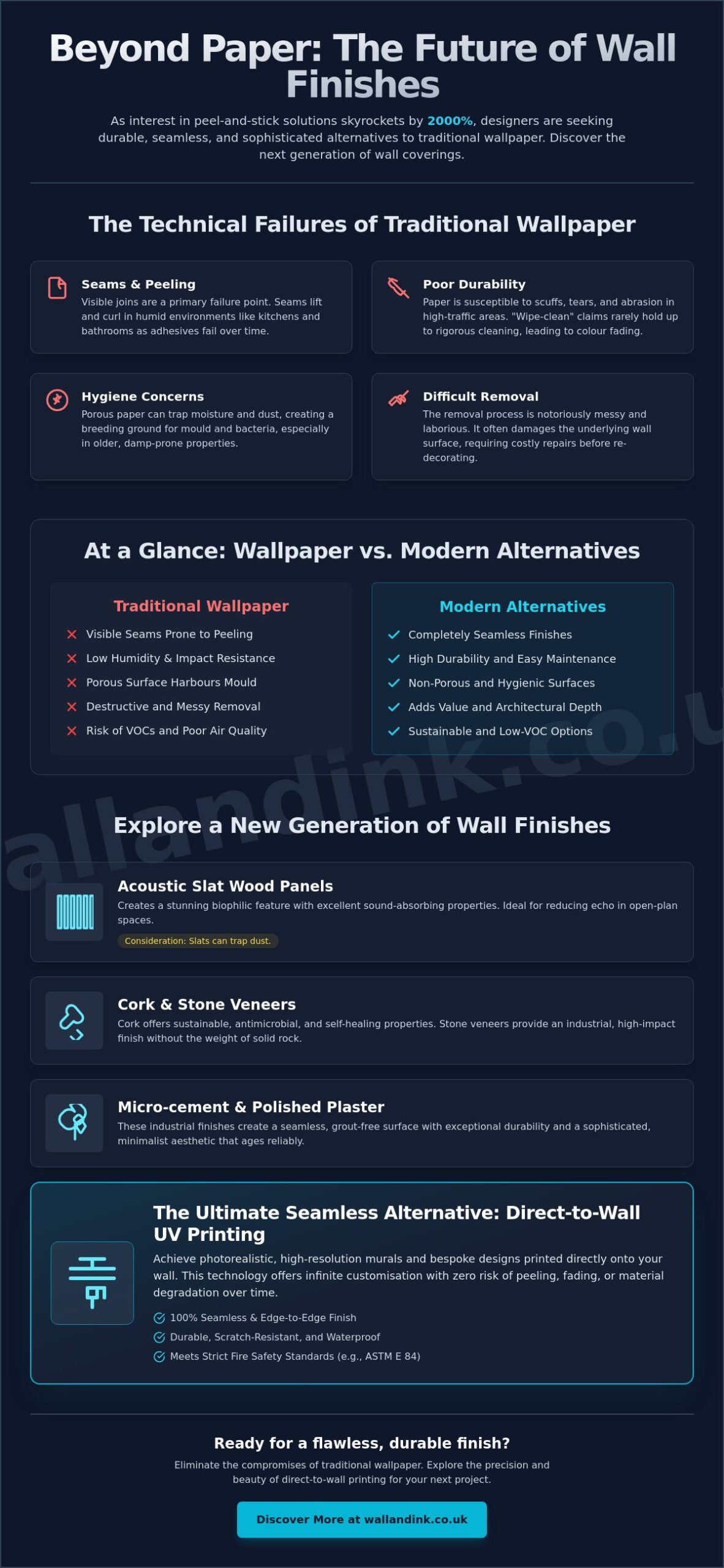
Did you know that interest in non-traditional wall coverings has surged, with Google Trends data from FineHomeKeeping showing a 2000% increase in peel-and-stick popularity over the last decade? This shift proves that property owners are moving away from the inherent limitations of paper. It’s a common frustration; you invest in a design only to watch seams lift in humid environments or struggle with the messy, destructive removal process of old paper. Generic, off-the-shelf patterns often lack the customisation required for a truly bespoke space.
You can achieve a high-impact, durable finish without these traditional compromises. This guide explores unique alternatives to wallpaper that offer industrial precision, seamless aesthetics, and long-term reliability. We’ll examine five modern solutions, ranging from tactile wood slat panels and sustainable cork to the precision of direct-to-wall printing, to help you choose a surface that meets both your aesthetic goals and strict fire safety standards such as ASTM E 84.
Key Takeaways
- Identify the technical failures of legacy wall coverings, such as lifting seams and humidity sensitivity, to prevent future maintenance costs.
- Evaluate the functional advantages of wood slat panels and cork; these solutions provide architectural depth whilst enhancing acoustic quality.
- Understand how industrial finishes like micro-cement and polished plaster create a seamless, high-durability surface that ages reliably.
- Discover unique alternatives to wallpaper such as direct-to-wall UV printing to achieve high-resolution murals with zero risk of material degradation.
- Learn to assess environmental factors like natural light and moisture levels to select the most effective finish for your specific substrate.
Why Modern Designers are Moving Away from Traditional Wallpaper
Traditional wallpaper is a legacy product that frequently fails the technical requirements of modern interior architecture. Whilst it provides aesthetic variety, the physical limitations of paper and adhesive-based systems create long-term maintenance liabilities. Professional designers now prioritise unique alternatives to wallpaper to eliminate these structural weaknesses. This shift is driven by the need for finishes that withstand the fluctuating humidity levels common in British homes and commercial properties.
The environmental footprint of different types of wallcoverings remains a significant concern for pragmatic decision-makers. Many standard rolls use PVC-based vinyls and chemical adhesives that emit volatile organic compounds (VOCs). These materials impact air quality and complicate the decommissioning of a space. Maintenance also presents a challenge. The promise of “wipe-clean” wallpaper rarely holds up under industrial cleaning protocols. Scrubbing often leads to surface abrasion or colour fading, which ruins the aesthetic in high-traffic zones.
The Problem with Seams and Peeling
Visible joins are the primary failure point in any paper-based installation. As wall substrates undergo thermal expansion, the tension on the paper causes edges to lift and curl amongst different wall substrates. This is most common in kitchens and bathrooms where steam accelerates adhesive failure. Repairing a single damaged section is technically difficult. Slight variations in batch dye lots mean a new strip won’t match the existing wall, often necessitating a full room strip-back.
Hygiene and Durability in High-Traffic Areas
In professional environments like schools and hospitals, hygiene is a critical specification. Traditional paper is porous and can trap moisture, leading to mould growth behind the surface in older UK properties. Modern designers specify non-porous, high-impact solutions for better daily wear resistance. These unique alternatives to wallpaper provide a seamless barrier that is easy to sanitise. They offer mechanical superiority over paper, which scuffs and tears under minimal pressure.
Tactile and Textural Alternatives: Wood, Cork, and Fabric
Modern interiors require more than just a flat pattern; they demand structural depth and functional benefits. Tactile materials provide unique alternatives to wallpaper by introducing physical texture that paper cannot replicate. Wood, cork, and fabric systems solve the “flatness” problem whilst offering technical advantages like sound absorption and thermal insulation. These luxurious alternatives to wallpaper transform a standard wall into an architectural feature through mechanical precision and material honesty.
The Rise of Acoustic Slat Wood Panels
Timber slat panels create a biophilic connection to nature, which is increasingly vital in urban spaces. The dual benefit of visual texture and noise reduction makes them a preferred choice for open-plan living. Most panels feature a felt backing that absorbs sound waves, significantly reducing reverberation. However, potential users must consider the maintenance profile. Unlike flat surfaces, deep-slat designs can trap dust within the recesses, requiring methodical cleaning with specialised vacuum attachments. Installation is a technical process; wood slat panels typically cost between $18 and $25 per square foot for materials alone and require a stable substrate to support their weight.
Natural Materials: Cork and Stone Veneers
Cork wall tiles have become a favourite for eco-conscious British renovators due to their sustainable and antimicrobial properties. Cork is naturally self-healing and hypoallergenic, making it a functional choice for home offices. For those seeking an industrial aesthetic, stone veneers provide the look of solid rock without the excessive weight. These veneers are lightweight enough for standard internal walls but offer high impact resistance. Maintenance for these natural fibres is straightforward but essential; regular sealing ensures the material remains non-porous and resistant to staining. If you require a bespoke mural without the physical depth of timber or stone, direct-to-wall printing offers a high-resolution, seamless solution.
Fabric walling and 3D panels represent the high end of the market. Fabric provides a traditional luxury method for sound dampening and warmth, whilst 3D panels create dramatic shadows through light play in modern centres. These systems are durable and offer a “wow” factor that off-the-shelf paper cannot achieve. Every choice must comply with fire safety standards, such as ASTM E 84, to ensure the interior remains safe and compliant with building codes.
Industrial and Architectural Finishes: Plaster, Cement, and Tiles
Industrial finishes represent a shift from decorative layers to structural permanence. Professional designers specify these unique alternatives to wallpaper when a project demands high durability and a seamless aesthetic. Unlike paper, which relies on surface-level adhesion, architectural finishes like polished plaster and micro-cement become part of the wall substrate itself. This integration eliminates the risk of lifting or bubbling, providing a reliable surface for high-traffic environments and professional centres.
Hand-applied Venetian plaster offers a marble-like finish that ages reliably over time. The process involves multiple layers of lime-based putty, resulting in a breathable surface that manages moisture better than synthetic wallcoverings. For those seeking a minimalist, industrial look, micro-cement serves as a versatile solution for both walls and floors. It’s the ultimate waterproof alternative for wet rooms and kitchens, where traditional paper would inevitably fail due to humidity and heat.
Seamless Finishes: Venetian Plaster and Micro-cement
Hand-applied finishes require a high level of technical skill. The artistry involved ensures that every wall is a one-of-a-kind installation. In terms of longevity, plaster finishes significantly outperform traditional options. Whilst a standard wallpaper may require replacement every five to seven years, a well-maintained plaster or cement finish can last for decades. This durability makes it a pragmatic choice for decision-makers who value long-term efficiency over temporary trends.
Tiles and Cladding Beyond the Bathroom
Textured porcelain tiles are no longer restricted to utility areas. Modern interiors now utilise large-format porcelain to create permanent feature walls in living and reception areas. These tiles reduce the number of visible grout lines, contributing to a cleaner, more expansive aesthetic. Selecting a colour-matched grout is essential; it ensures the transition between tiles is nearly invisible, mimicking a solid slab. This technique is one of the most effective unique alternatives to wallpaper for those prioritising mechanical superiority.
External-grade cladding is another robust option amongst modern wall finishes. Using these materials internally creates a seamless design flow between interior and exterior spaces. This approach is particularly effective in residential designs featuring large glass partitions. Exposed brickwork remains a classic choice for a rugged, timeless feature wall. It requires minimal maintenance and provides excellent impact resistance, making it suitable for both private and professional settings. All these materials must meet strict fire safety standards, such as a Class A rating under ASTM E 84, to ensure compliance in commercial and multi-unit buildings.
How to Choose the Right Alternative for Your Specific Space
Selecting from the available unique alternatives to wallpaper requires a methodical assessment of your environment. It isn’t merely a matter of visual preference; you must evaluate the technical performance of the substrate and the ambient conditions of the room. Light levels play a critical role in how a finish performs. Textural materials, such as 3D panels or wood slats, react dynamically to natural and artificial light by casting shadows that change throughout the day. Conversely, flat, high-resolution prints maintain a consistent appearance regardless of the light source, making them more predictable for internal corridors or windowless rooms.
Older UK properties often present challenges regarding moisture management. In these builds, selecting breathable materials like lime-based plaster is a pragmatic decision to prevent dampness. Maintenance is another essential consideration. Whilst deep-textured surfaces offer a high “wow” factor, they require more frequent cleaning than a smooth, printed surface. Future-proofing your space means choosing an alternative that is easy to update. Systems that are applied directly to the wall without heavy adhesives are typically the most efficient to refresh when design requirements change.
Residential vs Commercial Requirements
Durability is the primary specification for schools, hospitals, and retail environments. These spaces require surfaces that resist impact and can be sanitised without degrading the finish. In these high-traffic zones, mechanical superiority is non-negotiable. Public buildings must also comply with strict fire safety regulations. Materials should be rated Class A under ASTM E 84 or NFPA 286 standards to ensure they don’t contribute to flame spread. Residential settings allow for a greater focus on comfort and acoustic dampening, but the core principles of durability still apply to ensure a long-lasting result.
The Aesthetic Decision: Bold Statements vs Subtle Backdrops
Your choice depends on whether the wall should serve as a dominant feature or a quiet backdrop. High-resolution graphics are ideal for organising a space around a single focal point, such as a reception area or a primary living wall. Subtle textural finishes work better amongst existing architectural features, providing depth without competing for attention. If your project requires high-resolution precision without the physical depth of timber, view our bespoke wall murals for a seamless and durable solution. Proper colour-matching ensures the new finish integrates perfectly with your existing flooring and joinery.
The Ultimate Seamless Alternative: Direct-to-Wall UV Printing
Direct-to-wall UV printing represents the most significant technological leap amongst unique alternatives to wallpaper. Whilst previous sections detailed physical coverings like timber and plaster, this method removes the need for a separate material layer entirely. By applying high-resolution pigment directly to the existing substrate, you eliminate the primary failure points of traditional decor: seams, peeling, and adhesive degradation. It’s a “no-material” solution that ensures a perfectly seamless finish regardless of the wall’s dimensions.
This process utilises eco-friendly UV inks that are odourless and dry instantly upon application. For pragmatic decision-makers, this means zero downtime. You don’t have to wait days for adhesives to cure or for paint fumes to dissipate. The result is a durable, high-impact surface that meets the strictest hygiene and fire safety standards required in modern professional centres. It’s an efficient, industrial-grade solution for those who value precision over traditional, messy application methods.
How Direct-to-Wall Printing Disrupts Traditional Decor
The technical process involves a computer-controlled vertical printer that applies ink to almost any surface, including plaster, brick, stone, and glass. UV-cured ink is mechanically superior to traditional paint or vinyl decals. Once the ink is cured by the integrated UV light, it becomes highly resistant to scratches and UV fading. It won’t peel off like a decal or bubble like paper. Installation is remarkably efficient. A complex mural that would take a traditional artist days to paint can be completed with digital precision in a fraction of the time. There is no mess, no bucket of paste, and no waste material.
Applications for Schools, Offices, and Homes
In educational environments, this technology allows for the creation of interactive murals that are both scratch-resistant and easy to sanitise. Schools benefit from the non-porous nature of the finish, which prevents the moisture-trapping issues often associated with legacy paper-based solutions. For commercial offices, it provides branding that looks like a hand-painted mural but maintains the crisp lines of a digital logo. It creates an atmosphere of trust and modernity that generic patterns cannot match.
Residential spaces also benefit from this level of hyper-customisation. You can transform your own high-resolution photos or bespoke designs into permanent wall art that fits the exact contours of your room. To see how this technology can transform your specific substrate, book a consultation with Wall & Ink to see your design visualised. This approach ensures your interior remains truly one-of-a-kind whilst providing the mechanical durability required for high-traffic home environments.
Modernise Your Walls with Precision
Transitioning from legacy wallcoverings to modern architectural finishes ensures your interior remains durable and visually striking. By exploring unique alternatives to wallpaper, you eliminate the mechanical failures of paper, such as lifting seams and moisture trapment. Whether you specify the tactile depth of timber slats or the industrial permanence of polished plaster, the goal is a surface that withstands daily wear whilst meeting strict fire safety codes. These solutions provide a level of customisation and reliability that off-the-shelf rolls simply cannot match.
Direct-to-wall UV technology represents the pinnacle of this shift. It offers a completely seamless application that won’t peel or degrade, providing a hygienic and scratch-resistant finish for schools, offices, and private residences. Every project begins with a precise technical assessment to ensure the design integrates perfectly with your specific substrate. It’s time to move beyond the limitations of traditional decor and embrace a more efficient, high-quality result. Discover the future of wall decor with Wall & Ink’s bespoke printing services and transform your space with digital precision today.
Frequently Asked Questions
What is the most durable alternative to wallpaper for a hallway?
Micro-cement and large-format porcelain tiles are the most durable unique alternatives to wallpaper for hallways. These materials offer mechanical superiority against scuffs and impacts from daily traffic. Unlike paper, they don’t tear or show surface abrasion, making them a reliable choice for professional and residential corridors.
Can I use wood panelling in a bathroom without it warping?
You can use wood panelling in a bathroom provided the material is specifically engineered for high-humidity environments and sealed with a moisture-resistant finish. Natural timber remains susceptible to warping if ventilation is inadequate. For a completely waterproof solution that maintains a high-end aesthetic, micro-cement or porcelain cladding are safer technical specifications.
Is direct-to-wall printing better than vinyl wall stickers?
Direct-to-wall printing is technically superior to vinyl stickers because it eliminates the physical material layer that causes peeling. Vinyl decals rely on adhesives that eventually fail, especially in humid conditions or high-traffic zones. UV printing applies pigment directly to the substrate, ensuring a permanent, seamless finish that won’t lift or bubble.
How much do unique wall alternatives cost compared to wallpaper?
The cost of unique alternatives to wallpaper varies significantly based on material complexity and labour requirements. Research indicates that wood slat panels can range from $18 to $25 per square foot, whilst shiplap panels typically cost between $15 and $20 per square foot. These options often require a higher initial investment than basic paper but offer better long-term value through increased durability.
What is the best way to cover a wall without using paint or paper?
Architectural panels, such as cork or stone veneers, are the most effective ways to cover a wall without using paint or paper. These materials provide structural depth and tactile interest whilst improving acoustic performance. Direct-to-wall UV printing also serves as a modern alternative, applying high-resolution art directly to the substrate without the mess of traditional adhesives.
Are there any eco-friendly alternatives to traditional vinyl wallpaper?
Cork and lime-based Venetian plasters are excellent sustainable choices for modern interiors. Cork is a renewable, hypoallergenic material that provides natural insulation and is antimicrobial. UV-cured inks used in direct-to-wall printing are also eco-friendly; they are odourless, low in VOCs, and dry instantly, which minimises the environmental impact of the installation process.
Can you print directly onto a newly plastered wall?
You can print directly onto a newly plastered wall once the substrate has fully cured and reached a stable moisture level. Printing on damp plaster will compromise the adhesion of the UV-cured ink. It’s essential to ensure the surface is clean, smooth, and free from dust to achieve the highest resolution and a permanent mechanical bond.
How long does a direct-to-wall printed mural last?
A direct-to-wall printed mural is designed for long-term reliability and can last for many years without fading or degrading. The UV-curing process makes the ink highly resistant to scratches and sunlight. In high-stakes environments like schools or offices, these murals provide a durable, hygienic finish that withstands regular cleaning protocols and daily wear.