
Why does the bespoke art industry treat pricing like a guarded secret? Most traditional muralists hide their fees behind lengthy consultations, leaving you to guess the final bill until the very last moment. When you’re managing a commercial fit-out or a residential upgrade, you need a definitive direct to wall printing price per square metre to plan your budget effectively. It’s a common frustration to encounter hidden travel costs or unexpected design fees that complicate what should be a straightforward mechanical process.
We believe that industrial precision should be matched by radical transparency. You likely feel that bespoke decor shouldn’t involve guesswork regarding ink adhesion or surprise surcharges. This guide explains the specific variables that influence your quote and provides the tools to calculate the true value of your project in 2026. You’ll discover how to measure your surface for an accurate estimate, the technical reasons behind substrate-specific pricing, and why this digital method offers a ten-year interior durability that traditional vinyl cannot match.
Key Takeaways
- Learn how to calculate the direct to wall printing price per square metre and why this metric provides the most reliable budget baseline for 2026 projects.
- Understand how surface textures like brick or glass influence ink density requirements and determine the final cost of your digital mural.
- Compare the ten-year durability of UV-cured ink against traditional vinyl to see why direct application is the pragmatic choice for high-traffic environments.
- Follow a logical two-step process to measure your printable area and account for bespoke design visualisations before requesting a quote.
- Identify the specific maintenance and hygiene advantages that make digital wall printing a superior solution for schools, hospitals, and retail spaces.
Understanding the Baseline: Direct to Wall Printing Price per Square Metre in 2026
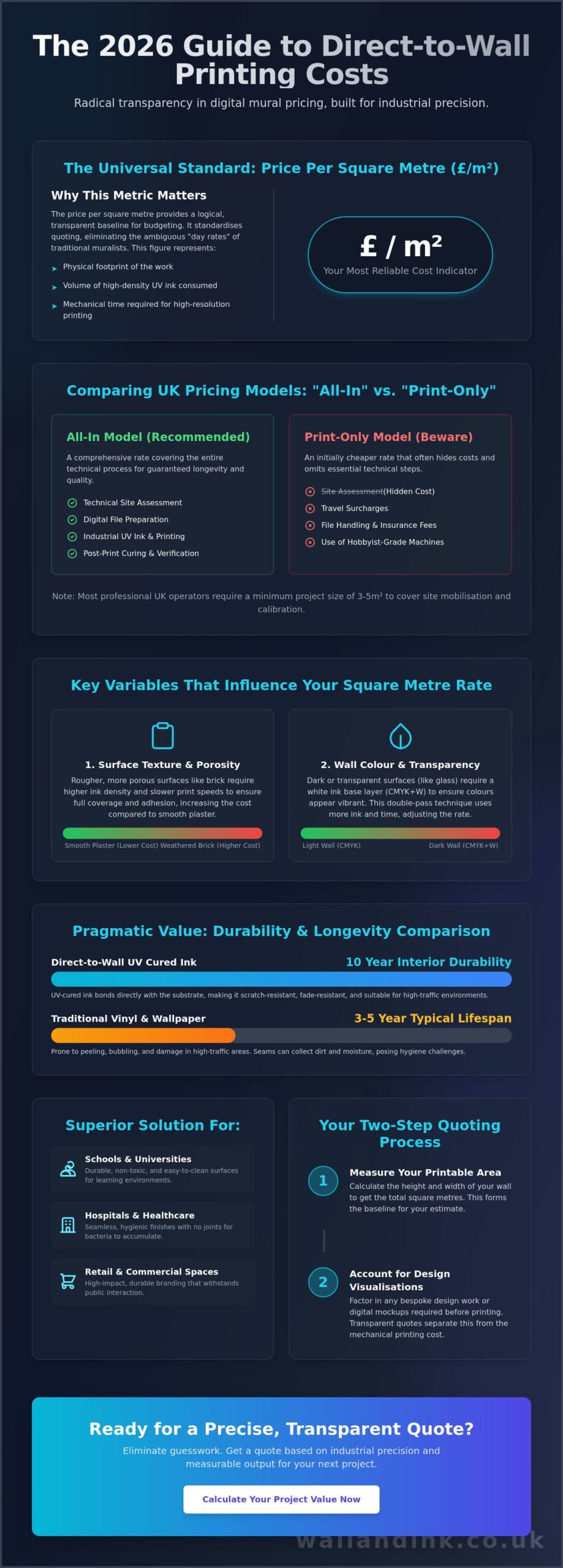
The square metre is the universal language of the architectural and fit-out industries. It provides a logical, transparent metric that allows project managers and homeowners to compare digital applications with other interior finishes. When you evaluate a direct to wall printing price per square metre, you’re looking at a figure that represents the physical footprint of the work, the volume of ink consumed, and the mechanical time required for execution. This standardisation eliminates the ambiguity often found in traditional mural commissions, where pricing is frequently dictated by the artist’s subjective “day rate” rather than measurable output.
In the UK market, pricing typically follows two distinct paths: “All-In” or “Print-Only” models. An All-In model covers everything from the initial digital file preparation to the final surface curing. Conversely, Print-Only models might appear cheaper initially but often exclude essential technical steps. By 2026, technological refinements in vertical printing hardware have increased mechanical speed and ink efficiency. This evolution allows for more competitive rates than were possible five years ago, making large-scale commercial murals a pragmatic alternative to high-end wallpaper. Most professional UK operators now set a minimum project size, usually around three to five square metres, to cover the logistics of site mobilisation and machine calibration.
What is Included in a Professional Square Metre Rate?
A professional rate isn’t just about the ink on the wall. It represents a comprehensive technical process designed for longevity. To understand the evolution of this technology and what is wall printing in a modern industrial context, one must look at the precision involved in the setup. A transparent square metre rate should include:
- Technical Site Assessment: Verifying substrate moisture levels and surface tension to ensure permanent ink adhesion.
- Industrial UV Ink: The use of high-density, UV-stable inks that cure instantly under specialised lamps.
- Mechanical Precision: High-resolution output that maintains consistent colour density across the entire surface.
- Post-Print Verification: A final quality check to ensure the digital file has been translated perfectly to the physical substrate.
Why “Cheap” Quotes Can Be Costly
Precision is not an optional extra. Selecting a provider based solely on a low headline figure often leads to technical failure. Budget operators frequently utilise hobbyist-grade machines that lack the stability of industrial-grade UV printers. This often results in “banding,” where visible lines appear across the image due to inconsistent print head movement. These low-cost quotes also tend to hide essential expenses. You might find that travel surcharges, equipment insurance, or “file handling” fees are added to the final invoice, significantly inflating the initial direct to wall printing price per square metre. Furthermore, budget inks often lack UV resistance, leading to premature fading in sunlit environments. We prioritise industrial reliability over temporary savings, ensuring your investment remains vibrant for years rather than months.
Variables That Influence Your Square Metre Rate
A transparent direct to wall printing price per square metre is rarely a “one-size-fits-all” figure. While a baseline exists for standard conditions, the physical reality of your installation environment determines the final technical requirements. We prioritise industrial precision, which means our pricing reflects the exact mechanical resources needed to achieve a permanent, high-definition result on your specific substrate. Pragmatic decision-makers understand that a quote for a smooth office partition shouldn’t be the same as a quote for a weathered exterior brick wall.
One primary technical variable is the requirement for white ink. Standard CMYK printing relies on the wall’s light colour to reflect light through the ink. If your surface is dark, vibrant colours will disappear without a dedicated white base layer (CMYK+W). This process involves a double-pass technique where the machine lays down a white foundation before applying the coloured image. This ensures colour accuracy and prevents the substrate’s base tone from “bleeding” through the artwork. Because this requires additional ink volume and machine time, it naturally adjusts the direct to wall printing price per square metre for dark or transparent surfaces.
Logistics also play a role in cost calculation. Printing at eye level is a straightforward mechanical process, but vertical printing at heights exceeding 2.5 metres introduces accessibility challenges. Our machines operate on a modular track system. When a project requires murals reaching 4 metres or higher, we must account for specialised scaffolding and the additional time needed to calibrate the vertical sensors at height. These technical justifications ensure the print remains perfectly aligned, even on the largest commercial wall murals.
Surface Substrates: From Plaster to Concrete
The porosity and texture of your wall dictate the ink’s behaviour. Standard painted plaster is the most efficient substrate because it requires minimal preparation and standard ink density. Textured surfaces like brick or stone are different; the printer’s sensors must constantly adjust the distance between the print head and the wall to maintain focus. Recent advancements in printing technology allow us to print on non-porous materials like glass or metal, but these require specialised primers and specific UV curing speeds to ensure the bond is permanent.
Design Complexity and Resolution Requirements
Design density affects the volume of UV ink consumed per square metre. A minimalist line-art logo uses significantly less ink than a photorealistic, full-bleed panoramic mural. Our high-resolution process ensures that even at massive scales, your art won’t pixelate. We utilise an “Ink Pass” system where we can increase the number of layers for deep colour saturation in high-traffic retail environments. This methodical approach guarantees a durable finish that resists fading, regardless of the design’s complexity.
Comparing Value: Wall Printing vs. Traditional Wallpaper and Vinyl
A pragmatic assessment of any interior finish requires looking beyond the initial invoice. Whilst the upfront direct to wall printing price per square metre might be higher than basic vinyl or off-the-shelf wallpaper, the total cost of ownership tells a different story. Traditional methods often fail at the seams or peel under environmental stress. In contrast, our digital application method involves UV-cured ink that integrates directly with the substrate, eliminating the physical vulnerabilities inherent in layered materials.
Maintenance and hygiene are critical factors for public sector and healthcare environments. Traditional murals and vinyl decals create microscopic ridges and seams where bacteria can accumulate. This is a significant concern for school and educational murals or hospital graphics. Because our process prints directly onto the wall surface, there are no edges to lift and no adhesive to degrade. The result is a perfectly flat, washable surface that withstands rigorous cleaning protocols without the risk of water ingress or “dog-eared” corners. This technical superiority is a primary driver behind the projected growth seen in the State of the Wall Printing Market, as facility managers move away from high-maintenance legacy alternatives.
Environmental responsibility is another area where digital printing outpaces traditional vinyl. Most commercial vinyl is PVC-based and relies on solvent-heavy adhesives that release Volatile Organic Compounds (VOCs) long after installation. Our UV inks are VOC-free and cure instantly, making them safe for immediate use in occupied spaces. When you calculate your direct to wall printing price per square metre, you’re also investing in a sustainable process that doesn’t require the future removal and landfill disposal of plastic-heavy materials.
The Longevity Factor: A Long-Term Investment
Durability is where the value proposition becomes most apparent. In high-sunlight areas like glass-fronted atriums, traditional inks often fade within 24 months. Our industrial-grade UV inks are engineered for high lightfastness, maintaining their vibrancy for up to ten years in interior settings. This scratch-resistant finish doesn’t require a secondary laminate, which is often where vinyl fails first. When you amortise the cost over a decade, a single digital print is significantly more economical than replacing wallpaper three times over the same period.
Aesthetics and Seamless Finishes
Industrial precision creates an aesthetic that manual methods cannot replicate. We eliminate the “seam” problem entirely, providing a continuous image that flows across corners and into architectural recesses. Our machines print with millimetre accuracy around light switches, sockets, and fire alarms, ensuring the artwork feels like a permanent part of the building’s architecture rather than a temporary sticker. This level of integration provides a high-end, bespoke finish that is essential for retail and hospitality environments where brand perception is paramount.
Budgeting for Your Project: From Design to Installation
Accurate budgeting for a digital mural begins with a tape measure and a clear understanding of the printable area. Whilst the direct to wall printing price per square metre provides a baseline, a professional quote accounts for the entire lifecycle of the project from the first digital mock-up to the final UV curing. Pragmatic project management requires a step-by-step approach to ensure there are no surprises when the final invoice arrives. You should begin by calculating the total height and width of the wall, then subtract any non-printable areas such as doors, windows, or fixed cabinetry to find your “net printable area.”
Site preparation is the next critical factor. Our industrial process requires a clean, dry, and stable substrate to ensure permanent ink adhesion. If a wall has recently been plastered, it must be fully cured and primed before our team arrives. Any dust or debris on the surface can interfere with the vertical rail sensors, which are calibrated for millimetre precision. Understanding these requirements early prevents delays on the day of installation. When you’re ready to move beyond estimates, you can request a detailed quote that reflects your specific site conditions and design requirements.
Bespoke Design and Visualisation Fees
Bespoke design is often where transparency fails in the traditional art industry. We eliminate this ambiguity by distinguishing between “print-ready” files and bespoke art creation. If you provide a high-resolution file that meets our technical specifications, the cost is focused purely on the application. However, many commercial wall murals require our specialists to adapt brand assets, scale graphics for massive surfaces, or create original artwork from a brief. We provide digital visualisations of the art in your actual space, allowing you to approve the layout before a single drop of ink is used. This methodical preparation ensures the final result matches your brand’s exact colour profile and aesthetic goals.
The Installation Day: What to Expect
Precision is non-negotiable during the installation phase. Our team begins by setting up a modular vertical rail system that guides the printer with mechanical accuracy. This setup and calibration phase is essential for maintaining consistent resolution across the entire wall. In a standard shift, an installation team can typically complete between 60 and 90 square metres of graphics, depending on the complexity of the design and the substrate texture. This speed is significantly higher than traditional methods, making it the ideal solution for retail and hospitality graphics where downtime must be minimised. Because our UV inks cure instantly and the process is virtually dust-free, your space can remain operational immediately after we finish, providing a clean-up-free experience that legacy alternatives can’t match.
Why Wall & Ink Offers the Most Precise Value in the UK
Wall & Ink is not a design agency that happens to print; we are technical specialists who prioritise industrial reliability. We’ve built our reputation on the elimination of traditional hassles, providing a service that moves from initial contact to final execution with methodical logic. In an industry where “hidden extras” are the norm, we lead with a definitive direct to wall printing price per square metre. This transparency ensures that your budget remains intact and your project timeline stays on track. Whether you require commercial wall murals for a corporate headquarters or durable retail and hospitality graphics, our pricing philosophy remains consistent across the UK.
Our national reach means we bring this industrial precision to your site, regardless of location. We maintain a consistent pricing structure that eliminates regional “premium” surcharges, providing a fair and predictable direct to wall printing price per square metre for every client. We don’t believe in “re-quote” surprises. Once we have verified your measurements and substrate type, the price we provide is the price you pay. This straightforward approach allows you to plan large-scale rollouts for school and educational murals or multi-site retail branding with complete financial confidence.
Our Advanced UV Printing Technology
Our commitment to technical precision is anchored in our choice of hardware. We utilise industrial-grade vertical printing machines that offer mechanical superiority over the hobbyist alternatives often found in the market. These machines produce crisp, vibrant results that are cured instantly by high-intensity UV lamps. This process isn’t just about speed; it’s about the chemical bond between the ink and the substrate. Our VOC-free inks are entirely safe for sensitive environments, including nurseries, schools, and healthcare facilities. We possess the hands-on expertise to print on everything from bare plaster and wood to complex exterior facades, ensuring the same level of aesthetic excellence regardless of the environment.
Start Your Transformation Today
Success in digital wall printing depends on preparation. We don’t just arrive and print; we guide you through a rigorous visualisation phase. This ensures that the scale, colour density, and architectural integration are perfect before we calibrate our rails. This methodical approach is why we are trusted by pragmatic decision-makers who value efficiency and high-quality results. To begin your project, we recommend a site assessment to confirm your specific surface requirements. Contact our team for a transparent project estimate and discover how our specialised process can transform your space with millimetre precision.
Secure a Precise Finish for Your Interior
Pragmatic decision-makers recognise that a transparent direct to wall printing price per square metre is the foundation of a successful fit-out. By accounting for substrate variables and design complexity early, you eliminate the technical failures associated with legacy alternatives like vinyl. Our process prioritises longevity through UV-cured ink that offers instant durability and a seamless finish that traditional methods cannot replicate. We provide national UK coverage and include bespoke digital visualisations in every project to ensure the final result aligns perfectly with your architectural requirements.
Securing a professional finish requires more than just a printer; it demands a specialist partner who understands the physical reality of your walls. This methodical approach transforms your space into a high-impact environment without the traditional hassles of manual installation. If you’re ready to upgrade your facility with industrial precision and long-term reliability, our team is prepared to assist you through every stage of the process. Get a Transparent Quote for Your Wall Printing Project
Your walls represent a significant portion of your brand’s physical presence. Choosing a modern, digital solution ensures they remain vibrant and professional for years to come.
Frequently Asked Questions
How is the square metre price calculated for a wall mural?
Calculation involves measuring the net printable area while accounting for substrate complexity and ink density. The direct to wall printing price per square metre is determined by the total footprint of the artwork rather than the total wall size. This ensures you only pay for the specific area where ink is applied. We subtract windows, doors, and architectural voids to provide a precise and transparent metric for your project budget.
Is there a minimum order size for direct to wall printing?
Most professional projects require a minimum printable area to justify the mechanical setup and site mobilisation. This threshold ensures that the logistical costs of transporting the vertical rail system and calibrating the sensors are covered. For smaller requirements, it’s often more efficient to consolidate multiple prints into a single site visit to maintain cost-effectiveness and industrial precision across your facility.
Do textured walls like brick cost more to print on?
Textured surfaces such as brick or stone involve a higher technical requirement for ink adhesion and sensor calibration. The printer’s vertical head must constantly adjust its distance from the substrate to maintain focus, which increases the time required for execution. Consequently, the direct to wall printing price per square metre typically reflects the additional ink volume needed to fill recessed mortar joints and porous textures effectively.
Are design fees included in the square metre price?
Design fees are generally separate from the standard square metre application rate to maintain radical transparency. If you provide a print-ready digital file that meets our technical specifications, the cost is focused purely on the printing process. However, bespoke artwork creation or digital visualisations involve a separate creative phase. We distinguish these costs so you don’t pay for design services you might not require.
How long does a direct to wall print last before it needs refreshing?
Interior wall prints are engineered to last up to 10 years without significant fading or degradation under standard conditions. This longevity is achieved through the use of UV-stable inks that bond chemically with the substrate. For exterior applications, the life expectancy is typically up to 5 years, depending on the surface type and its exposure to weather. This makes it a significantly more durable investment than vinyl.
Can you print on newly plastered walls?
You can print on newly plastered walls once they are fully cured and properly primed. Fresh plaster must be completely dry to prevent moisture from interfering with the ink’s adhesion. We recommend a standard white primer or a light-coloured emulsion base to provide a stable surface for the vertical sensors. Printing on uncured or unprimed plaster risks technical failure and a reduction in the mural’s long-term durability.
Is direct to wall printing more expensive than traditional wallpaper?
The total value exceeds traditional wallpaper because of its zero-maintenance lifecycle and superior durability. Wallpaper is prone to peeling at the seams and requires replacement every few years in high-traffic environments. Direct-to-wall printing is a permanent architectural finish that eliminates the recurring costs of removal and re-installation. When you amortise the cost over a decade, the digital method provides a more economical solution for commercial spaces.
What happens if I need to change the design after it has been printed?
Changes cannot be made to the design once the UV ink has been cured onto the substrate. Because the process creates a permanent bond, any alterations would require painting over the existing print with a standard emulsion before starting the application process again. We mitigate this risk through a rigorous digital visualisation phase, ensuring you approve the exact layout and scale before any ink is applied to your wall.