
Your event’s visual impact shouldn’t depend on the adhesive strength of a plastic sticker. When planning event space wall branding, most organisers have faced the frustration of vinyl decals peeling mid-keynote or fabric backdrops arriving with stubborn creases. These temporary fixes often compromise the professional atmosphere of a high-stakes venue and risk damaging the architecture during removal. You need a solution that prioritises industrial precision over temporary patches.
This guide explains how direct-to-wall UV printing provides a durable, high-resolution finish that integrates directly into the substrate. We will examine the technical superiority of UV-curable inks, the elimination of traditional installation hassles, and why this method is becoming the standard for premium UK venues. By removing the physical layer of branding, you can achieve a “wow factor” that looks integrated into the architecture. We’ll walk through the logical progression of the process, from initial consultation to the final, seamless execution.
Key Takeaways
- Understand the technical superiority of UV-cured ink technology, which provides instant drying and precision resolutions up to 2880 DPI.
- Discover how event space wall branding through direct-to-wall printing eliminates common industry failures like peeling edges, bubbling, and visible seams.
- Learn why painting over a digital print is a cleaner and more efficient removal method than stripping traditional vinyl or fabric adhesives.
- Identify key design strategies for large-scale graphics, including how to optimise “Human Scale” placement for high-impact photography.
- Gain insight into the end-to-end execution process for venue transformations across the UK to ensure reliable results for high-stakes professional environments.
What is Event Space Wall Branding and Why Choose Direct-to-Wall?
Effective event space wall branding is the strategic integration of high-resolution graphics directly into the existing architecture of a venue. It’s a move away from temporary, “tacked-on” signage towards a finish that appears as a permanent feature of the building. By utilising direct-to-wall printing, organisers can transform standard plaster, brick, or concrete surfaces into immersive marketing assets. This method uses a specialised UV curing process to bond ink instantly to the substrate, ensuring a result that is both durable and visually striking.
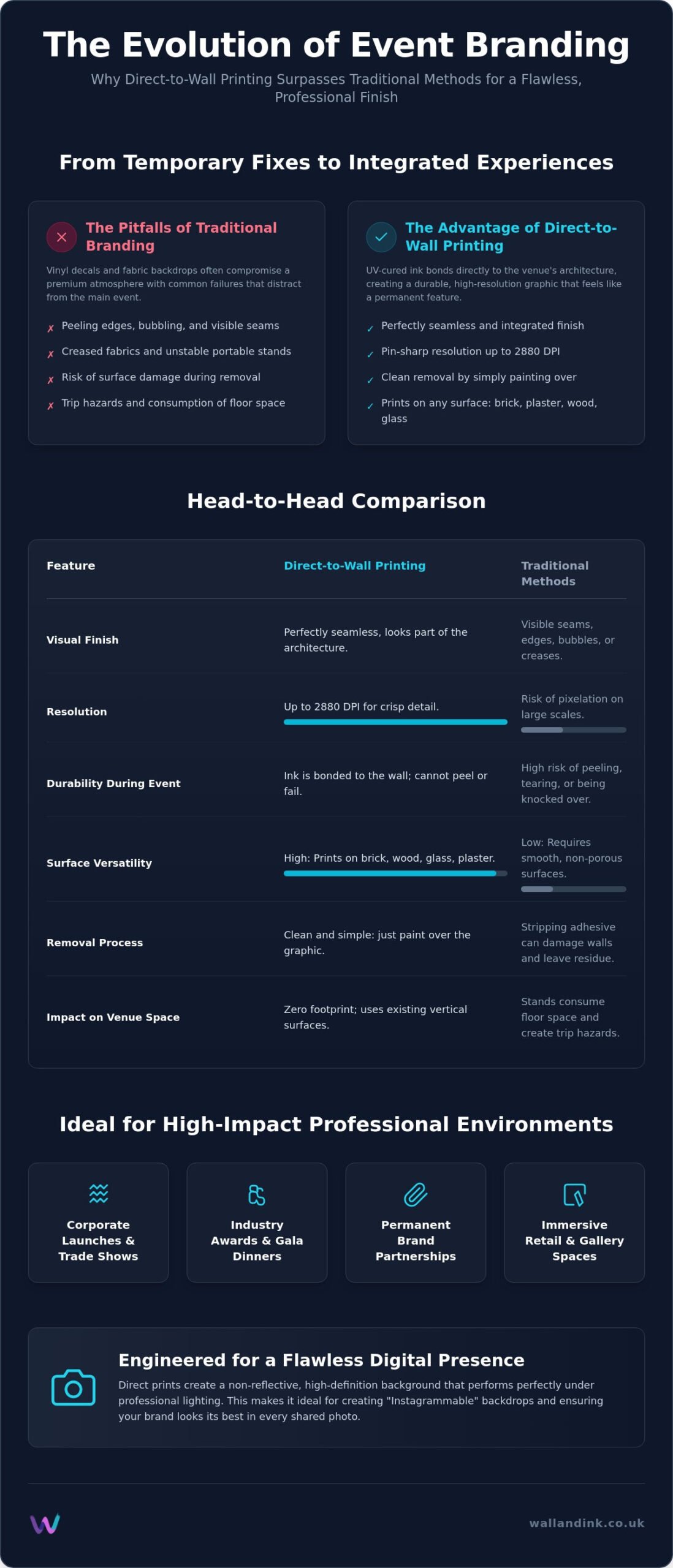
The primary benefit of this approach is the total absence of physical layers. Unlike traditional methods, there are no visible edges, no bubbling, and no peeling corners to distract guests. This seamless finish is particularly vital for high-stakes environments where professional aesthetics are non-negotiable. The shift from vinyl to integrated printing is driven by a need for reliability. When a brand invests in a venue, they don’t want a decal failing mid-event. Direct-to-wall technology removes this risk entirely by making the ink part of the wall itself. This creates a tactile, premium texture that invites closer inspection and reinforces brand authority.
Key applications for this technology include:
- High-profile corporate product launches and trade shows.
- Prestigious industry awards nights and gala dinners.
- Permanent brand partnerships within hospitality suites.
- Immersive retail pop-up environments and gallery spaces.
The Evolution of Venue Graphics
The industry has moved beyond the era of pull-up banners and taped posters. As we approach 2026, event standards demand a level of sophistication that matches the digital environments guests inhabit daily. Modern digital murals have replaced flat signage. Because social media platforms prioritise high-quality “Instagrammable” backdrops, the physical surface must be flawless. A direct-printed wall provides a non-reflective, high-definition background that performs perfectly under professional photography lighting, ensuring your brand looks its best in every shared post.
While direct-to-wall printing offers an integrated look, for other areas of your event that require high-impact portable solutions, you can learn more about Zodiac Event Displays and their specialised soft signage.
Direct-to-Wall vs. Portable Systems
Portable systems often present logistical challenges that direct printing avoids. Floor-standing backdrops create tripping hazards and consume valuable floor space, which is a significant drawback in crowded venues. Direct printing utilises every inch of vertical space without obstructing guest traffic. There’s also a distinct psychological advantage. Integrated graphics convey a sense of stability that a temporary fabric stand simply can’t replicate. It signals to your audience that the brand belongs in the space, rather than just visiting it for the day.
The mechanical precision of a wall printer is what distinguishes it from traditional large-format methods. At the heart of this technology is UV-curable ink, which undergoes a photochemical reaction when exposed to high-intensity ultraviolet light. This ensures the ink dries instantly, bonding with the substrate at a molecular level. For professional event space wall branding, this means there is no waiting time for drying and no risk of smudging during the high-pressure setup phase of an event.
Precision is managed through advanced printhead technology capable of resolutions ranging from 720 to 2880 DPI. This level of detail is essential when graphics are viewed from a close distance, such as in registration areas or photo backdrops. Whilst vinyl often shows pixelation or “banding” on large scales, direct-to-wall prints maintain sharp lines and vibrant colours. This technical accuracy supports the broader goals of Experiential Marketing, where the physical environment must flawlessly reflect the digital brand identity.
Another critical technical advantage is the lack of odour. Traditional solvent-based inks often emit volatile organic compounds (VOCs) that can linger for days. In venues involving food service or long guest stays, these smells are unacceptable. Our process is entirely odour-free, allowing for installation even whilst other vendors are setting up nearby.
Substrate Versatility in Venues
The printer is designed to handle the diverse materials found in modern UK venues. It can print directly onto bare brick, glass, wood, and plaster without requiring a separate adhesive layer. For industrial-style spaces, printing on brick allows the natural texture of the wall to show through, creating a sophisticated, integrated look. The machine’s sensors detect surface irregularities, adjusting the printhead distance in real-time to ensure consistent ink application across uneven surfaces. If you are planning a complex venue transformation, you can explore our range of Direct-to-Wall Printing solutions to see how different textures are handled.
Durability and Scratch Resistance
High-traffic corridors and registration areas demand graphics that can withstand physical contact. UV-cured ink is inherently scratch-resistant and durable. It does not scuff when brushed by bags or equipment, a common failing of vinyl stickers. Because the ink is bonded to the wall, it cannot be picked off or peeled by curious guests. This durability also offers environmental benefits. By eliminating the need for single-use plastic vinyl rolls and backing paper, the process significantly reduces the waste typically generated by short-term event branding.
Direct-to-Wall Printing vs. Vinyl Decals: A Comparison
Choosing between traditional vinyl and direct-to-wall printing is a choice between an additive layer and an integrated finish. Vinyl decals are physical stickers that sit on top of a surface. This creates a visible edge that catches the light and reveals the temporary nature of the branding. In contrast, event space wall branding executed via direct printing becomes part of the wall’s texture. There is no physical thickness to the graphic. This lack of a “physical layer” ensures a seamless aesthetic that looks like a permanent architectural feature rather than a last-minute addition.
Environmental stability is another area where these methods diverge. UK venues often experience significant fluctuations in temperature and humidity, particularly in spaces with high guest density or active catering. Vinyl is sensitive to these changes. It expands and contracts at a different rate to the wall substrate, which inevitably leads to bubbling and lifting. Direct UV printing avoids this failure entirely. Because the ink is bonded at a molecular level, it remains stable regardless of the venue’s climate control performance. It simply cannot bubble or peel because there is no adhesive to fail.
Installation efficiency also favours the mechanical approach for complex designs. Applying a large-scale, intricate vinyl wrap is a labour-intensive manual process. It requires multiple technicians and carries a high risk of human error, such as misalignment or trapped air. Our wall printer handles complex data files with absolute mechanical consistency. It maintains the same level of precision across a five-metre mural as it does for a small logo. This reliability is essential for tight setup windows where there is zero margin for error.
The Problem with Vinyl in High-Traffic Areas
High-traffic areas like registration halls and corridors are unforgiving to vinyl. When a guest’s bag or a piece of equipment brushes against a decal, the edges are prone to catching and tearing. Once a corner lifts, the entire graphic begins to look unpolished and cheap. Vinyl also struggles to adhere to the textured surfaces often found in premium venues, such as raw concrete, aged brick, or reclaimed wood. Direct printing thrives on these substrates. It fills the natural recesses of the material, providing a durable finish that resists scuffs and maintains its integrity throughout long-duration exhibitions.
Removal and Venue Restoration
The industry often markets vinyl as “easy-peel,” but the reality for venue managers is frequently different. Removing large vinyl installations often leaves behind a sticky adhesive residue or, worse, strips away the underlying paintwork. This “ghosting” requires significant labour to rectify. Direct-to-wall prints offer a more professional restoration path. Because the ink is a thin, flat layer, it can be professionally painted over with a standard primer and topcoat. This returns the wall to its original state with zero evidence of previous branding, ensuring the venue remains in pristine condition for the next client.
Strategic Design for Large-Scale Event Graphics
Successful event space wall branding requires a design logic that accounts for physical scale and architectural context. Large-format graphics are not merely upscaled versions of digital assets; they demand a high level of technical preparation. To utilise the 2880 DPI precision of our hardware, designers must provide high-resolution vector files or raster images with sufficient pixel density. On a wall spanning five metres, low-resolution files will inevitably show pixelation, which undermines the professional authority of the brand. We ensure that every asset is scaled correctly to maintain sharp lines and vibrant colour depth across the entire surface.
Lighting is a critical factor in large-scale design. Traditional gloss vinyl often creates a harsh glare under flash photography or high-intensity spotlights, which obscures brand logos in social media shares. UV-cured ink provides a naturally matte or satin finish that absorbs light rather than reflecting it. This technical property ensures that brand colours remain accurate and legible in both low-light gala environments and brightly lit trade show halls. By designing with these lighting conditions in mind, you can guarantee that the physical branding performs as well in photos as it does in person.
Optimising Logos for Step-and-Repeat Walls
Step-and-repeat walls are a staple of corporate events, but they fail if the logo sizing is incorrect. Logos must be large enough to be recognisable in a wide-angle shot, yet small enough that they aren’t entirely obscured by a guest’s head or shoulders. High colour contrast is essential for visibility in low-light environments. Safe zones are the specific vertical and horizontal areas where graphics remain unobstructed by speakers, furniture, or guest movement during photography. Maintaining these zones ensures that your primary brand markers are always visible in the “hero shot.”
Digital Visualisation and Mock-ups
Precision execution depends on thorough digital visualisation before the first drop of ink touches the wall. We use detailed mock-ups to map your design onto the specific architecture of the venue. This process allows us to adjust the placement of graphics around pillars, doors, light switches, and fire exit signs. Our “measure twice, print once” philosophy ensures that every bespoke project is perfectly aligned with the building’s features. This methodical approach eliminates the guesswork and ensures a flawless integration into the space. If you are ready to see how your design will look in situ, you can contact our team for a professional design consultation.
Executing Your Venue Transformation with Wall & Ink
The final phase of event space wall branding is the physical execution, a process we have engineered for industrial reliability. Our end-to-end service moves methodically from the initial design consultation to the final on-site print. We understand that venue access windows are often narrow and high-pressure. Our technical team manages every aspect of the installation to ensure the branding is completed on schedule and to the exact specifications of the digital mock-up. This approach eliminates the coordination errors that often occur when multiple vendors are involved in a single venue transformation.
To facilitate a flawless print, the technical setup requirements are straightforward and functional. Clients must provide a standard 240V power source and a clear, unobstructed work area in front of the target surface. Because our wall printer operates with mechanical precision, it does not require the messy preparation or chemical adhesives associated with traditional vinyl. There is no waste to clear away and no risk of paint damage. We provide comprehensive national UK coverage, ensuring that high-calibre branding solutions are available for exhibition centres and corporate venues across the entire country.
Our National End-to-End Service
Our service begins with professional design adaptation. We translate your brand assets into a format optimised for our specialized UV printing hardware. On-site, the printing process is defined by speed and cleanliness. Our UV technology is the preferred choice for major UK exhibition centres because it allows for rapid setup without disrupting other vendors. The ink is cured instantly, which means the space can be returned to full use immediately after the machine finishes its pass. This efficiency is a primary competitive advantage for organisers working within tight logistical timelines.
Booking Your Event Space Branding
Lead times are a critical consideration for large-scale corporate rebrands. We recommend early engagement during the event planning phase to allow for thorough site assessment and design visualisation. We work directly with event planners and venue managers to coordinate access and technical requirements, ensuring a seamless integration into the broader event schedule. This collaborative approach guarantees that the final result meets our standards for precision and durability. Enquire today to see how we can transform your event space with bespoke wall printing.
Transform Your Venue with Industrial Precision
Direct-to-surface UV technology has redefined the standards for high-stakes professional environments. By choosing an integrated approach, you eliminate the common industry failures of peeling vinyl and bubbling adhesives. This method ensures that your branding remains stable regardless of the venue’s climate or guest traffic. Our methodical process includes bespoke design and digital visualisation to guarantee that every graphic aligns perfectly with the unique architectural features of your space. Whether you’re branding a registration hall or a gala backdrop, the result is a seamless finish that reinforces brand authority.
Wall & Ink provides comprehensive national UK coverage for all major venues, delivering a mess-free and high-speed solution that respects your logistical timelines. We handle the technical complexities of event space wall branding so you can focus on the broader execution of your project. Our team is ready to help you transition from temporary signage to permanent-look murals that captivate your audience. Get a Quote for Your Event Space Wall Branding and discover how our specialised printing process can elevate your next venue transformation.
Frequently Asked Questions
Can you print on textured walls like brick or concrete?
Yes, our direct-to-wall printing technology is specifically designed to handle irregular substrates including bare brick, concrete, and timber. The hardware utilises advanced sensors to detect surface variations in real-time, adjusting the printhead distance to ensure consistent ink application. This allows for high-impact event space wall branding that retains the natural character of the venue’s architecture without the need for a flat primer layer.
How long does it take to print a large event wall?
The printing speed is determined by the chosen resolution and the complexity of the graphic. Most commercial projects are completed at a rate of several square metres per hour, which is often faster than the manual application of complex vinyl wraps. Because the UV ink cures instantly, the wall is ready for use the moment the machine finishes its pass, facilitating rapid venue handovers within tight setup windows.
Is the wall printing permanent or can it be removed?
The print is designed for long-term durability but can be professionally removed by painting over the surface. Unlike vinyl decals, which often leave behind a sticky residue or strip away underlying paint, direct prints are flat and stable. To restore the venue, you simply apply a standard primer and topcoat. This returns the wall to its original state with zero evidence of the previous branding.
Does the ink have a strong smell during or after printing?
No, the UV-curable inks we use are entirely odourless and free from volatile organic compounds (VOCs). This makes the process ideal for hospitality environments, gala dinners, or events involving food service where chemical smells would be unacceptable. You don’t need to worry about lingering scents after the installation is complete, as the photochemical reaction ensures the ink is inert and stable immediately.
What resolution does my artwork need to be for a 3-metre wall?
We recommend using vector files whenever possible to ensure infinite scalability without any loss of detail. If you are using raster images for a 3-metre wall, the file should ideally be 300 DPI at the final print size to match our machine’s high-resolution capabilities. This prevents pixelation and ensures that your event space wall branding looks sharp even when viewed from a close distance by guests or photographers.
Can you print onto glass or mirrored surfaces in venues?
Yes, the UV curing process allows the ink to bond effectively to non-porous surfaces such as glass, mirrors, and polished metal. This versatility is a significant advantage for modern venues that feature glass partitions or architectural mirrors. The result is a vibrant, durable graphic that maintains its integrity on smooth surfaces where traditional adhesives might struggle to hold or appear unpolished due to trapped air.
Is direct-to-wall printing more expensive than vinyl?
Whilst the technical setup differs from traditional methods, direct printing offers superior value by eliminating the common failures of vinyl. You avoid the costs associated with bubbling, peeling, and the labour-intensive removal of adhesive residue. For premium venues, the industrial precision and seamless finish provide a higher return on investment by ensuring a professional brand image that does not require mid-event repairs or costly wall restoration.
Do you provide the design service or do I need my own designer?
We offer a comprehensive design adaptation and digital visualisation service to ensure your branding integrates perfectly with the venue’s architecture. Whilst many clients provide their own core brand assets, our team handles the technical scaling and architectural mapping. This process includes creating detailed mock-ups that account for doors, pillars, and light switches, ensuring a level of reliability that matches the mechanical precision of our printing hardware.