
What if your next office mural was finished, dry, and ready for the public before your team finished their lunch break? Traditional decorating is notoriously slow; you are likely used to the disruption of scaffolds, the lingering smell of paint, and the “wet paint” signs that stall your operations for days. When planning a renovation, the most pressing question is usually: how long does direct wall printing take? It’s a valid concern for any pragmatic decision-maker who values efficiency and high-quality results without the typical mess or technical delays of legacy methods.
We understand that time is your most valuable asset. This guide provides a technical breakdown of project durations, from precise machine speeds of 50 minutes per square metre to the total turnaround time for UK commercial and residential spaces. We will examine setup protocols, the impact of white underprinting on your schedule, and why UV-cured technology eliminates the need for drying downtime entirely. You will gain a clear understanding of the end-to-end process, ensuring you can organise your next project with absolute confidence in the timeline.
Gain a technical understanding of UV ink throughput metrics, including standard speeds of approximately 50 minutes per square metre, to discover exactly how long does direct wall printing take for your specific space.
Identify the key variables that influence on-site duration, including image complexity, surface textures, and the specific requirements for white underprinting on dark substrates or varied colours.
Review the end-to-end project timeline, covering how we organise the initial consultation and artwork preparation through to the rapid-deployment printing process and immediate room handover.
Compare the efficiency of direct-to-wall technology against traditional decorating methods, highlighting the elimination of the 24-48 hour drying times often required for paint and wallpaper.
Learn how our methodical approach ensures industrial precision and minimal operational disruption whilst working in professional, educational, and healthcare environments.
Understanding Wall Printing Speed: The Technical Metrics
Direct-to-wall printing is a high-speed UV ink application process that bypasses the manual labour and extended timelines of traditional decorating. Unlike painting or wallpapering, where human fatigue and multi-stage drying cycles dictate the schedule, this method relies on industrial mechanical precision. When clients ask how long does direct wall printing take, the answer begins with the active throughput of the machinery. We measure this efficiency in square metres per hour (m²/hr), a metric that provides a transparent baseline for project planning.
It’s vital to distinguish between the total site visit and the actual printing time. The latter refers specifically to the machine’s active travel across the vertical surface. Because we utilise a specialised digital printing process, the work is completed the moment the print head makes its final pass. The ink is cured instantly by integrated UV lamps, which means there is zero drying time required after the pass. This eliminates the 24 to 48 hour waiting periods common with traditional paints, allowing you to return your space to full operation immediately.
Average Square Metre per Hour Rates
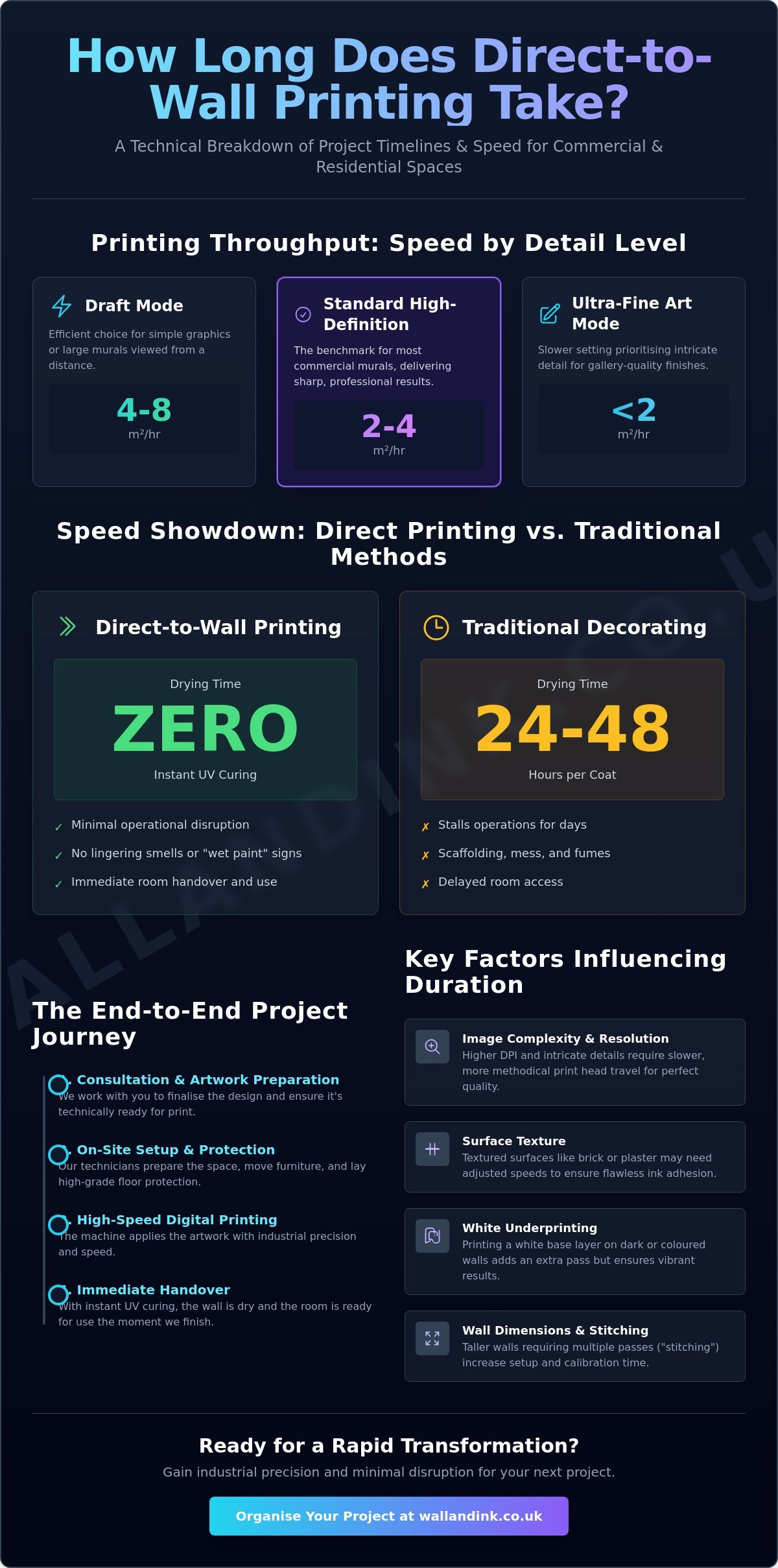
The speed of the printer is directly linked to the resolution and level of detail required for the graphic. We categorise these into three primary modes to help you manage your expectations:
- Low-resolution/draft mode: Typically achieves 4 to 8 m²/hr. This is an efficient choice for simple graphics or large-scale murals intended for distant viewing, such as those in schools or industrial warehouses.
- Standard high-definition mode: Operating at 2 to 4 m²/hr, this is the benchmark for most commercial murals. It delivers sharp, professional results suitable for offices and retail environments.
- Ultra-fine/art mode: This slower setting prioritises intricate detail for high-end residential art or close-up photography. The reduced speed ensures the highest possible dot density for a gallery-quality finish.
Vertical vs Horizontal Printing Passes
The physical dimensions of the wall influence the mechanical workflow. Most industrial wall printers operate on a vertical gantry with a specific maximum height. If your wall is within this height, the machine completes the image in a single continuous horizontal movement. However, taller walls require the gantry to be extended or the machine to be repositioned for multiple horizontal passes.
This process, known as “stitching,” involves aligning the top and bottom sections of a large-scale mural. Whilst the actual printing speed remains consistent, the requirement for multiple passes increases the setup and calibration time. Our technicians focus on technical alignment to ensure these passes are perfectly synchronised, maintaining a seamless image across the entire surface regardless of the wall’s height. This technical precision ensures that even complex, multi-pass projects remain significantly faster than traditional alternatives.
Factors That Influence How Long Your Print Takes
While machine metrics provide a technical baseline, the physical reality of the site determines the final schedule. When calculating how long does direct wall printing take, we must account for the specific variables of your environment. A high-detail photographic gradient on a textured brick wall requires a different technical approach than a simple vector logo on a smooth office partition. Our process prioritises industrial precision, which means we adjust our pace based on the mechanical requirements of the substrate and the complexity of the digital file.
Logistical preparation is equally significant. Protecting the workspace is a non-negotiable step in our workflow. We factor in time for moving furniture and laying high-grade floor protection to maintain a clean environment. Ambient conditions also play a role; excessive dust or extreme temperature fluctuations can interfere with the precision of the inkjet nozzles. A clean, temperature-controlled space streamlines workflow and prevents the need for technical recalibration mid-print, ensuring the project stays on track.
Resolution and Ink Density
DPI (dots per inch) is the primary regulator of printhead speed. Higher resolution settings require the printhead to make more frequent passes, which naturally extends the duration of the print. If your project involves dark or vibrantly coloured walls, we must apply a white ink under-print. This technical necessity ensures colour accuracy but effectively doubles the printing time as the machine applies a base layer before the final CMYK pass. For high-durability requirements, such as exterior wall printing, we may employ double-pass settings to enhance pigment density and weather resistance.
Surface Substrate Preparation
UK buildings often feature challenging surfaces like bare plaster, aged brick, or industrial metal. Fresh plaster must be fully cured and primed before we begin; moisture is the primary enemy of UV ink adhesion. When working on uneven floors common in older properties, our technicians spend additional time setting up stabilising floor rails. These rails ensure the gantry remains perfectly level, preventing distorted imagery. Non-porous surfaces like glass or metal require specialised degreasing protocols to guarantee a permanent bond, a step that is essential for long-term durability. Understanding how long does direct wall printing take requires acknowledging these vital preparation steps that guarantee a flawless result.
The End-to-End Project Timeline: From Enquiry to Completion
The total duration of a project is defined by more than just mechanical throughput. For a business or homeowner, the question of how long does direct wall printing take encompasses the entire journey from initial contact to the final inspection. We operate with a methodical sequence that prioritises transparency and minimises downtime. This process ensures that every stakeholder understands the milestones, preventing the uncertainty often associated with traditional decorating contractors.
Our workflow begins with a rapid consultation phase. Once you provide the dimensions of your wall and a concept of the artwork, we typically return a comprehensive quote within 24 to 48 hours. This efficiency allows you to make informed decisions quickly. It’s a vital feature for high-stakes commercial environments where project lead times are tight. After the quote is approved, we move into the preparation phase, which is the most critical stage for ensuring a smooth on-site experience.
Digital Visualisation and Proofing
We provide digital mock-ups to help you visualise the final result before the printer even arrives. This stage is designed to speed up the approval process and eliminate guesswork. We tailor the artwork to your specific space, carefully adjusting designs to account for architectural features like light switches, windows, or doors. Ensuring we have high-resolution files at this stage is essential. It prevents on-site delays and technical errors, allowing us to move straight into execution once we arrive at your premises.
On-Site Setup and Calibration
The first 60 to 90 minutes of the print day are dedicated to technical preparation. Our technicians laser-level the machine to ensure perfectly straight graphics, even on floors that may not be perfectly flat. We conduct rigorous tests on ink flow and printhead alignment to guarantee precision results from the first pass. This methodical setup is why we can maintain a “clean in, clean out” approach. We protect your flooring and furniture immediately, ensuring that our presence causes minimal disruption to your daily operations.
Once calibration is complete, the printing process itself is usually finished within a single working day for most standard walls. Because we use UV-cured inks, there is no need to wait for the surface to dry or for fumes to dissipate. We pack down our equipment and hand the room back to you immediately. You can resume using the space for meetings, teaching, or relaxation the moment we finish. This immediate room handover is a primary reason why clients choose our technology over traditional methods. When you consider how long does direct wall printing take, you must factor in this total elimination of post-project downtime.
Speed Comparison: Wall Printing vs Traditional Methods
The true measure of efficiency is not just the speed of the printhead, but the total time to room readiness. When evaluating how long does direct wall printing take, the comparison with traditional decorating methods is stark. Traditional paint projects often require a 24 to 48 hour drying period before the space is habitable. This delay is caused by the need for multiple coats and the time required for volatile organic compounds (VOCs) to dissipate. In contrast, our UV technology allows for immediate occupancy, making it a superior choice for environments that cannot afford extended downtime.
Vinyl decals and traditional wallpaper also present significant temporal bottlenecks. Whilst these methods avoid the drying time of paint, they introduce risks of peeling, bubbling, and misalignment. Correcting these issues often requires time-consuming re-work. Large-scale commercial wall murals executed via direct printing are typically 70 to 80% faster than hand-painted alternatives. By removing the need for scaffolding and multi-day artist schedules, we provide a rapid-deployment branding system that satisfies the requirements of pragmatic decision-makers.
Wall Printing vs Wallpaper Installation
Wallpapering is a labour-intensive process that involves measuring, cutting, pasting, and meticulous seam-matching. Each of these stages is a potential point of failure that can extend the project timeline. Our digital method eliminates these manual steps entirely. There is no risk of seams lifting or patterns misaligning due to human error. Because the UV lamp passes over the ink instantly, the surface is scratch-resistant and durable from the second the machine finishes. You don’t have to worry about delicate surfaces or “wet” areas for days after the installation.
Wall Printing vs Hand-Painted Murals
Hand-painted murals offer a bespoke aesthetic but at a significant cost to your schedule. A complex mural that might take a skilled artist three full days to complete can be executed by a UV printer in approximately four hours. This 70 to 80% reduction in on-site hours is a result of mechanical consistency; the machine follows the digital file with 100% accuracy, eliminating the need for sketches, base coats, and drying intervals between colours. This speed directly translates to reduced labour costs and minimal disruption to your daily operations. Whether you are looking for residential wall art or high-impact retail graphics, the precision of a machine-led process ensures a predictable and rapid result every time.
Maximising Efficiency: How Wall & Ink Organises Your Project
Efficiency in large-scale decorating is a product of rigorous organisation and industrial precision. When businesses evaluate how long does direct wall printing take, they are often looking for more than just a mechanical print speed; they are looking for a reliable partner who respects their operational schedule. We treat every project as a technical deployment, ensuring that the timelines we promise are the timelines we deliver. This methodical approach is designed for pragmatic decision-makers who require high-quality results without the traditional hassles of project creep or unexpected delays.
Our commitment to transparency extends to both our pricing and our scheduling. By providing a clear breakdown of the process, we eliminate the uncertainty that often plagues commercial renovations. You will know exactly when our technicians will arrive, how long the machine will be active, and precisely when your space will be ready for use. This level of predictability is essential for managing busy environments where every hour of downtime has a measurable cost. Beyond the immediate deployment, the durability of UV-cured ink offers long-term time savings. The scratch-resistant finish and pigment stability mean you won’t need to re-decorate or repair your wall art for years, effectively ending the cycle of frequent maintenance.
Professionalism in Commercial Environments
Minimising disruption is a core pillar of our service. We frequently work outside of standard business hours to ensure zero operational downtime for schools, hospitals, and corporate offices. This flexibility allows your team to leave a blank wall on Friday and return to a fully transformed environment on Monday. Our “no-mess” guarantee is a technical reality, not a marketing promise. Because the process is entirely digital and the ink cures instantly, there is no dust, no chemical fumes, and no leftover materials. We provide a clear technical justification for every step, ensuring our workflow integrates seamlessly with your health and safety requirements.
National Reach and Rapid Deployment
Our UK-wide coverage ensures that we can reach your site quickly, regardless of your geographic location. We maintain a fleet of modular printers that are ready for rapid deployment, allowing us to respond to tight deadlines with confidence. The efficiency of our on-site work is supported by our bespoke design service. We prepare and proof all artwork digitally before our technicians even leave the warehouse. This preparation ensures that once we are on-site, our focus remains entirely on the technical execution of the print. This streamlined workflow is the reason we can complete most projects within a single shift, providing a level of service that traditional decorating agencies cannot match.
Ready to transform your wall? Contact Wall & Ink for a bespoke quote and experience a modern solution to traditional decorating delays.
Streamline Your Next Branding Project
Direct wall printing is the definitive solution for pragmatic decision-makers who require high-impact results without the inherent delays of legacy decorating. By replacing the 48-hour drying cycles of traditional paint and the manual complexities of wallpaper with industrial precision, we provide a predictable and rapid workflow. Most commercial murals are completed in under a single working day, ensuring your operations continue with minimal interference.
Understanding how long does direct wall printing take involves recognising the benefits of UV-cured technology. Our ink cures instantly upon application, which means there is zero drying time and no lingering chemical fumes. We offer a professional national UK service, sending expert on-site technicians to handle every technical detail from laser-levelling to final inspection. This methodical approach ensures your space is ready for public use the moment we finish.
Stop waiting for traditional contractors to catch up with your schedule. Get an instant estimate for your wall printing project and discover a faster way to transform your professional or private environment. We are ready to help you achieve a high-quality finish with absolute reliability.
Frequently Asked Questions
How long does a typical office wall mural take to print?
Most standard office murals covering approximately 10 to 15 square metres are completed within 4 to 6 hours. This timeframe includes the mechanical pass of the printhead and the initial technical setup. Larger, full-wall graphics rendered in ultra-high-definition mode may require a full working day, but the space is returned to you for immediate use once the final pass is complete.
Do I need to leave the room empty whilst the printing is happening?
No, you don’t need to vacate the entire premises, although we recommend keeping the immediate work zone clear for safety and precision. The process is remarkably quiet and entirely free from the airborne dust or toxic fumes associated with traditional decorating. Many of our commercial clients continue their standard operations in the same office whilst our technicians work.
How long after printing can I touch the wall?
You can touch the wall immediately after the printhead has passed over the surface. Because our machines utilise integrated UV lamps to cure the ink instantly, the finish is dry and scratch-resistant the moment it is applied. This provides a significant advantage for high-traffic environments where waiting for paint to dry is not a viable option.
Does the machine take a long time to set up on uneven floors?
Setting up on uneven surfaces typically adds 30 to 45 minutes to our standard preparation protocol. We use specialised floor rails and laser-levelling equipment to ensure the vertical gantry remains perfectly plumb. This technical adjustment is essential for maintaining image accuracy and preventing distortions, particularly in older UK properties with irregular flooring.
Can you print an entire school corridor in one day?
We can often complete an entire corridor within a single shift depending on the graphic density and layout. If the design consists of spaced-out educational graphics or logos, we can cover significant linear distances very quickly. Full-coverage, floor-to-ceiling murals for a long corridor are usually scheduled over two days to maintain industrial precision across the entire area.
How much time does the design phase usually add to the project?
The design phase typically spans 3 to 7 working days, depending on the complexity of your requirements and the quality of the original files. This period includes artwork preparation, resolution checks, and digital proofing. Finalising these details before we arrive on-site is the most effective way to ensure the question of how long does direct wall printing take is answered with a rapid, one-day execution.
What happens if the wall isn’t perfectly flat; does it slow down the print?
Minor wall curvature or surface texture doesn’t significantly reduce the printing speed. Our machinery features advanced sensors that adjust the printhead distance in real-time to account for surface variations. However, extreme irregularities may require a slower mechanical pass to ensure the ink is deposited with precision across the entire substrate without compromising the image quality.
Is there any drying time or smell after the technician leaves?
There is absolutely no drying time or lingering smell once our technician finishes the project. UV-cured inks are chemically stable and dry the instant they are applied to the wall. This absence of VOCs and moisture means you can host a meeting or open a school classroom the second our team packs away the equipment.