
Why are commercial art commissions still treated like a subjective gamble when every other business asset requires a predictable return on investment? Most decision-makers understand that a blank wall is a wasted branding opportunity, yet they often hesitate because of the traditional “artist’s tax”: hidden material fees, weeks of disruptive scaffolding, and the fear that the final result won’t match the original brief. You want the visual impact of a bespoke installation, but you require the technical precision of a modern service. Evaluating your commercial wall mural ROI shouldn’t involve guesswork; it should be a matter of industrial calculation and durable performance.
In this guide, we’ll show you how to move beyond the unpredictability of hand-painted commissions to a transparent, price-per-square-metre framework. You’ll discover how digital UV printing eliminates the mess of traditional methods whilst delivering a superior, fade-resistant finish that maintains its integrity for years. We’ll break down the long-term financial returns of high-precision wall art and explain why businesses are now prioritising efficiency and technical reliability over legacy artistic processes.
Key Takeaways
- Learn how to calculate your commercial wall mural ROI by treating art as a technical asset rather than a subjective expense.
- Understand the transparent price-per-square-metre model that replaces the hidden costs and “artist’s tax” associated with traditional hand-painted work.
- Compare the operational efficiency of high-speed UV printing against legacy methods to minimise business disruption and eliminate installation mess.
- Identify how different substrates, including bare plaster, glass, and textured brick, affect ink adhesion and the long-term durability of your project.
- Discover a streamlined digital-to-wall process that ensures high-resolution accuracy and consistent quality across any professional environment.
Understanding the ROI of Commissioning a Mural in the UK
A commercial mural commission is far more than a decorative addition; it’s a specialised branding service that integrates design, site preparation, and technical execution. For UK businesses, the transition from viewing art as a discretionary expense to a strategic investment is now central to calculating commercial wall mural ROI. Whilst traditional commissions often suffered from opaque pricing, the 2026 market has shifted toward radical transparency. This evolution is driven by the adoption of direct-to-wall UV printing, which provides a predictable, industrial-grade alternative to the variability of hand-painted work.
The total value of a mural isn’t just found in the initial visual impact but in its performance over a 10-year period. Traditional paint often requires touch-ups or suffers from UV fading in high-traffic retail or office environments. Modern UV wall printing has become the professional standard amongst UK firms because it offers a maintenance-free finish. When you eliminate the recurring costs of repair and the disruption of repainting, the long-term financial case becomes clear. Investing in durable, high-resolution graphics ensures the asset remains an effective branding tool for years without further capital outlay.
The Core Components of a Mural Quote
Professional quotes are built on three technical pillars that ensure the project stays on budget and on schedule:
- Design and consultation fees: This covers bespoke conceptualisation and ensuring the artwork aligns with corporate brand guidelines.
- Technical execution costs: These include the use of high-grade UV inks, specialised printing equipment, and professional labour.
- Site-specific requirements: Costs associated with substrate preparation, such as cleaning or priming, and any necessary accessibility equipment for high-reach areas.
Why Traditional “Artist Fees” Vary So Widely
Historically, mural costs in the UK were dictated by artist reputation and portfolio strength. This subjective model often led to significant price fluctuations, making it difficult for pragmatic decision-makers to justify the spend. Various mural techniques have existed for centuries, but the transition to digital UV printing represents a major shift toward financial consistency. Digital methods allow for an objective, price-per-square-metre model that fits easily into commercial budgets.
By distinguishing between “fine art” commissions and “commercial wall graphics,” businesses can also better manage their accounts. Digital wall printing is often categorised as a professional fit-out service rather than a luxury purchase. This distinction is vital for accurately measuring commercial wall mural ROI, as it allows for clearer depreciation schedules and a more straightforward assessment of how the installation contributes to the professional atmosphere and brand equity of the space.
How Mural Pricing is Calculated: Square Metres and Complexity
The standard for commercial art procurement in the UK has moved away from the unpredictability of hourly artist rates toward a transparent price-per-square-metre model. This shift allows procurement teams to treat wall art as a fixed-cost line item rather than a variable expense. By utilising digital UV printing, the calculation becomes a matter of technical specification. This data-driven approach is essential for accurately forecasting your commercial wall mural ROI, as it removes the risk of budget creep common in traditional hand-painted projects.
Complexity also plays a critical role in the final quote. Whilst the physical size of the wall is the primary driver, the density of the design impacts technical machine time and ink consumption. A minimalist graphic with bold blocks of colour requires different resources than a hyper-detailed photographic reproduction or intricate fine-line illustration. Digital systems provide the precision needed to execute these complex designs without the exponential labour costs associated with manual painting. For smaller installations, a minimum call-out fee is typically applied. This ensures that even compact retail graphics receive the same level of technical calibration and professional site management as large-scale projects.
For organisations managing multiple sites or national roll-outs, economies of scale offer significant financial advantages. Standardising designs across several locations reduces the per-unit cost of digital preparation and logistics. This scalability is a key factor in the economic benefits of public art and commercial branding, as it allows businesses to create a cohesive visual identity across their entire estate whilst maintaining a lean budget.
Calculating Your Total Print Area
Accurate measurement is the first step in ensuring a mess-free installation. Professional surveys account for architectural features such as windows, doors, and light switches to prevent wasted ink and misaligned graphics. You must decide between “full-bleed” coverage, which fills the entire wall from floor to ceiling, and targeted spot graphics. Digital printing allows for precise forecasting of these costs, ensuring you only pay for the exact area of the substrate being utilised.
Design Visualisation and Mock-up Fees
One of the primary advantages of a digital-first approach is the ability to see a high-resolution mock-up before the first drop of ink is applied. This visualisation process ensures brand alignment and allows for necessary adjustments in a virtual environment. Most professional commissions include a set number of revisions to perfect the design. Investing in this stage prevents costly on-site errors and ensures the final result meets your exact specifications. If you are ready to see how your space could be transformed, you can explore the possibilities of direct-to-wall printing to streamline your next project.
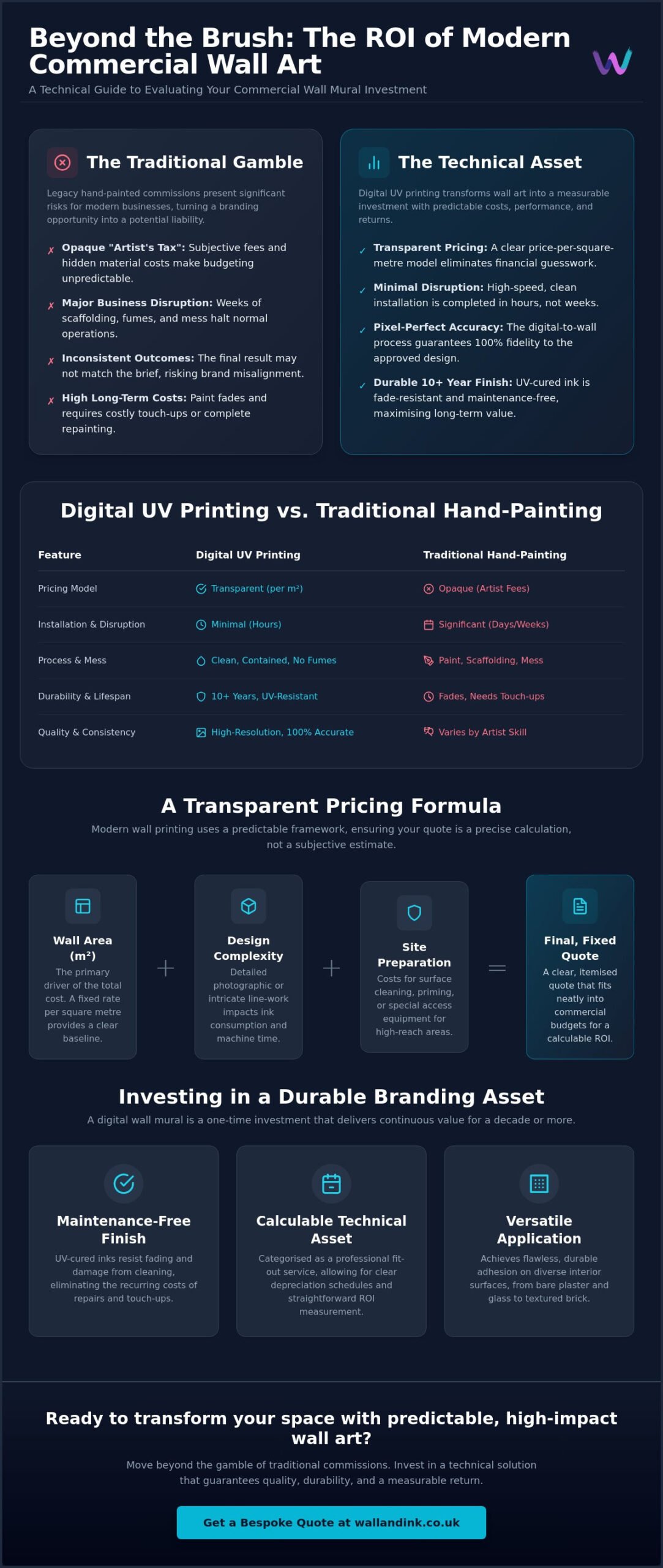
Digital Wall Printing vs. Traditional Hand-Painted Commissions
The choice between digital and traditional methods is often where the most significant gains in commercial wall mural ROI are realised. Traditional hand-painted commissions are inherently labour-intensive; they require a skilled artist to spend weeks on-site. This manual approach introduces variables that are difficult to control in a professional environment. In contrast, high-speed UV printing is a mechanical process defined by industrial precision. What takes a painter fifteen days to illustrate, a digital wall printer executes in fifteen hours. This radical reduction in labour hours directly translates to lower project costs and faster asset activation.
Operational cleanliness is another critical differentiator. Traditional painting involves the “mess factor”: open tins, drop-cloths, and the risk of splashes on expensive flooring. There is also the issue of volatile organic compounds (VOCs) and lingering paint fumes that can disrupt staff productivity or customer comfort. Digital direct-to-wall printing utilises instant-cure UV ink technology. The ink is cured by a specialised light source the moment it hits the surface. It’s a dry, odourless, and mess-free application that allows your business to remain fully operational whilst the work is being completed.
Durability is the final technical advantage. Traditional acrylic or emulsion paints are susceptible to scratching and UV-induced fading over time. UV-cured inks are engineered for high-traffic commercial interiors. They provide a resilient finish that resists mechanical wear and maintains colour saturation without the need for additional protective varnishes. This longevity ensures that your initial investment doesn’t degrade, preserving the visual quality of your brand for years to come.
Speed of Execution and Business Continuity
Downtime is a hidden cost that many firms overlook. For retail centres, hospitality venues, and busy offices, every day a space is cordoned off for decoration is a day of lost revenue or reduced efficiency. Digital printing eliminates the need for extensive scaffolding or long-term site access. Most projects are completed within 24 hours, significantly reducing project management fees. You don’t have to manage a multi-week construction site; you simply clear the wall and watch the print appear.
Precision and Brand Consistency
Corporate identity relies on exactness. Hand-painting complex technical logos or achieving perfect Pantone matching is notoriously difficult and subjective. Digital printing removes human error from the equation. It achieves high-resolution replicas of intricate photographs and brand assets with 100% accuracy. The final result on the wall matches your approved digital proof exactly, ensuring total brand consistency across every location in your estate.
Essential Preparation: Factors Influencing the Final Quote
Whilst a standard price-per-square-metre model provides a reliable baseline, the physical reality of your site dictates the final technical specification. Achieving a high commercial wall mural ROI requires a clear understanding of surface variables before any equipment is deployed. A smooth internal partition wall requires different machine calibration than a rough exterior brick facade. These factors aren’t just aesthetic; they determine the ink density and preparation time needed to ensure a permanent, high-resolution finish that lasts for years.
Bare plaster represents a specific technical challenge in many UK commercial developments. Because the material is highly porous, it can absorb standard pigments, leading to duller colours and poor adhesion. In these instances, a specialised primer or a white-ink base layer is necessary to provide a stable substrate. Addressing these priming requirements or minor wall repairs early prevents site delays. It ensures the final print meets industrial quality standards from the first pass.
Substrate Suitability and Ink Adhesion
UV printing technology is uniquely engineered for mechanical versatility. Unlike traditional paint, which often struggles with non-porous surfaces, UV-cured ink creates a resilient bond with glass, ceramic tiles, and metal. This allows for branding opportunities in unconventional spaces like lift lobbies or laboratory glass partitions. UV-cured inks provide 100% adhesion to almost any substrate, provided the surface is clean, dry, and free from loose debris. For textured walls, such as exposed brick or timber, you can choose to print directly to maintain the industrial aesthetic or sand the surface for a photorealistic finish.
Logistics and Site Accessibility
Accessibility is a primary factor in any professional quote. Ground-floor installations are straightforward, but high-reach areas in atriums or stairwells require specialised equipment hire. Scaffolding or scissor lifts ensure technical safety and machine stability during the printing process. Additionally, travel logistics and secure parking for technical equipment must be factored into the commission fee. We also evaluate existing fixtures like radiators, light switches, and skirting boards during the initial survey. Our printers work around these obstacles with millimetre precision, but a clean, dust-free environment remains essential for a flawless technical finish.
If you’re ready to secure an accurate quote for your project, contact our technical specialists to arrange a site assessment and discover the most efficient solution for your space.
Bespoke Wall Printing Solutions with Wall & Ink
Wall & Ink is the premier UK specialist in durable, direct-to-wall UV printing for commercial interiors. We’ve eliminated the unpredictability of traditional art commissions by replacing subjective processes with industrial-grade technology. Our service is designed for pragmatic decision-makers who require high-resolution results without the operational hassles of legacy methods. By choosing a technical solution over a manual one, you secure a predictable commercial wall mural ROI through increased durability and reduced maintenance costs. We let our technical specifications and promises of cleanliness speak to the quality of our work.
Our national service coverage ensures that professional on-site installation is available across the UK. We’ve refined our workflow to be a “no-hassle” experience, moving from digital visualisation to final execution with methodical speed. There is no peeling, no fading, and no mess. Unlike traditional murals that may degrade or vinyl graphics that bubble over time, our UV-cured prints become a permanent, resilient part of the substrate. This mechanical superiority ensures that your branding remains as sharp as the day it was printed.
The Wall & Ink Commissioning Process
The journey begins with a professional consultation and the creation of high-resolution digital mock-ups. This step ensures total brand alignment before any ink is applied to the wall. We then conduct a technical site assessment to evaluate the substrate and confirm perfect ink adhesion. On the day of printing, our team arrives with specialised equipment for an efficient, quiet execution phase. Most commercial projects are completed in a single shift, allowing your business to continue its operations without significant disruption.
- Initial consultation to define project scope and brand requirements.
- Digital mock-ups provided for precise visualisation in your specific space.
- Technical survey to identify substrate needs and accessibility requirements.
- Quiet, mess-free installation using direct-to-wall UV technology.
Why Choose Direct-to-Wall Technology?
Direct-to-wall printing offers a level of performance that traditional wallpaper or vinyl cannot match. Our UV-cured results are engineered for high-traffic centres, resisting mechanical wear and chemical cleaning. We also prioritise environmental standards by using eco-friendly, low-VOC inks. These are safe for sensitive environments such as hospitals and schools, as well as modern homes and professional offices. This technical superiority ensures that your commercial wall mural ROI is protected by an asset that maintains its quality for years. Book your bespoke design consultation with Wall & Ink today and experience the future of commercial wall art.
Maximising Your Branding Asset with Technical Precision
Securing a high-impact visual for your business no longer requires navigating the subjective pricing and long timelines of traditional art markets. By shifting to a transparent, price-per-square-metre model, you can accurately forecast your commercial wall mural ROI whilst ensuring total brand consistency. This technical approach replaces the unpredictability of manual painting with industrial reliability and high-resolution accuracy.
This commitment to technical reliability is shared by modern enterprises across all operational sectors; for instance, you can check out Computer Market Research to see how they provide similar automation for global channel management and sales networks.
Success relies on choosing a method that prioritises business continuity and long-term durability. Our advanced UV printing technology delivers a resilient, mess-free finish that outperforms legacy alternatives in high-traffic environments. With national UK coverage and bespoke digital visualisation included as standard, professional site transformation is now a streamlined reality for pragmatic decision-makers. You don’t have to settle for inconsistent quality or disruptive installations when a modern, technical solution is available.
Your walls are your most significant untapped branding asset. Ensure they reflect the precision and quality of your business. Request a Transparent Quote for Your Wall Mural Project and take the first step toward a smarter, more durable interior today.
Frequently Asked Questions
How much does a mural cost per square metre in the UK?
Traditional hand-painted murals in the UK typically range from £80 per square metre for simple graphics to over £220 for hyper-detailed work. In contrast, digital wall printing provides a more consistent pricing structure, generally starting between £100 and £120 per square metre for smooth, light surfaces. If the substrate is dark or heavily textured, the price typically increases to approximately £130 per square metre to account for the necessary white-ink base layer.
Is digital wall printing cheaper than hiring a hand-painter?
Digital wall printing is frequently more cost-effective than hand-painting for commercial projects due to the radical reduction in labour hours and site disruption. Whilst material costs remain competitive, the primary saving comes from the speed of execution, which minimises business downtime and project management fees. This efficiency significantly improves your commercial wall mural ROI by delivering a durable, high-resolution result in a fraction of the time required for manual art.
How long does a mural commission take to complete from start to finish?
The total timeline depends on the design approval process, but the physical execution is remarkably efficient. Once the digital mock-ups are approved and the technical survey is complete, most commercial installations are finished within a single day. This rapid execution ensures your space is ready for use immediately; this is a sharp contrast to the multiple weeks often required for traditional hand-applied art commissions.
What kind of wall surfaces can you print a mural on using UV technology?
UV-cured technology is compatible with a broad range of substrates including smooth plaster, textured brick, wood, glass, and metal. The instant-cure process allows the specialised ink to bond with non-porous surfaces that traditional paints often struggle to adhere to. This versatility makes it an ideal solution for varied architectural environments, ranging from industrial warehouses and retail units to modern office partitions and hospital corridors.
Do I need to prepare my wall before the Wall & Ink team arrives?
Walls must be clean, dry, and free from loose debris or peeling paint to ensure industrial-grade adhesion. Whilst the printing process handles minor textures effectively, significant repairs or priming should be completed beforehand to achieve the highest resolution finish. A technical site assessment will identify any specific preparation requirements needed for your chosen substrate to ensure the longevity of the final installation.
For property owners who need expert assistance with this initial phase, professional decorators such as Hudson Line Painters can provide the high-quality surface preparation and base painting required to ensure the longevity of any mural or digital installation.
How long will a UV-printed mural last in a commercial environment?
A UV-printed mural is engineered to last for many years in high-traffic commercial interiors without fading or scratching. The industrial-grade inks are cured instantly by a specialised light source, creating a resilient bond with the substrate that resists mechanical wear better than traditional acrylics. This long-term performance ensures a superior commercial wall mural ROI, as the asset maintains its visual integrity without the need for recurring maintenance.
Can you print a bespoke mural on an exterior wall?
Yes, we provide professional exterior wall printing services using weather-resistant UV inks. These specialised inks are engineered to withstand environmental exposure whilst maintaining high-resolution detail on outdoor substrates such as brickwork or render. It’s a durable solution for enhancing building facades or creating public art trails that remain vibrant despite the UK’s varied weather conditions and UV exposure.
What happens if I want to remove or change the mural later?
Removing or changing a digital mural is as straightforward as painting over the surface with a standard primer and emulsion. Because the ink is applied directly to the wall rather than as a thick layer of vinyl or wallpaper, there is no risk of adhesive residue or substrate damage. This allows you to update your commercial graphics or office branding with minimal effort, ensuring your space remains modern and aligned.