
What if you could overhaul your office walls on a Tuesday afternoon without sending a single employee home or shifting a single desk? For most facilities managers, the prospect of redecorating usually triggers visions of wet paint signs, lingering VOC smells, and the inevitable operational downtime that eats into the bottom line. You likely agree that a professional, branded environment is essential, yet the logistical mess of traditional methods often makes the project feel more like a burden than a benefit. This is where minimal disruption office decoration through direct-to-wall printing changes the equation entirely.
In this guide, you’ll discover how to transform your workspace with high-impact wall art whilst avoiding the peeling, bubbling, and debris associated with legacy alternatives. We’ll examine the technical precision of UV-cured inks that dry instantly and bond to almost any substrate, from brick to glass. By the end, you’ll understand why this specialised process is the modern standard for pragmatic decision-makers who demand a durable, professional finish without the traditional renovation headache.
Key Takeaways
- Understand how minimal disruption office decoration preserves business continuity by eliminating the need for staff relocation or operational shutdowns.
- Learn about the technical advantages of UV-cured inks that bond instantly to surfaces, ensuring zero drying time and a completely odourless installation.
- Compare direct-to-wall printing against traditional vinyl and paint to see why mechanical precision prevents common failures like peeling and bubbling.
- Explore the streamlined planning process, from digital visualisations for stakeholder approval to the minimal surface preparation required before printing begins.
- Discover how bespoke commercial wall murals can reinforce brand identity and improve employee retention without the logistical stress of a standard refurbishment.
Beyond Paint and Paper: Why Minimal Disruption Matters for UK Offices
Redecorating a corporate environment often feels like a trade-off between aesthetic improvement and operational momentum. Traditional renovation methods require significant preparation, protective sheeting, and, most importantly, time. We define minimal disruption office decoration as a technical approach that prioritises business continuity, allowing your team to remain productive whilst their environment is enhanced. Instead of closing off entire wings of a building, modern methods focus on precision application that requires no drying time or hazardous chemical ventilation.
The True Cost of Office Downtime
UK businesses often underestimate the secondary costs of a standard redecoration project. While a light refurbishment might cost between £250 and £500 per square metre, the real expense lies in the loss of billable hours. A traditional painting job for a 20 square metre area can take 2 to 3 days when accounting for multiple coats and drying times. This timeline often necessitates staff relocation or remote working, which can fracture communication and lower morale. Maintaining a professional image is equally critical. Clients visiting a workspace filled with dust and physical barriers may perceive the business as disorganised rather than evolving. When you calculate the impact of a 3-day office closure, the financial burden often exceeds the cost of the decoration itself.
Identifying the ‘Disruption Triggers’ in Traditional Decor
Traditional methods are riddled with triggers that interfere with the daily workflow. The most obvious is the ‘wet paint’ factor, where physical tape and plastic barriers restrict access to communal zones or essential meeting rooms. Then there is the issue of indoor air quality. Volatile Organic Compounds (VOCs) found in many paints and adhesives can cause headaches and reduced concentration among staff. Finally, the surface preparation required for wallpapering, such as stripping old paper or sanding walls, creates fine dust that settles on sensitive IT equipment and requires extensive post-decorating clean-up. These factors create a construction zone atmosphere that is incompatible with high-performance professional settings.
Direct-to-wall printing addresses these failures by utilising advanced digital printing technology to apply graphics directly onto the substrate. This method eliminates the need for adhesives, drying periods, and heavy machinery. It is the primary solution for high-traffic corporate environments where every hour of downtime represents a tangible financial loss. By moving away from paint and paper, facilities managers can achieve a branded workspace without the logistical stress of a legacy renovation.
The Science of Silent Renovation: How UV Wall Printing Works
Direct-to-wall printing is a sophisticated mechanical process that bypasses the manual labour of traditional painting. It uses a vertical carriage system to glide across surfaces, applying ink with photographic clarity. For those seeking minimal disruption office decoration, this technology provides the answer. It achieves resolutions between 720 and 1,440 DPI, ensuring that complex logos or intricate textures appear sharp and professional. The machinery operates on a track system, moving with a level of precision that human hands cannot replicate, making it ideal for the high standards of corporate branding.
Instant Curing and Zero-Odour Inks
The primary advantage of this method lies in the ink chemistry. Traditional oil-based or emulsion paints rely on evaporation to dry, a process that releases Volatile Organic Compounds (VOCs) into the air. These gases often mandate days of ventilation, which is impractical in modern workspaces. UV inks, however, don’t evaporate. Instead, they undergo a chemical reaction when exposed to the printer’s integrated UV lights. This makes the process ideal for environments with high health and safety standards, such as schools or healthcare facilities. Recent guidance for office design emphasises the importance of indoor air quality for employee well-being, a standard that UV printing meets effortlessly.
Precision Engineering for Tight Spaces
Unlike traditional methods that require bulky scaffolding or extensive masking tape, wall printers have a remarkably compact footprint. The machinery requires only a small corridor of floor space to operate, meaning desks and furniture rarely need moving. It handles architectural obstacles like power sockets, light switches, and corners with millimetre precision. Because the ink is applied with mechanical accuracy, there is no risk of splatter or over-spray, removing the need for protective dust sheets. UV curing is a process that hardens ink via light rather than evaporation.
This level of precision allows for a truly minimal disruption office decoration experience. Whether the substrate is standard plasterboard, rustic exposed brick, or sleek glass partitioning, the bond is immediate and durable. If you want to see how this technology applies to your specific workspace, you can explore our range of commercial wall murals to find the right fit for your brand. The result is a high-impact visual transformation that respects the operational needs of your business.
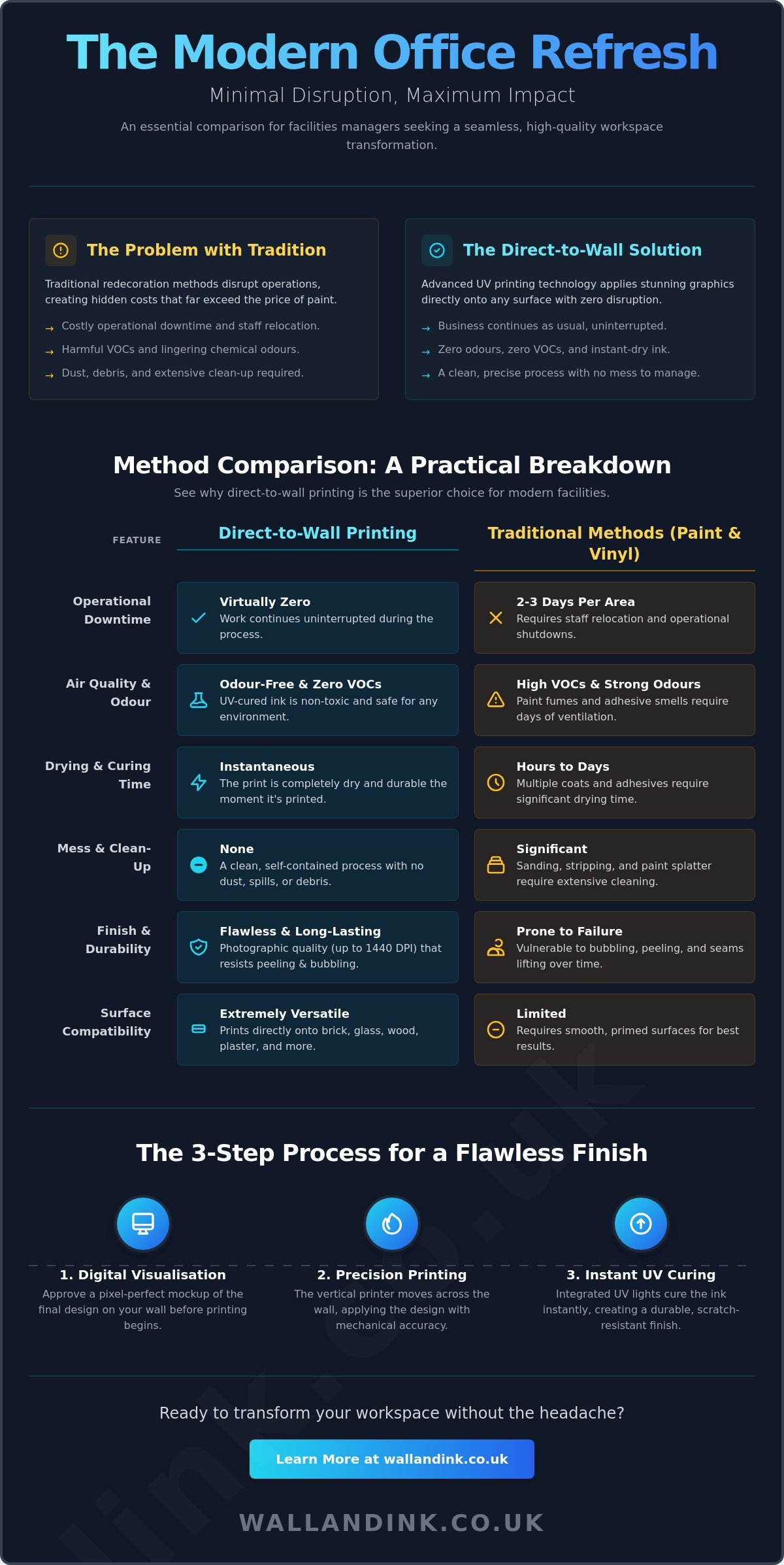
Wall Printing vs Traditional Methods: A Practical Comparison for Facilities Managers
Choosing the right medium for a workspace upgrade requires a balance of speed, cost, and longevity. Traditional painting and wallpapering are labour-intensive processes that often conflict with the goal of minimal disruption office decoration. While a standard paint job for a 20 square metre feature wall might span 2 to 3 days when accounting for multiple coats, direct-to-wall printing completes the same area in 4 to 8 hours. There are no buckets to tip, no brushes to clean, and no risk of paint spills on expensive office carpeting. The process is self-contained and surgically clean.
- Execution: 4-8 hours for a 20 square metre area compared to 2-3 days for traditional paint.
- Cleanliness: No dust, no paint splatters, and zero post-decoration cleanup required.
- Longevity: Scratch-resistant surfaces that do not peel, bubble, or fade under office lighting.
Wallpaper vs Vinyl vs Direct Printing
Facilities managers frequently encounter the failure points of traditional coverings. Wallpaper relies on adhesives that eventually dry out, causing seams to lift and curl in high-traffic areas. Vinyl graphics present a similar challenge; the edges often peel or bubble when exposed to temperature fluctuations or physical contact in busy corridors. Direct-to-wall printing eliminates these mechanical failures by bonding the ink directly into the substrate. Unlike PVC-based vinyls, which can trap moisture and lack breathability, UV-curable inks allow the wall to remain porous. This is a significant advantage for maintaining the structural integrity of the building whilst achieving a professional finish.
Maintenance and Long-Term Durability
The durability of a workspace finish is tested daily by cleaning crews and moving equipment. UV-printed murals are engineered for industrial resilience. The inks are scratch-resistant and highly colour-fast, maintaining their vibrancy even under the constant output of fluorescent office lighting. Maintenance is straightforward. You don’t need specialised chemicals; a damp cloth and standard office cleaning supplies are sufficient to keep the art pristine. If your brand identity evolves in the future, the mural doesn’t need to be stripped or scraped away. Because the ink layer is incredibly thin and flat, you can simply paint over it with a standard emulsion, returning the wall to its original state with zero textural ghosting.
This comparison highlights a clear shift in the industry. Traditional methods are reactive and messy. Direct-to-wall printing is proactive and precise. For the pragmatic manager, the choice between days of disruption and a few hours of mechanical application is a matter of operational efficiency in achieving minimal disruption office decoration.
Streamlining Your Office Refresh: A Step-by-Step Guide to Planning
Planning for a workspace upgrade doesn’t need to be a logistical burden. For minimal disruption office decoration, the process is built on technical precision rather than manual labour. A typical project for a 10-square-metre mural takes approximately 2 to 4 hours of printing time, with setup and breakdown completed in under 30 minutes. This efficiency allows for a streamlined programme that fits into a single morning or afternoon slot. Because the process is so compact, you don’t need to worry about the multi-day schedules usually required for paint to dry and cure.
Preparation is minimal. We require the surface to be clean, dry, and relatively flat. Unlike wallpapering, there is no need to strip old layers or apply heavy primers. If your wall is already finished with a standard emulsion, the printer can begin immediately. This lack of prep work is a key component of minimal disruption office decoration, saving you the dust and debris associated with a traditional construction site.
Digital Visualisation: Seeing the Result Before the Print
Digital mock-ups are the cornerstone of a successful installation. We use high-resolution images of your specific wall to create a digital overlay of the artwork. This prevents ‘designer regret’ by showing exactly how a graphic sits amongst your current furniture, light switches, and architectural features. We can position logos with millimetre precision, ensuring brand alignment before the printer even arrives. We adapt your high-res brand assets to ensure they translate perfectly to a large-scale vertical surface, maintaining colour accuracy and sharp detail throughout the scaling process.
The Printing Day: What to Expect
The installation day is remarkably quiet and controlled. Our machinery produces low decibel levels, similar to a standard office printer, meaning your team can usually remain in the room whilst work is underway. There are no heavy tools, hazardous fumes, or physical barriers to manage. Handover is instantaneous. Because the UV light cures the ink during the printing pass, the surface is touch-dry the second the machine finishes. You can enquire about direct-to-wall printing today to begin your planning process. This methodical approach ensures your office refresh is completed with industrial efficiency and absolute clarity.
Future-Proofing Your Workspace with Wall & Ink
Wall & Ink specialises in the technical application of minimal disruption office decoration across the United Kingdom. We understand that multi-site corporate clients require a consistent aesthetic that reflects their brand identity across every location. Our national service capability ensures that whether you are upgrading a single boardroom or an entire regional network, the result is uniform and professional. This centralised project management removes the variability and logistical stress of hiring different local contractors for every office. It is the logical choice for the modern, agile business that values its time as much as its image.
Enhancing Brand Identity Through Bespoke Art
Bespoke murals are a strategic asset for company culture and recruitment. In a competitive job market, a workspace that reflects innovation and care can be a deciding factor for top talent. Custom murals communicate your values the second a visitor or prospective hire enters the building. We focus on ‘breakout zones’ where high-impact visuals encourage collaboration and provide a mental reset for employees. Because our machinery replicates complex graphics with photographic precision, we can print brand elements that traditional paint simply cannot match. This level of detail ensures your environment is as sophisticated as your business, providing a visual standard that resonates with both staff and stakeholders.
Sustainable Decorating for the Modern Era
Sustainability is no longer optional for the modern UK office. Our process aligns with green building standards by radically reducing material waste. We use precise ink delivery systems that ensure only the necessary amount of product is applied to the wall, which eliminates the environmental burden of leftover paint tins or discarded wallpaper adhesives. There are no offcuts destined for landfill and no hazardous chemical residues left behind. The durability of the UV-cured finish means your walls won’t require frequent touch-ups or total repaints, making it a long-term sustainable investment. Transforming your workspace is now a matter of mechanical precision rather than manual chaos.
You don’t need to settle for the limitations of legacy decorating methods. Wall & Ink provides a clean, fast, and high-resolution alternative that respects your operational schedule. Contact us today to arrange a bespoke design consultation and discover how our minimal disruption office decoration can elevate your professional environment with zero mess and absolute precision.
Transform Your Workspace with Industrial Precision
Modern workspace design requires a solution that prioritises both brand identity and operational momentum. By moving away from legacy methods, you eliminate the common failures of peeling vinyl and the costly downtime associated with traditional painting. You receive a durable, high-resolution finish that is touch-dry the second the mechanical carriage completes its pass. Our process includes bespoke digital visualisations as standard; this ensures absolute alignment with your corporate identity before the application begins. Precision is guaranteed.
This technical approach represents the pinnacle of minimal disruption office decoration, offering a surgically clean installation with no VOCs or toxic fumes. It’s a pragmatic choice for facilities managers who demand high-quality results without the logistical burden of a construction site. Our advanced UV-ink technology ensures that your new mural is safe for immediate use in occupied offices. There’s no drying time and no lingering odour.
Ready to overhaul your professional environment without the mess? Book your bespoke design consultation and get a quote today to see how we can transform your walls with industrial precision. Your next office refresh should be as efficient as the business it supports.
Frequently Asked Questions
Can wall printing be done whilst staff are still in the office?
Yes, the process is designed for active environments. The machinery operates at low decibel levels and requires only a narrow track of floor space to function. Unlike traditional painting, there is no need for physical barriers or protective sheeting that blocks access to communal areas, allowing your team to remain productive throughout the installation.
Is the ink used in wall printing safe for indoor air quality?
The UV-cured inks are entirely odourless and emit no Volatile Organic Compounds (VOCs). Because the ink hardens instantly via light rather than evaporation, there is no chemical off-gassing during or after the process. This makes it a primary choice for minimal disruption office decoration in settings where staff health and concentration are priorities.
How long does a typical office mural take to complete from start to finish?
A standard 20 square metre mural typically takes between 4 and 8 hours to print. Setup and breakdown are efficient, usually requiring only 15 to 20 minutes of on-site time. This allows most projects to be finished within a single working day without requiring staff to work remotely or relocate to different floors.
What kind of wall surfaces can you print on in an office environment?
We can print on almost any vertical substrate found in a modern workspace. This includes standard plasterboard, exposed brick, wood panelling, and even glass partitions or metal surfaces. The ink bonds directly to the material, maintaining the underlying texture whilst delivering a high-resolution finish that is durable and permanent.
Is direct-to-wall printing more durable than traditional office wallpaper?
Direct-to-wall printing is significantly more durable than wallpaper or vinyl graphics. It doesn’t have seams that can lift or edges that can peel in high-traffic corridors. The finished surface is scratch-resistant and doesn’t bubble or fade under the constant output of fluorescent office lighting.
Do I need to move all the furniture out of the room before you arrive?
You don’t need to empty the room or hire removals teams. We only require a clear corridor of approximately 1 metre from the wall to accommodate the printer’s track. Most desks and chairs can remain in place, which is a key advantage of minimal disruption office decoration for busy facilities managers.
Can you print company logos and specific brand colours accurately?
Yes, we achieve photographic quality with resolutions typically between 720 and 1,440 DPI. This precision allows us to reproduce complex company logos and specific brand colours with absolute accuracy. Digital visualisations are provided beforehand to ensure the placement and scale align perfectly with your existing branding guidelines.
What happens if we want to change the design or move offices in a few years?
The mural is permanent but easily reversible if your brand identity evolves. If you need to return the wall to its original state, you can simply paint over the mural with a standard emulsion. Because the ink layer is exceptionally thin, it leaves no textural ghosting or ridges on the wall surface once covered.