
The most significant barrier to a truly photorealistic mural isn’t the quality of the digital file; it’s the physical layer of paper between the art and the architecture. For years, developers and designers have settled for visible seams and peeling edges because there was no viable alternative to traditional wallpaper. High resolution wall printing has disrupted this legacy method by removing the substrate entirely. By printing directly onto the surface, we eliminate the “sticker” effect and ensure the artwork integrates perfectly with the structural texture of the building.
You likely recognise the frustration of watching a premium installation fail due to adhesive breakdown, bubbling, or poor alignment in high-traffic areas. This article demonstrates how advanced UV technology creates seamless, high-definition murals on almost any surface, from internal plaster to external brickwork. We will explore the technical precision of industrial-grade printheads capable of 2880 DPI, the mess-free application process, and why UV-cured finishes provide a ten-year indoor lifespan that traditional vinyl or paper cannot match.
Key Takeaways
- Understand how direct-to-wall UV technology achieves resolutions up to 2880 DPI to deliver genuine photorealism without the need for traditional paper media.
- Learn why substrate-free application is the superior choice for high-traffic areas. It eliminates the common risks of peeling, bubbling, and visible seams found in wallpaper.
- Discover how high resolution wall printing adapts to complex textures like brick and concrete whilst preserving the natural character of the underlying material.
- Master the essential design specifications. You’ll see why 300 DPI at 1:1 scale is the industry benchmark for maintaining clarity on large-scale mural projects.
- Recognise the efficiency of a mess-free installation process. It combines robotic precision with professional site assessment for a durable, scratch-resistant finish.
What is Photorealistic Wall Mural Printing? Defining Direct-to-Wall Technology
Photorealistic wall mural printing represents a fundamental shift in how we apply large-scale imagery to architectural surfaces. Unlike traditional methods that rely on paper or vinyl carriers, this process utilises specialised Direct-to-Wall Technology to deposit UV-curable ink directly onto the substrate. This method is currently disrupting the UK’s commercial branding and interior design sectors by removing the mechanical failures inherent in legacy media. By using high resolution wall printing, we achieve a level of clarity that was previously impossible on textured or irregular surfaces.
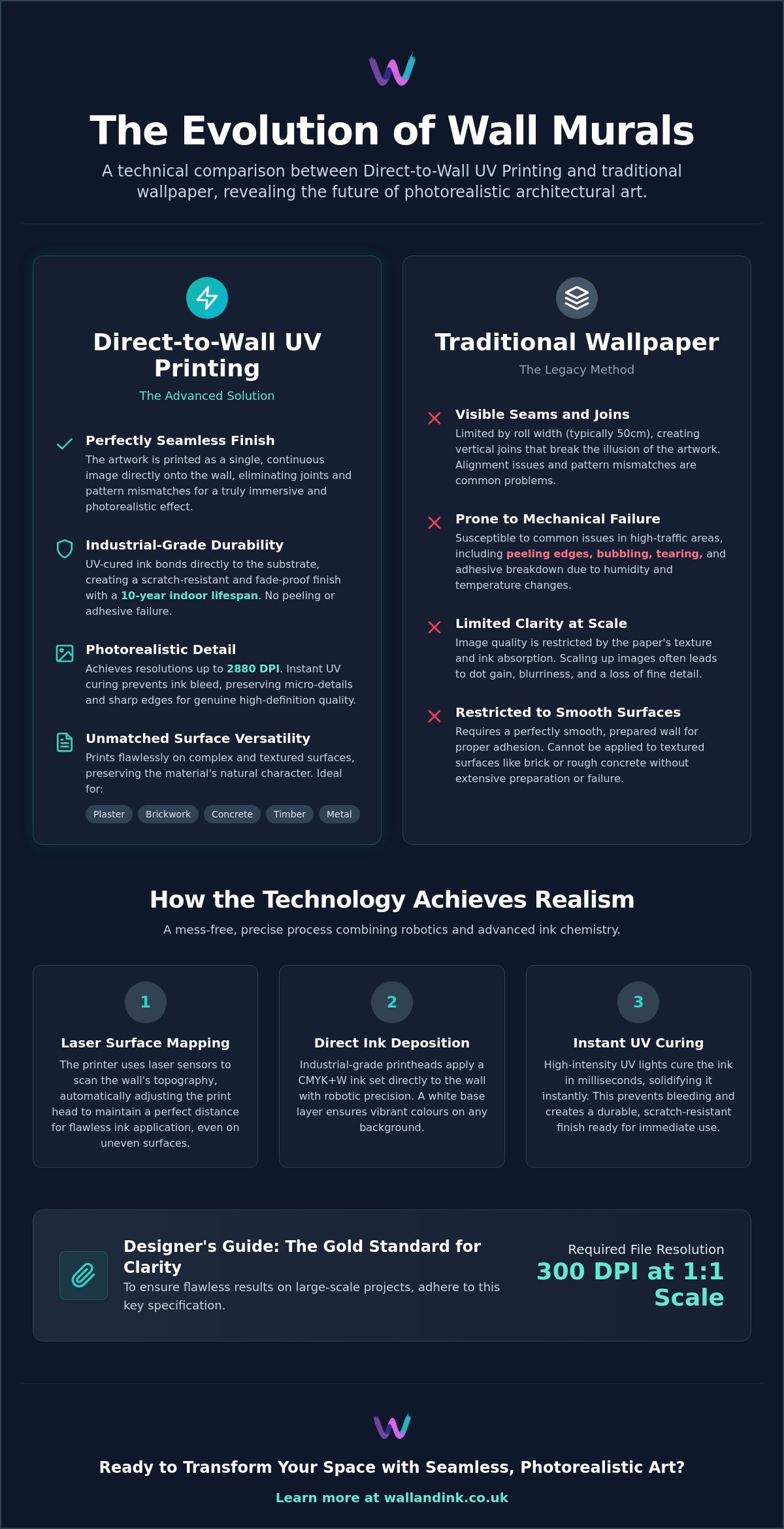
In this technical context, “photorealistic” refers to a specific output benchmark: resolutions ranging from 720 to 2880 DPI. Traditional wallpaper often suffers from dot gain and blurriness when scaled up to mural size. Direct-to-wall systems maintain sharp edges and micro-details because the ink is cured instantly by UV light. This prevents the “bleeding” effect common in standard inkjet processes. The result is a crisp, vibrant finish that stands up to close inspection, even in well-lit professional environments whilst maintaining the integrity of the original digital file.
Direct-to-Wall vs Traditional Wallpaper
Traditional wallpaper is fundamentally limited by its adhesive layer. Over time, heat fluctuations and humidity in UK commercial spaces cause edges to peel and bubbles to form. Direct-to-wall printing eliminates these risks. Since there is no paper layer, the ink bonds directly with the wall material. This lack of paper texture means the image doesn’t compete with a visible grain, resulting in superior sharpness and colour clarity. UV inks are also scratch-resistant and highly durable; they don’t fade or degrade in high-traffic corridors, schools, or retail centres. This industrial-grade reliability ensures the installation remains pristine for years without the need for constant maintenance or repair.
The Aesthetic Advantage of Seamless Art
The absence of seams is the primary driver of photorealistic depth. When the human eye detects a vertical join every 50cm, the illusion of a three-dimensional landscape or architectural view is instantly broken. Seamless application allows for an uninterrupted visual field that enhances the perceived depth of the room. It creates a truly immersive environment where the art feels like an extension of the space rather than a temporary addition. This technology allows designers to transform flat vertical surfaces into windows to other worlds without any visual interruptions or mismatched joins. Direct-to-wall printing is the fusion of digital precision and physical architecture.
The Technology of Realism: How UV Wall Printers Achieve Photographic Detail
Realism in wall art is no longer a matter of artistic skill alone; it’s a result of mechanical precision. Our process relies on a combination of advanced robotics and specialised ink chemistry to bypass the limitations of traditional printing. UV-curable inks are the backbone of this system. Unlike water-based inks that dry through evaporation, these inks undergo a photochemical reaction when exposed to high-intensity UV light. This is central to How UV Wall Printers Achieve Photographic Detail, as the ink transitions from liquid to solid in milliseconds. This instant solidification prevents the ink from spreading or soaking into porous surfaces, which is why high resolution wall printing maintains such sharp clarity on materials like brick or timber.
The printer operates with robotic accuracy, using laser sensors to track the wall’s topography in real-time. It maintains a consistent distance from the surface, typically within a 1-2mm tolerance, to ensure the ink droplet trajectory remains perfect. This automated adjustment handles surface irregularities that would otherwise cause distortion or banding. We also utilise a CMYK+W ink set to ensure colour accuracy. By applying a dedicated white base layer, we can print vibrant, true-to-life images on dark or coloured walls without any loss of saturation. This technical capability is vital for maintaining brand consistency in professional environments.
Safety and environmental impact are equally important for indoor applications. The inks we use are low-VOC and virtually odourless, meeting strict standards for air quality. This makes the technology ideal for healthcare and educational settings where traditional solvent-based prints would be unsuitable. The result is a high-performance finish that is as safe as it is visually striking.
Resolution and Ink Droplet Precision
We measure ink droplets in picolitres, which are microscopic volumes that allow for incredibly fine detail. These tiny droplets are the reason we can reproduce smooth gradients in skin tones and complex textures without visible banding. Whilst a standard 300 DPI print might look acceptable from a distance, our 1440 DPI output remains indistinguishable from a high-quality photograph even at close range. This level of detail is a prerequisite for commercial wall murals in retail or hospitality spaces where customers are in close proximity to the art.
Durability in High-Traffic Areas
UV curing creates a chemical bond with the substrate for maximum longevity. These prints aren’t just a layer of film; they’re integrated into the wall itself. They are highly resistant to UV fading, even in spaces with significant direct sunlight exposure. Because the cured ink is scratch-resistant and washable, it’s the preferred choice for high-traffic corridors in schools and hospitals. You can clean the surface with standard detergents without risking the integrity of the design.
Surface Versatility: Printing Photorealistic Art on Any Substrate
Traditional media like vinyl and wallpaper are restricted by their physical form. They require a smooth, flat surface to adhere correctly. Any texture, such as the mortar lines of a brick wall or the grain of timber, creates air pockets that eventually lead to adhesive failure. High resolution wall printing bypasses these physical constraints. The ink is sprayed directly onto the substrate, allowing the artwork to follow the wall’s natural topography without losing definition. This capability allows us to transform surfaces that were previously considered “unprintable” into high-impact visual features.
The industrial appeal of printing directly onto raw materials like concrete or wood lies in the integration of the art with the architecture. Instead of masking the material, the ink settles into the crevices whilst preserving the original character. This creates a “painted-on” aesthetic that looks like a high-end custom commission, but with the precision of a digital file. Whether the surface is bare plaster or has been previously painted, the technology adapts to the existing substrate to deliver a permanent, high-performance finish. We don’t need to hide the wall; we use its texture to enhance the final image.
Printing on Brick and Concrete
Brick and concrete are notoriously difficult for traditional graphics. Vinyl wraps often bubble in the recesses; wallpaper simply won’t stick. Direct-to-wall printing is the preferred choice for industrial-style offices and retail units across the UK because it embraces the raw material. The printer’s sensors handle the depth changes of the mortar joints, ensuring the image remains coherent across the entire surface. Technical preparation is minimal. The wall must be structurally sound, dry, and free from loose dust or debris. We don’t require a perfectly skimmed surface, just a clean one. This efficiency reduces project timelines and eliminates the need for expensive remedial plastering.
Glass, Metal, and Wood Applications
Non-porous surfaces like glass, tiles, or metal require a slightly modified approach. We use specialist primers to create a receptive base for the UV ink, ensuring a permanent bond. This allows for photorealistic feature walls in environments like kitchens and bathrooms where moisture would typically destroy paper-based murals. The technology also handles slight curves and uneven plasterwork effectively. Because the printhead is non-contact, it can navigate surfaces that aren’t perfectly plumb. From reclaimed wood features to sleek glass partitions, the result is a durable, high-definition finish that integrates with the building’s structure rather than sitting on top of it.
Designing for Scale: Achieving High-Resolution Outcomes
Achieving photorealism at scale is a matter of mathematical rigour. Whilst a digital image might look crisp on a desktop monitor, the physical reality of a five-metre wall requires a much higher level of data density. The golden rule for high resolution wall printing is to maintain 300 DPI (dots per inch) at a 1:1 scale. This benchmark ensures that the transition from a digital file to a physical surface remains sharp and indistinguishable from a traditional photograph. Without this precision, large-scale murals can suffer from pixilation or “soft” edges that break the immersive illusion.
The choice between vector and raster files is the first technical hurdle. Vector files are essential for brand logos and geometric patterns because they can be scaled infinitely without any loss of clarity. Raster images, such as high-end photography, require massive pixel counts to cover architectural surfaces effectively. We specialise in adapting these files to fit specific dimensions whilst maintaining colour integrity. This bespoke design process allows us to integrate client branding and personal photography into the very fabric of a building. The design phase is where architectural constraints meet creative vision.
The Digital Visualisation Process
We provide digital visualisations to eliminate the guesswork inherent in traditional decorating. By creating a mock-up of the mural within a photo of your actual space, we can accurately determine the correct scale and orientation. This process allows us to adjust colours to match existing interior palettes or specific brand guidelines. It also ensures that critical elements of the design aren’t obscured by fixed architectural features. Key details such as a subject’s face or a corporate tagline must not be lost behind radiators, light switches, or furniture. This methodical approach ensures the final print functions perfectly within its environment.
Image Sourcing and Quality Control
Successful outcomes start with high-quality source material. We work with professional photographers and high-end stock libraries to find images that meet our strict resolution requirements. Whilst upscaling technology has improved significantly, it cannot always compensate for a poor-quality original. We use advanced interpolation algorithms to enhance files when necessary, but we always prioritise raw, high-bitrate data. This commitment to quality control prevents the banding and artefacts that often plague lower-tier printing services. If you are ready to see how your vision looks at scale, contact us for a professional design consultation.
The Wall & Ink Process: Professional Execution Across the UK
The execution of a high-resolution mural requires more than just advanced hardware; it demands a methodical approach to logistics and site management. At Wall & Ink, we provide a national service that brings industrial-grade technology to commercial and residential projects across the United Kingdom. Our process is designed for decision-makers who value reliability and the elimination of traditional decorating hassles. By removing the need for wallpaper rolls and adhesives, we offer a cleaner, more efficient alternative for modern interiors. This substrate-free method ensures that the final art is as durable as the building itself.
The installation day is characterised by its lack of disruption. Unlike traditional decorating, which involves cutting, pasting, and lengthy drying times, our high resolution wall printing is a dry process. Setup is rapid. Noise levels are comparable to a standard office printer. Most standard murals are completed within a single working day, allowing your space to remain operational throughout the process. Our no-mess guarantee is a direct result of the UV-curing technology; there is no chemical runoff, no adhesive residue, and no waste material left behind on your site.
From Consultation to Final Print
The journey begins with a comprehensive site assessment to identify the best surface and design for your specific environment. We evaluate the substrate’s condition and take precise measurements to ensure the robotic track system operates at peak efficiency. Transparency is fundamental to our service model. We provide clear pricing on a per-square-metre basis, allowing for accurate budgeting without hidden costs or consultation fees. Throughout the installation, our specialist technicians oversee every aspect of machine precision and colour accuracy. This ensures the final output matches the approved digital visualisation exactly.
Why Choose Wall & Ink for Your Project?
We are committed to industrial precision in every print we execute. By printing directly onto the wall, we eliminate the middleman of wallpaper production and the logistical delays associated with traditional media. This creates a streamlined workflow that delivers superior durability and photographic clarity. Whether you are managing a school, a retail unit, or a private office, our technology provides a permanent solution to the failures of legacy alternatives. If you are ready to transform your space with a seamless, high-definition finish, enquire about our national wall printing services today.
Transforming Architectural Surfaces with Precision
Direct-to-wall technology has effectively solved the legacy issues of traditional mural applications. By removing the paper layer, we eliminate the risks of peeling edges and visible seams that have historically compromised large-scale designs. High resolution wall printing allows for an unprecedented level of detail, ensuring that photographic art maintains its integrity on diverse substrates including brick, plaster, and glass. Our use of UV-cured scratch-resistant inks provides a durable, industrial-grade finish that thrives in high-traffic commercial and educational environments.
With national UK coverage, Wall & Ink manages the entire process from digital visualisation to final execution with robotic precision. This methodical approach ensures that your architectural vision is translated into a permanent, high-performance feature without the mess or disruption of traditional decorating methods. If you are ready to upgrade your environment with a seamless, photorealistic mural, Get a Bespoke Quote for Your Wall Printing Project. We look forward to bringing technical excellence to your next installation.
Frequently Asked Questions
Is high resolution wall printing more expensive than high-end wallpaper?
Direct wall printing is competitive with premium wallpaper when you calculate the total cost of ownership. Traditional wallpaper requires you to purchase the media and hire a specialist installer; our service combines these into a single process. You also avoid the future costs of repairing peeling edges or bubbling, as the ink forms a permanent bond with the substrate.
How long does a photorealistic wall mural take to print?
Most standard projects are completed within a single working day. The printing speed depends on the chosen resolution and surface texture, but the process is significantly faster than traditional decorating. Because the UV ink cures instantly under the printhead, there is no drying time; you can return the room to full use immediately after we finish.
Can the mural be removed if I want to change the design later?
Yes, you can remove a mural by simply painting over it. Unlike wallpaper or vinyl, there is no adhesive to strip and no risk of damaging the underlying plaster. Two coats of high-quality primer and emulsion are typically enough to cover the artwork, providing a clean slate for your next design or a return to a neutral finish.
Is the ink safe for use in children’s bedrooms or hospitals?
The inks used in high resolution wall printing are low-VOC and virtually odourless. They meet strict UK safety standards for indoor air quality and emissions. This makes the technology a reliable choice for sensitive environments such as nurseries, schools, and hospital wards where traditional solvent-based printing methods would be unsuitable.
Do I need to prepare my wall in a special way before you arrive?
The surface must be structurally sound, dry, and free from loose dust or debris. We don’t require the perfectly skimmed finish that wallpaper demands, but major cracks or holes should be filled beforehand. A clean, matte-painted surface usually provides the most consistent base for the ink to bond with the architecture.
Can you print photorealistic images on outdoor walls?
We provide exterior wall printing services that are highly resistant to weather and sunlight. The UV-cured inks are designed to withstand the elements without fading or peeling. Industry standards indicate that these outdoor prints typically maintain their colour vibrancy for approximately five years, depending on the level of direct exposure to UV radiation.
What is the maximum size of a wall mural you can print?
There is no functional limit to the width of our murals. The printer operates on a modular track system that can be extended to cover any length of wall. Whilst the vertical height is determined by the machine’s mast, we can print in multiple horizontal passes to cover massive architectural spaces or multi-storey feature walls.
Does the printer work on uneven or rough surfaces like brick?
The printer is specifically designed to handle textured surfaces such as brick, concrete, and stone. It utilises laser sensors to track the wall’s topography in real-time, maintaining a consistent distance between the printhead and the substrate. This ensures high resolution wall printing remains sharp even when navigating mortar joints or irregular masonry.