
The traditional assumption that bespoke wall art requires weeks of on-site disruption, scaffolding, and paint fumes is no longer true. When evaluating printed murals vs hand painted murals for an active commercial premises or residential project, facility managers and designers often face a difficult trade-off between handcrafted prestige and practical execution.
You want an impactful feature wall that reinforces your brand identity without the anxiety of visual inconsistency, peeling vinyl, or an artist departing from approved digital proofs. You also need certainty that the finished surface will withstand everyday scuffs, heavy footfall, and UV fading without demanding constant maintenance.
This comprehensive comparison guide examines how modern direct-to-wall printing compares to conventional hand painting across long-term durability, visual fidelity, turnaround speed, and substrate compatibility across plaster, brick, wood, and glass. You will discover exactly which method aligns with your operational timelines and architectural requirements, ensuring you can commission large-scale artwork with complete confidence.
Key Takeaways
- Evaluating printed murals vs hand painted murals helps facility managers balance hand-crafted artisan style against mechanical precision, speed, and programme disruption.
- Direct-to-wall digital printing delivers exact brand reproduction and micron-level detail using UV-cured inks that dry instantly and resist heavy physical wear.
- Hand-painted artwork offers organic, painterly texture for bespoke showcase spaces, but demands longer on-site installation schedules and multi-day workspace closures.
- Modern direct wall printing operates effectively across challenging substrates, including bare brick, wood, glass, and roughcast plaster, without peeling edges or visible vinyl seams.
- Clear criteria around footfall, downtime tolerance, and surface materials will help you select the most resilient and practical mural method for your building.
Understanding Mural Mediums: Hand-Painted Art vs Modern Wall Printing
Selecting architectural artwork requires balancing design vision against practical site realities. While exploring What is a Mural? reveals centuries of wet plaster frescoes and oil commissions, today’s project leaders face a modern choice: printed murals vs hand painted murals. Digital visualisations and tight building programmes now drive commercial interiors, forcing decision-makers to evaluate operational downtime alongside visual impact.
The Craft and Character of Hand-Painted Murals
Hand-painted murals rely on manual execution directly onto plastered, primed, or exposed masonry surfaces. An artist works with liquid acrylics, spray mediums, or mineral paints, applying pigment through brushes and rollers. This technique yields a distinct physical quality:
- Tactile depth: Layered brushstrokes, physical glazes, and varied impasto thicknesses create genuine organic character.
- Singular authenticity: Each installation is a unique, one-of-one piece, offering tailored personality for boutique residential features or signature gallery walls.
- Artistic interpretation: The manual painting process introduces subjective variations, meaning the finished wall art can drift naturally from initial sketch concepts.
The Evolution of Printed Murals and Wall Technology
Printed wall treatments were historically limited to adhesive vinyl films and modular wallpaper drops. These legacy solutions introduced persistent failure points, including visible vertical seams, adhesive breakdown, edge-peeling, and trapped air bubbles in high-humidity or high-traffic settings.
Direct-to-wall printing removes these limitations entirely. Industrial vertical printers apply UV-curable inks straight onto bare substrates, transforming vertical surfaces into high-resolution graphic displays without intermediary papers or plastics. This engineering delivers decisive benefits for precision projects:
- Direct substrate bonding: Inks bond directly to bare brick, plaster, timber, or glass without peeling edges.
- Photographic accuracy: High-definition multi-channel inkjet heads reproduce complex vector artwork, fine gradients, and corporate typography down to the micron.
- Absolute predictability: Digital visualisations map your design directly to the wall dimensions, ensuring the final print mirrors approved digital proofs without artistic deviation.
Choosing between printed murals vs hand painted murals ultimately hinges on your priority: hand-crafted, artisanal nuance that accepts longer installation times, or mechanical precision that guarantees swift, clean execution with zero aesthetic guesswork.
Key Performance Factors: Aesthetics, Durability, and Maintenance
A feature wall must withstand daily environmental demands without degrading. Evaluating printed murals vs hand painted murals requires examining how pigment systems hold up against footfall, UV exposure, and maintenance regimes over multi-year operational cycles.
Visual Fidelity: Expressive Texture vs Photographic Clarity
Hand-painted murals provide tangible brush textures and painterly layering. Acrylics and spray pigments suit stylised, organic concepts or classical trompe-l’œil effects. However, manual brushwork cannot replicate micro-typography, tight vector grids, or complex brand identities reliably across large elevations.
Direct-to-wall printing relies on an engineered CMYK+W digital gamut. Piezoelectric printheads jet microscopic droplets directly into the surface pores, achieving sharp edge definition, smooth tonal gradients, and true photorealism. For corporate logos, complex technical schematics, or detailed educational graphics, digital reproduction guarantees identical reproduction of your digital assets.
Wear Resistance and Environmental Resilience
Durability depends heavily on chemical bonding. As detailed in the University of Utah guide to The Mural Making Process, hand-painted artwork requires thorough surface priming, followed by secondary protective varnishes to guard against moisture and abrasion. Without robust top-coats, standard acrylics remain vulnerable to scuffing, chemical cleaning agents, and pigment fading in sunlit spaces.
Direct digital printing changes this durability profile through UV-curable inks:
- Instant curing: Integrated UV lamps cure ink droplets immediately on contact, solidifying them into a resilient, cross-linked polymer layer.
- Scratch and abrasion resistance: The ink forms a durable mechanical bond with the substrate, resisting heavy everyday contact in high-traffic corridors and commercial venues.
- UV stability: UV-cured formulations prevent chromatic fading, even when placed opposite full-height exterior glazing or skylights.
- Moisture and chemical tolerance: The cured surface is washable with standard commercial detergents without running or lifting.
Maintenance presents another operational contrast. Touching up a damaged hand-painted mural requires re-hiring an artist to hand-mix pigments, where slight tonal discrepancies often show against the aged original paint. With direct digital printing, original vector or raster files remain archived. If building alterations or structural repairs damage a wall section, the digital file allows identical re-printing over the repaired plaster with zero colour mismatch. If you require resilient, high-precision surfaces for demanding environments, exploring bespoke commercial wall murals delivers lasting performance with minimal operational upkeep.
Head-to-Head Comparison: Cost, Turnaround, and Practical Execution
Every commercial fit-out or domestic renovation operates under strict programme constraints. When contrasting printed murals vs hand painted murals, project managers must look past initial visual concepts and evaluate site disruption, installation speed, and budget predictability.
On-Site Disruption and Turnaround Speeds
Commissioning an artist involves an extended on-site footprint. Hand painting demands days, sometimes weeks, of manual labour. During this time, areas require cordoning off for scaffolding, ladders, solvent washes, and drying paint trays. Wet paint creates lingering odours and airborne fumes, which often forces operational shutdowns across occupied offices, healthcare wings, or retail floors. In fact, industry data compiled by labour cost analyses indicates that on-site manual work accounts for approximately 75% of a traditional painted mural’s total budget.
Direct digital wall printing condenses this timeline drastically. Modern vertical printing equipment operates quietly and cleanly:
- Single-day execution: Multi-metre elevations that take an artist ten days are printed in hours.
- Zero wet drying periods: High-intensity UV lamps cure every ink deposit instantaneously as the printhead passes, eliminating tacky paint hazards.
- No toxic fumes: Solvent-free UV inks produce minimal odour and zero volatile organic compound (VOC) emissions, keeping adjoining work areas fully usable throughout the print.
- Compact machinery: Vertical wall tracks assemble cleanly beside the working plane without bulky tower scaffolding obstructing main corridors.
Scalability, Repeatability, and Multi-Site Consistency
For educational trusts, hospitality groups, and multi-branch retailers, visual consistency across multiple properties is essential. Traditional hand painting relies on subjective manual execution. Even when hiring the same muralist, subtle shifts in brush pressure, colour blending, and architectural scale will produce visible variations between locations.
Direct-to-wall printing solves the repeatability challenge. Digital vector files guarantee identical graphic reproduction whether applied to a single reception wall or deployed across twelve regional facilities. If structural remodelling, wall repairs, or partition movements occur months later, the original digital asset can be recalled and reprinted identically over new plaster. Weighing printed murals vs hand painted murals through this operational lens shows that direct digital printing offers industrial speed, exact budget predictability, and seamless repeatability that manual artistry cannot match.
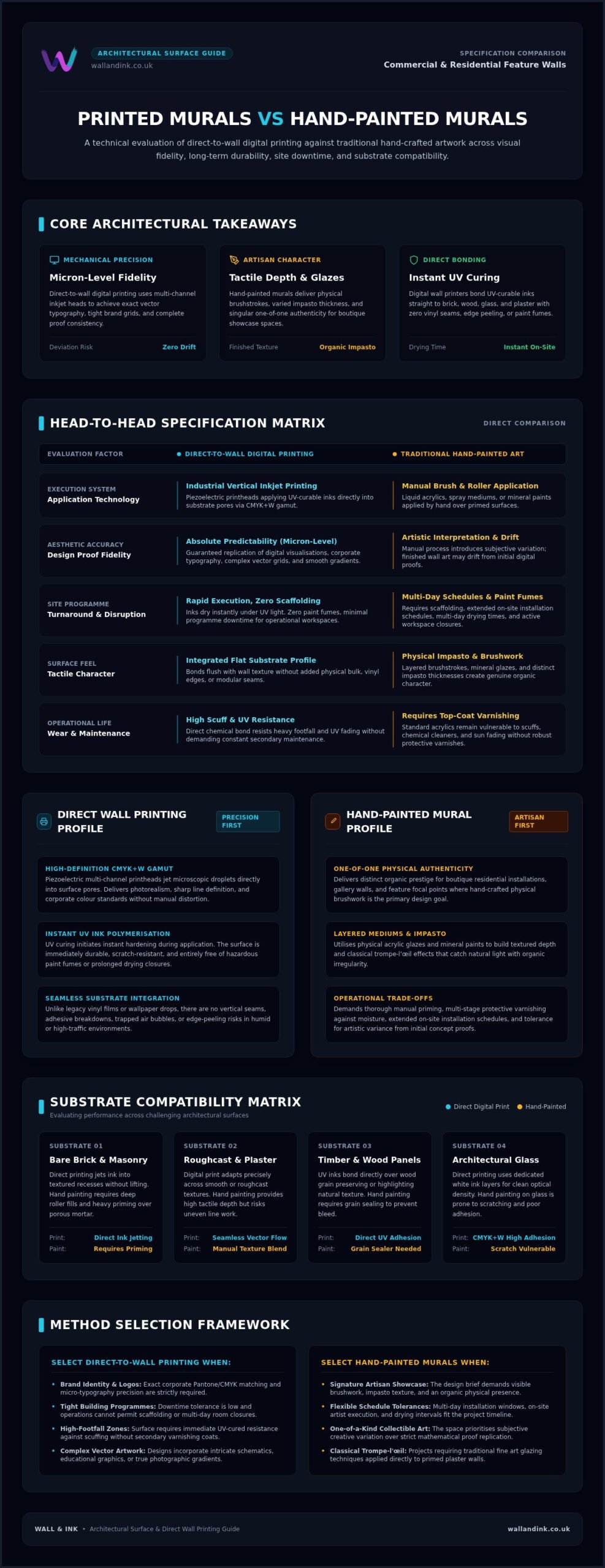
Substrate Suitability: Evaluating Walls, Textures, and Materials
Every architectural surface presents distinct physical characteristics that govern ink adhesion and pigment stability. When weighing printed murals vs hand painted murals, the chemical porosity and dimensional profile of your wall determine both the final visual quality and long-term durability.
Performance on Textured Masonry and Industrial Surfaces
Masonry substrates like bare brick, concrete block, and roughcast plaster pose major challenges for liquid paints. Manual painting over textured walls demands labour-intensive prep work, including heavy base-coating and manual filling of deep mortar joins. Brush bristles struggle to coat jagged crevices evenly, often leading to uneven paint pools, drips, and blurred borders.
Direct-to-wall printing handles surface variation through automated mechanical tracking. Advanced vertical printers employ ultrasonic surface-tracking sensors that measure elevation shifts in real time:
- Dynamic nozzle positioning: Printheads adjust their offset distance automatically across mortar recesses and brick faces, maintaining precise droplet trajectory.
- Sharp edge rendering: Inks settle evenly across structural irregularities without running or bridging across recessed grout lines.
- Substrate preservation: Natural brick textures remain visually exposed beneath the artwork, preserving an industrial aesthetic rather than masking it under thick latex paint.
Glass, Metal, and Non-Porous Architectural Features
Modern commercial workspaces regularly feature architectural materials that resist liquid emulsion paints. Untreated glass dividers, lacquered timber panels, and composite metals lack the porosity required for standard brushwork. Water-based paints bead, smear, and scratch off smooth surfaces easily, necessitating caustic chemical bonding primers that often leave streaky residues.
Direct-to-wall UV printing resolves non-porous applications cleanly. High-intensity UV lamps instantly photopolymerise the ink on contact, establishing a tough mechanical bond directly to glass partitions, finished timber cladding, and aluminium sheets. This allows businesses to add branded graphics across glass meeting rooms or natural wood panelling without vinyl adhesive films that cloud, bubble, or peel at the perimeter over time.
Surface preparation remains straightforward across both methods: substrates must be structurally sound, dry, and free of dust, grease, or loose efflorescence. For smooth plastered walls, brick elevations, or structural glazing, direct digital application avoids messy adhesives and extensive surface sanding. To transform challenging interior or exterior elevations with engineered reliability, book your direct-to-wall printing consultation today.
Choosing the Right Solution: Which Mural Method Suits Your Space?
Every commercial development and high-end residential refurbishment presents unique practical demands. When weighing printed murals vs hand painted murals, the best choice depends on balancing artistic spontaneity against technical precision, footfall demands, and building programme constraints.
Decision Matrix: Matching Method to Space and Purpose
Commissioning an artisanal muralist works best when a project calls for organic interpretation, visible impasto brushstrokes, and bespoke painterly atmosphere:
- Signature residential dining and living rooms: Where hand-crafted exclusivity and singular artistic prestige are the primary criteria.
- Boutique hospitality features: Ideal for one-of-a-kind bar backdrops or luxury hotel suites where natural visual variations add character.
- Heritage restoration environments: Where period-accurate painting techniques and historic mineral pigments must blend seamlessly into aged decorative plaster.
Direct digital wall printing provides an engineered alternative designed for high-traffic environments, corporate compliance, and rapid execution:
- Commercial offices and boardrooms: Requiring exact corporate branding, tight vector graphics, and zero tolerance for colour variance.
- Education and healthcare facilities: High-traffic corridors that demand durable, scuff-resistant, and washable surfaces with zero toxic VOC fumes during installation.
- Retail and hospitality fit-outs: Fast refurbishment schedules where site closures and multi-day scaffolding are simply unacceptable.
- Challenging industrial substrates: Feature elevations across bare brick, concrete, structural timber, or architectural glass.
The Direct-to-Wall Solution with Wall & Ink
Traditional decorative wall coverings introduce inevitable compromises. Conventional pasted wallpaper tears, bubbles, and displays visible vertical joins. Vinyl adhesive films lift at the borders, trap air pockets, and degrade in humid conditions. Hand painting demands days of on-site disruption, cordoned zones, and unavoidable artistic drift from concept sketches.
Direct-to-wall UV printing eliminates these operational hurdles entirely. Printheads deposit UV-cured inks directly into the pores of the vertical plane, delivering clean, hard-wearing graphics that dry instantly without volatile solvents. Detailed digital visualisations allow project teams to inspect placement, scale, and tonal accuracy before any printing begins, removing aesthetic uncertainty from the sign-off process.
Whether you require photorealistic feature walls, intricate wayfinding, or bold commercial branding across plaster, brick, wood, or glass, direct digital execution guarantees long-term durability with zero seam failure. Discover professional direct-to-wall printing across the UK with Wall & Ink to transform your interior elevations with engineered precision.
Elevate Your Walls with Precision and Durability
Deciding between printed murals vs hand painted murals comes down to balancing tactile artisan craft against industrial efficiency. Traditional hand painting delivers expressive texture for exclusive signature spaces, but it demands extended on-site timescales, higher disruption, and inevitable visual variance. Modern direct-to-wall printing bridges artistic fidelity with mechanical speed, providing photorealistic precision and guaranteed colour consistency across demanding architectural surfaces.
You no longer need to accept peeling wallpaper seams, bubbling vinyl films, or weeks of scaffolding. Advanced UV-curable ink technology bonds instantly to plaster, brick, wood, and glass, creating scratch-resistant, washable feature walls that maintain their vibrancy for years without fading. Whether updating corporate headquarters, educational corridors, or contemporary residential interiors, direct digital application ensures your final wall matches approved digital concepts down to the micron.
Take complete control over your interior design project with zero aesthetic guesswork and minimal site downtime. Explore custom direct-to-wall printing for your space with Wall & Ink and transform your vertical elevations with national service delivery across the UK.
Frequently Asked Questions
How long do direct-to-wall printed murals last compared to hand-painted murals?
Direct-to-wall printed murals provide exceptional longevity, often outlasting standard hand-painted finishes in indoor settings. UV-curable inks bond mechanically into surface pores and resist fading or yellowing for many years. Hand-painted artworks also offer strong durability, but they rely heavily on periodic clear-coat reapplication to prevent standard acrylic pigments from scuffing or dulling under continuous light exposure.
Can printed wall murals be applied to uneven surfaces like exposed brick or concrete?
Yes, direct-to-wall printing adapts seamlessly to textured surfaces including exposed brick, breeze block, roughcast plaster, and stone. Advanced vertical printers utilise real-time ultrasonic distance sensors to adjust printhead height continuously across recesses and mortar gaps. This maintains crisp, undistorted graphic rendering without the pooling, dripping, or tedious manual filling required when hand-painting irregular masonry.
Do printed murals peel, bubble, or lift at the edges like traditional wallpaper?
No, direct-to-wall printing completely eliminates peeling, bubbling, and lifting edges because it uses no paper rolls, vinyl film, or adhesive paste. The printer deposits UV ink directly onto the bare substrate, where it cures instantly into a durable layer. Without physical seams or backing materials, the artwork cannot lift or peel away in humid commercial or domestic environments.
How much disruption and downtime does direct wall printing cause compared to hand painting?
Direct wall printing causes negligible disruption, usually completing multi-metre feature walls within several hours rather than multiple weeks. Hand painting requires erecting tower scaffolding, mixing wet paints, and managing lingering paint fumes across cordoned workspaces. Direct printing equipment sets up on compact floor rails, producing zero wet paint hazards and minimal odour so adjacent rooms stay fully operational throughout.
Can direct-to-wall printers accurately reproduce our company branding and vector logos?
Direct-to-wall printing provides micron-level mechanical precision, reproducing corporate branding, complex vector logos, and strict brand colour palettes with complete fidelity. Hand painting introduces subjective human variance and manual brush strokes that struggle with razor-sharp geometric alignment. When comparing printed murals vs hand painted murals for corporate compliance, direct digital output ensures your finished elevation matches approved vector files identically.
Is direct-to-wall printing suitable for high-traffic environments like schools and hospitals?
Direct-to-wall printing is engineered specifically for demanding, high-traffic corridors found in schools, healthcare facilities, and retail units. The UV-cured ink layer forms an abrasion-resistant, scratch-proof surface that handles heavy contact from bags, equipment, and frequent cleaning regimes. Because the process avoids toxic VOC solvents, it satisfies stringent indoor air quality requirements across sensitive public buildings.
Can a printed wall mural be painted over if we decide to redecorate in the future?
Yes, direct-to-wall printed graphics can be easily painted over whenever interior design schemes change. Because the cured UV ink layer is micro-thin and embeds directly into the substrate, it leaves no heavy surface texture, seams, or vinyl residue to strip away. Simply apply a standard trade primer or base coat over the wall and repaint as normal.