
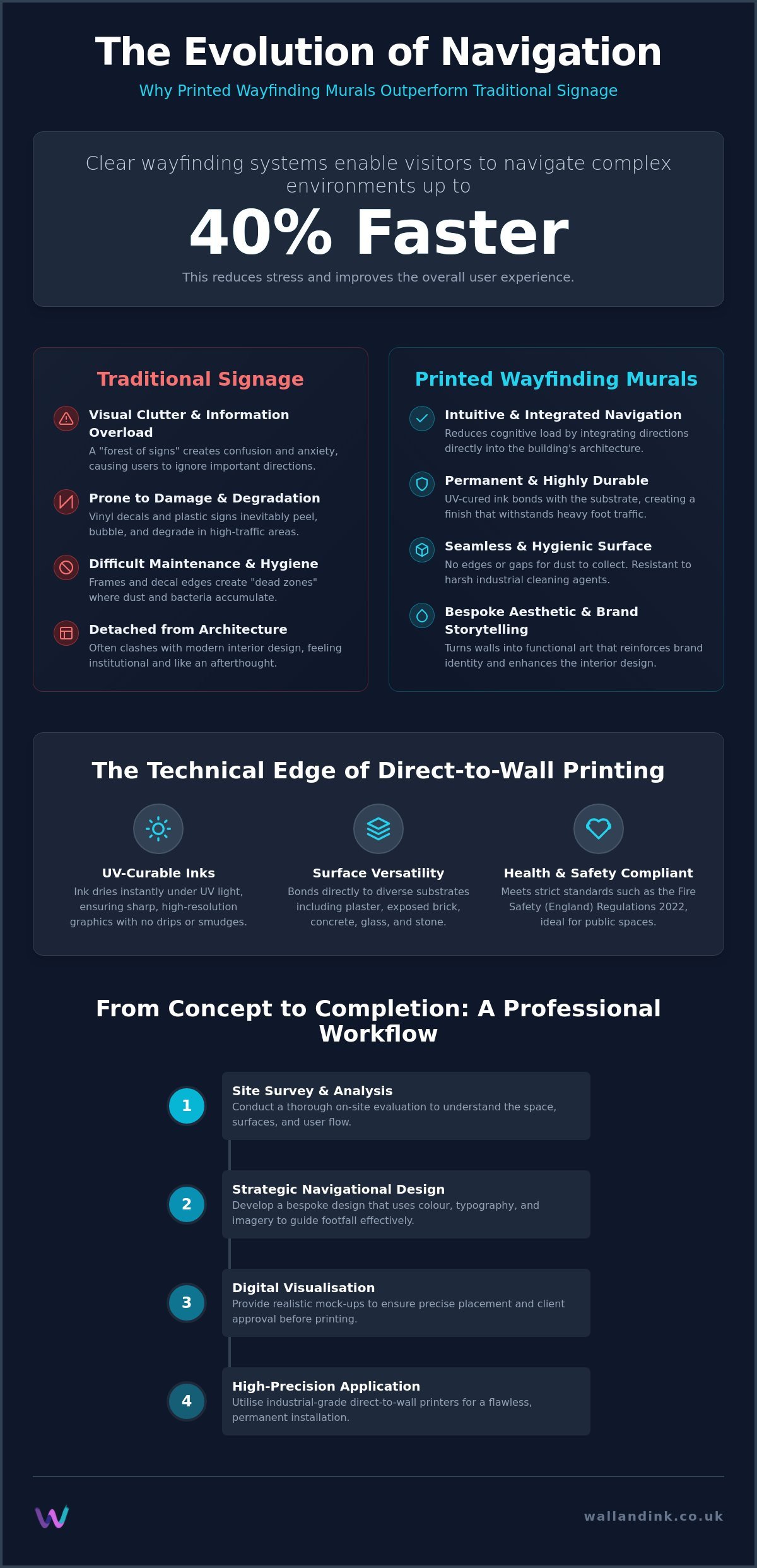
Did you know that visitors navigate complex environments up to 40% faster when supported by clear wayfinding systems? It’s a significant metric, yet many facilities still rely on cluttered plastic signs or vinyl decals that inevitably peel and degrade in high-traffic corridors. You’ve likely dealt with the frustration of maintaining traditional signage that fails to align with your brand’s professional identity or causes unnecessary navigation anxiety. This is why printed wayfinding murals are becoming the standard for modern interior design. They eliminate these common hassles by integrating directions directly into the architecture of the building, providing a permanent and precise solution.
This guide explores how direct-to-wall printed murals are revolutionising environmental design by combining high-precision UV technology with bespoke aesthetics. You’ll discover how these durable, industrial-grade solutions withstand heavy foot traffic whilst meeting strict safety standards, such as the Fire Safety (England) Regulations 2022. We’ll examine the technical advantages of direct-to-surface application, including the ability to print on diverse substrates like glass and stone. By the end, you’ll understand how to create a clean, intuitive interior that guides people effortlessly through your space whilst reinforcing your brand’s authority.
Key Takeaways
- Identify why transitioning from traditional signage to integrated environmental graphics reduces visual clutter and improves the user experience.
- Discover the technical advantages of UV-curable inks that provide instant-dry, durable finishes without the peeling or bubbling seen in vinyl alternatives.
- Learn how bespoke printed wayfinding murals use strategic design to manage footfall and influence user behaviour in complex building layouts.
- Master the professional design workflow, from conducting thorough site surveys to using digital visualisation for precise navigational placement.
- Access a reliable, national solution for industrial-grade wall art that maintains brand identity whilst ensuring compliance with modern safety standards.
The Evolution of Navigation: Why Printed Wayfinding Murals are Replacing Signs
Navigational systems have moved far beyond the static directory boards of the past. The Evolution of Navigation within the built environment now focuses on integrated environmental graphics. These systems use the architecture itself to communicate, rather than relying on an overlay of small, disconnected signs. Printed wayfinding murals represent this shift by turning entire wall surfaces into functional navigational tools. This technical approach addresses the persistent problem of signage clutter, which often leads to information overload and increased stress for building users. When directions are baked into the environment, the building begins to speak for itself.
In modern UK commercial interior design, “placemaking” has become a central pillar of facilities management. It’s no longer enough to simply provide a map; the environment must feel intuitive and intentional. Large-scale graphics reduce the cognitive load on visitors, allowing them to navigate complex architectural spaces without constant reliance on digital devices or reception staff. By integrating directions into the wall itself, you create a permanent solution that feels like a natural extension of the building. This method transforms a standard corridor into a clear pathway, using industrial-grade precision to ensure every visual cue is sharp and legible.
From Traditional Signage to Environmental Graphics
Physical signs frequently fail in high-volume environments like hospitals or large educational campuses. In these spaces, a saturation of small plaques creates a “forest of signs” that users eventually ignore. Printed wayfinding murals solve this through intuitive zoning. By using distinct colour palettes and large-scale imagery, facilities can create unmistakable landmarks. People remember visual cues and specific colours much more effectively than room numbers or text-heavy directions. This psychological benefit is vital for reducing navigation anxiety in high-stakes environments where time and clarity are critical.
The Aesthetic Advantage of Direct-to-Surface Printing
Traditional plastic or metal signs often carry an institutional feel that clashes with modern interior design. Direct-to-surface printing allows navigational cues to become part of the building’s character rather than an afterthought. This method integrates wayfinding into the existing architectural substrate, whether that is concrete, brick, or plaster. It’s a professional finish that allows an organisation to tell its brand story whilst providing essential functional directions. By using bespoke art, a commercial space feels more cohesive and less like a maze of sterile corridors. This technical approach ensures the art is durable and easy to maintain, avoiding the peeling issues common with legacy vinyl alternatives. It’s a shift from merely adding signs to truly designing the user journey.
Direct-to-Wall UV Printing: The Technical Edge Over Vinyl and Paint
Direct-to-wall UV printing offers a level of technical reliability that traditional vinyl decals and hand-painted murals cannot match. The process relies on specialised UV-curable inks that dry instantly upon exposure to ultraviolet light. This rapid curing ensures that high-resolution designs remain sharp on vertical surfaces, eliminating the drips or smudges associated with traditional paint. Because the ink bonds directly with the substrate, printed wayfinding murals become an integral part of the wall rather than a temporary layer. This method is compatible with a wide range of UK building materials, including textured plaster, exposed brick, and industrial concrete.
Hygiene and maintenance are critical in professional environments. Traditional signage often creates “dead zones” behind frames or at the edges of decals where dust and bacteria accumulate. Direct printing is completely seamless. The resulting surface is resistant to harsh industrial cleaning agents, making it an ideal choice for healthcare centres and schools. If your project requires high-precision execution on challenging surfaces, you can explore our commercial wall murals for a more durable alternative to legacy signage.
Durability in High-Traffic Corridors
Public spaces demand materials that can withstand constant physical contact. Vinyl decals are prone to “picking” and edge-peeling in narrow corridors, but UV-printed graphics are virtually impossible to remove by hand. The ink is significantly more scratch-resistant than standard emulsion paint, providing a robust finish that maintains its integrity over time. Additionally, these inks are formulated for lightfastness. In sunlit atriums or glass-fronted lobbies, the colours remain vibrant without the fading typically seen in digital prints or traditional dyes. This mechanical superiority ensures the navigational cues remain legible for years.
Direct Printing vs Vinyl Decals: A Comparison
When evaluating long-term costs, the lifespan of the installation is the primary factor. Vinyl decals often require replacement every three to five years due to adhesive failure or environmental wear. Direct-to-wall UV printing is a 10-year plus solution that removes the need for frequent maintenance cycles. This longevity is particularly important when adhering to the Strategic Implementation Across Professional UK Sectors, where legal compliance for high-rise residential buildings requires permanent, legible wayfinding. By choosing a direct-to-surface method, you eliminate the aesthetic and functional failures of bubbling vinyl whilst ensuring a professional, industrial-grade result that aligns with modern safety standards.
Strategic Implementation Across Professional UK Sectors
Successful navigation relies on predicting human behaviour before a single drop of ink hits the wall. Effective wayfinding isn’t merely about pointing the way; it’s about managing the flow of people to reduce congestion at critical bottlenecks. In narrow corridors, high-resolution printed wayfinding murals are essential because visitors often view the graphics from a distance of less than one metre. At this range, any pixelation or lack of detail becomes immediately apparent. Precision printing ensures that fine text, intricate maps, and directional arrows remain sharp, providing clarity in high-pressure environments where every second counts.
Accessibility remains a primary consideration for any professional installation. Designers must prioritise high contrast and appropriate font scaling to ensure the environment is inclusive for visually impaired users. By using universal icons alongside text, facilities can guide diverse groups of people, including those who may not speak English as their first language. This methodical approach to design ensures that the building remains navigable for everyone, meeting both ethical standards and practical operational requirements.
In large-scale industrial or logistics hubs, this navigational clarity often extends from the walls to the floor, where specialists like StripeGuys Warhouse Line Striping apply durable markings to ensure safe movement across vast floorplates.
Healthcare and Hospitals: Dementia-Friendly Wayfinding
In the medical sector, the strategic use of art for wayfinding in healthcare has proven to reduce patient and visitor anxiety. For dementia-friendly wards, large-scale murals serve as vital cognitive anchors. By using distinct, recognisable imagery on specific floors, patients can identify their location through visual recognition rather than struggling with complex room numbers. Colour-coding these graphics provides an additional layer of non-verbal support, helping patients navigate safely whilst reducing the burden on hospital staff.
Educational Environments: Zoning for Schools and Universities
Schools and universities utilise “subject zoning” to delineate different departments. Large-scale school and educational murals can transform a science wing or a humanities department into a distinct visual territory. These graphics are designed to be exceptionally durable, withstanding the daily wear and physical contact common in primary school corridors. Beyond their functional role, these installations foster a sense of pride and identity amongst students, turning sterile hallways into engaging, branded learning environments.
Corporate Offices and Retail: Branding Meets Navigation
Corporate offices frequently use integrated graphics to guide staff and clients through complex, flexible floorplans. By incorporating company logos and brand values into the wayfinding design, the environment feels cohesive and professional. In retail settings, these murals often serve a dual purpose. They guide footfall toward specific product zones whilst creating “Instagrammable” moments that double as organic marketing. This approach ensures that every square metre of wall space contributes to both the user experience and the brand’s commercial objectives.
The Design Process: From Concept to Digital Visualisation
Precision in the design phase is what separates a successful installation from a confusing one. The process begins with a comprehensive site survey to map out the “decision points” within your building. These are the specific locations where a visitor is likely to hesitate or require direction. By identifying these points early, we ensure that printed wayfinding murals are placed exactly where they’ll have the most impact. This methodical approach eliminates the guesswork often associated with traditional signage placement, providing a streamlined navigational experience from the moment a visitor enters the building.
Every architectural space has a unique flow, and the design must reflect that reality. We don’t just apply generic templates; we create a bespoke navigational language that speaks to the specific needs of your facility. This involves a deep dive into the user journey, ensuring that every visual cue is placed at the optimal height and angle for maximum visibility. By focusing on the practicalities of movement, we turn complex floorplans into intuitive pathways.
Bespoke Design Consultations
Creating a unique navigational language requires close collaboration. We work alongside architects and interior designers to ensure that the mural’s aesthetic aligns with the broader design scheme of the building. This isn’t just about adding arrows; it’s about adapting your existing brand assets into large-format graphics that feel native to the space. Choosing the correct colour palette is essential for legibility. We prioritise high-contrast combinations that meet accessibility standards whilst maintaining a professional, modern finish.
Digital Mock-ups and Visualisation
Visualising a large-scale mural in a 3D space is difficult without the right tools. We provide detailed digital mock-ups that show the proposed design in situ within your actual corridors or lobbies. This step is critical for identifying potential conflicts with wall-mounted hardware like light switches, fire alarms, or thermostats. Our UV printers offer a 1:1 match between the approved digital design and the final printed output, ensuring that the scale and positioning are exactly as intended. If you’re ready to see how this technology can transform your facility, you can request a bespoke design consultation to begin the process.
Technical preparation of the artwork is the final hurdle. When scaling graphics to cover a 10-metre wall, high-resolution vector files are mandatory to prevent pixelation. Our specialist designers handle the conversion of your branding into print-ready formats that maintain industrial-grade sharpness at any scale. This level of technical oversight guarantees that the final mural is as precise as the digital file, providing a crisp, professional result that stands up to close inspection in narrow corridors and high-traffic areas.
Wall & Ink: Specialist Direct-to-Wall Printing Across the UK
Wall & Ink operates with industrial precision across the United Kingdom, delivering specialised direct-to-wall printing solutions for diverse professional sectors. Our team provides high-resolution printed wayfinding murals that meet the rigorous demands of commercial and educational facilities. By utilising advanced UV technology, we ensure that every navigational cue is applied with mechanical accuracy. This process eliminates the traditional inconveniences of onsite work. There’s no adhesive residue from vinyl and no lingering fumes from traditional paint. Our method is a clean, efficient alternative that fits seamlessly into active professional environments without disrupting daily operations.
Transparency is central to our service. Facility managers often struggle with hidden costs in bespoke design projects, but we provide clear pricing structures based on square footage and surface complexity. This allows for precise budgeting from the initial consultation through to final execution. We understand that pragmatic decision-makers value results over decorative language, which is why we let our technical specifications and finished projects demonstrate our capability. Every installation is handled by experts who understand the physical reality of the trade, ensuring that the final output is as durable as it is precise.
A Reliable Partner for Large-Scale Projects
We have extensive experience collaborating with main contractors and interior designers on high-stakes developments. Speed of execution is a primary advantage of our system. Because the UV ink cures instantly, we can complete large installations in a fraction of the time required for hand-painted alternatives. This efficiency minimises downtime in busy public buildings such as hospitals, universities, and transport hubs. For projects that require a holistic approach to building maintenance, partnering with experts like Archers Roofing Services Ltd ensures that structural integrity is maintained alongside aesthetic improvements. Our commitment doesn’t end at installation. The longevity of our UV-printed murals ensures that your investment remains functional and visually sharp for over a decade, providing a long-term solution to navigational challenges.
Getting Started with Your Wayfinding Project
Our nationwide service coverage ensures that high-quality printed wayfinding murals are accessible regardless of your location in the UK. Whether you require graphics for a single office or a multi-storey healthcare facility, we provide a methodical step-by-step process. To begin, you can request a bespoke quote tailored to your specific square footage and surface type. We’ll guide you through the technical requirements to ensure a professional, industrial-grade finish that aligns with your brand’s identity and meets all safety regulations.
Enquire about our direct-to-wall printing services today to see how our precision technology can transform your facility and improve the visitor experience through intuitive design.
Optimise Your Environment with Precision Navigation
Integrating directions into the building’s fabric is a technical requirement for efficient facility management. You’ve seen how printed wayfinding murals provide a permanent, industrial-grade alternative to traditional signs that often fail in high-traffic corridors. By utilising advanced UV ink technology, these installations offer a durable, pick-resistant finish that withstands the rigours of daily public use whilst maintaining brand clarity and legibility over the long term.
Precision execution starts with our bespoke digital visualisation, ensuring the final output aligns perfectly with your architectural decision points. This methodical approach eliminates the mess of traditional painting and the inevitable degradation of vinyl decals. Our process is designed for pragmatic decision-makers who value mechanical superiority and the elimination of maintenance hassles. It’s a modern solution for those who prioritised efficiency and professional results.
Request a bespoke design consultation for your wayfinding project to secure a modern navigational solution for your space. We look forward to helping you create an intuitive, high-performance environment that guides your visitors with absolute clarity.
Frequently Asked Questions
Are printed wayfinding murals more durable than vinyl stickers?
Yes, printed wayfinding murals offer superior durability because the UV ink bonds directly with the wall substrate. This eliminates common industry failures such as peeling edges, bubbling, or “picking” in high-traffic corridors. Whilst vinyl acts as a temporary layer that degrades over time, our direct printing method provides a permanent, industrial-grade solution. It withstands physical contact and heavy cleaning without the adhesive failure associated with traditional decals.
Can you print wayfinding murals on textured surfaces like brick or breeze blocks?
You can print directly onto almost any vertical surface, including textured materials like brick, breeze blocks, and concrete. The specialised UV print heads adjust to the contours of the substrate, ensuring a sharp and consistent finish regardless of the surface texture. This versatility allows you to integrate navigational graphics into the existing architectural character of a building without the need for additional mounting boards or smooth plastering.
How long does the wall printing process take for a typical corridor?
Installation speed depends on the total square footage and design complexity, but most projects are completed in a fraction of the time required for hand-painting. A standard corridor section can often be printed within a single working day. Because the UV ink cures instantly, the area is ready for public use immediately after the machine finishes. This efficiency significantly reduces downtime for busy facilities compared to multi-day painting schedules.
Are the inks used in wayfinding murals safe for hospitals and schools?
Our UV-curable inks are entirely safe for sensitive environments like hospitals and schools. The process is low-odour and produces no harmful emissions during or after application. Unlike traditional solvent-based paints, these inks dry instantly under ultraviolet light, allowing the space to remain occupied whilst we work. This makes printed wayfinding murals an ideal choice for facilities that require high hygiene standards and minimal environmental disruption.
What happens if a printed mural gets damaged or scratched?
If a mural sustains significant mechanical damage, the affected section can be digitally reprinted with absolute precision. Because we maintain the original high-resolution design files, we can achieve a 1:1 colour and alignment match for the repair. This is a major advantage over hand-painted murals, which are difficult to touch up consistently. Our finishes are inherently scratch-resistant, but the ability to perform targeted repairs ensures the long-term integrity of the installation.
Do I need to prepare the wall surface before the printing team arrives?
The wall should be clean, dry, and free from loose debris or flaking paint before the team arrives. In most cases, a standard emulsion finish is an ideal base for the UV ink. If you are printing on dark or highly porous surfaces, we may advise on a specific primer or base layer to ensure maximum colour vibrancy. We provide a clear site preparation checklist during the consultation phase to ensure the surface is ready for industrial-grade application.
Can wayfinding murals be used on exterior walls?
Yes, we provide exterior wall printing services using weather-resistant UV inks designed to withstand outdoor conditions. These inks are formulated for high lightfastness, preventing significant colour fade from solar exposure. Whether applied to brick, render, or metal cladding, printed wayfinding murals provide durable navigational cues for car parks and building entrances. This ensures your system remains cohesive from the exterior approach through to the interior corridors.
How much do printed wayfinding murals cost compared to traditional signs?
Whilst the initial investment for a direct-to-wall mural may differ from basic plastic signage, the long-term cost-effectiveness is significantly higher. You eliminate the recurring costs associated with replacing damaged signs or peeling vinyl decals. Our transparent pricing is based on the total area and surface type, allowing facility managers to budget accurately. By choosing a permanent, low-maintenance solution, you reduce the total lifecycle cost of your building’s navigational system.