
What if the rugged texture of your exterior masonry isn’t a barrier to high-end design, but actually the perfect substrate for a digital masterpiece? Many property owners settle for standard masonry paint colours because they assume that the uneven surface of a rendered wall would distort a complex mural or cause the art to flake away within a season. You might worry that the grit and grain of the render will swallow the fine details of your vision, or that the British weather will quickly dull the finish.
We understand that you value precision and longevity over temporary fixes like vinyl or traditional wallpaper. This guide shows you how advanced UV technology enables direct printing on rendered walls with industrial accuracy, ensuring your bespoke art remains vibrant and intact for years. We’ll break down the technical process behind high-resolution UV curing, examine the durability of these specialised inks against the elements, and outline the essential planning permissions required for large-scale exterior projects.
Key Takeaways
- Understand how advanced distance-sensing UV technology ensures sharp, high-resolution results on textured surfaces by managing the unique peaks and troughs of masonry.
- Discover why printing on rendered walls is compatible with modern substrates like K-Rend and Monocouche without compromising the structural integrity of the surface.
- Learn how industrial-grade UV-cured inks provide superior weather resistance and UV stability, significantly outlasting traditional paint and vinyl in the British climate.
- Identify the logistical advantages of a digital-first approach that delivers high-impact visuals without the mess, fumes, or lengthy lead times of manual mural painting.
Beyond Masonry Paint: The Rise of Printing on Rendered Walls
Rendered walls have traditionally been the final frontier for high-detail design. Whilst internal plasterboard allows for wallpaper or vinyl, the rugged nature of exterior render usually forces a compromise: a single, flat colour of masonry paint. This limitation is no longer a technical reality. The emergence of specialised digital printing technology has transformed how we approach large-scale exterior aesthetics. Instead of hiding the texture under thick layers of paint, printing on rendered walls utilises the substrate as a high-definition canvas.
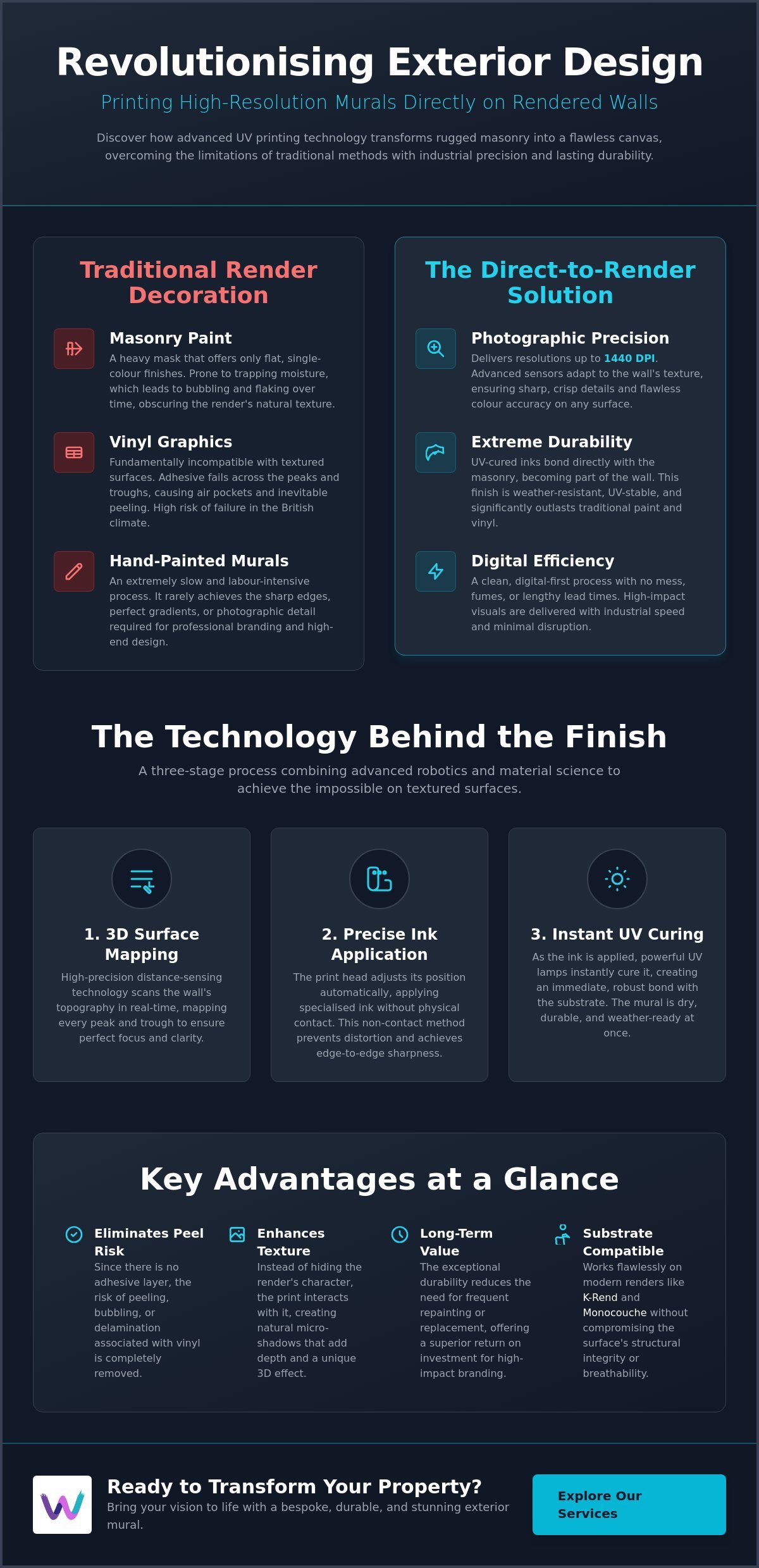
This process doesn’t just sit on the surface. It bonds with it. Traditional masonry paint often feels like a heavy mask. It can obscure the fine grain of the render and, over time, trap moisture that leads to bubbling or flaking. Digital application uses UV-cured inks that penetrate the surface profile. This ensures the mural becomes part of the wall itself rather than a fragile layer on top. UV technology has disrupted the design industry by offering a level of precision that was previously impossible on such unforgiving surfaces, allowing for industrial-grade durability without sacrificing aesthetic detail.
The Limitations of Traditional Render Decor
Standard decorative solutions are fundamentally incompatible with textured masonry. Traditional wallpaper requires a perfectly smooth surface for adhesion; on render, it simply cannot bond. Vinyl decals face similar failures. The adhesive struggles to maintain contact across the peaks and troughs of the texture, leading to unsightly air pockets and inevitable peeling. Attempting to hand-paint complex logos or photographic murals on rough render is equally problematic. It is a slow, labour-intensive process that rarely achieves the sharp edges or colour gradients required for modern branding. These legacy methods often end up smothering the natural character of the render rather than enhancing it.
The Direct-to-Surface Advantage
Our technology overcomes these hurdles by achieving photographic detail on substrates that were once considered unprintable. Because the ink is applied without physical contact, there is no risk of the design being distorted by the wall’s texture. This method completely eliminates the “peel risk” associated with vinyl graphics because there is no adhesive layer to fail. UV wall printing is the precision application of ink directly onto textured masonry. It allows for high-resolution output that remains crisp and clear against the rugged backdrop of the wall, providing a professional finish that manual methods cannot replicate.
The Technical Precision of UV Printing on Textured Substrates
Precision on an uneven surface requires more than just a steady hand; it demands advanced sensory technology. When printing on rendered walls, the primary technical hurdle is the inconsistent depth of the substrate. Traditional printing methods require a flat plane to maintain focus. Our industrial wall printers overcome this by utilising high-precision 3D tracking sensors that map the wall’s topography in real-time. This ensures the print head maintains a consistent distance from the masonry, whether it is passing over a recessed mortar joint or a protruding piece of grit.
The ruggedness of the render doesn’t just present a challenge; it provides an aesthetic opportunity. The peaks and troughs of the surface create natural micro-shadows that add a tangible sense of depth to the digital art. This interaction between light, texture, and ink produces a three-dimensional effect that flat surfaces cannot replicate. By using Ricoh Gen6 printheads, we achieve resolutions of up to 1440 DPI, ensuring that even on coarse sand-and-cement render, the colour accuracy and sharpness remain uncompromisingly professional.
Smart Sensors and Surface Adaptation
The success of the application relies on the machine’s ability to adapt to “blown” render or significant surface imperfections. The smart sensors detect changes in the wall’s profile at a millisecond rate, automatically adjusting the print head’s position. This prevents the “ghosting” or blurring that occurs when ink is fired from varying distances. It ensures edge-to-edge clarity across the entire mural, regardless of how heavy the render grain might be. If you are looking for a reliable partner to handle these technical complexities, you can explore our commercial wall murals for high-stakes environments.
UV Ink: The Science of Immediate Adhesion
The chemistry of the ink is just as vital as the hardware. Unlike traditional architectural coatings that rely on evaporation to dry, UV-cured inks undergo a photochemical reaction. As the ink hits the porous render, it is immediately exposed to high-intensity UV light, which hardens it instantly. This prevents the ink from running or bleeding into the texture of the masonry, a common failure point for manual painting on vertical surfaces. This instant curing process also makes the technology ideal for sensitive environments. The inks we use are low-VOC and eco-friendly, making them safe for immediate use in residential spaces, hospitals, and school settings without the lingering fumes associated with solvent-based alternatives.
Preparing Different Types of Render for High-Resolution Art
Successful printing on rendered walls begins with a technical assessment of the substrate. Not all renders react to UV ink in the same way, and the age of the surface significantly dictates the final colour vibrance. New render typically requires a curing period of at least 28 days before any digital application can take place. This allows the pH levels to stabilise and ensures that internal moisture has evaporated. If the render is too fresh, the high alkalinity can interfere with the chemical bonding of the ink, leading to premature fading or adhesion failure.
Cleaning protocols are a mandatory prerequisite for industrial-grade results. The surface must be entirely free from atmospheric pollutants, organic growth like algae, and loose friable material. We utilise specific pre-print checks to ensure the wall is structurally sound. Moisture management is equally vital; a dry substrate is critical for the UV process. Because the ink is cured instantly by high-intensity light, any residual dampness trapped within the render pores can prevent the ink from achieving a permanent mechanical bond. We don’t print on damp masonry because it compromises the longevity of the installation.
K-Rend and Monocouche: The Modern Standards
Modern through-coloured renders, such as K-Rend and Monocouche, are considered the gold standard for digital wall printing. Their consistent, uniform finish allows our sensors to maintain a perfect focal distance, resulting in the sharpest possible image. However, these surfaces can sometimes exhibit “chalkiness” or efflorescence as they age. This fine dust must be professionally removed or stabilised before the printing process begins. If the surface leaves a white residue on your hand, it isn’t ready for a mural. Once properly prepared, these modern renders provide an excellent, low-absorption base that keeps the ink on the surface for maximum visual impact.
Sand, Cement, and Pebble Dash Challenges
Traditional sand and cement renders offer a rugged, classic aesthetic that works well with larger, more abstract designs. The primary requirement here is the repair of any hairline cracks or “blown” sections. Any structural repairs must be fully cured and sanded to match the surrounding texture to avoid visible seams in the artwork. Whilst our technology is highly versatile, pebble dash represents the physical limit of the process. The extreme, jagged depth of the stones makes it impossible for the print head to maintain a safe or consistent distance. For pebble-dashed properties, we recommend applying a smooth render “window” or a dedicated panel to serve as the printing area.
Durability and Maintenance: Weatherproofing Your Custom Mural
Printing on rendered walls requires a solution that survives the volatility of the British climate. Unlike traditional masonry paint, which relies on a superficial layer to provide colour, UV-cured inks bond at a molecular level with the substrate. This mechanical superiority ensures that the mural can withstand the expansion and contraction cycles caused by frost and heat without the cracking or peeling typical of legacy coatings. High humidity and heavy rainfall do not cause the ink to run or bleed once the curing process is complete. The result is a finish that remains structurally sound and visually striking despite constant exposure to the elements.
Solar exposure is the primary enemy of exterior art. Standard masonry paints often lose their saturation within 24 months due to pigment degradation from ultraviolet radiation. Our process utilises industrial-grade inks that are specifically formulated for high UV resistance. UV-cured inks are inherently lightfast for up to 12 years indoors and 5 years outdoors when applied correctly to a stable substrate. For maximum longevity, we recommend the application of a UV-resistant clear coating. This protective layer acts as a sacrificial barrier against pollutants and can be reapplied every two to three years to maintain the vibrancy of the original design.
Fade Resistance and UV Protection
The chemical composition of our inks ensures superior pigment retention compared to standard exterior paint. While traditional coatings might flake or dull as the binder breaks down under sunlight, UV inks are cured into a hard, durable state. This technology prevents the “chalking” effect often seen on older rendered surfaces. The precision of the application means that even subtle gradients and fine lines retain their integrity over time. This makes digital murals a pragmatic choice for commercial properties where branding must remain crisp and professional for several years without the need for constant repainting.
General Upkeep of Printed Masonry
Maintaining the visual impact of your mural is straightforward but requires the right technical approach. We recommend a soft-wash protocol rather than high-pressure washing. High-pressure water can erode the render itself and potentially compromise the ink bond over time. For general dirt and atmospheric pollutants, a gentle rinse with low-pressure water and a neutral detergent is sufficient. Dealing with organic growth like algae is also manageable; if it does occur, use a specialised fungicidal wash that doesn’t contain abrasive bleach. If you need a durable solution for your property, you can book our exterior wall printing service to ensure a professional, long-lasting finish.
Transforming Your Property with Wall & Ink’s Bespoke Printing
Wall & Ink operates as a specialised partner for property owners who require more than just a decorative finish. Our approach to printing on rendered walls is rooted in industrial precision. We’ve replaced the unpredictability of manual painting with a methodical, technology-driven workflow. This begins with a comprehensive site assessment and ends with a high-resolution mural that is cured instantly for immediate use. Our UV technology is specifically calibrated for large-scale external render projects, providing a level of colour depth and edge definition that traditional methods cannot match.
We provide a national service, bringing our specialised printing equipment directly to your site. This eliminates the logistical burden of coordinating multiple contractors or managing messy on-site paint stations. Our mobile units are designed for efficiency, allowing us to execute complex designs in high-stakes professional environments or private settings with minimal disruption. Every project is handled by specialists who understand the physical reality of masonry substrates, ensuring that the transition from digital file to physical wall is seamless and technically sound.
Digital Visualisation: See Before You Print
Precision starts before the first drop of ink hits the masonry. We provide a digital visualisation service that allows you to see the final result before we arrive on-site. By overlaying your chosen design onto high-resolution photographs of your actual rendered wall, we can account for architectural features like windows, vents, and downpipes. This process is vital for adjusting colour palettes. We calibrate the design to work with the base shade of your render, ensuring that the final output remains vibrant and true to your brand or artistic vision. It allows for a level of planning that eliminates guesswork and ensures the scale is architecturally appropriate.
Commercial and Residential Applications
The versatility of our technology allows for a broad range of applications across different sectors. For commercial clients, we brand exterior retail units with durable, high-impact graphics that serve as long-term advertising assets. These murals withstand the rigours of high-traffic environments whilst maintaining their professional appearance. In the residential sector, we create unique feature walls in garden courtyards and patio areas. These bespoke installations turn standard masonry into a focal point without the need for high-maintenance cladding or traditional art. Ready to transform your render? Contact Wall & Ink for a bespoke visualisation.
Precision Engineering for Your Exterior Walls
The transition from standard masonry paint to digital precision represents a fundamental shift in property maintenance and design. By utilising advanced UV ink technology, we’ve eliminated the technical barriers previously associated with textured masonry. You don’t have to choose between the rugged character of your render and the clarity of a bespoke mural. Our distance-sensing technology ensures that every drop of ink is placed with industrial accuracy, regardless of the surface profile. This method provides durable, weather-resistant results that outperform traditional alternatives in both longevity and visual impact.
Success in large-scale exterior projects depends on meticulous planning and technical expertise. Our bespoke digital visualisations allow you to verify the scale and colour accuracy of your project before execution begins. This transparency ensures that the final installation meets your exact specifications without the mess or delays of manual painting. If you’re ready to move beyond the limitations of single-colour finishes, we’re here to facilitate that transformation. Get a Quote for Your Rendered Wall Project and discover the potential of high-resolution printing on rendered walls today.
Frequently Asked Questions
Can you print on rough or textured render?
Yes, you can print on most textured masonry surfaces with high precision. Our equipment utilises 3D tracking sensors to maintain a consistent focal distance from the wall as the print head moves. This allows the ink to reach into the recesses of the render grain without losing resolution or clarity. Whilst extremely jagged surfaces like pebble dash are unsuitable, standard roughcast or sand-and-cement renders are ideal substrates for digital murals.
Is printing on exterior rendered walls waterproof?
Yes, the printing process is entirely waterproof once the UV curing is complete. Unlike traditional paints that require lengthy drying times, UV-cured inks harden instantly upon application. This creates a durable, weather-resistant bond that does not run or smudge when exposed to rain, frost, or humidity. It is a robust solution specifically designed to withstand the volatility of the British climate.
How long does a print on a rendered wall last?
An exterior mural typically maintains its vibrancy for up to five years before showing signs of weathering. Indoors, the lifespan of printing on rendered walls extends to twelve years or more. These figures are based on the inherent lightfastness of UV-stable inks. To maximise longevity, we recommend applying a clear UV-resistant coating every two to three years to protect the pigment from atmospheric pollutants and solar degradation.
Do I need to prime my rendered wall before printing?
Priming is generally unnecessary for standard rendered surfaces as the ink is engineered to bond directly with the masonry. However, the substrate must be professionally cleaned and completely dry before we arrive on-site. If the render is particularly old or friable, a stabilising solution may be required to prevent the surface from crumbling. We assess each wall individually to ensure the mechanical bond is secure.
Can the wall printer handle K-Rend or Monocouche surfaces?
Yes, K-Rend and Monocouche are excellent substrates for direct-to-surface digital application. Their uniform texture and through-coloured composition provide a stable, high-quality base for the ink. We calibrate our sensors to account for the specific grain of these modern renders. This ensures that the ink sits correctly on the surface, resulting in sharp edges and consistent colour saturation across the entire architectural feature.
What happens if the render has small cracks?
Any cracks must be repaired and fully cured before the printing process begins. Small hairline cracks can be filled with a matching render compound to create a continuous surface. If left unaddressed, the printer will apply ink over the gap, but any further structural movement will cause the design to split. Ensuring the masonry is structurally sound is a vital part of our technical pre-print protocol.
How much does it cost to print on a rendered wall?
The cost of printing on rendered walls is determined by the total square meterage, the complexity of the design, and the project location. Because every mural is a bespoke installation, we provide a detailed quote following a digital visualisation of your project. Factors such as surface preparation requirements and the need for specialised access equipment also influence the final investment. We provide clear, project-specific pricing after our initial consultation.
Can you remove a print from a rendered wall if I change my mind?
Yes, you can remove or change the mural by simply painting over it with standard masonry paint. Because the ink layer is exceptionally thin, it does not leave a raised profile or a ghost image on the render. This makes it significantly easier to update your branding or residential decor compared to removing vinyl decals, which often leave adhesive residue or damage the render surface during the removal process.