
Most exterior murals fail because they sit on top of the wall rather than becoming part of it. You’ve likely seen the result; vinyl graphics peeling at the edges or colours washed out by UV exposure within months. It’s frustrating to invest in branding only for it to look temporary or cheap. If you’re looking for weatherproof outdoor wall graphics that actually last, you need to move beyond traditional decals and legacy application methods.
You deserve a solution that offers industrial-grade durability and a permanent, high-end feel. This guide explains how to choose exterior graphics that withstand the British elements without peeling, fading, or bubbling. We’ll examine the technical benchmarks for success, including why the BS 5609 marine standard is the ultimate test for print permanence. You’ll also learn how the September 30, 2026 amendments to Approved Document B impact large-scale exterior graphics on residential buildings. We’ll move from the frustrations of traditional vinyl to the mechanical superiority of direct-to-wall precision.
Key Takeaways
- Distinguish between “water-resistant” and “weatherproof” to ensure your exterior graphics survive the specific challenges of the British climate.
- Compare the 10-year lifespan of direct-to-wall UV printing against the typical 2-year failure rate of traditional vinyl decals.
- Discover how UV-cured polymers bond directly into the pores of brick and stone for weatherproof outdoor wall graphics that never peel or bubble.
- Identify ideal substrates and learn the essential preparation steps for concrete, render, and masonry to guarantee industrial-grade ink adhesion.
- Transition from temporary-looking stickers to permanent, high-definition murals that seamlessly integrate with the natural texture of your building’s facade.
What Defines Truly Weatherproof Outdoor Wall Graphics?
True weatherproofing in the British climate requires more than a strong adhesive. Whilst many suppliers label their products as “weatherproof”, they are often merely water-resistant. A water-resistant surface might repel a light shower, but it won’t survive the relentless cycle of moisture ingress and thermal expansion common in UK winters. Industrial-grade durability is defined by how a graphic handles three primary environmental stressors.
First, UV radiation acts as a constant bleach. Even on overcast days, ultraviolet light breaks down the chemical bonds in standard pigments, causing colours to wash out. Second, moisture ingress is the silent killer of exterior branding. If water penetrates the boundary between the graphic and the wall, it remains trapped, leading to structural failure. Finally, thermal expansion presents a physical challenge. Walls expand and contract as temperatures fluctuate. If a graphic cannot move in sync with the substrate, it will crack or delaminate.
To understand the technical requirements of high-performance exterior art, it helps to look at Mural techniques and history. Historically, the most durable murals were integrated directly into the building’s surface. Modern weatherproof outdoor wall graphics follow this same logic by replacing temporary layers with industrial-grade UV-cured polymers that bond to the building itself.
The Problem with Traditional Vinyl Exterior Graphics
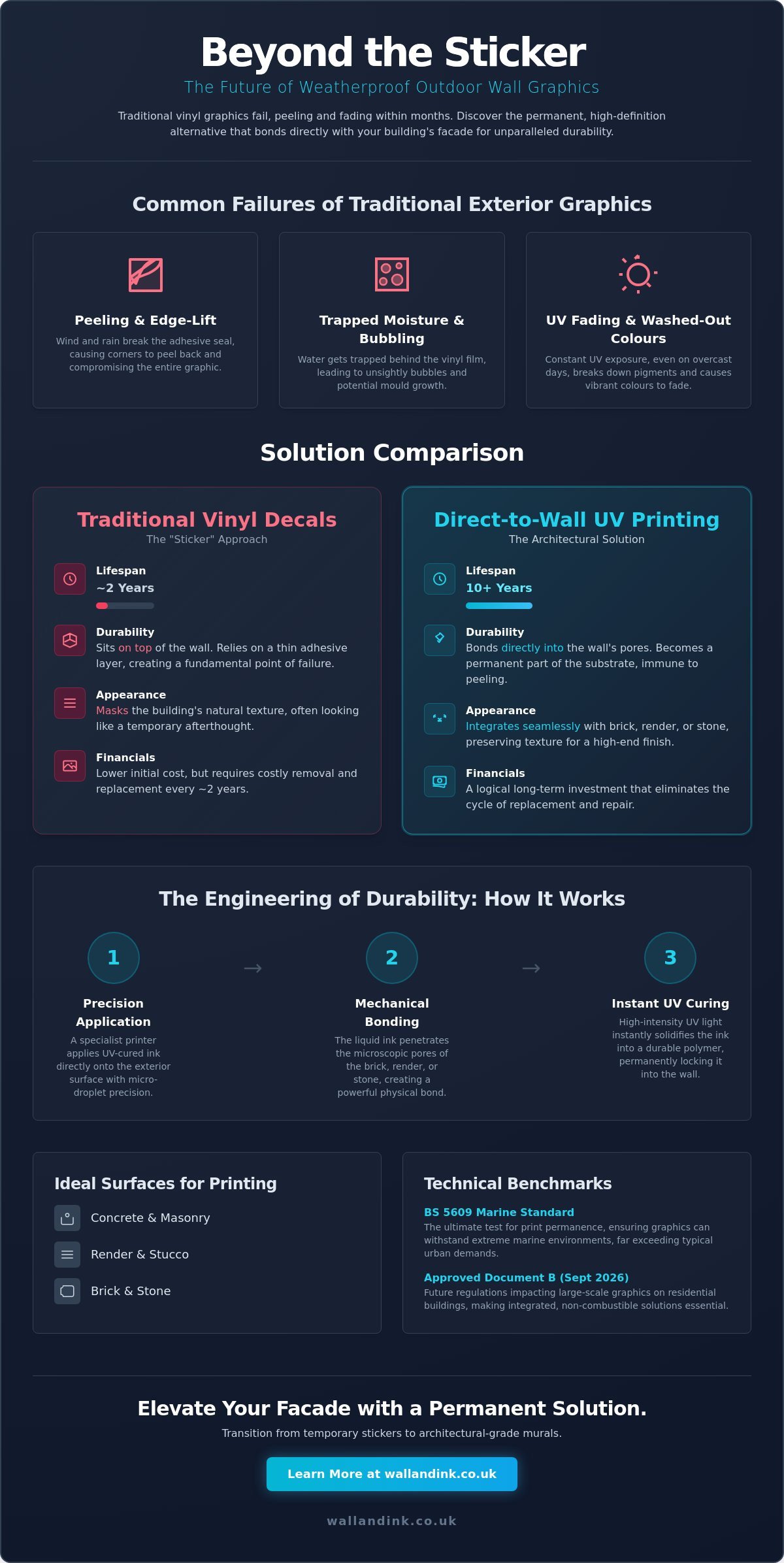
Vinyl is essentially a giant plastic sticker. It relies on a thin layer of pressure-sensitive adhesive to bridge the gap between the plastic film and the masonry. This creates a fundamental point of failure. Wind and rain eventually cause “edge-lift”, where the corners peel back from the wall. Once this seal is broken, moisture gets trapped behind the film. This leads to unsightly bubbling and, eventually, mould growth that damages both the graphic and the underlying render. Beyond the mechanical failures, stickers often look like an afterthought amongst professional architecture; they mask the natural texture of the building rather than enhancing it.
The Shift to Direct-to-Wall UV Printing
The industry is moving away from applied layers toward integrated finishes. Direct-to-wall printing removes the adhesive middleman entirely. This process involves a specialist machine that applies ink directly onto the surface of the brick, render, or stone. Because the ink is cured instantly with high-intensity UV light, it transforms from a liquid into a solid polymer that “grabs” the microscopic pores of the wall. It doesn’t sit on the surface; it lives within it. By eliminating the vinyl layer, you eliminate the risk of peeling and bubbling, resulting in weatherproof outdoor wall graphics that feel like a permanent architectural feature rather than a temporary sign.
Solution Comparison: Vinyl Decals vs Direct-to-Wall UV Printing
Choosing weatherproof outdoor wall graphics requires a shift in perspective from temporary signage to architectural investment. Whilst the industry standard durability of vinyl graphics is approximately 24 months for exterior use, direct-to-wall UV printing provides a decade of performance. This is the difference between a short-term decal and a permanent structural feature.
Surface texture handling distinguishes these two methods. Vinyl masks the wall. It creates a flat, plasticised surface that ignores the underlying masonry. Direct printing, by contrast, integrates with the building. The ink settles into the grain of the brick or the peaks of the render; it preserves the architectural intent whilst adding visual impact. This seamless integration ensures the mural feels like a deliberate part of the design rather than an afterthought.
Maintenance requirements are significantly lower for printed walls. Vinyl creates a physical lip that traps road grime and pollution. Because direct printing has no edges, it’s as easy to maintain as the wall itself. You don’t have to worry about power-washing a decal off the surface or managing the adhesive residue that attracts dirt. The industrial precision of UV technology eliminates these traditional hassles.
The cost-benefit analysis is clear for pragmatic decision-makers. A vinyl mural might seem cheaper initially. However, when you factor in the cost of removal, surface repair, and re-application every two years, the industrial precision of direct-to-wall printing becomes the more logical financial choice. It eliminates the cycle of replacement and provides a consistent, high-quality result for years.
Durability and Environmental Resistance
Cured UV inks are chemically stable. They don’t fade under intense sunlight or crack during the freeze-thaw cycles of a British winter. Whilst thin plastic films become brittle and snap, the polymer bond of UV ink remains resilient. It offers superior impact resistance against the daily wear of high-traffic commercial environments. It’s a robust solution designed for the physical reality of the trade.
Visual Quality and Design Flexibility
Achieving photo-realistic weatherproof outdoor wall graphics on masonry was once a technical challenge. Modern UV technology allows for high-resolution art directly on uneven substrates. There are no size limits and no visible seams. Large-scale murals flow across the facade without the distracting grid lines found in vinyl panelling. You can even design graphics that fade naturally into the wall’s original colour for a sophisticated, integrated look. If you’re looking to upgrade your building facade, you can view our previous exterior projects to see the difference industrial-grade printing makes.
The Engineering of Durability: How UV Inks Defy the British Weather
The durability of industrial-grade weatherproof outdoor wall graphics isn’t accidental; it’s a result of precise chemical engineering. This technology relies on a photochemical process known as UV curing. As the printer applies liquid ink to the wall, high-intensity ultraviolet lamps follow immediately behind, triggering a reaction that transforms the liquid into a solid, cross-linked polymer. This instant solidification prevents the ink from bleeding or running, ensuring that every detail remains sharp regardless of the surface texture.
Unlike traditional films that rely on a surface-level adhesive, UV inks penetrate the microscopic surface profile of the substrate. Whether applied to brick, render, or stone, the ink anchors itself into the pores of the material. UV ink anchors itself into the microscopic fissures of masonry to create a permanent mechanical bond. This integration is vital for building health. Standard vinyl applications often act as a vapour barrier, trapping moisture within the building fabric. Direct-to-wall printing maintains a degree of breathability, allowing moisture to move through the masonry without causing the graphic to bubble or the wall to deteriorate.
Urban environments present additional chemical challenges. Weatherproof outdoor wall graphics must withstand more than just rain; they must resist nitrogen dioxide, sulphur dioxide, and various cleaning agents used in city maintenance. The cured polymer surface is naturally resilient against these pollutants. It doesn’t soften or become tacky when exposed to heat, which prevents soot and dirt from becoming permanently embedded in the artwork.
Understanding UV Stability and Colour Retention
Sun-bleaching is a primary cause of failure for exterior murals. We utilise high-grade pigments specifically engineered for high UV resistance. It’s a common misconception that British “grey skies” protect graphics from fading. Ultraviolet rays penetrate cloud cover effectively, meaning inferior inks will wash out even in the absence of direct sunlight. Our technical process ensures that the chemical bond remains stable, preserving colour vibrancy for over a decade. This industrial precision eliminates the need for frequent touch-ups or total replacements.
Thermal Expansion and Substrate Movement
Concrete, brick, and steel are not static materials. They expand and contract as temperatures fluctuate between summer highs and winter frosts. Rigid panels or adhesive stickers often fail because they cannot accommodate this natural building movement. When the wall shifts, the adhesive bond shears, leading to cracks or delamination. Modern UV-cured inks possess a calculated level of flexibility. They move in sync with the substrate, ensuring the graphic remains intact during extreme thermal cycles without losing its structural integrity.
Site Selection and Surface Preparation for Exterior Graphics
Achieving industrial-grade weatherproof outdoor wall graphics depends entirely on the condition of the receiving substrate. A graphic is only as durable as the surface it bonds to. For maximum ink adhesion, the wall must be stable, dry, and free from organic growth like algae or moss. Whilst traditional vinyl installers might simply wipe a surface down, our technical process requires a deeper assessment of surface porosity and structural integrity to ensure long-term performance.
Surface porosity determines how effectively the UV ink anchors itself. Ideal candidates include raw brick, concrete, and modern render systems. If a wall has been previously treated with “anti-graffiti” coatings or silicone-based water repellents, these must be identified early. Such coatings are designed to repel liquids, which can interfere with the polymer bonding process. In these instances, mechanical abrasion or specific priming may be necessary to ensure the artwork becomes a permanent architectural feature rather than a surface-level addition.
Environmental factors also dictate the installation window. In the UK, we must account for ambient humidity and surface temperature. Printing on a damp wall traps moisture behind the ink, which can lead to premature failure. We monitor these conditions with industrial precision to ensure the curing process is optimal. If you’re unsure if your building is suitable, you can contact our technical team for a site assessment to verify your substrate’s condition.
Common UK Wall Types and Their Suitability
- Standard Brickwork: From common Flettons to smooth engineering bricks, we manage mortar lines to ensure the design remains legible. The ink flows into the recesses, preventing the “bridging” effect that causes vinyl to tear or peel at the joints.
- Monocouche and K-Rend: These through-coloured renders are excellent substrates. Their natural breathability and high porosity allow for deep ink penetration and exceptional colour saturation that lasts for a decade.
- Concrete and Stone: Raw masonry provides a sophisticated, industrial backdrop. We utilise the natural variations in the stone to add depth and character to the final mural, embracing the material’s texture.
The Visualisation and Design Process
Large-scale external facades require meticulous planning. We use high-resolution digital mock-ups to place the artwork within its exact architectural context. This allows us to scale the graphics without losing detail, ensuring that a mural remains sharp even when viewed from a distance. Our design team organises the composition to work around windows, doors, and external pipework. By treating these obstacles as part of the canvas rather than inconveniences, we ensure a professional, integrated finish that respects the building’s original lines. This methodical approach eliminates the traditional hassles of misaligned panels or awkward seams.
Elevating Commercial and Residential Facades with Wall & Ink
Wall & Ink operates as a specialist partner for those who value efficiency and industrial precision. We provide an end-to-end service that transforms building facades into durable visual assets. By utilising direct-to-wall UV technology, we offer a solution that bypasses the failures of legacy alternatives. Our weatherproof outdoor wall graphics are designed for pragmatic decision-makers who require high-quality results without the traditional hassles of site disruption or ongoing maintenance.
Our process is fundamentally cleaner and faster than traditional painting or vinyl application. There are no fumes, no adhesive residues, and no long drying times. The UV-curing process happens instantly; this means the site is returned to full use immediately after the print is complete. This mechanical superiority ensures a level of cleanliness and speed that traditional methods cannot match. We eliminate the need for complex scaffolding or the long-term risk of peeling plastic films.
We maintain a commitment to radical transparency in both our pricing and our technical processes. Every project begins with a clear understanding of the substrate and the environmental requirements. This straightforward approach builds trust and ensures that every claim we make is backed by the physical reality of the trade. We don’t hide behind whimsical design language; we let the technical results and durability specifications speak for themselves. It’s a modern solution for a modern architectural landscape.
Bespoke Design for Architectural Impact
Collaboration is central to our method. Our design team works with you to create site-specific artwork that respects the architectural context of the building. Digital visualisation plays a critical role here, allowing you to see the final result before a single drop of ink is applied. This de-risks the creative process and ensures that the final mural achieves its intended branding or aesthetic goals. We turn uninspired exteriors into local landmarks that command attention whilst maintaining the structural integrity of the wall.
Professional Execution and UK-Wide Service
Our reach extends across the UK, providing a consistent service from initial survey to final execution. We follow a logical, methodical rhythm that ensures precision at every stage. This precision-led industrial method is why professional environments and high-stakes commercial sectors favour our service over temporary alternatives. We are as comfortable in high-stakes professional environments as we are in private settings. If you’re ready to secure a permanent, high-definition finish for your building, you can enquire about your outdoor wall graphics project today.
Future-Proof Your Building Facade with Industrial Precision
Traditional methods like vinyl decals fail because they fight the wall rather than integrating with it. By choosing industrial UV-cured ink technology, you ensure your branding becomes a permanent part of the building’s fabric. We’ve explored how direct-to-wall printing handles thermal expansion and UV exposure to provide a decade of performance that outclasses legacy stickers. This process eliminates the traditional hassles of bubbling and edge-lift; it provides a clean, professional finish every time. You don’t have to settle for temporary solutions that look cheap within months.
Wall & Ink provides national UK coverage for commercial and residential projects, delivering a service built on technical transparency and mechanical superiority. Every project includes bespoke design and digital visualisation to de-risk your investment and ensure the final mural meets your exact architectural specifications. It’s time to move beyond the frustrations of peeling edges and faded colours. Our specialists are ready to help you transform your facade into a durable, high-definition landmark.
You can Get a Quote for Your Exterior Wall Printing Project and start your transition to high-performance weatherproof outdoor wall graphics. We’re here to ensure your building stands up to the British elements with total confidence.
Frequently Asked Questions
How long do weatherproof outdoor wall graphics actually last?
Direct-to-wall printing typically lasts over 10 years in exterior environments. This industrial-grade longevity is achieved through UV-cured ink that bonds to the substrate’s pores. Whilst traditional vinyl decals often fail or peel within 24 months, our printing process offers a permanent solution that withstands the British weather. It’s a robust choice for those seeking a long-term architectural feature rather than a temporary sign.
Can you print on textured surfaces like brick or pebbledash?
We can print directly onto almost any textured surface, including brick, concrete, and various renders. Our specialist machinery uses sensors to maintain a consistent distance from the wall, allowing the ink to settle into the grain of the masonry. This ensures a seamless look that preserves the building’s natural texture. It eliminates the “bridging” effect where vinyl would otherwise tear or bubble over mortar lines.
Will the colours fade in direct sunlight?
Our weatherproof outdoor wall graphics utilise UV-stable pigments specifically engineered to resist sun-bleaching. The inks are cured instantly with high-intensity ultraviolet light, creating a chemically stable polymer that maintains colour vibrancy for a decade. This technical process ensures that even facades in direct sunlight don’t suffer from the “washed out” look common with inferior printing methods or standard paints.
Is direct-to-wall printing waterproof immediately after application?
The ink is waterproof immediately after the printing process is complete. Because we use high-intensity UV lamps to cure the ink instantly, there is no drying time required. This allows us to complete projects efficiently without worrying about sudden rain showers affecting the wet artwork. It’s a precision-led method that provides immediate environmental defiance from the moment the machine finishes its pass.
What happens if the wall needs to be cleaned or jet-washed?
You can clean the printed surface using standard low-pressure washing or manual cleaning methods. The cured ink is highly resilient and doesn’t soften when exposed to water or mild detergents. Whilst we recommend avoiding high-pressure industrial jet washes at point-blank range, the graphic’s mechanical bond to the wall ensures it remains intact during routine building maintenance. It’s a practical solution for urban environments.
Do I need to prepare the wall before your team arrives?
The wall must be clean, dry, and structurally stable before we begin the printing process. We require the removal of loose debris, organic growth, or flaking paint to ensure maximum ink adhesion. If the surface has been treated with silicone-based water repellents, please inform our team during the consultation. Proper preparation is the foundation of a durable finish that eliminates traditional failure points like peeling.
Is direct-to-wall printing more expensive than vinyl stickers?
Direct-to-wall printing represents a higher initial investment compared to basic vinyl stickers, but it offers superior long-term value. When you factor in the cost of replacing vinyl every two years and the potential for wall damage during removal, our industrial method is the more economical choice. It provides a permanent, high-end aesthetic that removes the recurring expense of replacement cycles. We operate with radical transparency regarding our pricing.
Can the graphics be removed if the branding changes?
You can remove weatherproof outdoor wall graphics by painting over the surface with a standard masonry primer and topcoat. Because the ink is integrated into the wall texture rather than sitting as a thick plastic layer, there is no adhesive residue to scrape away. This makes rebranding a straightforward process that doesn’t damage the underlying render or brickwork. It’s a clean solution for evolving commercial spaces.