
Traditional hospital wall art for patients is often an overlooked infection risk rather than a healing tool. You understand that maintaining a sterile environment is non-negotiable, yet peeling vinyl decals and torn wallpaper create micro-cracks where pathogens thrive. These outdated materials don’t just look unprofessional; they compromise patient safety and require frequent, disruptive replacements that lead to costly clinical downtime.
We’re here to show you how advanced direct-to-wall UV printing transforms clinical spaces into therapeutic environments that accelerate recovery whilst exceeding strict NHS hygiene standards. This industrial-grade solution provides a permanent, non-porous finish that withstands aggressive chemical cleaning and meets the Joint Commission’s latest requirements for non-combustible, smoke-tight materials. You’ll discover how our precision technology delivers high-resolution, biophilic designs with no wallpaper and no mess. We’ll explore the technical advantages of direct-to-wall murals, from their rapid 15-minute setup time to their proven ability to reduce patient anxiety through evidence-based design.
Key Takeaways
- Learn how Evidence-Based Design (EBD) uses specific visual elements to lower patient cortisol levels and transform sterile wards into calming recovery spaces.
- Discover why direct-to-wall printing is replacing traditional hospital wall art for patients by eliminating the infection risks associated with peeling vinyl and adhesive wallpapers.
- Understand the technical specifications that make UV-printed murals scrub-resistant and capable of withstanding heavy impact from hospital beds and trolleys.
- Explore bespoke design strategies for specific healthcare needs, including interactive paediatric murals and wayfinding art designed for dementia-friendly environments.
- See how our mess-free installation process allows for high-resolution mural application without the clinical downtime required by traditional redecorating projects.
The Therapeutic Role of Hospital Wall Art in Patient Recovery
Modern healthcare design has moved beyond simple aesthetics. In UK hospitals, we’re seeing a fundamental transition from “decorative” art to “therapeutic” installations that serve as active clinical tools. This shift is driven by Evidence-based design principles, where every visual element in a ward is chosen based on its ability to improve patient outcomes. Hospital wall art for patients isn’t just about making a corridor look better; it’s about using researched design strategies to influence physiological healing.
The psychological impact of a sterile environment is well-documented. Stark, white walls and industrial lighting often lead to “institutionalisation,” a state that increases patient cortisol levels and heightens anxiety. High cortisol doesn’t just cause stress; it actively suppresses the immune system and slows down physical recovery. By replacing these blank surfaces with high-resolution, direct-to-wall murals, Trusts can create a calming atmosphere that lowers stress markers. It’s a pragmatic solution to a complex clinical problem.
Visual distraction also serves as a vital non-pharmacological intervention for pain management. When a patient is engaged with a detailed, high-resolution image, the brain’s cognitive resources are diverted. This distraction can reduce the perceived intensity of pain and, in some cases, lower the requirement for certain analgesics. Our direct-to-wall technology ensures these images are rendered with the precision needed to be truly immersive, providing a seamless visual escape within the clinical setting.
Reducing Patient Anxiety through Visual Distraction
Waiting areas and pre-operative bays are often the most high-stress zones in a hospital. Using hospital wall art for patients in these spaces provides a “window” out of the clinical environment, offering a mental reprieve when it’s needed most. Engaging imagery also alters the perceived duration of time. Patients who are mentally occupied by a detailed scene often report that their wait felt shorter, which helps prevent the onset of ward-based fatigue and irritability. It’s a simple way to improve the patient experience without increasing clinical workload.
Biophilic Design: Why Nature Imagery Accelerates Healing
Biophilic design is based on the science of biophilia, the innate human connection to natural systems. We respond positively to natural patterns, soft horizons, and specific palettes of greens and blues. These elements trigger a parasympathetic nervous system response, aiding relaxation. However, the choice of imagery must be precise. Whilst landscapes and flora accelerate healing, “challenging” abstract art can actually increase confusion amongst vulnerable or elderly patients. We focus on clear, recognisable nature themes that provide a sense of safety. Our direct-to-wall process applies these designs directly to plaster or brick, ensuring a clean finish that feels like a natural part of the architecture.
Direct-to-Wall UV Printing vs Traditional Hospital Murals
Traditional hospital murals usually involve vinyl decals or heavy-duty wallpaper. While these methods provide initial colour, they often fail under the rigorous demands of a clinical environment. Direct-to-wall UV printing is a modern alternative that applies ink directly onto the substrate, whether it’s plaster, brick, or even glass. This process eliminates the need for adhesives entirely. It’s a precise, mechanical application that ensures hospital wall art for patients remains a permanent part of the room rather than a temporary covering. By using a specialised vertical printer, we achieve pixel-perfect resolution that mimics the quality of a hand-painted mural but with industrial-grade durability.
The technology uses UV-curable inks that cure instantly under a high-intensity lamp attached to the print head. This creates a bond that is significantly more durable than traditional paint or vinyl. While standard interior paint can develop micro-cracks that harbour pathogens, UV-cured ink forms a non-porous, scrub-resistant surface. This level of durability is essential for maintaining hygiene standards, as supported by research on art in hospitals which highlights the need for materials that don’t compromise clinical safety. Because the ink is cured the moment it hits the wall, there’s no risk of smudging or waiting days for the surface to be touch-dry. It’s a fast, efficient solution for high-traffic wards where hospital wall art for patients must be installed without disrupting patient care.
Eliminating Seams and Peel Risks
One of the greatest risks in ward environments is the “pickable” edge. In paediatric or mental health units, peeling wallpaper or lifting vinyl isn’t just an aesthetic issue; it’s a safety hazard and an infection risk. Traditional murals have seams where dust and bacteria can accumulate over time. Direct-to-wall printing is entirely seamless. Because the ink is integrated into the wall surface, there are no edges to lift and no gaps for pathogens to hide. This provides a clean finish that’s easy for domestic teams to sanitise using standard hospital-grade chemicals. It’s the ultimate “no wallpaper, no mess” approach to clinical decoration.
The Environmental Impact of UV Ink Technology
UV printing is a cleaner, faster process than traditional decorating. The inks we use are VOC-free, meaning they don’t release harmful volatile organic compounds into the air. This is a critical factor for indoor air quality, especially in wards housing respiratory patients or newborns. Because the ink cures instantly, there’s no drying time and no lingering chemical smell. You can return a room to clinical use the moment the print finishes. We also eliminate the significant waste associated with traditional methods; there’s no backing paper to discard and no adhesive residues to clean up. For Trusts looking to modernise their facilities, our direct-to-wall printing services provide a sustainable way to enhance clinical spaces with zero mess and maximum impact.
Infection Control and Durability in High-Traffic Wards
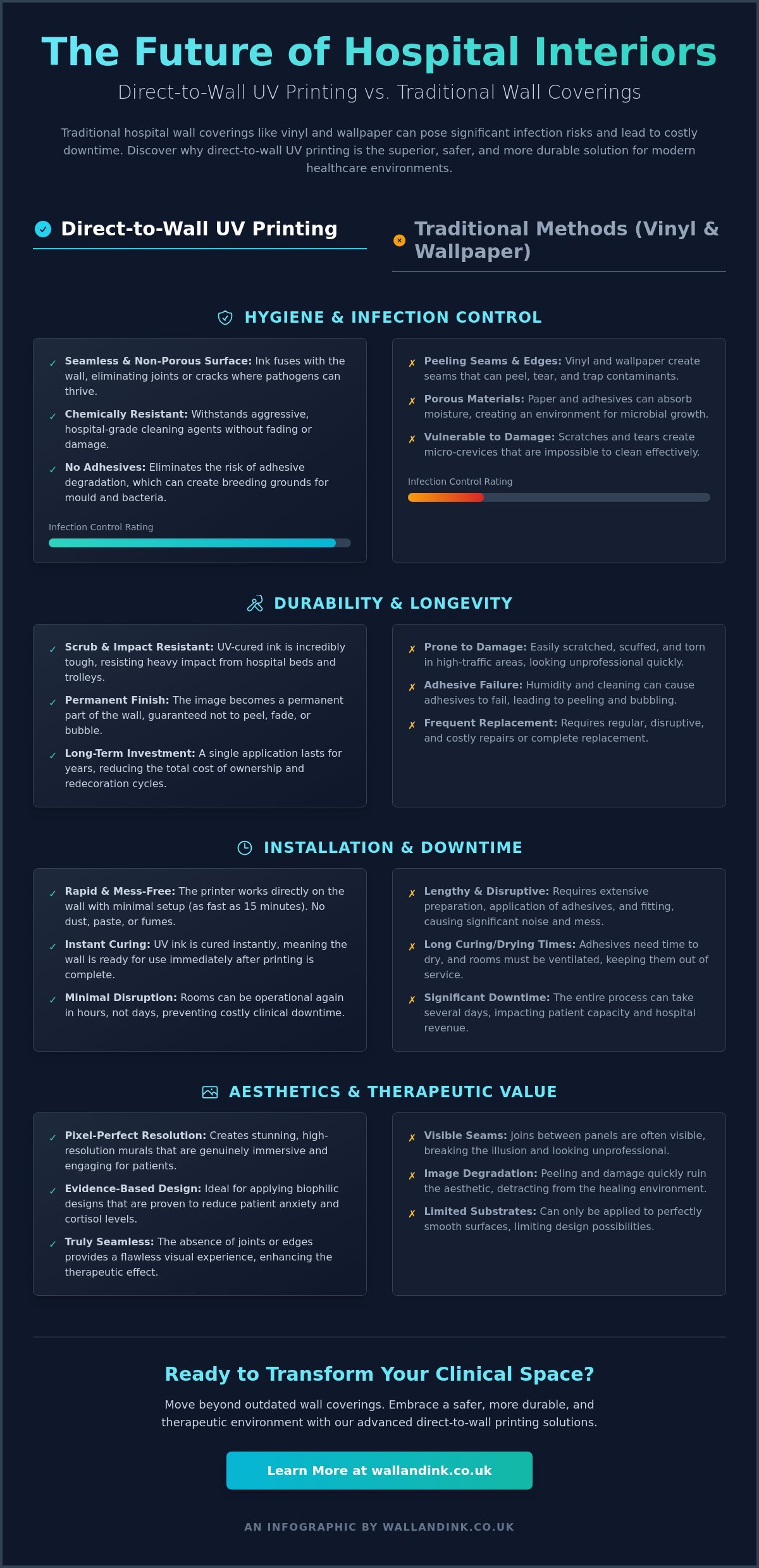
Hospital environments demand more than just aesthetic appeal; they require surfaces that meet the most stringent infection control protocols. Traditional hospital wall art for patients often fails because it cannot withstand the aggressive cleaning regimes necessary to prevent healthcare-associated infections. Our direct-to-wall technology solves this by creating a non-porous, flat surface that integrates with the wall itself. This prevents the formation of biofilms, which often colonise the edges of vinyl decals or the textured surfaces of traditional wallpaper. By eliminating these microscopic hiding places, we help clinical teams maintain a sterile environment.
Maintenance teams often struggle with traditional art because frames collect dust and require constant, individual sanitisation. By printing directly onto the substrate, we eliminate these dust traps entirely. There’s no glass to break and no frame to harbour pathogens. The result is a clinical environment that stays cleaner for longer with significantly less manual upkeep. It’s a pragmatic approach to ward management that prioritises patient safety without sacrificing the therapeutic benefits of high-resolution visual art.
Scrub-Resistant Surfaces for Clinical Cleaning
The UV-cured inks we use are engineered for industrial durability. Once the printing process is complete, the ink forms a robust bond with the substrate that allows for vigorous, daily sanitisation. These surfaces are fully compatible with hospital-grade disinfectants, including chlorine-based cleaners and hydrogen peroxide solutions. Unlike standard interior paints or vinyls that may bleach or degrade over time, our murals maintain their colour vibrancy and structural integrity even after years of intensive cleaning cycles. This ensures the ward remains welcoming and professional without the need for constant touch-ups.
Protecting Walls from Mechanical Damage
Corridors and wards are high-impact zones where “trolley rash” is a constant problem. Moving beds, porters with trolleys, and wheelchairs frequently clip the walls, causing traditional wallpaper to tear and paint to chip. These damages aren’t just unsightly; they create jagged edges that are impossible to clean effectively and eventually become an infection risk. Direct-to-wall printing is fundamentally different because there’s no material to tear or peel away. The UV-cured ink penetrates the surface pores to create a scratch-resistant barrier on bare plaster that withstands daily abrasions. This mechanical superiority ensures that your investment in hospital wall art for patients remains intact and professional-looking, regardless of the daily traffic it endures. It’s a long-term solution designed for the physical reality of a busy NHS Trust.
Tailoring Art for Specific Patient Demographics
Hospital wall art for patients is most effective when it addresses the specific cognitive and emotional requirements of a ward’s demographic. A generic approach fails to provide the therapeutic benefits needed for recovery. In dementia-friendly environments, we use recognisable local landmarks to aid wayfinding and memory. These visual anchors help patients orient themselves within a large complex, reducing the distress caused by confusion. For maternity units and women’s health centres, the focus shifts to creating serene, spa-like environments. Soft horizons and biophilic patterns replace sterile white walls, helping to lower blood pressure and promote relaxation during labour.
Long-stay wards and intensive care units present a unique challenge as patients are often bed-bound. In these settings, the ceiling becomes the primary visual field. Our direct-to-wall technology allows us to print high-resolution imagery directly onto ceiling tiles or plaster surfaces. This provides a mental escape for patients who would otherwise spend hours staring at industrial light fittings. We ensure every installation is bespoke, aligning the visual content with the clinical goals of the specific department. To see how we can transform your specific ward, explore our bespoke commercial wall murals for healthcare settings.
Wayfinding and Navigation through Visual Markers
Large hospital complexes are notoriously difficult to navigate, which adds unnecessary stress to patients and visitors. We use murals as intuitive landmarks to simplify wayfinding. By colour-coding different departments with specific nature themes or geometric patterns, we make the environment self-explanatory. A patient is more likely to remember a vibrant floral mural than a room number or a text-based sign. This visual mapping reduces the cognitive load on visitors and allows clinical staff to focus on care rather than giving directions.
Paediatric Murals: Beyond Simple Cartoon Characters
Designing for children requires a sophisticated balance of stimulation and calm. We avoid dated cartoon characters that quickly become obsolete. Instead, we create “find and seek” interactive elements that engage toddlers whilst remaining sophisticated enough for teenagers. For wards with integrated schools, we incorporate educational themes that turn corridors into learning environments. We believe in the importance of non-threatening, inclusive character design that ensures every child, regardless of their background or ability, feels welcomed and safe. Our direct-to-wall process ensures these detailed designs are durable and easy to clean. No wallpaper, no mess; just a permanent clinical tool that withstands the rigours of a paediatric environment.
The Wall & Ink Process: From Consultation to Completion
Our approach to hospital wall art for patients is built on industrial precision and clinical transparency. We begin every project with a bespoke design consultation to ensure the chosen imagery aligns with the specific therapeutic goals of your ward. Rather than relying on guesswork, we provide high-resolution digital visualisations. These allow your estates team to see exactly how the mural integrates with existing fixtures and medical equipment before any printing begins. This methodical preparation ensures a seamless finish that meets your exact requirements without the surprises often associated with traditional decorating.
Budgetary clarity is essential for NHS Trusts and private healthcare providers. We operate with a transparent pricing model, starting from £120/m², which allows for accurate project forecasting without hidden consultation fees. Our UK-wide service ensures that whether you’re managing a single clinic or a multi-site hospital estate, you receive the same level of technical expertise and reliable execution. We handle the entire logistics chain, from initial site survey to final print, providing a single point of contact for your project. It’s a professional service designed for pragmatic decision-makers who value efficiency and high-quality results.
Zero-Downtime Installation for Busy Hospitals
The primary failure of traditional redecorating is the disruption it causes to patient care. Painting or wallpapering often requires closing wards, moving patients, and managing strong chemical odours. Our direct-to-wall printer operates whilst the ward remains fully functional. The process is virtually silent and produces zero dust, making it safe for use in sensitive areas like ICU or neonatal units. Because the UV ink cures instantly, there are no lingering odours or VOCs. We complete large-scale murals in a fraction of the time required for traditional methods, ensuring your facility remains operational throughout the process. No wallpaper, no mess; just a rapid, professional installation.
Next Steps: Organising Your Healthcare Mural Project
Implementing durable hospital wall art for patients is a straightforward process. We can print on almost any substrate, including plaster, brick, and existing painted walls, provided the surface is structurally sound. To begin, we recommend a site survey to assess your space and discuss your clinical objectives. We’ll then provide a digital mock-up and a detailed quote based on your specific requirements. Our team organises every aspect of the print to ensure it fits into your ward’s schedule with minimal impact on clinical staff. Contact Wall & Ink for a bespoke healthcare art consultation to start your project and discover the benefits of direct-to-wall technology.
Modernising Clinical Environments with Precision Technology
Transitioning from a sterile, institutional ward to a therapeutic healing environment is a clinical necessity. We’ve explored how direct-to-wall UV technology eliminates the infection risks inherent in peeling vinyl and the significant downtime required for traditional redecorating. High-quality hospital wall art for patients is no longer a decorative luxury; it’s a durable, scrub-resistant tool that supports Evidence-Based Design whilst meeting the most stringent NHS hygiene standards.
By choosing a “no wallpaper, no mess” approach, you ensure your facility remains fully operational. Our installations provide a permanent, high-resolution finish that survives daily impacts and aggressive chemical sanitisation. With transparent pricing starting from £120/m², it’s a pragmatic and cost-effective solution for any modern healthcare estate. It’s time to replace outdated, peeling materials with a long-term visual strategy that prioritises patient recovery. Transform your clinical space with a bespoke Wall & Ink mural and create a lasting, positive impact on your ward’s atmosphere.
Frequently Asked Questions
Is hospital wall art safe for infection control?
Yes, direct-to-wall printing is specifically designed to meet NHS infection control standards. Unlike vinyl or wallpaper, our UV-cured ink creates a seamless, non-porous surface that doesn’t harbour pathogens in edges or seams. The resulting finish is fully compatible with hospital-grade disinfectants, including chlorine-based cleaners. This ensures that your hospital wall art for patients remains a hygienic clinical tool rather than an infection risk.
Can you print art on existing painted hospital walls?
We can print directly onto almost any sound substrate, including existing painted walls, plaster, brick, and concrete. The only requirement is that the surface is clean and the existing paint isn’t flaking or peeling. This flexibility allows us to transform clinical spaces without the need for extensive structural preparation or messy removal of old wall coverings. It’s a straightforward, industrial solution for modernising older ward environments.
How long does it take to install a large-scale mural in a ward?
Installation is exceptionally fast compared to traditional decorating. A professional wall printing machine can be set up and ready to print in as little as 15 minutes. Once operational, our commercial printers apply ink at a speed of 2 to 6 square metres per hour. Most standard ward murals are completed within a single day, allowing you to return the space to clinical use immediately after the print finishes.
What happens if a printed wall gets damaged by a trolley or bed?
Our UV-cured ink creates a scratch-resistant barrier that withstands the daily impact of trolleys, beds, and wheelchairs. Because the ink bonds directly to the substrate, it won’t tear or peel like vinyl. In the rare event of significant structural damage to the wall, we can easily overprint the affected area. This precision repair ensures the mural remains professional and hygienic without the need to replace an entire wall covering.
Are the inks used in wall printing safe for patients with respiratory issues?
Yes, the inks are entirely safe for use in sensitive clinical areas. We use VOC-free, UV-curable inks that don’t release harmful volatile organic compounds into the atmosphere. Because the ink cures instantly under a high-intensity lamp, there are no lingering chemical odours or drying times. This makes the process ideal for wards housing respiratory patients, newborns, or those with compromised immune systems.
How much does bespoke hospital wall art cost per square metre?
We maintain a transparent pricing structure to assist with NHS and private healthcare budgeting. Our bespoke printing services start from £120/m², covering the entire process from setup to final execution. This all-inclusive model eliminates the hidden costs often associated with traditional murals, such as adhesive materials, specialist installers, and the financial impact of clinical downtime. It’s a cost-effective, long-term investment in patient well-being.
Can you provide ceiling art for patients who are bed-bound?
Yes, our technology allows for direct printing onto ceiling tiles and plaster surfaces. This is a critical feature for ICU and long-stay wards where bed-bound patients spend significant time looking upwards. By replacing sterile ceiling panels with high-resolution nature imagery, we provide a vital visual distraction that helps lower anxiety. This application follows the same “no wallpaper, no mess” principle, ensuring a clean, durable finish overhead.
Does the hospital need to close the ward during the printing process?
No, the ward can remain fully operational throughout the installation. The direct-to-wall printer is virtually silent and produces no dust or harmful fumes, allowing clinical staff to continue their work without disruption. Because the ink cures instantly, there’s no need to cordon off areas for drying. This zero-downtime approach is a primary reason why Trusts are moving away from traditional redecorating methods for hospital wall art for patients.